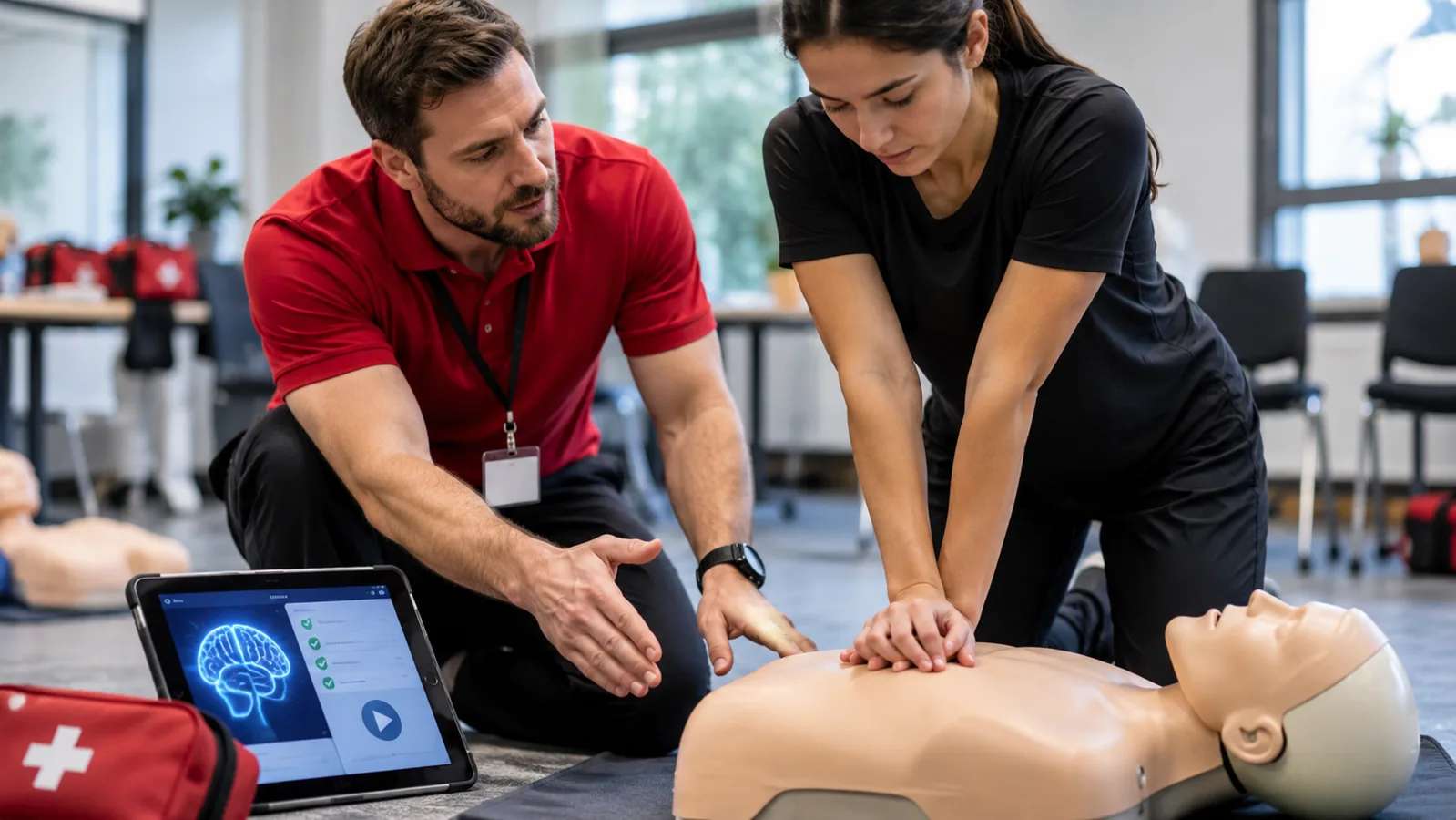
AI can explain first aid, quiz you and help you study, but it can’t press on a chest for you. Real CPR certification still needs hands-on practice. The smartest approach blends both: online First Aid and CPR theory, AI study tools, then an in-person skills session.
AI can write your emails, summarize your meetings and plan your week. It can explain quantum physics to a five-year-old and debug code faster than most of us can read it.
So it’s fair to ask: can AI teach you to save a life? The honest answer is yes, partly. And understanding where AI helps, and where it hits a wall, says a lot about learning in general.
How Is AI Already Used in First Aid Education?
AI is showing up in safety training in some genuinely useful ways:
- AI study tutors that explain concepts in plain language and answer follow-up questions
- Adaptive quizzes that focus on the topics you keep getting wrong
- Feedback manikins that measure compression depth, rate and recoil in real time
- Scenario simulations that let you practise decision-making before class
- Translation and accessibility tools that help newcomers and learners with different needs
Some training providers have built their own AI tutors. Coast2Coast, for example, offers Coasty, an AI study companion that helps students review first aid and CPR topics before, during and after class. It works alongside instructors and official Red Cross material, not instead of them.
What Can AI Do Really Well?
AI shines at the knowledge side of first aid. It can:
- Explain the “why” behind each step, which helps memory
- Repeat explanations as many times as you need without getting impatient
- Spot gaps in your understanding through targeted questions
- Fit your schedule, so you can study at midnight or on your lunch break
For theory-heavy topics, like recognizing a stroke or understanding the difference between fainting and cardiac arrest, AI support can be excellent.
Where Does AI Hit Its Limits?
Here’s the catch. First aid isn’t just knowledge. It’s a physical skill performed under stress.
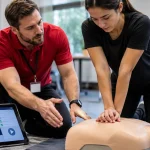
Consider CPR. Adult compressions need to go at least 5 centimetres deep, at 100 to 120 per minute, with full chest recoil every time. You can read those numbers a hundred times. But until you’ve felt that depth under your own hands, and felt your arms tire after two minutes, you don’t really know it.
Same with choking response, bandaging, placing AED pads or rolling someone into the recovery position. These are motor skills. They live in your muscles, not your memory.
AI also can’t do what a good instructor does in the room: notice your elbows bending, correct your hand placement, or calm you down during a tough scenario.
What Is Blended Learning, and Why Does It Work?
Blended learning combines the best of both worlds. You complete the theory online, at your own pace, often with digital tools and AI support. Then you attend a shorter in-person session focused entirely on hands-on practice and skills testing.
It’s efficient. Classroom time isn’t spent reading slides. It’s spent doing.
And it’s how certification works. In Ontario, for example, WSIB-approved first aid courses require an in-person skills component. Online-only certificates generally aren’t accepted for workplace requirements.
How Should You Use AI to Study First Aid?
If you’re preparing for a course, AI can be a great study buddy. A few tips:
- Use AI to review concepts, not to replace official course material
- Ask it to quiz you on signs and symptoms
- Have it explain steps in your own language if English isn’t your first
- Double-check anything medical against your course manual. General-purpose AI can be wrong
- Save your energy for the hands-on session, where the real learning happens
What Does the Future of First Aid Training Look Like?
AI will keep improving, and training will keep changing with it. Expect smarter study tools that adapt to how each person learns, more realistic simulations using augmented and virtual reality, and manikins that give even richer feedback on technique.
Some apps already help connect trained bystanders with nearby emergencies, and AED maps are getting easier to access on phones.
But the core won’t change. When someone collapses, a human still needs to kneel down, push hard and fast, and stay calm until help arrives. Technology can make learning faster and more personal. It can’t replace the courage to act.
The best approach is to use AI for what it does well, then trust hands-on practice for the rest. That combination produces confident, capable responders.
In other words, think of AI as a coach, not a replacement. It can prepare you, test you and remind you. The final exam, though, still happens on the floor, with your own hands on a manikin and an instructor watching closely.
Your Smart Learner’s Checklist
- Pick a blended course with online theory
- Use AI tools for review and quizzes
- Show up ready to practise, not just listen
- Ask your instructor for feedback on your technique
- Refresh your skills before your certificate expires
If you are looking for first aid training near King Street, St. Paul Street, downtown St. Catharines, or other areas close to our facility, then you may reach out to Coast2Coast First Aid/CPR – St. Catharines in that area. Its courses are WSIB approved, and you can see how the courses work, from online theory to in-class practice.
Frequently Asked Questions
Can I get CPR certified completely online?
Workplace-recognized certification requires an in-person skills session. Blended courses let you do the theory online first.
Is AI medical advice reliable?
General AI tools can make mistakes. Use them for study support, and always follow your official course material and instructor.
What are feedback manikins?
They’re training manikins that measure your compression depth, rate and recoil, so you know if your CPR is effective.
How long does a blended first aid course take?
Online theory can take a few hours. The in-person skills session is usually shorter than a full classroom course.
How long is a first aid and CPR certificate valid?
Canadian Red Cross first aid and CPR certificates are valid for three years.