Introduction
Artificial intelligence (AI) has progressively become a cornerstone of modern digital interactions. From composing emails to generating Sophisticated visuals, AI systems are redefining how individuals communicate, learn, and execute tasks in online environments. The emergence of conversational AI tools is especially transformative, bridging the gap between human language and computational intelligence.
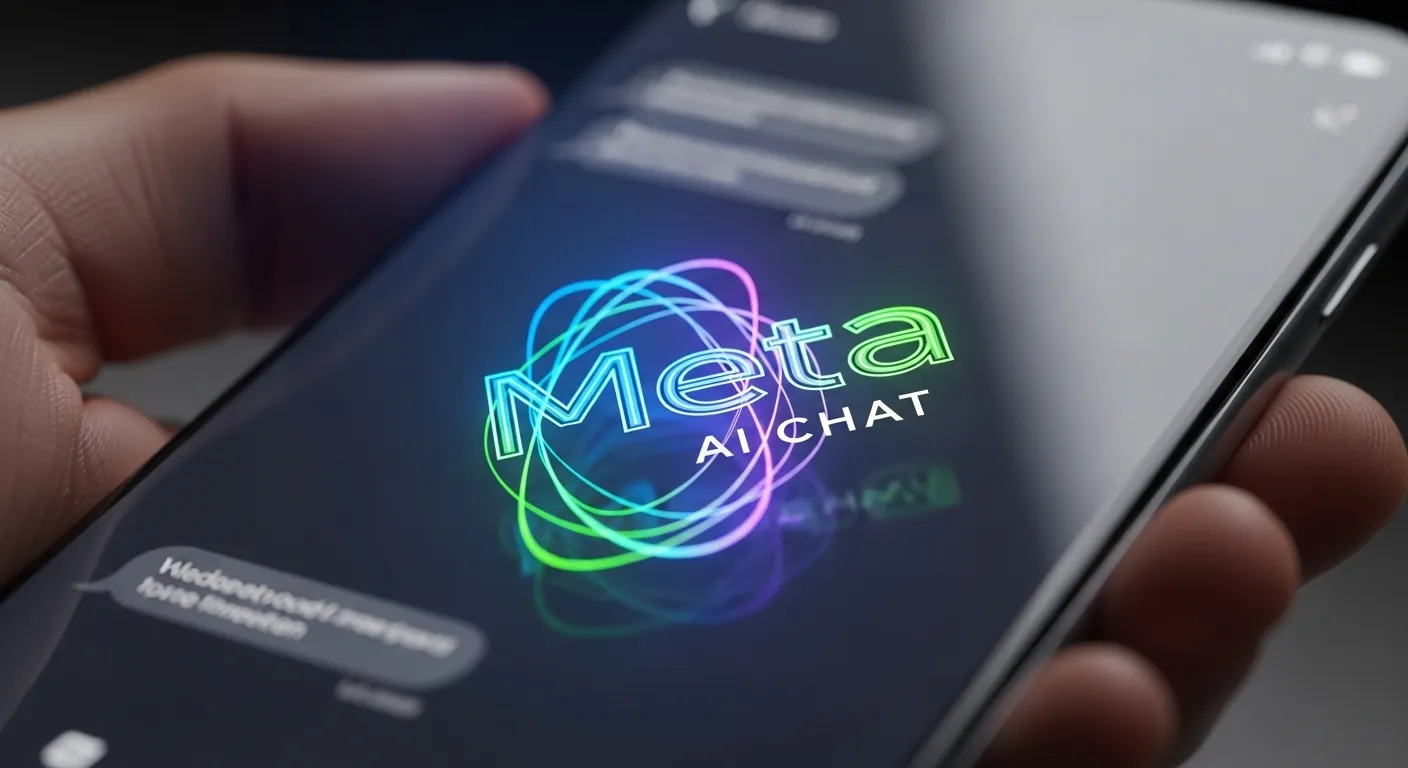
Among the most rapidly expanding AI assistants today is Meta AI Chat, a highly intelligent, context-aware conversational assistant developed by Meta Platforms. Unlike standalone AI services that require separate applications or web portals, Meta AI is seamlessly embedded within the social and messaging apps people already use daily, thereby lowering barriers to adoption.
Meta AI Integration Across Platforms
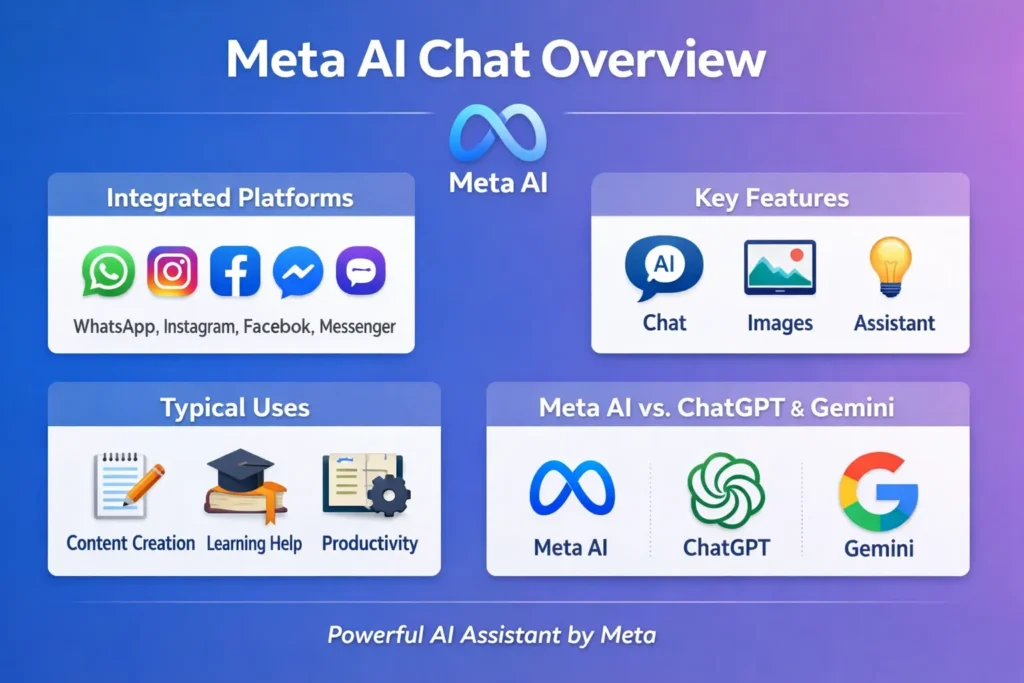
Meta AI is deeply woven into Meta’s ecosystem, which includes:
- Messenger
This level of integration enables billions of users worldwide to access advanced AI functionalities without needing to install additional software or learn new interfaces.
Capabilities of Meta AI
Powered by state-of-the-art large language models such as Llama 3, Meta AI can:
- Provide detailed explanations for complex topics
- Generate digital images and creative content
- Assist with writing tasks, social media captions, and blog content
- Support learning through summaries and tutorials
- Offer personalized recommendations
- Facilitate productivity, including scheduling, brainstorming, and task management
This guide will provide an exhaustive exploration of Meta AI Chat, covering:
- An introduction to Meta AI Chat and its operational principles
- Platform availability and integration
- Core functionalities and features
- Practical use cases for creators, students, and businesses
- Example prompts to optimise AI output
- Comparisons with ChatGPT and Google Gemini
- Privacy, security, and data management considerations
- Prospective developments in Meta’s AI ecosystem
By the end of this comprehensive resource, you will have a clear understanding of how Meta AI Chat functions, how to leverage its capabilities effectively, and how it differs from other AI assistants.
What Is Meta AI Chat?
Meta AI Chat is a generative AI-powered assistant designed by Meta Platforms, which enables users to converse with AI using natural language rather than traditional search queries.
Instead of entering a search term into a conventional engine, users can directly ask questions in a conversational format. This approach simulates a human-like interaction, where the AI can remember context, interpret intent, and generate relevant responses.
Examples of Meta AI interactions:
- User: “Explain quantum computing in simple terms.”
Meta AI: Offers a clear, digestible explanation with practical examples. - User: “How is quantum computing applied in the banking sector?”
Meta AI: Continues the discussion seamlessly, maintaining contextual continuity.
This dialogic model allows the AI to feel like an intelligent assistant rather than a mere information retrieval system.
Distinctive Advantages of Meta AI Chat
Although other AI assistants exist — notably ChatGPT by OpenAI and Gemini by Google — Meta AI Chat presents unique advantages:
- It is fully embedded within widely used messaging and social applications, meaning users do not need to access separate websites.
- Its integration leverages user familiarity with Meta’s app ecosystem, resulting in more accessible and immediate AI interactions.
| Feature | Meta AI | ChatGPT | Gemini |
| Developer | Meta | OpenAI | |
| Core Model | Llama models | GPT models | Gemini models |
| Messaging Integration | Very strong | Limited | Moderate |
| Image Generation | Yes | Yes | Yes |
| Social Media Tools | Excellent | Limited | Moderate |
| Ecosystem | Meta apps | Standalone tools | Google services |
Due to its strong ecosystem embedding, Meta AI Chat can engage users naturally as part of their everyday digital conversations.
How Meta AI Chat Operates
Meta AI Chat functions on advanced large language models (LLMs) trained on massive datasets comprising text, code, and images. The underlying architecture allows it to parse user inputs, infer intent, and generate human-like outputs.
The process can be divided into several stages:
User Input
The process begins when a user submits a request via text or voice. Prompts may include instructions, queries, or creative requests.
Example prompts:
- “Generate an Instagram caption for a travel photo.”
- “Explain blockchain technology in simple terms.”
- “Create a digital artwork of a futuristic cityscape.”
AI Model Processing
Requests are aanalysedby Llama-based models, including Llama 3, which examine:
- Linguistic patterns
- Grammar and sentence structures
- User intent and context
- Ongoing conversational history
This step ensures the AI accurately understands the nuances of the query.
Contextual Interpretation
The system determines the most appropriate response type based on the user’s request:
- Informational answers
- Creative content
- Image generation
- Personalized recommendations
- Task execution
This contextual awareness is essential for producing outputs that are relevant, coherent, and valuable.
Response Generation
Once the prompt is processed, the AI generates responses that may include:
- Explanatory text
- Creative writing or content
- Structured information
- Visual outputs such as AI-generated images
These outputs appear instantly within the chat interface, maintaining a seamless conversational experience.
Continuous Conversation
Meta AI supports ongoing dialogue, allowing users to ask follow-up questions without repeating prior context.
Example:
- User: “Explain blockchain.”
- User: “How does it integrate into financial institutions?”
The AI maintains contextual continuity, ensuring responses remain coherent and relevant.
Platforms Supporting Meta AI
One of Meta AI Chat’s core strengths is its integration across the Meta ecosystem. Users can access the AI without downloading additional applications.
Meta AI on WhatsApp
WhatsApp, a globally dominant messaging platform, provides an AI contact that users can message directly.
Typical Use Cases:
- Trip planning
- Recipe suggestions
- Quick research
- Brainstorming
- Image creation
Sample Prompts:
- “Plan a 5-day itinerary for Istanbul.”
- “Provide simple dinner recipes for beginners.”
- “Generate an illustration of a cyberpunk cityscape.”
Meta AI on Instagram
Instagram creators can harness Meta AI to enhance content ideation and social engagement.
Popular Applications:
- Crafting captions
- Suggesting hashtags
- Content planning
- Trending topic discovery
Sample Prompt:
- “Write an engaging caption for a sunset beach photo.”
Meta AI on Facebook
On Facebook, the AI enhances user engagement by personalising interactions and content discovery.
Capabilities:
- Explain posts
- Suggest relevant groups
- Answer general questions
- Recommend content
Meta AI on Messenger
Messenger offers a virtual AI chat companion for rapid interaction.
Examples of Use:
- Planning events
- Generating creative ideas
- Obtaining instant answers
- Learning new concepts
Meta AI Web Interface
Meta AI also provides a standalone web app for extended functionality.
Advantages:
- Long-form conversations
- Productivity workflows
- In-depth research
- Collaborative writing projects
This web interface positions Meta AI alongside other comprehensive AI assistants such as ChatGPT.
Core Features of Meta AI Chat
Meta AI delivers a rich suite of functionalities designed to enhance user productivity and creativity.
Context-Aware Conversations
Meta AI retains conversational context, enabling seamless multi-turn interactions.
Example:
- User: “Explain blockchain.”
- User: “How is it implemented in finance?”
AI-Powered Image Generation
Meta AI uutilisesEmu AI to generate digital visuals from textual descriptions.
Example Prompt:
- “Create a futuristic Tokyo cityscape at night.”
Real-Time Information Retrieval
Meta AI can fetch current data from the web, providing up-to-date answers for:
- Current events
- Statistical data
- News updates
- Trending topics
Personalized Responses
Over time, Meta AI tailors outputs to user preferences, including:
- Favorite subjects
- Interaction style
- Interests and hobbies
Voice Interaction
Meta AI supports hands-free engagement via voice input, useful during:
- Driving
- Cooking
- Multi-tasking
This functionality creates a natural, conversational interface.
Meta AI vs ChatGPT vs Gemini
| Feature | Meta AI | ChatGPT | Gemini |
| Developer | Meta | OpenAI | |
| AI Model | Llama | GPT | Gemini |
| Social Media Integration | Excellent | Limited | Moderate |
| Coding Assistance | Moderate | Excellent | Strong |
| Research Capabilities | Good | Excellent | Excellent |
| Image Generation | Yes | Yes | Yes |
Key Takeaways:
- Meta AI: OOptimisedfor social media integration and widespread user access.
- ChatGPT: Excels in advanced reasoning, coding, and content generation.
- Gemini: Integrates effectively with Google services, strong in information retrieval.
Real-World Applications of Meta AI
Meta AI’s versatility makes it suitable for creators, students, marketers, and businesses.
Content Creation
- Blog ideas
- Social media captions
- Ad copy
- Marketing content
Example Prompt:
- “Generate 10 blog topics on artificial intelligence.”
Learning and Education
- Science explanations
- History summaries
- Math problem assistance
- Article summarization
Example Prompt:
- “Explain photosynthesis in simple language.”
Social Media Management
- Caption and hashtag generation
- Content calendar planning
- Trend analysis
Productivity Support
Task brainstorming
- Message drafting
- Trip planning
- To-do lists
Creative Projects
- Concept art
- Story ideation
- Character design
- Visual prompts
Best Prompts for Meta AI
Optimised prompts ensure higher-quality AI outputs.
Content Creation:
- “Write an engaging caption for a sunset photo.”
- “Generate 10 AI blog ideas.”
Learning:
- “Explain quantum computing in llayman’sterms.”
- “Summarise AI history.”
Productivity:
- “Create a 7-day workout schedule.”
- “Plan a budget-friendly Dubai itinerary.”
Image Generation:
- “Create a futuristic cyberpunk city.”
- “Generate a space explorer illustration.”
Business Use Cases
Meta AI presents significant advantages for businesses through automation and engagement:
- Marketing Automation:
- Crafting copy
- Ad ideation
- Social post generation
- Customer Interaction:
- Automated FAQs
- Personalized recommendations
- Instant responses
- Content Strategy:
- Trend analysis
- Blog ideation
- Caption writing
The combination of AI and billions of potential users offers massive opportunities for marketers.
Privacy and Security Considerations
As with other AI tools, Meta AI raises Data privacy concerns due to Meta’s ad-supported business model.
Potential Risks:
- Data collection
- Personalized advertising
- Conversational data analysis
Best Practices for Users:
- Review privacy settings regularly
- Avoid sharing sensitive information
- Stay informed about data usage policies
Pros and Cons of Meta AI Chat
Pros:
- Integrated into widely used apps
- Accessible to billions of users
- Free for most features
- Image generation and real-time search
- Enhances creativity and productivity
Cons:
- Privacy concerns regarding data handling
- Limited developer customization
- Some features are restricted geographically
- Technology still evolving
The Future of Meta AI
Meta is pursuing a long-term vision of AI-augmented digital experiences, exploring AI integration in:
- Meta Quest and VR/AR devices
- AI-driven smart assistants
- Advanced ppersonalisationVoice interaction improvements
- Video and image generation
- AI-powered business solutions
With Meta’s extensive reach, Meta AI has the potential to become a mainstream AI assistant globally.
FAQs
A: Most features are free. Premium features may be introduced in the future.
A: WhatsApp
Instagram
Facebook
Messenger
Web interface
A: It depends on the task. Meta AI excels in social media integration; ChatGPT is superior for coding, reasoning, and advanced writing.
A: It includes built-in image generation from textual prompts.
A: Generally, yes, but users should review privacy settings and avoid sharing sensitive data.
Conclusion
Meta AI Chat marks a significant evolution in the accessibility and usability of AI. By Embedding advanced conversational intelligence directly within platforms like WhatsApp, Instagram, Facebook, and Messenger, Meta has made AI seamlessly accessible.
Users can now:
- Search for information efficiently
- Create content with AI assistance
- Communicate and collaborate online
- Manage daily tasks more effectively
While privacy considerations persist, the rapid advancement of AI models, integration, and new capabilities positions Meta AI Chat as a leading assistant in the digital age. Its combination of social media embedding, contextual understanding, and multimodal outputs ensures it will play a critical role in the future of personal and professional AI interactions.