Introduction
Artificial Intelligence has evolved far beyond being a temporary technological trend—it has now become the foundational infrastructure powering modern digital ecosystems across Europe and worldwide. From agile SaaS startups operating in Berlin to large-scale enterprise automation frameworks deployed in London, the selection of a large language model (LLM) directly influences efficiency, scalability, operational costs, and overall user satisfaction.
In this comprehensive comparison of Grok-1 vs Claude Haiku 4.5, we go significantly deeper than surface-level feature lists. Most content available online suffers from critical flaws such as:
- Mixing incompatible model versions
- Comparing unrelated architectures
- Ignoring real-world deployment impact
This guide eliminates those issues.
This is not just another comparison article. It is a complete decision-making blueprint designed for developers, founders, AI engineers, and technology strategists.
In This Guide, You’ll Discover:
- In-depth architectural analysis
- Real benchmark interpretation (simplified clearly)
- Practical real-world implementations
- Accurate pricing vs ROI evaluation
- Strategic recommendations tailored for 2026
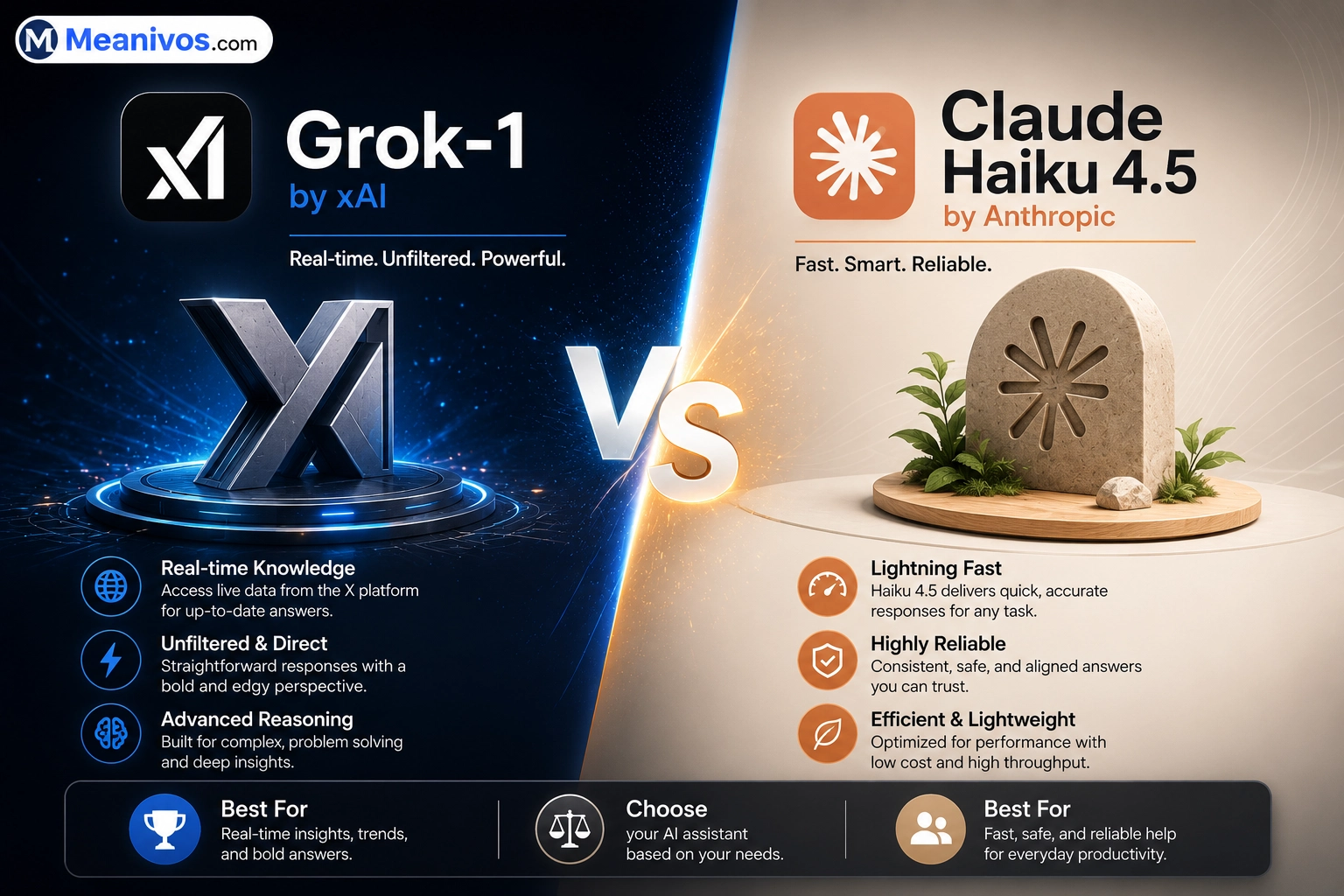
Grok-1 vs Claude Haiku 4.5: Quick Overview
Before diving into technical complexity, it’s important to establish a clear understanding of both models.
Grok-1
- Developed by xAI
- Type: Open-weight large language model
- Release Date: March 2024
- Core Focus: Transparency, adaptability, experimentation
Claude Haiku 4.5
- Developed by Anthropic
- Type: Closed proprietary AI system
- Release Date: October 2025
- Core Focus: speed, efficiency, scalability
Claude Haiku 4.5 is designed for high-performance production environments and enterprise-grade systems.
Architecture Deep Dive
One of the most overlooked aspects in AI comparisons is architecture. However, architecture determines how a model behaves under real-world conditions.
Let’s break this down properly.
Grok-1 Architecture
Grok-1 is constructed as a dense transformer-based neural network with openly accessible weights.
Key Characteristics:
- Fully open-weight framework
- Customizable and fine-tunable
- Approximate context window: 8K tokens
- Built for experimentation and research flexibility
Strengths:
- Complete customization capabilities
- Ideal for on-premise deployment scenarios
- Suitable for academic and industrial research labs
- Eliminates vendor dependency
Weaknesses:
- Limited long-context comprehension
- Not optimized for ultra-fast inference
- Requires significant infrastructure investment
Simplified Explanation:
Grok-1 resembles a modular AI engine—you can configure and modify it extensively, but it demands technical expertise and computational resources.
Claude Haiku 4.5 Architecture
Claude Haiku 4.5 represents a next-generation optimized transformer system, engineered for speed and efficiency.
Key Characteristics:
- Massive 200K token context capacity
- Multimodal support (text + image input)
- Optimized for low-latency processing
- Designed for cloud-native environments
Strengths:
- Handles extremely large datasets
- Exceptional real-time responsiveness
- Ideal for AI agents and automated workflows
- Highly efficient inference performance
Weaknesses:
- Closed ecosystem limits flexibility
- Cannot be self-hosted
Simplified Explanation:
Claude Haiku 4.5 is like a high-performance AI engine ready for immediate deployment—fast, powerful, and scalable without heavy setup.
Benchmark Performance
Benchmarks are often misunderstood or misrepresented. Let’s interpret them correctly.
Intelligence & Reasoning
Claude Haiku 4.5:
- Strong logical reasoning
- Capable of multi-step problem solving
- High instruction-following accuracy
Grok-1:
- Performs adequately on basic tasks
- Limited capability in complex reasoning scenarios
Insight:
Claude Haiku 4.5 operates closer to advanced AI intelligence levels, whereas Grok-1 remains at a foundational capability tier.
Coding Performance
| Model | SWE-Bench Score | Coding Capability |
| Claude Haiku 4.5 | ~73% | Advanced |
| Grok-1 | ~40–50% (estimated) | Moderate |
Interpretation:
- Claude produces cleaner and more optimized code
- Superior debugging and error detection
- Reduced hallucination rate
For SaaS development, this distinction is critically important.
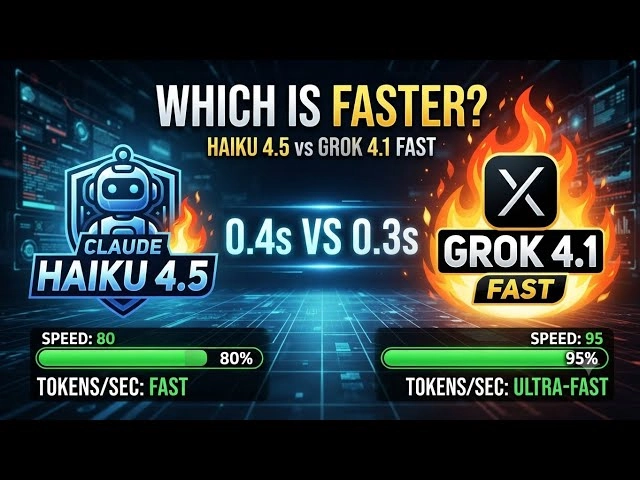
Speed & Latency Comparison
| Feature | Claude Haiku 4.5 | Grok-1 |
| Response Speed | Ultra-fast | Moderate |
| Real-time Processing | Excellent | Limited |
| Scalability | High | Medium |
Claude excels in:
- Conversational AI systems
- Autonomous AI agents
- Automation pipelines
Pricing & ROI Analysis
Let’s examine the economic implications.
Claude Haiku 4.5 Pricing
- ~$1 per million input tokens
- ~$5 per million output tokens
Grok-1 Pricing
- Model weights: Free
- Costs include:
- GPU infrastructure
- Maintenance
- DevOps resources
Real Cost Insight
| Scenario | Recommended Model |
| Startup SaaS | Claude Haiku 4.5 |
| Enterprise automation | Claude Haiku 4.5 |
| Research lab | Grok-1 |
| Self-hosted AI | Grok-1 |
Reality Check:
- Claude = Lower cost per task
- Grok = Greater autonomy but higher hidden operational expenses
Context Window
This is one of the most transformative differences in 2026.
| Model | Context Window |
| Claude Haiku 4.5 | 200K tokens |
| Grok-1 | ~8K tokens |
Why Context Size Matters
Claude Can:
- Process entire books
- Analyze complex legal documentation
- Manage long multi-step workflows
Grok Struggles With:
- Extended conversations
- Large-scale datasets
- Memory-intensive tasks
Example:
- Claude = Reads full research reports
- Grok = Processes limited excerpts
Real-World Use Cases
Claude Haiku 4.5 Excels In:
- AI-driven automation systems
- SaaS copilots
- Customer service chatbots
- Long-document analysis
- Advanced coding assistants
Grok-1 Excels In:
- AI experimentation
- Model fine-tuning
- Privacy-centric deployments
- On-premise infrastructure
Head-to-Head Comparison
| Feature | Grok-1 | Claude Haiku 4.5 |
| Model Type | Open-weight | Closed |
| Context Window | ~8K | 200K |
| Speed | Moderate | Very Fast |
| Coding Ability | Moderate | Advanced |
| Cost Structure | Infrastructure-based | API-based |
| Best Use Case | Custom AI systems | Scalable AI solutions |
| Performance Level | Baseline | High |
Pros & Cons
Claude Haiku 4.5
Advantages:
- Extremely fast processing
- Massive context capacity
- Cost-efficient usage model
- Strong reasoning and coding
Disadvantages:
- Closed-source limitations
- Restricted customization
Grok-1
Advantages:
- Open-weight accessibility
- Full system control
- No vendor dependency
Disadvantages:
- Lower performance efficiency
- Limited context size
- Requires infrastructure setup
Implementation Guide
Using Claude Haiku 4.5
- Access via API
- Integrate into applications
- Optimize prompt engineering
- Scale dynamically
Using Grok-1
- Download model weights
- Deploy on GPU servers
- Fine-tune configurations
- Build custom pipelines
Prompt Optimization Strategies
Effective prompts significantly improve output quality.
Best Practices:
- Be precise and explicit
- Structure instructions step-by-step
- Provide sufficient context
- Iterate and test variations
Advanced Tip:
Use multilingual prompts (English, French, German) to enhance performance in European markets.
Europe Market Relevance
Europe operates under strict data protection frameworks like GDPR.
Market Insights:
- Germany & Switzerland → Prefer self-hosted AI
- UK startups → Prefer API-driven solutions
Regional Model Preference:
| Region | Preferred Model |
| Germany | Grok-1 |
| Switzerland | Grok-1 |
| UK | Claude Haiku 4.5 |
| EU SaaS | Claude Haiku 4.5 |
Final Verdict
Winner: Claude Haiku 4.5
Claude dominates the 2026 landscape due to:
- Superior performance
- Faster execution speed
- Lower cost per operation
- Massive context window
When to Choose Grok-1
Select Grok-1 if:
- You require full system control
- You need custom AI architectures
- You operate in privacy-sensitive environments
People Also Ask
Yes, for most use cases like SaaS, automation, and coding, Claude Haiku 4.5 performs better.
Claude Haiku 4.5 due to speed, scalability, and cost efficiency.
Yes, but it requires infrastructure and setup.
Its 200K context window and fast performance.
Model is free, but hosting costs apply.
Conclusion
Selecting between Grok-1 and Claude Haiku 4.5 ultimately depends on your strategic objectives.
- Need speed, scalability, and efficiency? → Choose Claude
- Need control, privacy, and customization? → Choose Grok
In 2026, Claude Haiku 4.5 stands as the dominant choice for most businesses, while Grok-1 remains a Powerful option for specialized use cases.