Introduction
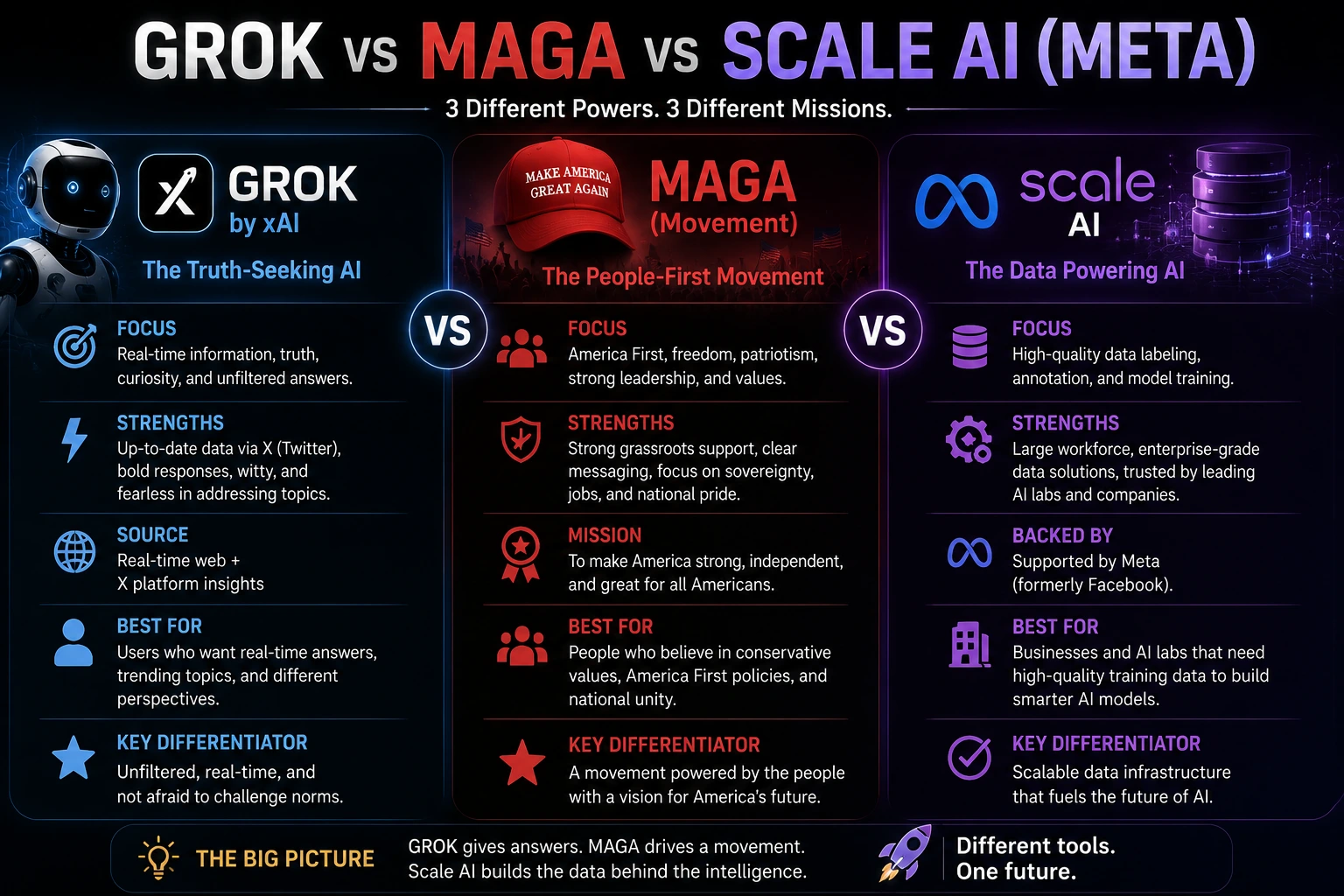
The AI landscape in 2026 is no longer just about chatbots—it has evolved into a complex ecosystem of models, platforms, infrastructure, and even cultural narratives. When people search for terms like Grok vs Meta AI vs Scale AI vs MAGA, they are often confused because these terms belong to completely different categories.
For example, Grok is a real-time AI chatbot integrated with social data streams, while Meta AI powers communication tools across Facebook, Instagram, and WhatsApp. On the other hand, Scale AI is not a chatbot at all—it is a behind-the-scenes infrastructure company that helps train AI models. Meanwhile, MAGA represents a political ideology that sometimes appears in AI bias discussions rather than being an AI tool.
This article breaks everything down into a clear ecosystem structure so you can finally understand what each term really means, how they interact, and which one matters most for real-world AI applications in 2026.
Understanding the AI Ecosystem
Before comparing them, it’s important to understand that modern AI works in layers:
AI Ecosystem Layers
- Data Layer → Scale AI (data labeling, training datasets)
- Model Layer → Grok, Meta AI (AI assistants)
- Distribution Layer → X, Meta platforms (apps where AI is used)
- Narrative Layer → political and social discourse (including MAGA discussions)
This structure shows why Comparing all four directly is misleading—they operate at different levels of the AI world.
What is Grok AI?
Grok is an advanced AI chatbot developed to deliver real-time responses based on live data sources, especially social platforms like X (Twitter).
Key Features of Grok AI
- Real-time internet and social data access
- Strong trend analysis capability
- Conversational reasoning with humor and personality
- Designed for fast-moving information environments
Strengths
- Excellent for breaking news insights
- Strong awareness of viral trends
- Real-time contextual responses
Weaknesses
- Limited enterprise adoption compared to competitors
- Still evolving in deep academic reasoning
- Depends heavily on platform ecosystem (X)
What is Meta AI?
Meta AI is integrated into Meta’s ecosystem, including WhatsApp, Instagram, Messenger, and Facebook.
Key Features
- Built into billions of users’ apps
- Conversational AI for everyday tasks
- Image generation and text assistance
- Strong personalization via social data
Strengths
- Massive global distribution
- Seamless integration with social apps
- User-friendly experience
Weaknesses
- Less powerful in real-time news analysis than Grok
- Limited transparency in advanced reasoning models
- Restricted customization for developers
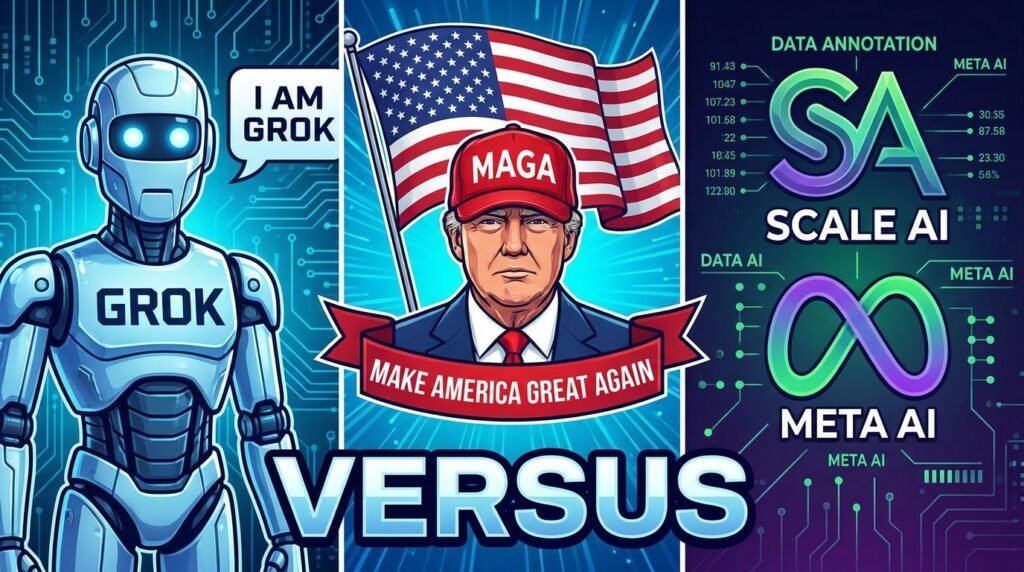
Visual representation of the modern AI ecosystem in 2026, including model, infrastructure, and narrative layers.
What is Scale AI?
Scale AI is not a chatbot. It is a foundational AI infrastructure company that powers training datasets for Advanced AI models.
Core Functions
- Data labeling and annotation
- Reinforcement Learning from Human Feedback (RLHF)
- AI training pipeline optimization
- Enterprise AI data infrastructure
Why Scale AI Matters
Without Scale AI-style systems:
- AI models would have poor training data
- LLM accuracy would drop significantly
- Enterprise AI deployment would slow down
Strengths
- Critical infrastructure provider
- Works with major AI labs
- High enterprise value
Weaknesses
- Not a consumer-facing product
- Invisible to most users
- Depends on enterprise contracts
What is MAGA in AI Discussions?
MAGA is NOT an AI system.
Instead, it appears in AI discussions in three ways:
AI Bias Discussions
People debate whether AI models show political bias influenced by training data.
Cultural Narrative Layer
MAGA is sometimes used in content analysis related to:
- political alignment
- content moderation
SEO Confusion
Many articles incorrectly mix MAGA with AI tools, leading to misleading search results.
Important clarification: MAGA is not a technology, model, or AI system.
Grok vs Meta AI
Feature Comparison Table
| Feature | Grok | Meta AI |
| Real-time data | ⭐⭐⭐⭐⭐ | ⭐⭐⭐ |
| Social integration | ⭐⭐⭐⭐ | ⭐⭐⭐⭐⭐ |
| Creativity | ⭐⭐⭐ | ⭐⭐⭐⭐⭐ |
| Enterprise use | ⭐⭐⭐ | ⭐⭐⭐⭐ |
| Trend awareness | ⭐⭐⭐⭐⭐ | ⭐⭐⭐ |
Pros & Cons
Grok Pros
- Real-time intelligence
- Strong trend analysis
- Fast responses
Grok Cons
- Limited enterprise ecosystem
- Smaller user base
Meta AI Pros
- Massive global integration
- Easy accessibility
- Strong user Personalization
Meta AI Cons
- Less real-time depth
- Limited advanced reasoning transparency
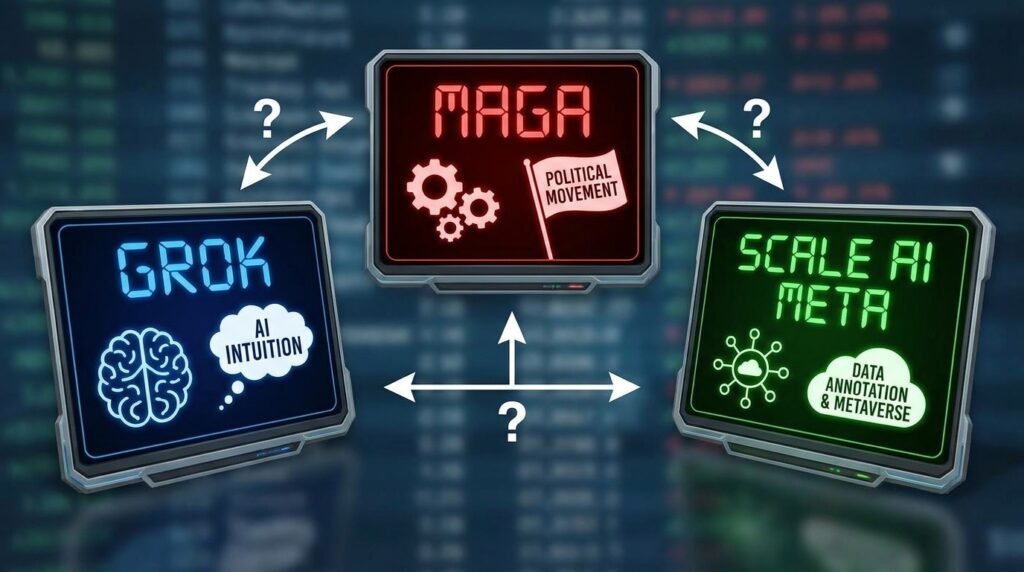
Visual representation of the modern AI ecosystem in 2026, including model, infrastructure, and narrative layers.
Scale AI vs Chatbots
| Category | Scale AI | Grok / Meta AI |
| Type | Infrastructure | Application layer |
| Users | Enterprises | Consumers |
| Function | Data training | Conversations |
| Visibility | Invisible | Highly visible |
Key Insight:
Scale AI is the “engine factory,” while Grok and Meta AI are the “cars.”
- Consumers
- Developers
Real-World Use Cases
Best AI for Coding
- Meta AI → better structured assistance
News & Trends
- Grok → real-time insights
Enterprise Training
- Scale AI → data backbone
Social Media Use
- Meta AI → seamless integration
Pros & Cons
Grok AI
Pros:
- Real-time intelligence
- Strong trend awareness
Cons:
- Limited enterprise penetration
Meta AI
Pros:
- Huge ecosystem reach
- User-friendly
Cons:
- Less real-time depth
Scale AI
Pros:
- Core infrastructure role
- Enterprise-grade importance
Cons:
- Not consumer-facing
MAGA
Pros:
- Relevant in discourse analysis
Cons:
- Not an AI system (misinterpreted in SEO content)
FAQs
A: Grok is better for real-time updates, while Meta AI is stronger for everyday social integration.
A: It is used for data labeling and training AI models for enterprise systems.
A: No, it is a political movement and not related to AI technology.
A: Scale AI is best for enterprise training infrastructure, while Meta AI supports consumer engagement.
A: No, each AI serves different ecosystem roles and use cases.
Conclusion
The comparison of Grok, Meta AI, Scale AI, and MAGA highlights a major misunderstanding in today’s AI search landscape. These terms are often grouped in SEO articles, but in reality, they belong to completely different layers of Technology and society.
Grok and Meta AI represent consumer-facing AI models designed for communication, creativity, and real-time interaction. Meanwhile, Scale AI plays a foundational role in training AI systems at the infrastructure level. On the other hand, MAGA belongs to political discourse and is not an AI technology at all.
Understanding this ecosystem approach is essential for anyone researching AI in 2026. Instead of comparing unrelated concepts, the real insight comes from seeing how data, models, platforms, and narratives interact.
For readers and bloggers, this topic offers strong SEO potential, especially when structured with clarity, tables, and ecosystem thinking. As AI continues to evolve, those who understand these layers will stay ahead in both knowledge and content creation.