Introduction
The artificial intelligence landscape in 2026 is no longer dominated by text-only models. The real Competition is now happening in multimodal AI systems—models that can see, read, understand, and reason across images, documents, charts, and real-world visual input.
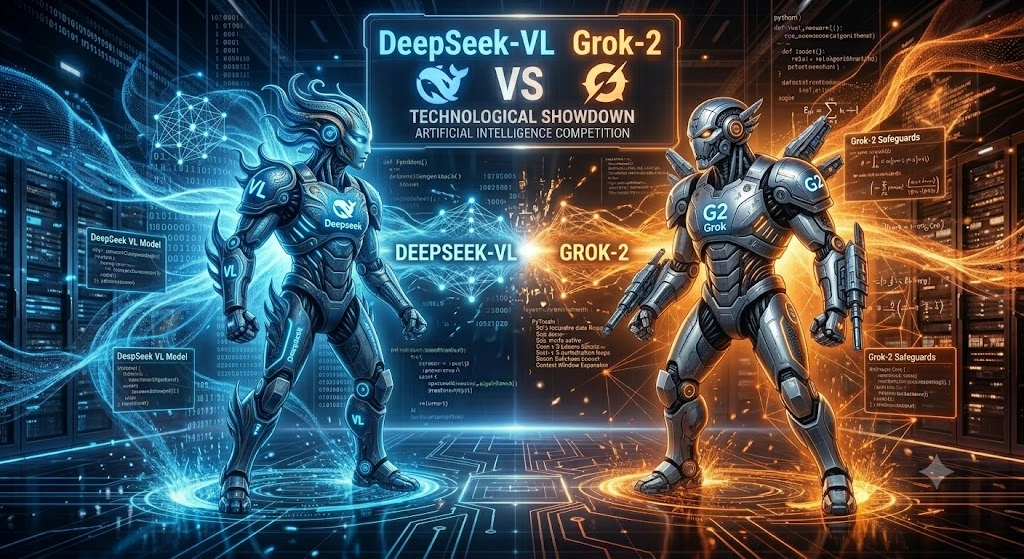
Two standout contenders in this space are DeepSeek VL and Grok-2, both representing different philosophies of AI design.
On one side, DeepSeek VL focuses on efficient vision-language understanding, OCR precision, and structured document intelligence, making it highly practical for enterprise workflows. On the other hand, Grok-2 pushes the boundaries of real-time reasoning, contextual intelligence, and advanced multimodal interpretation, offering a more generalized but powerful AI experience.
This article provides a complete breakdown of DeepSeek VL vs Grok-2, including architecture, benchmarks, real-world use cases, pros and cons, and which model is better suited for different industries—especially for users across Europe and global AI-driven businesses.
What is DeepSeek VL?
DeepSeek VL (Vision-Language Model) is a multimodal AI system designed to process and understand both visual and textual information simultaneously.
It is widely recognized for its strength in OCR (Optical Character Recognition), structured document understanding, and efficient deployment in production systems.
Key Capabilities of DeepSeek VL
- Advanced OCR for scanned documents
- Table and chart interpretation
- Image-to-text reasoning
- Multilingual support (especially English & Chinese)
- Lightweight deployment options for enterprises
How DeepSeek VL Works
DeepSeek VL uses a hybrid architecture combining:
Vision Encoder
Extracts features from images such as text, shapes, and layout structures.
Language Model Backbone
Processes extracted visual embeddings and converts them into meaningful textual reasoning.
Cross-Modal Fusion Layer
Aligns image + text understanding into a unified representation.
Strengths of DeepSeek VL
- Excellent at structured visual data (forms, receipts, PDFs)
- High OCR accuracy
- Efficient for cloud and on-premise deployment
- Lower compute cost compared to frontier models
Limitations of DeepSeek VL
- Limited abstract reasoning capabilities
- Weak performance in dynamic or video-based tasks
- Less effective in open-ended visual storytelling
What is Grok-2?
Grok-2, developed by xAI, is a next-generation multimodal AI model built for real-time intelligence, contextual reasoning, and conversational depth.
Unlike specialized OCR-focused systems, Grok-2 is designed as a general-purpose reasoning engine with strong vision capabilities.
Key Features of Grok-2
- Real-time multimodal reasoning (text + images)
- Strong contextual awareness
- Advanced conversational intelligence
- High-level abstract image interpretation
- Integrated ecosystem support
How Grok-2 Works
Large Transformer Backbone
Handles both text and visual input in a unified architecture.
Reinforcement Learning Alignment (RLHF++)
Optimizes responses based on human feedback and reasoning quality.
Multimodal Attention System
Allows dynamic focus across image regions and textual context.
Strengths of Grok-2
- Superior reasoning across complex visual scenes
- Strong abstraction and interpretation skills
- Excellent conversational flow
- Better handling of ambiguous queries
Limitations of Grok-2
- Closed-source ecosystem
- Higher computational cost
- Less customizable for developers
- Not optimized for OCR-heavy workflows
DeepSeek VL vs Grok-2: Architecture Comparison
| Feature | DeepSeek VL | Grok-2 |
| Model Type | Vision-Language Specialized | General Multimodal Transformer |
| Primary Focus | OCR & Document Understanding | Reasoning & Intelligence |
| Deployment | Lightweight / Enterprise-friendly | Cloud-based ecosystem |
| Vision Processing | Structured extraction | Contextual interpretation |
| Customization | High | Limited |
| Efficiency | Very High | Moderate |
Benchmark Comparison
| Benchmark Area | DeepSeek VL | Grok-2 |
| OCR Accuracy | ⭐⭐⭐⭐⭐ | ⭐⭐⭐⭐ |
| Chart Understanding | ⭐⭐⭐⭐⭐ | ⭐⭐⭐⭐ |
| Visual Reasoning | ⭐⭐⭐ | ⭐⭐⭐⭐⭐ |
| Mathematical Reasoning | ⭐⭐⭐ | ⭐⭐⭐⭐⭐ |
| Real-Time Knowledge | ⭐⭐⭐ | ⭐⭐⭐⭐⭐ |
| Efficiency | ⭐⭐⭐⭐⭐ | ⭐⭐⭐ |
Real-World Use Case Comparison
Document Intelligence
DeepSeek VL dominates in:
- Invoice processing
- Scanned PDF extraction
- Legal document digitization
- Financial report parsing
It is highly optimized for enterprise document automation.
Grok-2, however, excels in interpreting meaning rather than extracting raw data.
Visual Reasoning Tasks
Grok-2 performs significantly better in:
- Scene understanding
- Abstract image interpretation
- Multi-step reasoning from visuals
DeepSeek VL struggles when images require deep conceptual analysis instead of structured extraction.
Charts & Data Interpretation
DeepSeek VL is stronger in:
- Financial charts
- Statistical graphs
- Spreadsheet extraction
- Data-heavy visuals
Pros & Cons Section
DeepSeek VL
Pros
- Extremely strong OCR performance
- Efficient and lightweight
- Great for structured business workflows
- Cost-effective deployment
Cons
- Weak abstract reasoning
- Limited multimodal creativity
- No advanced video understanding
Grok-2
Pros
- Powerful reasoning capabilities
- Excellent contextual intelligence
- Strong general multimodal understanding
- Better for complex tasks
Cons
- Closed ecosystem
- Higher resource consumption
- Less transparency in benchmarking
How to Use These AI Models Effectively
Using DeepSeek VL
Best practices:
- Use for document automation pipelines
- Integrate into OCR-based SaaS tools
- Combine with databases for structured extraction
Using Grok-2
Best practices:
- Use for AI assistants and copilots
- Apply in research and reasoning systems
- Leverage for multimodal conversational tools
Tips for Writing AI Tool Comparisons
Europe Market Relevance
In Europe, especially in countries like Germany, France, and the Netherlands, AI adoption is heavily driven by:
- Data privacy compliance (GDPR)
- Enterprise automation needs
- Document-heavy industries (legal, finance, healthcare)
This makes DeepSeek VL particularly attractive for European businesses needing secure OCR and document processing, while Grok-2 is preferred in innovation-driven startups and AI research environments.
People Also Ask
A: Yes, DeepSeek VL is significantly better for OCR tasks due to its structured vision-language design optimized for text extraction.
A: Grok-2 performs better in reasoning tasks, especially those involving abstract interpretation and complex image understanding.
A: Yes, but it is more suited for batch processing rather than real-time conversational intelligence like Grok-2.
A: No, Grok-2 is a closed-source model with limited external customization options.
A: Businesses should choose based on workflow:
DeepSeek VL → OCR, documents, structured data
Grok-2 → reasoning, assistants, multimodal intelligence
Conclusion
The comparison between DeepSeek VL and Grok-2 highlights a major shift in AI development: specialization vs general intelligence. DeepSeek VL is the clear leader in precision, OCR accuracy, and structured document processing, making it ideal for enterprise systems and data-heavy industries.
Grok-2, however, stands out in reasoning, contextual understanding, and advanced multimodal intelligence, making it better for next-generation AI assistants. In 2026, the question is not which model is universally better, but which one aligns with your specific workflow. For Europe’s rapidly evolving AI ecosystem, both models offer unique advantages depending on industry needs and scalability requirements.