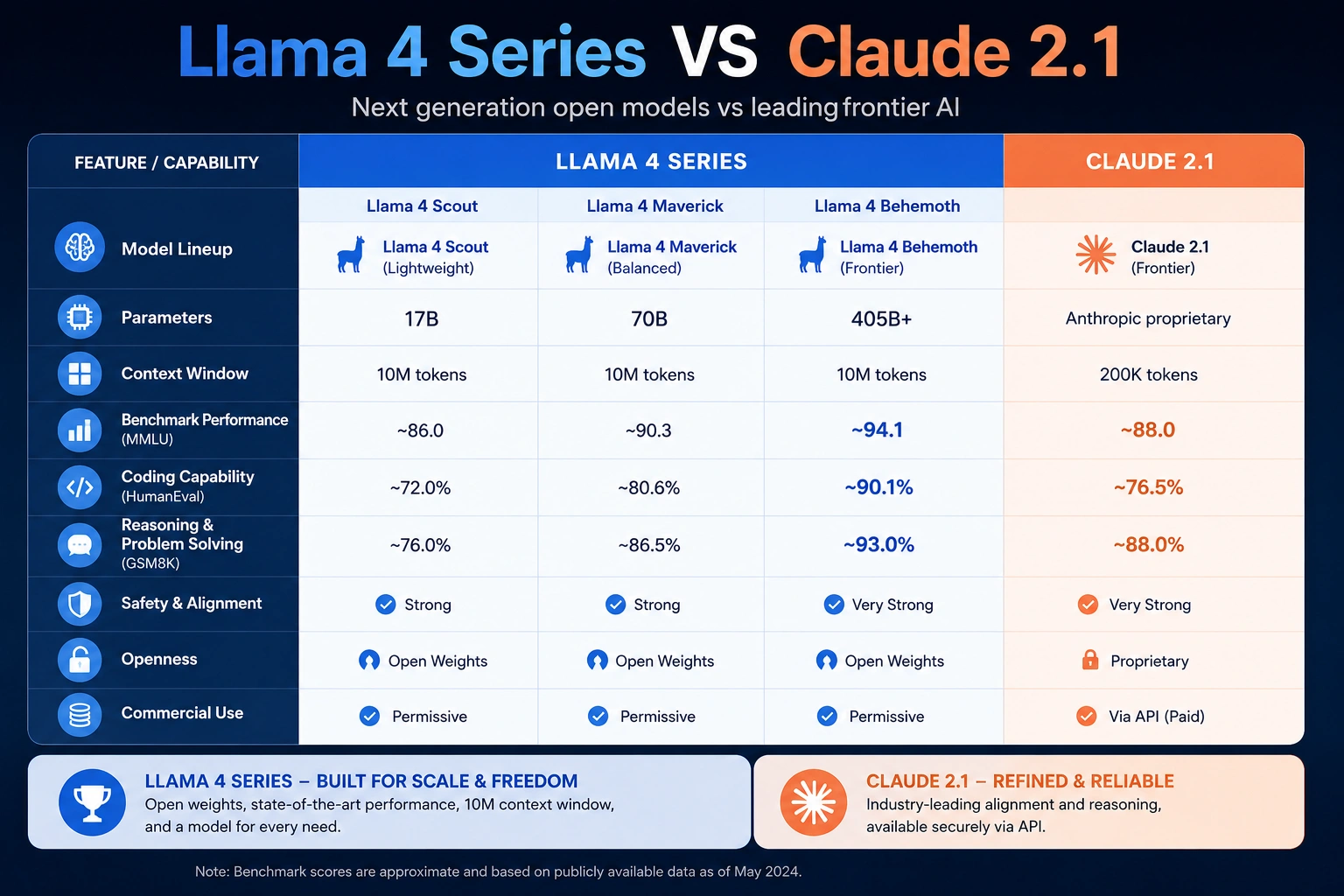
Introduction
Artificial intelligence moves faster than almost any modern technology category. That creates a problem. Many comparison articles judge AI systems from different generations as if they were released in the same market environment, solving the same problems, and competing for the same users. That approach creates misleading conclusions. Llama 4 Series and Claude 2.1 represent two different eras of large language model development. One emphasizes deployment flexibility, ecosystem openness, infrastructure ownership, and modern scaling strategies. The other helped define enterprise-grade conversational AI and practical long-context workflows. So which one actually makes sense in 202?. The answer depends less on benchmark screenshots and more on business goals, infrastructure maturity, operating costs, privacy requirements, and developer workflows.
In this complete comparison guide, you will learn:
- How Llama 4 Series and Claude 2.1 differ
- Architecture and deployment tradeoffs
- Context window realities vs marketing claims
- Cost and ROI analysis
- Enterprise adoption considerations
- Developer experience comparison
- Real-world use cases
- Which AI model to choose in 2026
Whether you are an AI builder, startup founder, content team, or enterprise decision maker, this guide will help you make a smarter choice.
What Are Llama 4 Series and Claude 2.1?
Llama 4 Series
Llama 4 Series represents Meta’s modern generation of language models focused on scalability, multimodal capabilities, longer context handling, and flexible deployment.
The lineup includes:
- Llama 4 Scout
- Llama 4 Maverick
- Llama 4 Behemoth
The ecosystem philosophy centers around enabling organizations to run AI inside their own infrastructure rather than relying exclusively on hosted APIs.
Core characteristics:
- Modern architecture
- Large context support
- Infrastructure flexibility
- Private deployment options
- Ecosystem extensibility
Claude 2.1
Claude 2.1 was introduced as an advancement in conversational reliability and long-document understanding.
At launch, Claude gained strong adoption among teams looking for:
- Long context analysis
- Safe conversational workflows
- Managed AI infrastructure
- Enterprise productivity
Claude 2.1 became especially popular among business users who wanted AI without maintaining infrastructure.
Key Differences at a Glance
| Category | Llama 4 Series | Claude 2.1 |
| Provider | Meta | Anthropic |
| Generation | Modern | Earlier Frontier Generation |
| Context Strategy | Expanded large-scale | 200K context |
| Hosting | Self-host + Cloud | Managed API |
| Customization | Extensive | Moderate |
| Infrastructure Control | High | Low |
| Ownership Cost | Potentially lower at scale | Predictable subscription |
| Enterprise Simplicity | Moderate | High |
| Best Audience | Builders & engineering teams | Business teams |
Architecture Comparison
Llama 4 Architecture Philosophy
Llama 4 reflects a shift toward operational flexibility.
Modern AI teams increasingly want:
- Infrastructure ownership
- Lower recurring costs
- Deployment control
- Compliance readiness
Llama supports these goals.
Advantages:
Flexible Deployment
Organizations can build private AI environments.
Infrastructure Independence
Reduces dependency on external API providers.
Custom Model Pipelines
Teams can integrate internal workflows more deeply.
Long-Term Cost Efficiency
Large-scale inference can become economically attractive.
Potential challenges:
- Infrastructure responsibility
- Monitoring requirements
- Hardware planning
Claude 2.1 Architecture Philosophy
Claude follows a managed-service approach.
Rather than optimizing for infrastructure ownership, Claude emphasizes productivity and operational simplicity.
Advantages:
Fast Adoption
Minimal operational overhead.
Stable Conversational Experience
Strong instruction-following behavior.
Reduced Engineering Complexity
Less maintenance compared with private hosting.
Potential limitations:
- API dependency
- Limited infrastructure control
- Recurring operational expenses
Benchmarks and Real Performance
Benchmarks help.
Production performance matters more.
Most comparison articles stop at test scores.
Real deployment success depends on:
- Latency
- Reliability
- Cost
- Scaling behavior
- Workflow integration
Coding and Development
Llama 4has strengths:
- Internal tooling
- AI product building
- Infrastructure experimentation
Claude’s strengths:
- Documentation
- Requirements analysis
- Workflow support
Content Creation
Claude typically delivers:
- Structured responses
- Consistent writing
- Business communication
Llama provides:
- More deployment flexibility
- Higher customization potential
Research and Retrieval
Winner depends on implementation quality.
Context size alone rarely determines outcomes.
Context Window and Long Document Processing
The context window has become one of AI’s most competitive metrics.
But advertised numbers often create unrealistic expectations.
Llama 4 Context Strategy
Benefits:
- Larger memory ranges
- Long-form retrieval support
- Complex workflow potential
Challenges:
- Memory quality varies
- Retrieval architecture matters
Claude 2.1 Context Strategy
Claude helped popularize practical long-document workflows.
Strengths:
- Reliable summaries
- Better document handling
- Enterprise usability
Usable Context vs Advertised Context
Important evaluation criteria:
- Retrieval accuracy
- Hallucination control
- Citation quality
- Long-session stability
Large context does not automatically equal better results.

Pricing and Ownership Cost
Most comparisons oversimplify pricing.
The real question:
What does AI cost after deployment?
Claude 2.1 Cost Profile
Advantages:
- Predictable budgeting
- Minimal setup
Tradeoffs:
- Long-term recurring expenses
- Vendor dependency
Llama 4 Cost Profile
Advantages:
- Cost optimization potential
- Scale efficiency
Tradeoffs:
- Infrastructure investment
- Operations overhead
Total Ownership Comparison
| Cost Category | Llama 4 | Claude 2.1 |
| Initial Setup | Higher | Lower |
| Monthly Predictability | Moderate | High |
| Scale Efficiency | Excellent | Moderate |
| Maintenance | High | Minimal |
| Enterprise Control | High | Moderate |
Developer Experience
Choose Llama 4 If You Need
- Model experimentation
- Custom deployment
- Internal AI products
- Infrastructure control
Choose Claude 2.1 If You Need
- Fast onboarding
- Managed workflows
- Team collaboration
- Minimal maintenance
Enterprise and Security Comparison
Llama 4 Works Best For
- Internal systems
- Compliance-Heavy sectors
- Private deployment
Examples:
- Healthcare analytics
- Banking workflows
- Government research
Claude 2.1 Works Best For
- Rapid implementation
- SaaS productivity
- Corporate operations
Examples:
- Knowledge management
- Internal documentation
- Content operations
Europe-Focused Considerations
European organizations increasingly evaluate AI through:
- Data governance
- Infrastructure location
- Vendor concentration risk
- Long-term cost management
Llama may appeal more to organizations seeking deployment control.
Claude often appeals to teams prioritizing operational speed.
Real Use Cases
| Use Case | Recommended |
| Content Teams | Claude 2.1 |
| Internal AI Products | Llama 4 |
| Research Pipelines | Llama 4 |
| Corporate Knowledge Search | Claude 2.1 |
| Large Infrastructure | Llama 4 |
| Startup Productivity | Claude 2.1 |
Pros and Cons
Llama 4 Series
Pros
- Flexible deployment
- Greater ownership
- Lower scale costs
- Customizable
Cons
- Operational complexity
- Infrastructure requirements
- Maintenance burden
Claude 2.1
Pros
- Easy onboarding
- Stable output
- Fast deployment
Cons
- Recurring costs
- Limited ownership
- Vendor dependency
How to Use These AI Tools
Define Your Goal
Ask:
- Productivity?
- Product development?
- Automation?
Choose Deployment Style
Options:
- Managed API
- Private hosting
Test Real Workflows
Measure:
- Speed
- Cost
- Quality
Scale Carefully
Expand only after proving ROI.
Tips to Write Your Own AI Tool Captions
Good AI content captions:
- Focus on outcomes
- Use active language
- Avoid hype
- Add measurable benefits
Examples:
Compare AI faster
Reduce infrastructure cost
Build smarter workflows
Avoid:
Best AI ever
Guaranteed results
Which AI Model Should You Choose?
Choose Llama 4 Series if:
- You need flexibility
- Scale matters
- You prefer infrastructure ownership
- Cost control is strategic
Choose Claude 2.1 if:
- You want simplicity
- You prioritize speed
- Your team lacks AI operations resources
People Also Ask
A: For infrastructure flexibility and future scalability, Llama 4 often leads. For managed productivity workflows, Claude 2.1 remains attractive.
A: Short-term deployment usually favors Claude. Long-term large-scale usage may favor Llama depending on the infrastructure.
A: Yes. Many organizations still value reliability and managed operation.
A: Developers often prefer Llama for experimentation and control.
A: It depends.
Control-heavy environments lean toward Llama.
Simplicity-focused teams often prefer Claude.
Conclusion
Llama 4 Series and Claude 2.1 should not be treated as direct generational equals. They represent different philosophies. Llama 4 pushes Flexibility, ownership, and long-term infrastructure efficiency. Claude 2.1 prioritizes convenience, business usability, and managed AI experiences. If your organization builds AI products, values infrastructure control, and expects large-scale growth, Llama 4 is usually the stronger long-term decision.
If your priorities are productivity, faster implementation, and a lower operational burden, Claude 2.1 still delivers meaningful value. Choose based on operating model—not benchmark screenshots. If this comparison helped, bookmark ToolKitByAI and explore more AI comparison guides.