Introduction
Artificial Intelligence is evolving faster than ever, and selecting the right AI model has become one of the most important decisions for developers, startups, researchers, and enterprises. Among the most discussed models today are Llama 2 7B and Claude Opus 4.5.
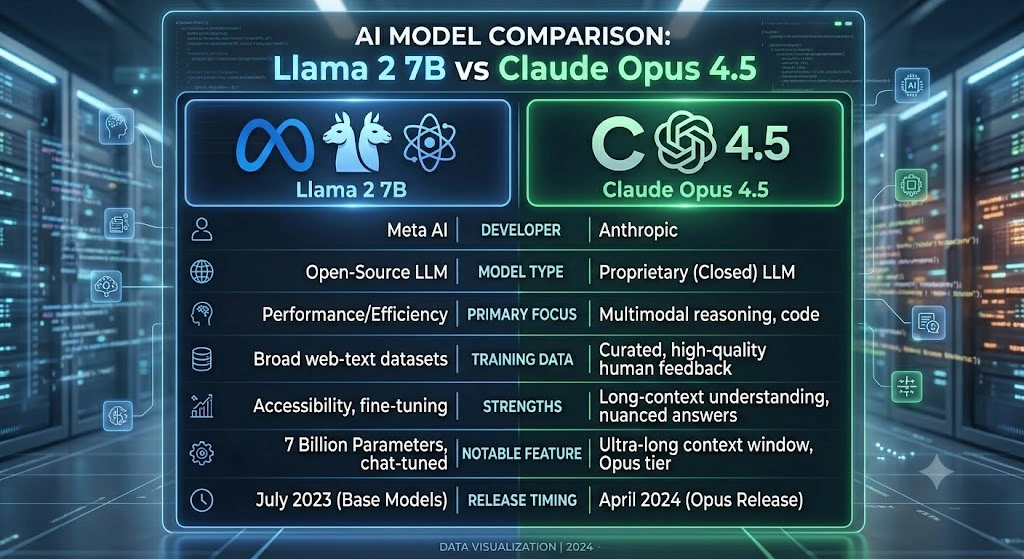
Although both belong to the large language model (LLM) category, they were built for entirely different purposes. Llama 2 7B focuses on accessibility, customization, local deployment, and open-source innovation. Claude Opus 4.5 represents a frontier AI system optimized for advanced reasoning, coding, enterprise workflows, and large-scale automation.
Comparing these two models is like comparing a lightweight sports car with a Formula 1 racing machine. One emphasizes affordability and flexibility, while the other pushes the limits of intelligence and performance.
This comprehensive guide explores architecture, benchmarks, coding capabilities, context windows, deployment options, pricing, privacy, enterprise applications, and future outlook to help you determine which AI model is best for your needs.
Quick Verdict
If your goal is advanced reasoning, enterprise AI, software development, research, and large-scale workflows, Claude Opus 4.5 is the clear winner.
If you need complete control, local deployment, privacy, customization, and lower operational costs, Llama 2 7B remains one of the strongest open-source AI models available.
| Category | Winner |
| Coding | Claude Opus 4.5 |
| Reasoning | Claude Opus 4.5 |
| Mathematics | Claude Opus 4.5 |
| Long Context Tasks | Claude Opus 4.5 |
| Enterprise AI | Claude Opus 4.5 |
| AI Agents | Claude Opus 4.5 |
| Local Deployment | Llama 2 7B |
| Privacy Control | Llama 2 7B |
| Open Source Flexibility | Llama 2 7B |
| Cost Efficiency | Llama 2 7B |
What Is Llama 2 7B?
Llama 2 7B is an open-source large language model developed by Meta. The model contains approximately seven billion parameters and was designed to provide powerful language capabilities while remaining accessible to developers and organizations with limited resources.
The release of Llama 2 transformed the open-source AI landscape by allowing developers to build AI applications without depending entirely on expensive cloud providers.
Key Features
- Open-source availability
- Local deployment support
- Fine-tuning capability
- Strong developer community
- Lower hardware requirements
- Cost-effective implementation
Why Llama 2 7B Was Revolutionary
Before the emergence of open-source models like Llama 2, advanced AI capabilities were largely restricted to large technology companies. Llama 2 enabled startups, researchers, and independent developers to build customized AI systems with greater freedom and transparency.
What Is Claude Opus 4.5?
Claude Opus 4.5 is Anthropic’s flagship AI model designed for advanced reasoning, coding, research, and enterprise productivity.
Unlike lightweight open-source models, Claude Opus 4.5 is optimized to solve complex business and technical problems. It excels at understanding long documents, generating production-quality code, performing multi-step reasoning, and supporting agentic AI workflows.
Key Features
- Advanced reasoning
- Exceptional coding performance
- Large context window
- Enterprise integrations
- Agentic workflow support
- High reliability and accuracy
Claude Opus 4.5 represents a newer generation of AI systems focused on maximum performance rather than local accessibility.
Llama 2 7B vs Claude Opus 4.5: Architecture Comparison
Parameters
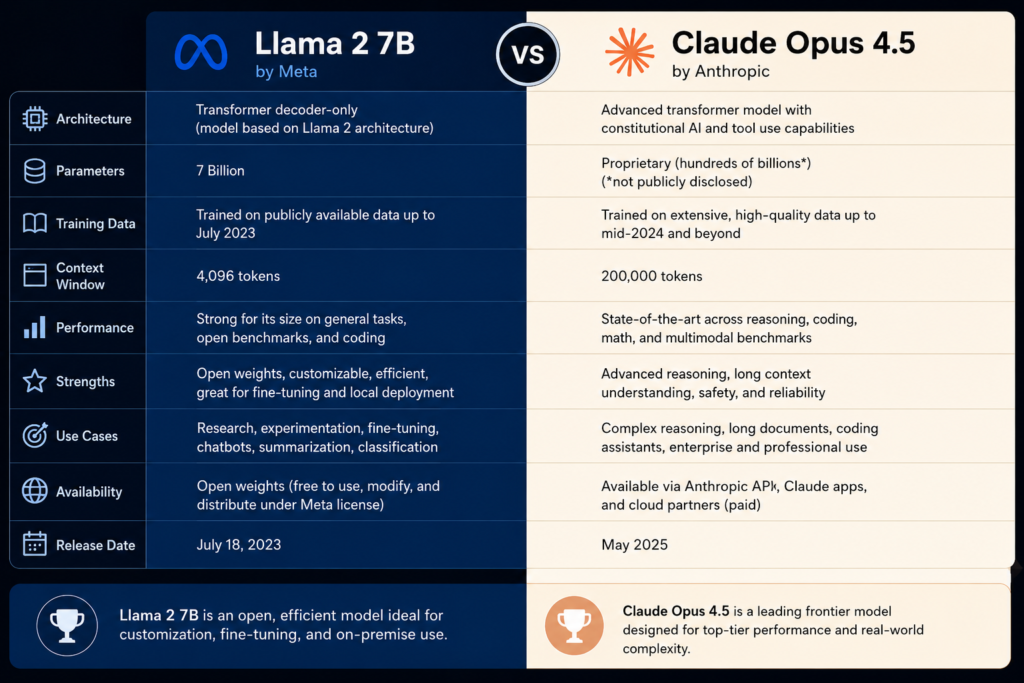
| Feature | Llama 2 7B | Claude Opus 4.5 |
| Parameters | 7 Billion | Not Publicly Disclosed |
| Open Source | Yes | No |
| Local Deployment | Yes | No |
| Fine-Tuning | Supported | Limited |
| Cloud Required | Optional | Yes |
While parameter count is important, modern AI performance depends on training quality, optimization methods, alignment strategies, and reasoning capabilities.
Training Approach
Llama 2 7B uses a transformer-based architecture trained on large-scale datasets and supports extensive community-driven fine-tuning.
Claude Opus 4.5 utilizes proprietary training techniques, reinforcement learning methods, and advanced alignment processes designed to improve reasoning and reliability.
Benchmark Performance Comparison
Reasoning
Reasoning has become one of the most important benchmarks for evaluating modern AI systems.
Llama 2 7B performs adequately for simple reasoning tasks and general conversational use.
Claude Opus 4.5 excels at:
- Multi-step reasoning
- Strategic planning
- Research synthesis
- Decision-making
- Complex problem solving
Winner: Claude Opus 4.5
Coding
AI coding assistants have transformed software development.
Llama 2 7B
Suitable for:
- Basic code generation
- Learning programming
- Small development projects
- Offline coding environments
Claude Opus 4.5
Suitable for:
- Enterprise software development
- Large repositories
- Multi-file projects
- Debugging
- Code reviews
- Architecture planning
Winner: Claude Opus 4.5
Mathematics
Claude Opus 4.5 demonstrates stronger mathematical reasoning across advanced calculations, engineering tasks, and analytical workflows.
Winner: Claude Opus 4.5
Knowledge Tasks
Claude Opus 4.5 generally performs better when understanding, synthesizing, and applying information across multiple domains.
Winner: Claude Opus 4.5
Agentic Workflows
Modern AI agents require planning, reasoning, memory, and tool usage.
Claude Opus 4.5 is significantly stronger for autonomous workflows and enterprise automation.
Winner: Claude Opus 4.5
Coding Performance: Which Model Is Better for Developers?
For developers, coding capability is often the most important factor.
Llama 2 7B is valuable when privacy and local deployment are priorities. Developers can run the model entirely on their own infrastructure and customize it for specialized workflows.
Claude Opus 4.5 offers a dramatically superior coding experience. It can analyze large codebases, understand software Architecture, generate complex functions, debug issues, and assist with full-stack development projects.
For professional development teams, Claude Opus 4.5 is generally the preferred solution.
Reasoning and Problem Solving
Reasoning separates modern frontier AI models from older generations.
Claude Opus 4.5 was specifically designed for advanced reasoning and performs exceptionally well in tasks requiring multiple logical steps.
Examples include:
- Strategic business planning
- Technical analysis
- Scientific research
- Workflow design
- Financial evaluation
Llama 2 7B remains useful for simpler tasks but cannot consistently match the reasoning depth of Claude Opus 4.5.
Context Window Comparison
The context window determines how much information a model can process at once.
| Model | Context Window |
| Llama 2 7B | Approximately 4K Tokens |
| Claude Opus 4.5 | Up to 200K Tokens |
Why Context Length Matters
A larger context window enables users to:
- Analyze entire codebases
- Process long reports
- Review contracts
- Study research papers
- Build advanced AI agents
For enterprise users and researchers, this advantage is substantial.
Winner: Claude Opus 4.5
Speed and Efficiency
Llama 2 7B is lightweight and can run efficiently on consumer hardware.
Claude Opus 4.5 delivers superior intelligence but typically requires cloud infrastructure and more computational resources.
If speed on local devices is your priority, Llama 2 7B offers significant advantages.
Open Source vs Proprietary AI
Benefits of Open Source AI
Llama 2 7B provides:
- Transparency
- Flexibility
- Ownership
- Customization
- Cost control
Benefits of Proprietary AI
Claude Opus 4.5 provides:
- Higher performance
- Continuous improvements
- Enterprise support
- Better reliability
The choice ultimately depends on whether you prioritize flexibility or raw capability.
Privacy and Security
Llama 2 7B
Ideal for:
- Sensitive data
- Internal systems
- Regulatory compliance
- Private deployments
Claude Opus 4.5
Ideal for:
- Managed cloud workflows
- Enterprise integrations
- Large-scale business automation
For maximum privacy, Llama 2 7B remains the stronger option because organizations maintain complete control over their infrastructure.
Local Deployment Comparison
One of the biggest advantages of Llama 2 7B is its ability to run locally.
Popular deployment platforms include:
- Ollama
- LM Studio
- Hugging Face
- Text Generation WebUI
Claude Opus 4.5 is cloud-based and does not support local deployment.
Winner: Llama 2 7B
Enterprise Use Cases
Llama 2 7B
Best for:
- Internal knowledge systems
- Custom AI assistants
- Offline environments
- Cost-sensitive deployments
Claude Opus 4.5
Best for:
- Enterprise research
- Customer support automation
- Strategic planning
- Coding teams
- Agentic AI systems
Winner: Claude Opus 4.5
Cost Analysis
| Factor | Llama 2 7B | Claude Opus 4.5 |
| Licensing | Free | Paid |
| Hosting | Self-Managed | Cloud-Based |
| Infrastructure | User-Controlled | Provider-Controlled |
| Enterprise Support | Limited | Strong |
Organizations with technical expertise often find Llama 2 7B more economical over the long term.
Claude Opus 4.5 costs more but delivers significantly higher productivity.
Who Should Choose Llama 2 7B?
Choose Llama 2 7B if you:
- Need local deployment
- Prioritize privacy
- Require customization
- Have budget limitations
- Prefer open-source solutions
Who Should Choose Claude Opus 4.5?
Choose Claude Opus 4.5 if you:
- Need advanced reasoning
- Require top-tier coding assistance
- Work with large documents
- Run enterprise workflows
- Build AI agents
Can Llama 2 7B Replace Claude Opus 4.5?
For basic AI tasks, Llama 2 7B may be sufficient.
However, for enterprise automation, advanced coding, research, reasoning, and large-scale workflows, Claude Opus 4.5 remains significantly more capable.
Best Alternatives to Both Models
If neither model perfectly matches your needs, consider:
- GPT-5
- Gemini 2.5 Pro
- DeepSeek R1
- DeepSeek V3
- Qwen 3
- Mistral Large
- Llama 4
AI Model Selection Framework
Before choosing an AI model, ask yourself:
- Do I need local deployment?
- Is privacy a major concern?
- Do I require advanced reasoning?
- What is my budget?
- Will I process large documents?
- Do I need enterprise support?
Answering these questions will quickly reveal which model aligns with your requirements.
Pros and Cons
Llama 2 7B Pros
- Open source
- Free to use
- Local deployment
- Customizable
- Privacy-friendly
Llama 2 7B Cons
- Smaller context window
- Weaker reasoning
- Lower coding performance
Claude Opus 4.5 Pros
- Exceptional reasoning
- Superior coding assistance
- Large context window
- Enterprise-ready
Claude Opus 4.5 Cons
- Paid access
- Proprietary system
- No local deployment
People Also Ask
A: Yes. Claude Opus 4.5 significantly outperforms Llama 2 7B in reasoning, coding, context handling, and enterprise workflows.
A: Yes. Llama 2 7B was specifically designed to support local deployment on private hardware and infrastructure.
A: Claude Opus 4.5 is considerably stronger for debugging, code generation, architecture design, and large-scale software projects.
A: Yes. Llama 2 7B is available under Meta’s licensing terms and does not require recurring subscription fees.
A: Llama 2 7B generally provides stronger privacy because it can run entirely within an organization’s own infrastructure.
Conclusion
The comparison between Llama 2 7B and Claude Opus 4.5 highlights two very different approaches to artificial intelligence. Llama 2 7B remains one of the most influential open-source AI models thanks to its flexibility, affordability, privacy benefits, and ability to run locally. It is an excellent choice for developers, researchers, startups, and organizations seeking complete control over their AI systems.
Claude Opus 4.5, however, represents the cutting edge of AI performance. With superior reasoning, coding, long-context understanding, and enterprise capabilities, it is the stronger choice for businesses and professionals who require the highest levels of productivity and intelligence.
For most enterprise users in 2026, Claude Opus 4.5 is the better option. For privacy-focused deployments and budget-conscious projects, Llama 2 7B remains an outstanding solution. Bookmark this guide, share it with your team, and explore more AI model comparisons on UltraAIGuide.com to stay ahead in the rapidly evolving world of artificial intelligence.