Introduction
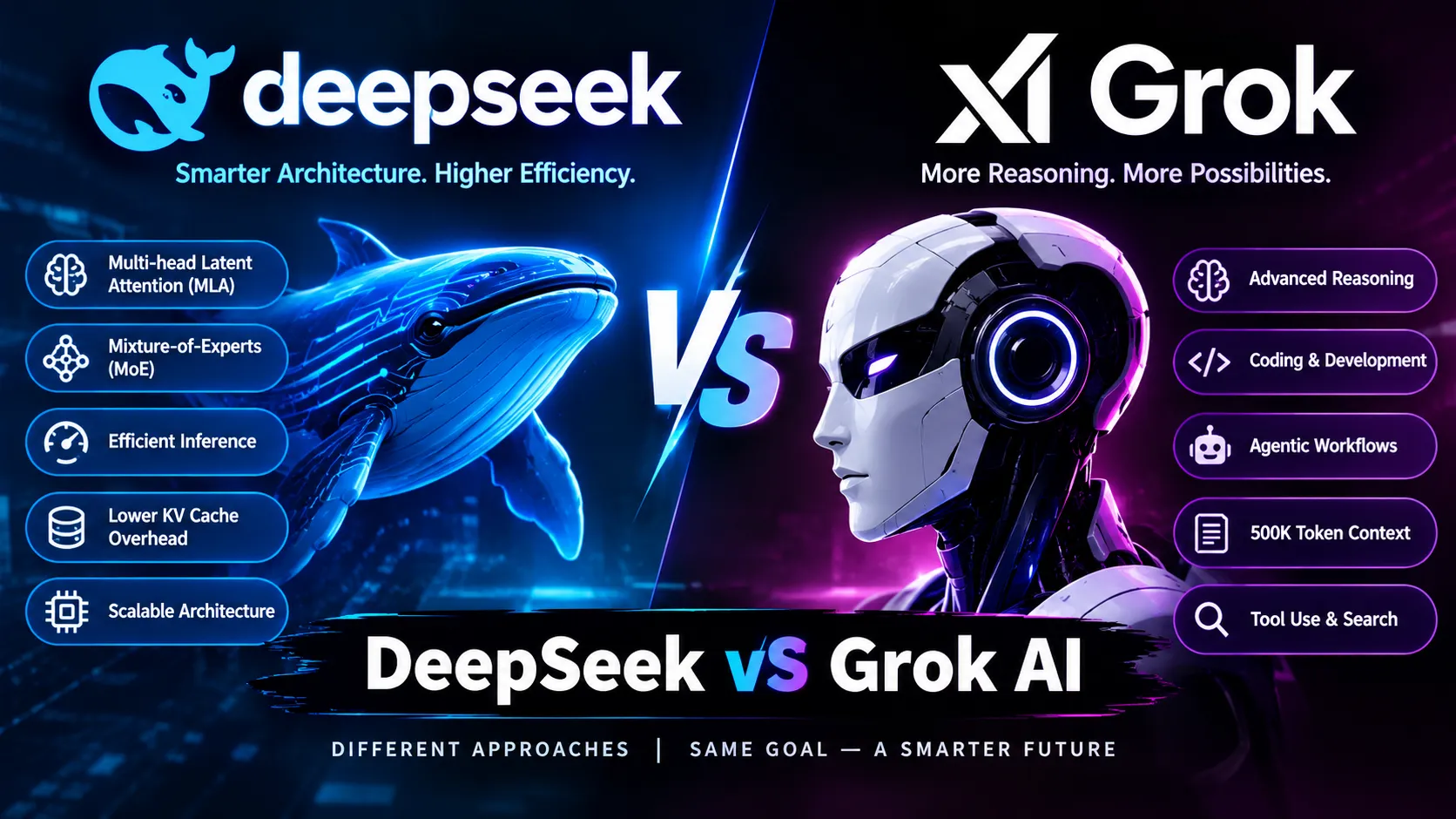
DeepSeek and Grok are no longer simple alternatives to the same AI chatbot. They represent different approaches to building and delivering modern AI systems. DeepSeek has made its model architecture and efficiency research unusually visible, including techniques such as Multi-Head Latent Attention (MLA), sparse attention, and mixture-of-experts designs. Its current V4 family offers 1 million-token context and open weights. Grok, meanwhile, is developed by xAI/SpaceXAI as a proprietary model family focused heavily on reasoning, coding, agentic workflows, and access to tools such as web search and X search. Current xAI documentation lists Grok 4.5 with a 500,000-token context window.
There is no universal winner. DeepSeek is particularly compelling when efficiency, open weights, large context, and deployment control matter. Grok 4.5 is especially attractive for managed agentic workflows, coding, and tool-enabled research. The more interesting question is why these systems make different trade-offs.
DeepSeek vs Grok AI: Quick Verdict
| Category | DeepSeek V4 | Grok 4.5 |
| Provider | DeepSeek | xAI / SpaceXAI |
| Architecture transparency | High relative to proprietary models | Limited |
| Open weights | Yes | No |
| Context window | 1M tokens | 500K tokens |
| Reasoning | Yes | Yes |
| Image input | V4 capabilities vary by model/interface | Yes |
| Tool calling | Yes | Yes |
| Web/X tools | Product/API dependent | Web + X search available |
| Self-hosting | Major advantage | Not comparable |
| API | Yes | Yes |
| Best strength | Efficiency, openness, long context | Agentic coding, managed tools |
| Ideal user | Developers/researchers wanting control | Users wanting integrated managed AI |
DeepSeek officially describes V4-Pro and V4-Flash as 1M-context models with thinking and non-thinking modes. xAI lists Grok 4.5 at 500K context and provides function calling, web search, X search, and code execution.
Independent model comparisons also show why a model-by-model approach is essential. Artificial Analysis currently compares specific releases such as DeepSeek V4 Pro 0813 vs Grok 4.5, rather than treating “DeepSeek” and “Grok” as permanent single models.
Quick recommendation
Choose DeepSeek when:
- open weights matter
- self-hosting matters
- long context is important
- you want lower API costs
- you need experimentation and customization
- you want more control over deployment
Choose Grok when:
- managed infrastructure is preferable
- agentic coding is important
- web/X search matters
- you need integrated tools
- you want a polished proprietary ecosystem
What Is DeepSeek MLA?
MLA stands for Multi-Head Latent Attention.
It is one of DeepSeek’s important architectural approaches for making attention more memory-efficient.
To understand why MLA matters, start with the KV cache.
During autoregressive generation, transformer models repeatedly use previously generated information. Key and value representations are stored so the system does not have to recompute everything for every new token.
The problem is that the KV cache can become expensive as context grows.
That matters because modern AI applications increasingly use:
- long documents
- large codebases
- agentic conversations
- research material
- multi-step workflows
- large context windows
DeepSeek’s approach compresses information into a lower-dimensional latent representation, reducing the amount of information that must be stored for attention.
In simple terms:
Traditional attention → larger KV representation
MLA → compressed latent representation
The result is an architectural strategy aimed at reducing memory pressure during inference.
DeepSeek’s earlier technical work documented MLA as an approach for significantly reducing KV-cache requirements, and its newer V4 materials emphasize further attention and context-efficiency improvements.
DeepSeek MLA vs Traditional Attention
The easiest way to understand the difference is to compare three approaches.
MHA — Multi-Head Attention
Traditional multi-head attention maintains separate key/value representations across attention heads.
This can produce a large KV cache.
GQA — Grouped-Query Attention
GQA reduces memory requirements by sharing key/value representations among groups of query heads.
MLA — Multi-Head Latent Attention
MLA takes a different approach by compressing information into a latent representation.
Conceptually:
MHA
Tokens → K/V heads → Large KV cache
GQA
Tokens → grouped K/V heads → Smaller KV cache
MLA
Tokens → latent compression → compact KV representation
This distinction is important because MLA is not simply “fewer attention heads.”
It is a different strategy for handling the information that attention needs during inference.
MLA and MoE Are Not the Same Thing
This is one of the most important technical distinctions in the entire comparison.
MLA and MoE solve different problems.
MLA
Primarily addresses the attention and KV-cache side of inference.
Think:
How can the model retain the information needed for attention without maintaining an unnecessarily large cache?
MoE
Mixture of Experts addresses computational scaling.
Instead of activating every expert for every token, a routing mechanism selects relevant experts.
Think:
How can a huge model have many parameters without activating all of them for every token?
So:
MLA → attention/memory efficiency
MoE → sparse computational activation
That is why describing DeepSeek simply as “an MoE model” misses an important part of the architecture story.
The supplied research correctly highlights this distinction as a major information-gain opportunity.
What Is DeepSeek V4?
The current DeepSeek generation has moved beyond the V3-era comparison that appears in many older articles.
DeepSeek announced V4 in April 2026 with two major variants:
- DeepSeek-V4-Pro
- DeepSeek-V4-Flash
DeepSeek describes V4-Pro as 1.6 trillion total parameters with 49 billion active parameters, while V4-Flash has 284 billion total parameters with 13 billion active parameters. Both support a 1M context length.
DeepSeek also describes V4 as introducing:
- token-wise compression
- DeepSeek Sparse Attention
- 1M-token context
- improved agentic capabilities
- thinking and non-thinking modes
- open weights
This means an article written around DeepSeek V3 vs Grok 3 can quickly become outdated.
For a 2026 article, model names should always be explicit.
What Is Grok 4.5?
Grok is xAI’s AI model family.
Current xAI documentation describes Grok 4.5 as a frontier model designed for:
- coding
- agentic software work
- Engineering
- reasoning
- knowledge work
It supports:
- text
- image input
- reasoning
- function calling
- structured outputs
- web search
- X search
- code execution
The documented context window is 500,000 tokens.
xAI also positions Grok 4.5 for real-world engineering and agentic tasks, including coding workflows and office productivity.
That makes Grok’s product-level capabilities an important part of this comparison.
DeepSeek vs Grok Architecture
This is where you need to be technically careful.
| Architecture question | DeepSeek | Grok |
| Public technical documentation | Extensive | More limited |
| MLA publicly documented | Yes, in DeepSeek architectures | Not publicly established |
| MoE publicly documented | Yes | Internal details not fully public |
| Open weights | Current V4 models released with open weights | No |
| Self-hosting | Possible for released weights | Not comparable |
| Internal Grok attention architecture | N/A | Not fully disclosed |
DeepSeek explicitly publishes technical information about its models and says its released model weights and inference code are available under its stated open-source approach.
By contrast, do not write that Grok “does not use MLA.”
The accurate statement is:
There is no public confirmation establishing MLA as a Grok 4.5 architectural feature.
That distinction is critical for E-E-A-T.
An absence of public documentation is not proof that a technology is absent.
DeepSeek vs Grok Performance
Performance depends heavily on the exact models and evaluation methodology.
A statement such as:
“DeepSeek is better than Grok.”
is too broad.
A technically stronger statement is:
“DeepSeek V4 Pro and Grok 4.5 should be compared using the same benchmark, configuration, date, and task conditions.”
Independent comparison platforms already follow this model-specific approach. Artificial Analysis currently provides separate comparisons for DeepSeek V4 variants and Grok 4.5, measuring dimensions such as intelligence, cost, speed, context, and openness.
What to compare
For a serious benchmark table, record:
- exact model
- release/version
- reasoning setting
- benchmark name
- score
- test date
- vendor vs independent evaluation
- token usage
- cost
- context length
This prevents one of the biggest problems in AI comparison articles: comparing different generations as if they were released simultaneously.
DeepSeek vs Grok for Coding
For developers, the choice is less about “which chatbot writes better code?” and more about which model fits the development workflow.
DeepSeek is attractive for:
- API-heavy applications
- large code contexts
- self-hosted experimentation
- cost-sensitive development
- Code Analysis
- customized deployments
- long repository context
Grok 4.5 is attractive for:
- agentic coding
- managed APIs
- tool calling
- code execution
- integrated workflows
- IDE environments
xAI specifically positions Grok 4.5 around coding and agentic software engineering and makes it available through its API and environments including Cursor and GitHub Copilot.
Coding verdict
For maximum control and open deployment: DeepSeek.
For managed agentic coding workflows: Grok 4.5.
DeepSeek vs Grok for Reasoning
Both model families target reasoning-intensive tasks.
Consider:
- mathematics
- logical analysis
- coding
- planning
- technical research
- multi-step reasoning
- agentic tasks
However, reasoning performance can change significantly between model versions and inference settings.
For that reason, avoid publishing a permanent statement such as:
“DeepSeek always beats Grok at reasoning.”
Instead, publish version-specific results.
A good editorial format is:
Model tested → reasoning mode → benchmark → result → test date → source
That makes your content far more defensible and easier for AI systems to cite.
DeepSeek vs Grok for Real-Time Research
This is one of the clearest product-level differences.
Grok’s API documentation explicitly lists web search and X search among its tools.
That makes Grok particularly useful when the question depends on information that changes rapidly.
Examples include:
- today’s news
- current events
- X discussions
- recent product launches
- rapidly changing technology
- live web research
The key concept is:
Model knowledge ≠ live information retrieval.
Even an excellent language model can be wrong about an event that happened recently if it cannot retrieve current information.
Grok’s tool-enabled architecture gives it a practical advantage for workflows where current external information is central.
DeepSeek vs Grok Pricing
Pricing should be evaluated at the model level, not simply the brand level.
DeepSeek V4
DeepSeek’s current API documentation lists:
| Model | Input — cache miss | Input — cache hit | Output |
| V4-Flash | $0.14 / 1M | $0.0028 / 1M | $0.28 / 1M |
| V4-Pro | $0.435 / 1M | $0.003625 / 1M | $0.87 / 1M |
Both have a 1M context length.
Grok 4.5
xAI lists:
| Model | Input | Cached input | Output |
| Grok 4.5 | $2 / 1M | $0.30 / 1M | $6 / 1M |
At list price alone, DeepSeek V4 models are substantially cheaper.
But price per token isn’t the same as cost per completed task.
A better calculation is:
Total task cost = input tokens × input price + output tokens × output price
For agentic systems, also consider:
- number of model calls
- tool calls
- Retries
- reasoning tokens
- cached context
- latency
- task completion rate
This is one of the strongest commercial information-gain opportunities for your page.
DeepSeek vs Grok: Privacy, Openness & Deployment
This is where the two ecosystems diverge significantly.
DeepSeek
Open-weight releases provide developers with greater opportunities for:
- experimentation
- customization
- self-hosting
- controlled inference
- research
- alternative deployment architectures
DeepSeek states that it publicly releases model weights, parameters, and inference tooling for its models under its stated open-source approach.
Grok
Grok 4.5 is provided as a proprietary managed model through xAI’s ecosystem and API.
That can be an advantage for users who do not want to manage:
- GPUs
- inference servers
- model deployment
- scaling infrastructure
- hardware capacity
The trade-off
Open weights provide control.
Managed proprietary APIs provide convenience.
Neither approach is automatically better for every organization.
Which One Should You Choose?
Use this decision framework.
| Your priority | Better fit |
| Open weights | DeepSeek |
| Self-hosting | DeepSeek |
| Lowest API cost | DeepSeek |
| Very large context | DeepSeek |
| Technical experimentation | DeepSeek |
| Managed AI service | Grok |
| Agentic coding | Grok 4.5 |
| Web research | Grok |
| X research | Grok |
| Integrated developer ecosystem | Grok |
| Custom deployment | DeepSeek |
| Maximum infrastructure control | DeepSeek |
Choose DeepSeek if you are:
- a developer who wants deployment control
- building cost-sensitive AI products
- experimenting with model weights
- working with huge contexts
- researching LLM architecture
- building customized inference infrastructure
Choose Grok if you are:
- focused on agentic coding
- interested in live web/X information
- building with managed APIs
- prioritizing integrated tools
- looking for a proprietary AI assistant ecosystem
DeepSeek MLA vs Grok: Final Verdict
The most accurate verdict is not simply “DeepSeek wins” or “Grok wins.”
They optimize for different priorities.
DeepSeek’s strongest argument is architectural efficiency, open-weight flexibility, large context, and aggressive API economics.
Grok 4.5’s strongest argument is managed agentic intelligence, coding, integrated tool use, and access to web/X search.
DeepSeek V4 currently offers a 1M context window and open weights, while Grok 4.5 offers a 500K context window with tools including web search, X search, and code execution.
The architectural comparison also needs nuance:
DeepSeek publicly documents MLA and other efficiency techniques; Grok’s comparable internal architecture is not publicly established in the same level of detail.
So the better question is not:
“Which AI is universally better?”
It is:
“Which model architecture, deployment model, tool ecosystem,m and cost structure best match my workload?”
For control, cost, st and open deployment, DeepSeek is the stronger choice.
For managed agentic workflows, coding, and live information, Grok 4.5 can be the better choice.
And for production workloads, test the exact model versions yourself before committing.
People Also Ask
DeepSeek MLA stands for Multi-Head Latent Attention. It is an attention mechanism designed to reduce the memory pressure associated with the KV cache by using a compressed latent representation.
MLA can offer significant memory-efficiency advantages, particularly for long-context inference, but “better” depends on the workload and implementation. It should not be treated as a universal replacement for every attention design.
Neither is universally better. DeepSeek is particularly strong for open-weight flexibility, cost, and long-context workloads, while Grok 4.5 is strong for agentic coding and tool-enabled research.
There is no reliable public documentation establishing MLA as a Grok 4.5 feature. It is safer to describe Grok’s internal architecture as proprietary rather than speculate.
At the currently published API token prices, DeepSeek V4 is substantially cheaper than Grok 4.5. DeepSeek V4-Flash is listed at $0.14 per million input tokens and $0.28 per million output tokens, while Grok 4.5 is listed at $2 and $6, respectively.
Conclusion
DeepSeek MLA and Grok 4.5 highlight two very different directions in the evolution of modern AI. Rather than simply asking which model is better, it makes more sense to ask which technology is better suited to the job you actually need to accomplish.
DeepSeek’s Multi-head Latent Attention (MLA) stands out from an architectural perspective. Its primary goal is to make attention and key-value caching more efficient, helping reduce memory overhead during inference. When combined with techniques such as Mixture-of-Experts (MoE), this approach Demonstrates how sophisticated model design can improve efficiency without relying solely on increasing computational scale.