Introduction
Meta AI Chat vs Claude 2 Use Cases is a more complicated comparison than it first appears.
The two technologies belong to different points in the development of generative AI. Claude 2 was Anthropic’s 2023 language model, while Meta AI has continued evolving into a broader consumer AI ecosystem with multimodal, image, research, and agentic capabilities.
Claude 2 was notable for its 100,000-token context window, long-document processing, coding, reasoning, and long-form text generation. Anthropic specifically described using its large context window to analyze hundreds of pages of technical documentation and even entire books.
Meta’s current AI ecosystem is substantially broader. Meta’s 2026 research shows Meta AI powered by the Muse Spark family, with current work extending into multimodal reasoning, tool use, agents, coding, and other workflows.
That means there is no honest one-word answer to “Which is better?”
Meta AI is the more relevant choice for modern consumer, multimodal, social, visual, and agent-oriented use cases. Claude 2 is mainly relevant as a historical model whose strengths included long-context text processing, coding, reasoning, and document analysis.
Important: Claude 2 was released in 2023. It should not be confused with Anthropic’s current Claude models. Anthropic’s current model lineup has progressed through multiple generations, including Claude Opus 5, Sonnet 5, Fable 5, and other newer models in 2026.
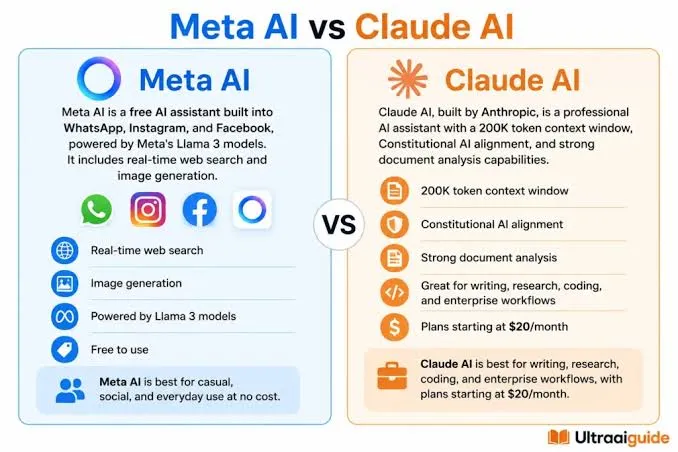
Meta AI Chat vs Claude 2: Quick Comparison
| Category | Meta AI Chat | Claude 2 |
| Product type | Modern AI assistant ecosystem | 2023 language model |
| Primary strength | Consumer and multimodal assistance | Long-context text and reasoning |
| Everyday questions | Excellent | Strong for its era |
| Social media | Excellent | Limited |
| Image generation | Yes | No native equivalent |
| Image editing | Yes | No native equivalent |
| Voice/multimodal workflows | Strong modern capability | Primarily text-focused |
| Long documents | Strong modern capabilities vary by experience | Major historical strength |
| Coding | Modern coding capabilities are developing rapidly | Strong for its era |
| Research | Modern research and agent capabilities | Mainly analysis of supplied information |
| Meta ecosystem | Major advantage | No |
| API/developer use | Modern developer ecosystem | API available historically |
| Best interpretation | Modern consumer/multimodal AI | Historical long-context LLM |
The table is useful as a starting point, but the use case matters more than the feature count.
What Is Meta AI Chat?
Meta AI is Meta’s AI assistant and broader AI ecosystem designed to help users with questions, content creation, image-related tasks, research, recommendations, and increasingly sophisticated agentic workflows.
Meta’s 2026 research identifies Muse Spark 1.1 as the model powering Meta AI, with capabilities spanning reasoning, coding, multimodal understanding, tool use, and agentic tasks.
Meta is also developing dedicated systems such as Muse Code and Muse Glimmer. Muse Code, for example, is designed for software-engineering tasks across large repositories, while Muse Glimmer targets local agent workflows and function calling.
For everyday users, the important point is that Meta AI is no longer best understood simply as a conventional chatbot.
It is becoming a multimodal assistant and AI platform.
What Can Meta AI Be Used For?
Depending on the product surface, region, account, and feature availability, Meta AI can support workflows such as:
- Answering questions
- Brainstorming
- Writing and rewriting
- Social media content
- Image generation
- Image editing
- Image analysis
- Recommendations
- Research
- File-based tasks
- Coding
- Multimodal reasoning
- Agentic workflows
Meta’s current image-generation service, for example, supports creating images from prompts, editing images, restyling images, generating graphics, and analyzing images.
What Was Claude 2?
Claude 2 was Anthropic’s second-generation Claude model, released in July 2023.
Its historical importance came partly from its 100K-token context window. Anthropic said that this allowed businesses to submit hundreds of pages of material for analysis and enabled users to work with very large documents in a single interaction.
Claude 2 was positioned around tasks including:
- Long-document analysis
- Summarization
- Coding
- Reasoning
- Mathematics
- Long-form writing
- Technical documentation
- Structured text generation
- Developer workflows
- API-based applications
Anthropic’s documentation also listed Claude 2 with a 100,000-token context window and positioned it for complex-reasoning workloads.
Why Claude 2 Still Matters
Claude 2 remains relevant when someone is researching the history of AI models, comparing 2023-era systems, studying model capabilities, or trying to understand why long-context AI became important.
It should not, however, be presented as Anthropic’s current flagship.
Anthropic’s official model history now lists Claude 2 alongside many newer generations, while its 2026 lineup includes substantially newer models.
Meta AI Use Cases
Everyday Questions
Meta AI is well suited to quick, general-purpose assistance.
Users can use an AI assistant to:
- Explain unfamiliar concepts
- Brainstorm ideas
- Generate lists
- Rewrite text
- Answer general questions
- Explore topics
- Get suggestions
This is one area where a modern consumer assistant has a major usability advantage: the user does not necessarily need to understand model architecture, APIs, or prompt engineering.
Social Media Content
This is one of Meta AI’s most natural use cases.
Meta owns a large social ecosystem, so AI assistance connected to social workflows can be particularly useful for:
- Instagram captions
- Facebook post ideas
- Short promotional copy
- Content hooks
- Replies
- Social media concepts
- Caption variations
- Creative brainstorming
For a social media creator, the value is not simply “which model writes better?”
The more important question is:
Which tool reduces the number of steps between creating an idea and publishing it?
Meta has a structural advantage here.
Writing and Editing
Meta AI can be useful for everyday writing tasks such as:
- Rewriting sentences
- Adjusting tone
- Brainstorming
- Drafting short messages
- Creating social posts
- Generating content ideas
- Improving clarity
For short-to-medium writing tasks, users should generally evaluate the output rather than assume one model always produces better prose.
Research
Modern Meta AI is increasingly positioned for research and agentic workflows.
Meta’s 2026 model work emphasizes tool use, multimodal reasoning, and agentic task execution. Muse Spark 1.1, for example, is described as capable of orchestrating complex tasks involving tools and external services.
This is fundamentally different from the historical Claude 2 workflow.
Claude 2 was particularly valuable when the user supplied the source material and asked the model to analyze it.
Therefore, separate two meanings of “research”:
Current web/agent research: Meta AI has a modern advantage.
Analysis of a large supplied document: Claude 2 was historically notable.
File and Data Analysis
AI assistants can be useful for turning unstructured information into structured insights.
Typical workflows include:
- Reviewing CSV data
- Identifying trends
- Summarizing reports
- Extracting information
- Categorizing text
- Comparing documents
- Explaining datasets
For business users, the important limitation is that AI-generated analysis should not automatically be treated as authoritative.
Numbers should be checked.
Calculations should be verified.
Source documents should be preserved.
Recommendations
A consumer assistant can also be useful for recommendation-style questions.
Examples include:
- Travel ideas
- Restaurants
- Activities
- Gift ideas
- Product categories
- Entertainment suggestions
However, recommendations are highly time-sensitive.
Users should verify:
- Current availability
- Prices
- Reviews
- Opening hours
- Location
- Policies
AI should be treated as a research assistant—not the final authority.
Agentic and Developer Workflows
One of the most important developments in the current Meta ecosystem is the move beyond simple chat.
Meta’s 2026 research describes Muse Spark 1.1 as a multimodal reasoning model with agentic capabilities, tool use, coding, and interaction with external environments.
Meta has also introduced Muse Code, a coding agent designed to work across large repositories, plan changes, write code, validate results, and coordinate persistent subagents.
This represents a major evolution from the simple “AI chatbot” category.
Claude 2 Use Cases
Long-Document Analysis
This was arguably Claude 2’s most distinctive historical use case.
Anthropic’s 100K-token context allowed users to provide extremely large amounts of text. Anthropic described workflows involving hundreds of pages of technical documentation and even complete books.
Potential applications included:
- Technical documentation
- Books
- Research papers
- Reports
- Policies
- Contracts
- Large text collections
- Internal documentation
The important insight is that context size changes workflow design.
If a model can process much more source material at once, users spend less time splitting documents into smaller pieces and manually stitching the results together.
Long-Form Writing
Claude 2 was also well suited to longer text generation.
Historical applications included:
- Memos
- Letters
- Stories
- Reports
- Documentation
- Structured content
- Detailed explanations
Its large context could also help when the writing task depended on extensive source material.
For example:
Source documents → instructions → draft → revision
could be handled with more context than was practical with many earlier models.
Coding Assistance
Coding was another major Claude 2 use case.
Anthropic highlighted improvements in coding and reported a HumanEval score of 71.2% for Claude 2 compared with 56.0% for Claude 1.3.
Historical coding workflows included:
- Code generation
- Debugging
- Code explanation
- Code review
- Technical questions
- Code transformation
- Working with large code context
Anthropic also discussed Claude’s use through Sourcegraph’s Cody, demonstrating how the model could be incorporated into developer tools.
For historical Claude 2 comparisons, coding should therefore remain one of the major categories.
Reasoning and Problem Solving
Claude 2 was designed to improve reasoning, mathematics, and coding performance compared with its predecessor.
That made it useful for text-based multi-step problems.
However, readers should avoid turning historical benchmark results into claims about today’s AI landscape.
A benchmark from 2023 tells you about a model at that time.
It does not prove that the same model would outperform modern systems in 2026.
Document Summarization
Claude 2’s large context naturally supported summarization.
Instead of repeatedly dividing a long report into smaller pieces, users could provide much more source material and request a structured summary.
A practical workflow might look like:
Upload source → identify major themes → summarize sections → identify contradictions → create executive summary.
This remains one of the clearest examples of why context windows matter.
Structured Content Generation
Claude 2 could also be used to transform Information into structured text.
For example:
Raw documentation → headings → summaries → FAQ → structured notes
or:
Research material → outline → draft → revision
This made the model useful for documentation and content workflows.
Developer and API Workflows
Claude 2 was not merely a consumer chatbot.
Anthropic made Claude available through API-oriented workflows, allowing developers and businesses to integrate language-model capabilities into other applications.
This is an important distinction because an AI model and an AI assistant are not necessarily the same thing.
A model can be embedded inside:
- SaaS platforms
- Developer tools
- Customer-support systems
- Content applications
- Enterprise workflows
- Automation systems
That model-versus-product distinction is one of the most commonly overlooked aspects of this comparison.
Meta AI vs Claude 2 for Writing
For social and everyday writing, Meta AI is the more natural modern choice.
For historical long-context writing, Claude 2 had an important advantage for its era.
| Writing task | Better fit |
| Instagram captions | Meta AI |
| Facebook content | Meta AI |
| Quick rewriting | Meta AI |
| Everyday messages | Meta AI |
| Image + text content | Meta AI |
| Long source-based writing | Claude 2 historically |
| Large-document rewriting | Claude 2 historically |
| Historical model comparison | Claude 2 |
| Modern professional AI writing | Evaluate current models |
Verdict
Meta AI wins for modern social and multimodal writing workflows.
Claude 2 was historically impressive for long-context, document-heavy writing.
Meta AI vs Claude 2 for Coding
Claude 2 had a notable historical reputation for coding.
Anthropic’s own reporting highlighted improvements in coding performance and its use through developer tooling.
However, modern Meta AI has also moved significantly toward coding and agentic software engineering.
Meta’s 2026 Muse Code announcement describes repository-scale software engineering, planning, code generation, validation, and persistent background agents.
Therefore, a 2026 coding decision should not be based on Claude 2 vs Meta AI alone.
If your question is historical:
Claude 2 was a strong coding model for its era.
If your question is what to use today:
Compare modern Meta AI coding capabilities with current Claude models, not Claude 2.
Meta AI vs Claude 2 for Research
This comparison depends on the meaning of research.
If you need current information
A modern research-oriented AI system has an obvious advantage over a 2023 model because current research may require access to current information, tools, sources, and web-connected workflows.
If you already have the documents
Claude 2’s large context was historically valuable for analyzing large supplied text collections.
So the decision becomes:
Current information discovery → modern AI research workflow
Large historical document analysis → Claude 2 was particularly notable
Meta AI vs Claude 2 for Long Documents
This is Claude 2’s strongest historical category.
Anthropic expanded Claude’s context window to 100,000 tokens in 2023 and described workflows involving hundreds of pages of material.
That made it Possible to ask questions across a much larger body of source material.
But there is an important 2026 caveat:
Modern AI systems have moved far beyond 2023-era context capabilities.
For example, Anthropic’s current Opus 4.8 is advertised with a 1-million-token context window.
So Claude 2’s 100K context remains historically significant, but it should not be described as state-of-the-art today.
Pros and Cons
Meta AI Advantages
- Modern consumer-oriented experience
- Multimodal capabilities
- Image generation
- Image editing
- Growing agentic capabilities
- Coding development
- Visual workflows
- Strong ecosystem integration
- Useful for everyday tasks
- Broad range of AI applications
Limitations
- Features can vary by product surface and availability
- AI output can contain mistakes
- Current capabilities change quickly
- Not every professional workflow should rely on a consumer assistant
- Sensitive information requires careful handling
- Important facts still need verification
Claude 2 Advantages
- 100K-token context window
- Strong historical text processing
- Long-document analysis
- Long-form writing
- Coding
- Reasoning
- Structured text generation
- API availability
- Developer integrations
Limitations
- Legacy 2023 model
- Not representative of current Claude
- No modern Meta-style social ecosystem
- No native image-generation experience comparable to Meta AI
- Not the appropriate benchmark for current AI purchasing decisions
- Historical benchmark results should not be interpreted as current performance
People Also Ask
For modern consumer and multimodal workflows, Meta AI is the more relevant choice. Claude 2 was particularly strong for its era in long-context text processing, coding, reasoning, and document analysis.
Claude 2 was used for long-form writing, document analysis, summarization, coding, reasoning, and other text-based tasks. Its 100K-token context window was one of its defining capabilities.
Meta AI can support everyday questions, writing, creative tasks, image generation and editing, multimodal interaction, coding, research, and increasingly agentic workflows, depending on the current product experience and availability.
Yes. Meta’s current image-generation service supports creating images from text prompts as well as editing, restyling, and analyzing images.
Yes. Coding was one of Claude 2’s highlighted capabilities, and Anthropic reported improved HumanEval performance compared with Claude 1.3.
Conclusion
Meta AI Chat and Claude 2 represent two Different stages of AI development. Meta AI is the better fit for modern consumer, multimodal, social, image, and increasingly agentic use cases, while Claude 2 remains important for its historical strengths in long-context text processing, coding, reasoning, and document analysis.
If you are choosing an AI tool today, compare Meta AI with current Claude models rather than Claude 2. If you are researching AI history or older LLM capabilities, Claude 2’s 100K-token context and document-focused workflows make it especially significant. The best AI is ultimately the one that matches your specific task, workflow, and requirements.