Introduction
Choosing between Claude 2 pricing vs Claude 3 Sonnet in 2026 is no longer just a technical comparison—it’s a strategic financial decision that can significantly impact your long-term profitability.
Whether you’re developing:
- AI-powered SaaS applications
- Automated content generation systems
- Intelligent chatbots or virtual assistants
- API-driven platforms and tools
Even a minor variation in token pricing can add up to thousands of dollars in annual savings—or unnecessary expenses.
Unfortunately, most comparison guides make critical mistakes:
They bury pricing information deep inside the article
They avoid giving a direct conclusion.
They overlook real-world cost implications
Let’s simplify everything upfront:
- Claude 3 Sonnet is considerably more affordable
- Claude 2 is older and relatively costly
- But the best option still depends on your specific use case and scaling needs
In this comprehensive guide, you’ll discover:
Detailed pricing breakdown
Cost-per-token analysis
Real-world monthly expense scenarios
Performance vs cost evaluation
A clear recommendation tailored for YOU
Claude 2 Pricing vs Claude 3 Sonnet
API Pricing Breakdown
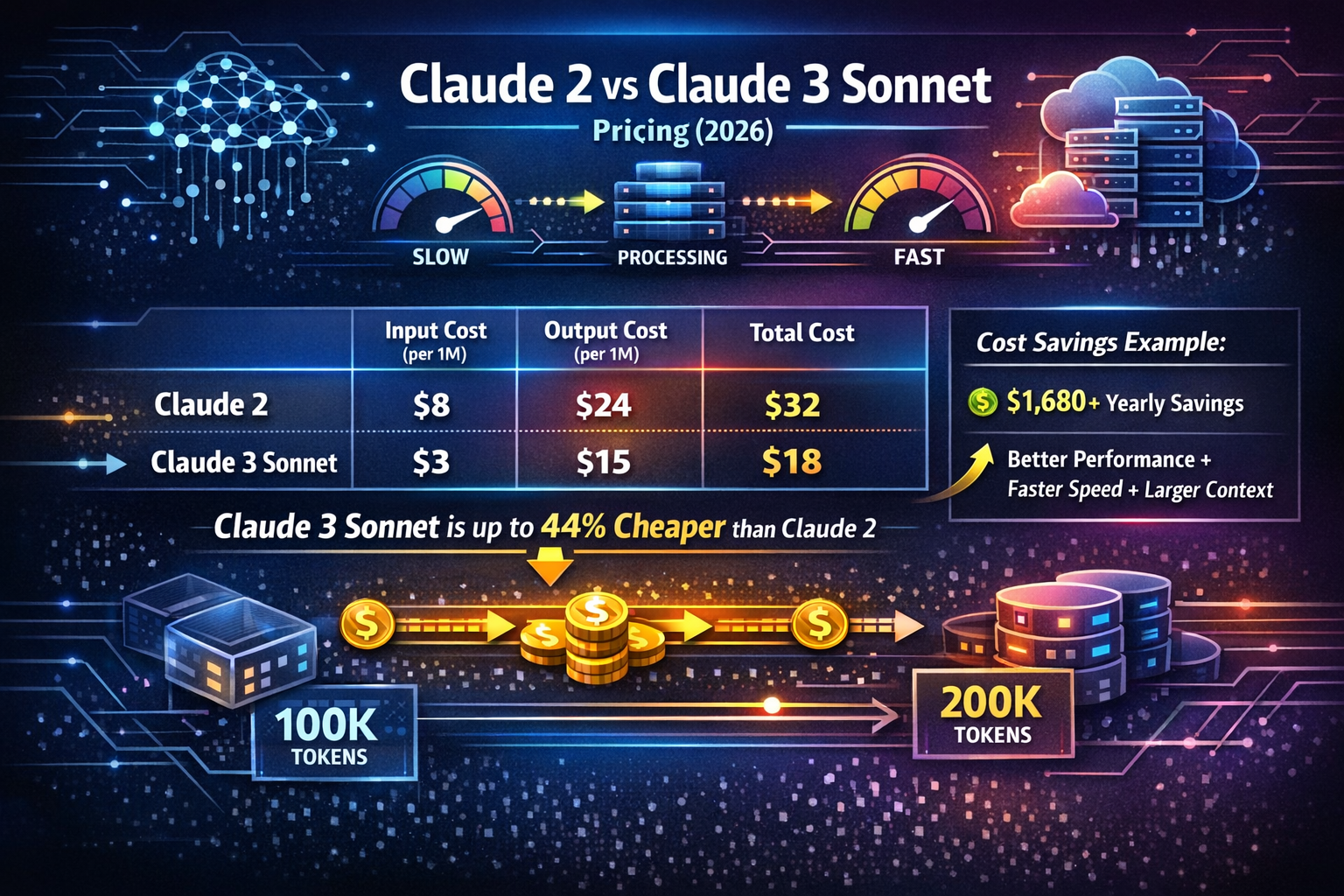
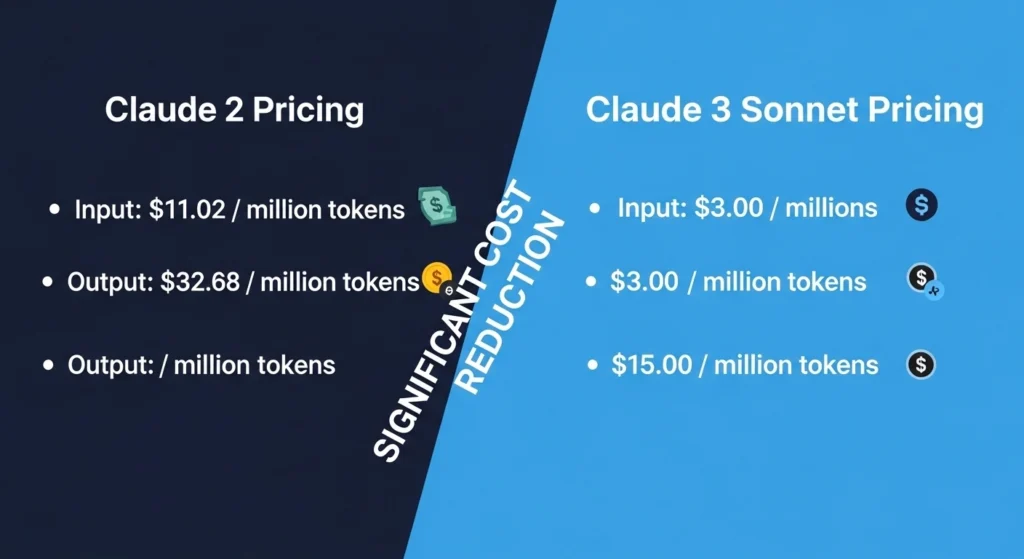
| Model | Input Cost | Output Cost | Total Cost |
| Claude 2 | $8 | $24 | $32 |
| Claude 3 Sonnet | $3 | $15 | $18 |
Key Takeaways
- Claude 3 Sonnet is approximately 44% more economical overall
- Claude 2 can be up to 166% more expensive for input tokens
- The largest savings come from output pricing differences
Cost Per 1K Tokens
| Model | Input Cost | Output Cost |
| Claude 2 | 0.8¢ | 2.4¢ |
| Claude 3 Sonnet | 0.3¢ | 1.5¢ |
Important Insight
Most modern AI applications:
Generate more output tokens than input tokens
This means:
Output pricing becomes the dominant cost driver
Claude 3 Sonnet delivers even greater savings in real-world scenarios
Real-World Cost Comparison
Let’s simulate a practical SaaS environment to understand actual expenses.
Example Usage:
- 10 million input tokens
- 10 million output tokens
Claude 2 Cost
- Input: $80
- Output: $240
- Total: $320/month
Claude 3 Sonnet Cost
- Input: $30
- Output: $150
- Total: $180/month
Final Savings
- Monthly savings: $140
- Annual savings: $1,680+
- Cost reduction: ~44%
Real Insight
As your application scales:
100M+ tokens per month can translate into $10,000+ yearly savings
This is why pricing isn’t just a detail—it’s a core business metric.
Performance vs Pricing
While pricing matters, performance efficiency is equally critical.
Claude 2
- Established legacy model
- MMLU score around ~78.5
- Reliable and consistent outputs
- Smaller context capacity
- Slower processing speed
Claude 3 Sonnet
- Next-generation AI architecture
- Enhanced reasoning and logical accuracy
- Approximately 2x faster throughput
- More efficient token utilization
- Higher-quality responses
Simple Translation
Claude 3 Sonnet is not only cheaper—it provides greater value per dollar spent.
You get:
- Superior answers
- Faster execution
- Reduced cost
Context Window Comparison
| Model | Context Window |
| Claude 2 | 100K tokens |
| Claude 3 Sonnet | 200K tokens |
Why Context Window Matters
A larger context window allows:
Processing more data in a single request
Reducing the need for repeated API calls
Improving efficiency and lowering costs
Example
If you’re handling:
- PDFs
- Legal contracts
- Research documents
Claude 3 Sonnet can process twice the data in one interaction
Hidden Cost Advantage
Fewer API calls result in:
- Lower latency
- Reduced infrastructure overhead
- Improved user experience
Claude 2 vs Claude 3 Sonnet
| Feature | Claude 2 | Claude 3 Sonnet |
| Pricing | Expensive | More affordable |
| Speed | Moderate | Fast |
| Context | 100K | 200K |
| Output Quality | Good | Excellent |
| Scalability | Limited | High |
Pros & Cons
Claude 3 Sonnet Pros
- Up to 44% lower cost
- Faster response time
- Improved reasoning capabilities
- Larger context capacity
- Ideal for scalable applications
Cons
- A relatively newer model
- May require adaptation for legacy systems
Claude 2 Pros
- Stable and predictable performance
- Compatible with older infrastructures
- Proven reliability over time
Cons
- Higher operational cost
- Limited context window
- Slower compared to modern models
- Becoming outdated
Which Model Should You Choose?
Choose Claude 3 Sonnet If:
- You want to reduce operational expenses
- You’re building SaaS platforms
- You process large datasets or documents
- You need faster response times
- You want a future-proof solution
Choose Claude 2 If:
- You rely on legacy integrations
- You need exact historical consistency
- Migration costs are too high
Final Recommendation
For 90% of users, Claude 3 Sonnet is the better and smarter choice.
Real Use Cases
SaaS Startups
Claude 3 Sonnet is ideal for:
- AI chatbots
- Automation platforms
- SaaS ecosystems
Lower cost = higher profit margins
Content Generation Platforms
- Blogging tools
- SEO automation systems
- Copywriting applications
Output-heavy workflows benefit massively from cheaper output tokens
Enterprise Workflows
Organizations handling:
- Compliance documentation
- Legal processing
- Long-form data
Benefit from larger context windows and efficiency
AI Research & Data Analysis
- Faster iteration cycles
- Enhanced reasoning
- Deeper insights
More value extracted per token
Claude Pricing Calculator
Formula:
Total Cost = (Input Tokens × Input Rate) + (Output Tokens × Output Rate)
Example (Claude 3 Sonnet)
- 5M input × $3 = $15
- 5M output × $15 = $75
Total = $90
How to Use These AI Models Effectively
Step-by-Step Guide
Define Your Use Case
- Chatbot
- Content creation
- Data processing
Estimate Token Usage
- Monthly traffic
- API requests
- Output size
Choose Model Based on Value
Don’t select the cheapest—choose the best cost-to-performance ratio
Optimize Prompts
- Keep prompts concise
- Avoid redundancy
- Use structured inputs
Monitor Usage
- Track token consumption
- Identify inefficiencies
- Optimize continuously
Tips to Reduce Claude API Costs
These strategies can reduce expenses by 20–40%:
Use shorter prompts
Limit output length
Cache responses
Batch API requests
Avoid redundant context
Advanced Cost Optimization Strategies
Token Compression
- Summarize inputs
- Use structured formats
Smart Routing
- Use Claude 2 for simple tasks
- Use Claude 3 Sonnet for complex tasks
Hybrid AI Strategy
Combine multiple models for:
- Cost efficiency
- Performance balance
Regional Insight
- AI adoption is accelerating worldwide
- Competition is increasing
- Cost efficiency is becoming critical
Compliance Considerations
AI systems must:
- Handle data securely
- Process large volumes efficiently
- Maintain regulatory compliance
Claude 3 Sonnet helps through:
Larger context handling
Reduced API calls
Improved efficiency
FAQs
A: Claude 3 Sonnet is about 44% cheaper, especially for output-heavy workloads.
A: Because it uses older architecture and has higher token pricing, especially for input.
A: Claude 3 Sonnet is better due to:
Lower cost
Faster speed
Better performance
A: Only for:
Legacy systems
Applications that cannot migrate
A: Claude 3 Sonnet is the best due to:
Cost savings
Scalability
Better ROI
Conclusion
After a complete breakdown of Claude 2 pricing vs Claude 3 Sonnet in 2026, it becomes clear that this is not just a simple model comparison—it is a strategic decision that directly impacts cost efficiency, scalability, and long-term AI performance.
Across every major factor we analyzed—pricing structure, token consumption, context window size, Processing speed, and real-world SaaS usage—one model consistently demonstrates stronger overall value.