DeepSeek-V3 Explained (2026) — Hidden Power, Real Limits & GPT-4o Truth
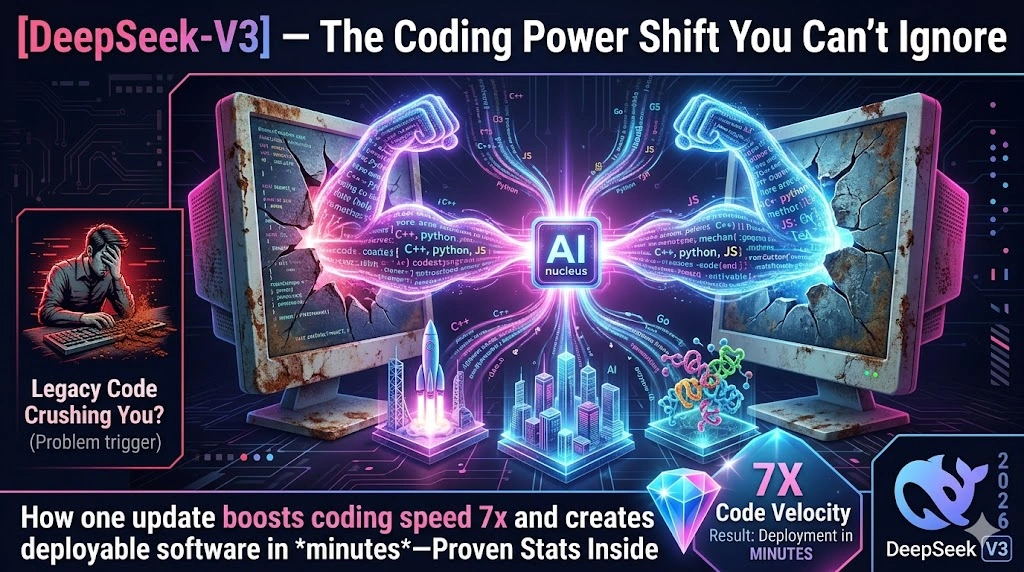
DeepSeek-V3 is a powerful open-source AI model built to deliver efficient reasoning, coding, and scalable performance in 2026. If you are comparing it with GPT-4 or Claude, this guide shows what really matters: architecture, benchmarks, strengths, and limits. You will quickly see why this model is surprising developers, startups, and researchers with its speed and cost advantage today.
Artificial Intelligence is evolving at an unprecedented speed in 2026, transforming industries, reshaping workflows, and redefining how humans interact with machines. Among the many advanced models emerging in this rapidly shifting landscape, DeepSeek-V3 has captured massive attention from developers, researchers, and technology companies worldwide.
Unlike traditional large language models, DeepSeek-V3 is not just another incremental upgrade. It represents a fundamental shift in AI design philosophy, emphasizing efficiency, scalability, and accessibility. While many leading AI systems remain proprietary and locked behind expensive APIs, DeepSeek-V3 offers an open-source alternative that empowers innovation without financial barriers.
What is DeepSeek-V3 and Why Is Everyone Talking About It?
What makes this model truly distinctive is its architecture. Instead of activating its entire neural network for every task, it uses a highly optimized system known as Mixture-of-Experts (MoE). This intelligent design ensures that only the most relevant components of the model are engaged, leading to faster computation, reduced resource consumption, and improved cost-effectiveness.
Across Europe and beyond, organizations are increasingly adopting DeepSeek-V3 to build custom AI solutions, deploy local infrastructure, and reduce dependence on centralized providers. For startups, this translates into lower operational expenses. So, researchers, it means greater flexibility. For enterprises, it offers control and scalability.
In this comprehensive guide, you will gain a clear and detailed understanding of DeepSeek-V3, including:
- Its core functionality and design principles
- Architectural innovations and technical framework
- Performance benchmarks and evaluation metrics
- Practical applications across industries
- Strengths and limitations in real-world scenarios
- Detailed comparison with GPT-4o, Claude, and other models
- Future outlook and emerging trends
By the end of this guide, you will have a complete, simplified, yet deeply insightful perspective on where DeepSeek-V3 stands in the modern AI ecosystem—and whether it aligns with your needs.
What is DeepSeek-V3?
DeepSeek-V3 is a next-generation open-source large language model (LLM) designed to handle complex computational tasks, logical reasoning, and software development challenges with remarkable efficiency.
It is specifically engineered for:
- Programming and code generation
- Logical and analytical reasoning
- Mathematical computations
- AI research and experimentation
Unlike earlier models that rely on a monolithic structure, DeepSeek-V3 adopts a selective activation mechanism, meaning it does not utilize its entire neural capacity for every query.
Key Idea in Simple Words
Instead of using the whole brain for every question, it intelligently selects only the most relevant “expert” components, making it faster and more efficient.
Key Highlights of DeepSeek-V3
- Built using an advanced Mixture-of-Experts (MoE) architecture
- Contains approximately 671 billion parameters, with only a fraction activated at once
- Demonstrates strong capabilities in coding and logical reasoning
- Designed to support the open-source AI ecosystem
- Optimized for efficiency, scalability, and reduced computational cost
Why It Matters in 2026
DeepSeek-V3 is gaining importance because it addresses some of the biggest challenges in modern AI:
- Reduces deployment costs significantly
- Enables localized AI systems, especially in Europe
- Competes with high-end proprietary models
- Provides developers with full customization and control
DeepSeek-V3 Architecture Explained (Step-by-Step)
The architecture is the backbone of DeepSeek-V3. Its innovative design is what makes it both powerful and efficient.
1. Mixture-of-Experts (MoE) System
The Mixture-of-Experts framework is the central concept behind DeepSeek-V3.
How it works:
- The model consists of multiple specialized subnetworks (“experts”)
- For each query, only a subset of these experts is activated
- The remaining components stay inactive, conserving resources
Why is it powerful:
- Minimizes computational overhead
- Reduces GPU usage and operational cost
- Enhances processing speed
- Improves scalability for large-scale applications
Think of it as a team of specialists where only the most qualified expert handles a specific problem.
2. Multi-Head Latent Attention (MLA)
Another major innovation in DeepSeek-V3 is its advanced attention mechanism.
Key improvements:
- Enhanced long-context understanding
- Better memory retention across conversations
- Increased accuracy in reasoning tasks
Simple explanation:
It allows the model to retain and process long sequences of information without confusion, improving coherence and consistency.
3. FP8 Precision Optimization
DeepSeek-V3 utilizes FP8 numerical precision, which is more efficient than traditional formats.
Benefits:
- Lower memory consumption
- Faster training and inference
- Reduced infrastructure requirements
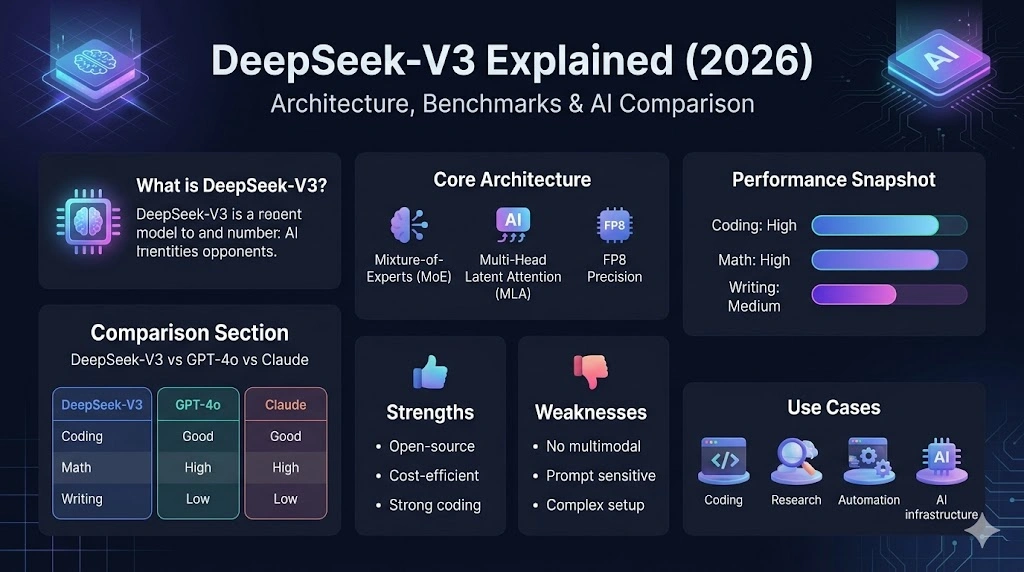
Architecture Summary Table
| Component | Function | Benefit |
| MoE | Selective expert activation | Efficiency + scalability |
| MLA | Advanced attention mechanism | Better context handling |
| FP8 | Optimized precision format | Faster computation |
DeepSeek-V3 Benchmarks & Performance Analysis
DeepSeek-V3 delivers strong performance across structured and technical domains.
Performance Overview
| Category | Performance | Notes |
| Coding | High | Strong in Python and algorithms |
| Math Reasoning | High | Excellent logical accuracy |
| General Knowledge | Medium-High | Competitive performance |
| Writing Quality | Medium | Less refined than top models |
Key Insight
DeepSeek-V3 excels in:
- Structured problem-solving
- Logical reasoning tasks
- Rule-based computations
However, it is less effective in:
- Creative storytelling
- Emotional expression
- Natural conversational flow
DeepSeek-V3 vs GPT-4o vs Claude 3.5 (Full Comparison)
Comparison Table
| Feature | DeepSeek-V3 | GPT-4o | Claude 3.5 |
| Open Source | ✔ Yes | ❌ No | ❌ No |
| Coding | High | High | Medium |
| Writing Quality | Medium | High | Very High |
| Multimodal | ❌ No | ✔ Yes | Limited |
| Efficiency | Very High | Medium | Medium |
| Best For | Developers | General AI | Writing |
Simple Conclusion
- DeepSeek-V3 → Best for developers and cost efficiency
- GPT-4o → Best all-around AI system
- Claude 3.5 → Best for writing quality and clarity
Strengths of DeepSeek-V3
✔ 1. Fully Open-Source
- Accessible to everyone
- Allows customization and modification
- Ideal for research and experimentation
✔ 2. Strong Coding Capability
It excels in:
- Software development
- Backend engineering
- Algorithm design
- Automation workflows
✔ 3. Cost Efficiency
- Requires fewer computational resources
- Reduces infrastructure expenses
- Suitable for startups and small teams
✔ 4. Research-Oriented Design
Perfect for:
- Academic studies
- AI experimentation
- Model benchmarking
Weaknesses of DeepSeek-V3 (Important Section)
1. No Multimodal Support
- Cannot process images
- Cannot analyze video content
2. Prompt Sensitivity
- Outputs vary with slight prompt changes
- Requires structured input
3. Deployment Complexity
- Needs technical expertise
- Not beginner-friendly
4. Writing Quality Limitations
- Less natural tone
- Reduced fluency compared to top models
Real-World Use Cases of DeepSeek-V3
1. Software Development
Used for:
- Code generation
- Debugging
- API development
2. Research & Data Science
Helps with:
- Academic summarization
- Pattern recognition
- Technical documentation
3. AI Infrastructure
Applied in:
- LLM pipelines
- Autonomous agents
- AI orchestration systems
4. Enterprise Automation
Used for:
- Workflow automation
- Data processing
- Internal AI tools
Is DeepSeek-V3 Better Than ChatGPT
The answer depends entirely on the use case.
Better than ChatGPT in:
- Open-source flexibility
- Coding-intensive tasks
- Cost-sensitive deployments
Worse than ChatGPT in:
- Writing quality
- Multimodal capabilities
- User experience
Simple Verdict
- DeepSeek-V3 = Developer-focused system
- ChatGPT = General-purpose AI assistant
Future of DeepSeek-V3 (2026 Outlook)
Experts anticipate significant advancements in:
- Multimodal integration
- Alignment and safety improvements
- Enhanced reasoning consistency
- Wider enterprise adoption
Future Direction
DeepSeek-V3 is expected to evolve into a core AI infrastructure layer, rather than just a conversational model.
How to Use DeepSeek-V3 Effectively
Step-by-Step Guide
- Use structured prompts
- Provide clear instructions
- Break tasks into smaller steps
- Avoid vague queries
- Focus on logic-driven tasks
Pro Prompt Tips
- Define the output format clearly
- Include examples
- Assign roles (e.g., “senior engineer”)
- Keep instructions concise
Pros and Cons Summary
Pros
- Open-source accessibility
- Strong coding performance
- Efficient architecture
- Cost-effective deployment
Cons
- No multimodal support
- Requires technical setup
- Limited writing fluency
FAQs
It is mainly used for coding, reasoning, and AI research tasks.
Yes, it is fully open-source and customizable.
Not fully. GPT-4o is better for general AI tasks.
Yes, but it may require technical understanding.
Its Mixture-of-Experts (MoE) system makes it efficient and scalable.
Conclusion: Final Verdict on DeepSeek-V3
DeepSeek-V3 represents a significant breakthrough in open-source AI development, combining efficiency, scalability, and flexibility in a way that few models currently achieve.
While it may not deliver the most polished conversational experience, it excels in areas that truly matter for developers and technical users. Its ability to balance performance with cost-effectiveness makes it a compelling choice for startups, enterprises, and research institutions.
Final Summary:
- Best suited for coding and infrastructure
- Highly efficient and scalable
- Strong in structured reasoning
- Limited in multimodal and creative tasks
For developers, innovators, and organizations seeking a powerful yet affordable AI solution, DeepSeek-V3 stands as a formidable alternative to Expensive proprietary systems.