Introduction
If you Compare AI models using only benchmark charts, there is a high chance you will choose the wrong platform. That sounds extreme—but it explains why so many businesses overspend on AI. Most comparison articles focus on metrics that look impressive on paper: context windows, token pricing, coding scores, and benchmark rankings. Those numbers matter, but they rarely explain what determines success in real production environments.
The questions decision-makers actually ask are different:
- Which model reduces long-term operating costs?
- Which AI platform scales more efficiently?
- Which model supports private deployment?
- Which option creates less vendor dependency?
- Which one works better for retrieval-heavy workloads?
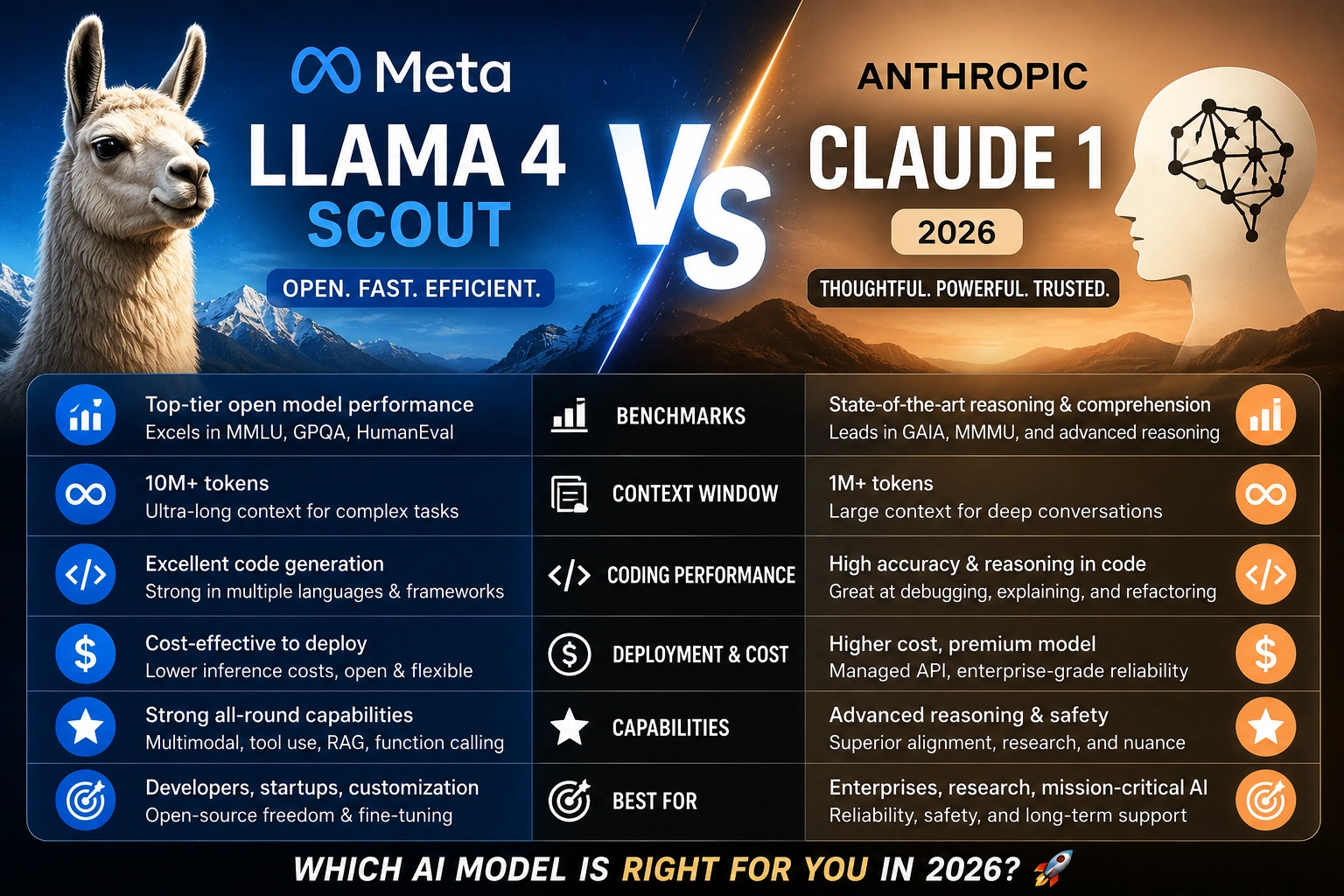
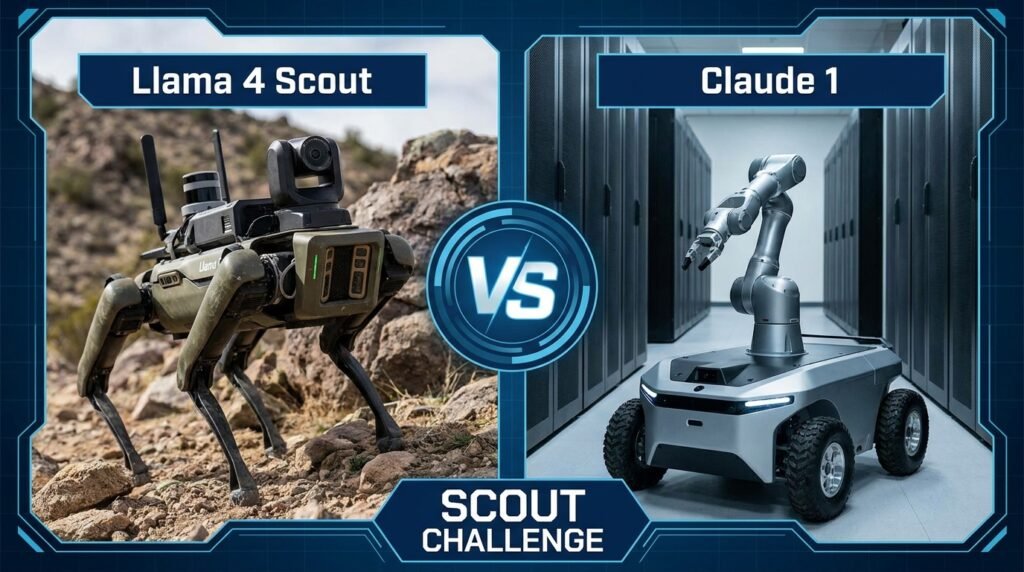
That is where this comparison becomes useful. This guide compares Llama 4 Scout vs Claude 1 from a practical perspective—not just raw model performance. These models belong to different generations of AI. Claude 1 represented an important phase in safe conversational AI and commercial deployment. Llama 4 Scout represents a newer philosophy built around flexible deployment, long-context operation, and infrastructure ownership.
For startups, developers, enterprises, and AI teams across Europe and North America, understanding that difference matters more than a benchmark leaderboard. By the end of this guide, you will know which model fits your technical goals, infrastructure strategy, and budget.
Llama 4 Scout vs Claude 1 Quick Verdict
Here is the short answer.
Choose Llama 4 Scout if you want:
Large-scale document understanding
Retrieval-Augmented Generation (RAG) systems
Greater infrastructure control
Long-context workloads
AI product development
Flexible deployment options
Claude 1 historically made sense if you wanted:
Managed AI experience
Strong conversational alignment
Lower operational complexity
Early enterprise adoption
Overall Winner for 2026:
Llama 4 Scout
Not because it automatically scores higher everywhere—but because modern AI value increasingly comes from ownership, extensibility, deployment flexibility, and operating economics.
What Is Llama 4 Scout?
Llama 4 Scout belongs to a newer generation of large language models designed to improve deployment flexibility and handle significantly larger working contexts.
Its design philosophy shifts attention away from pure chatbot interaction and toward broader production workloads.
Core Characteristics
Long Context Processing
Long context enables systems to process larger quantities of information in a single operation.
Examples include:
- enterprise documentation
- legal repositories
- software codebases
- internal knowledge systems
- large research collections
Open Deployment Philosophy
Unlike fully provider-controlled systems, open deployment allows organizations to explore:
- self-hosting
- private environments
- architecture customization
- infrastructure portability
Infrastructure Efficiency
Modern deployment approaches increasingly focus on:
- lower latency
- resource efficiency
- cost predictability
- scaling flexibility
Where Llama 4 Scout Performs Best
| Use Case | Suitability |
| Enterprise Search | Excellent |
| RAG Systems | Excellent |
| Long Documents | Excellent |
| Coding Assistance | Strong |
| Customer Support | Strong |
| Private Deployment | Excellent |
What Was Claude 1?
Claude 1 was part of an earlier generation of commercial conversational AI systems that emphasized safe interaction and reliability.
At the time of release, the market valued stability and conversational quality more than deployment ownership.
Claude 1 became notable for introducing Stronger alignment principles into mainstream AI experiences.
Core Characteristics
Safety-Oriented Responses
The system emphasized:
- controlled output behavior
- conversational consistency
- enterprise confidence
Managed Infrastructure
Users interacted through provider-controlled environments.
Advantages included:
- reduced setup complexity
- lower maintenance burden
- easier onboarding
Trade-offs included:
- dependency on provider infrastructure
- limited customization
- recurring usage economics
Where Claude 1 Historically Fit Best
| Use Case | Suitability |
| General Chat | Strong |
| Customer Conversations | Strong |
| Enterprise Pilots | Strong |
| Private Hosting | Limited |
| Large Context Retrieval | Limited |
| AI Infrastructure Control | Limited |
Architecture Comparison: Different Philosophies, Different Outcomes
Most comparison articles treat architecture like a technical footnote.
That misses the real story.
Architecture shapes:
- deployment freedom
- operating cost
- scaling behavior
- compliance flexibility
- future portability
Head-to-Head Comparison
| Category | Llama 4 Scout | Claude 1 |
| Model Era | Modern Generation | Earlier Generation |
| Availability | Open Deployment Options | Closed Deployment |
| Infrastructure Ownership | High | Low |
| Context Design | Long Context | Traditional |
| Customization | Extensive | Limited |
| Hosting Control | Flexible | Managed |
Key Insight
This comparison is not “new beats old.”
It is:
ownership versus convenience.
Organizations increasingly evaluate AI based on long-term strategic flexibility—not initial onboarding speed.
Benchmarks Don’t Equal Business Outcomes
Benchmark scores can be useful.
But they do not answer the most expensive questions.
Teams often discover this after deployment.
Benchmarks Measure Capability
Typical metrics include:
- reasoning
- language quality
- coding
- factual recall
Businesses Measure Outcomes
Actual production metrics include:
- cost per request
- latency
- uptime
- maintenance burden
- compliance readiness
- integration effort
A model that scores slightly lower can still produce better business results if infrastructure and operating costs remain lower.
People Also Ask
A: Yes, for modern AI use cases like RAG, long context, and deployment flexibility. Claude 1 is more legacy-focused.
A: Llama 4 Scout performs better for large knowledge bases and retrieval-heavy systems.
A: It depends on the total cost, not just the API price. Infrastructure and scaling matter.
A: Llama 4 Scout for AI products, Claude-style systems for quick MVPs.
A: Open gives control, closed gives simplicity—depends on your needs.
Conclusion
Llama 4 Scout vs Claude 1 is not just a model comparison — it’s a comparison of two completely different AI eras and philosophies.
Claude 1 represents the early stage of Commercial AI adoption, where the focus was mainly on safety, controlled responses, and ease of use. It helped businesses trust AI systems and introduced a more stable, managed experience for conversational applications.
On the other hand, Llama 4 Scout reflects the modern direction of AI development. It is built for scale, long-context processing, retrieval-heavy systems, and flexible deployment. Instead of focusing only on conversation quality, it prioritizes real-world production needs like infrastructure control, cost efficiency, and enterprise integration.