Introduction
Artificial intelligence buyers in 2026 are making a Different kind of decision. A year ago, most comparisons focused on benchmark charts, token pricing, and context windows.
Today, companies, startups, and developers are asking tougher questions:
Which model lowers production cost?
Which one scales without locking infrastructure?
Model performs better in real workflows—not demos?
Which AI survives long-term procurement and deployment decisions?
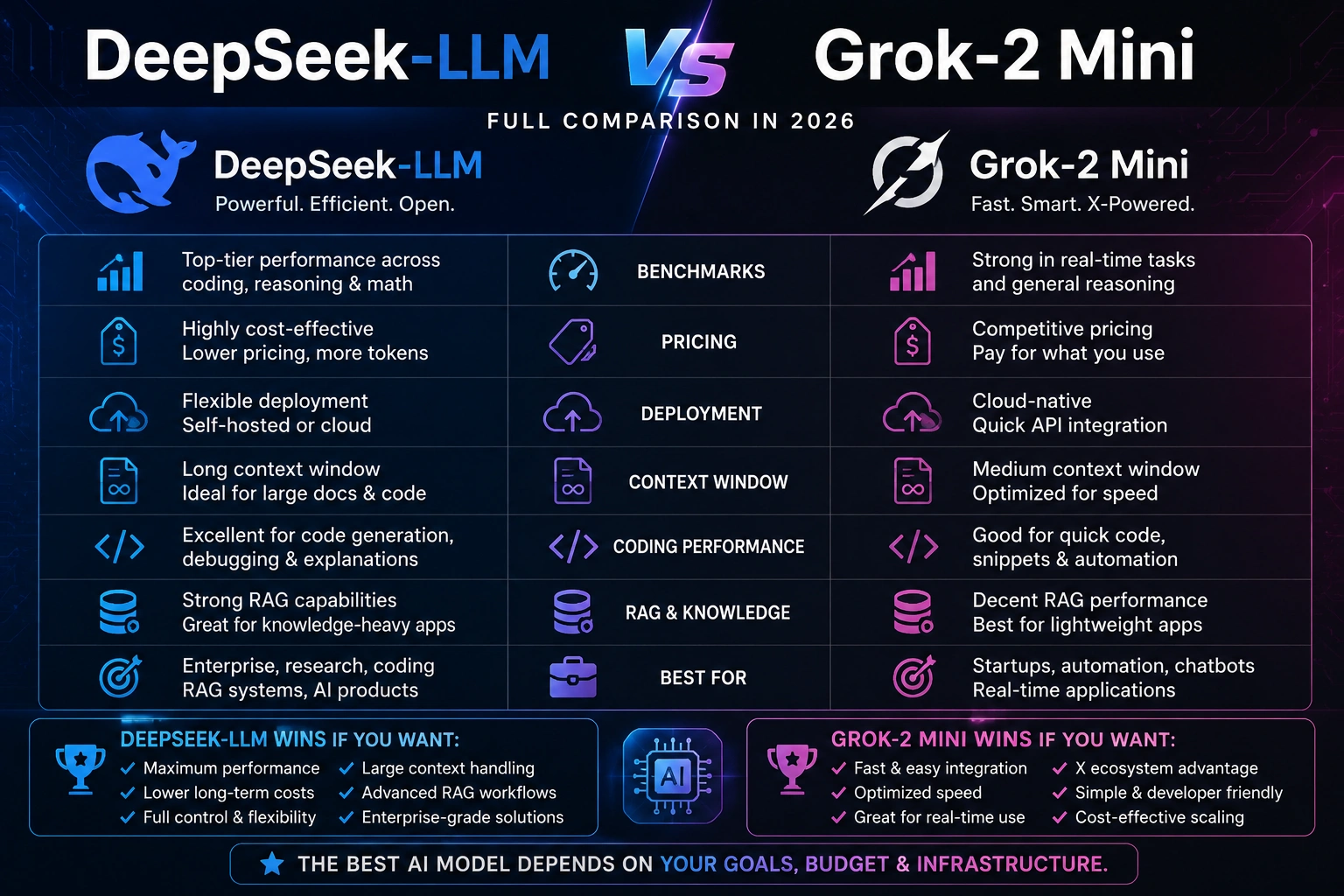
That shift makes the DeepSeek-LLM VS Grok-2 Mini comparison more interesting than typical leaderboard battles. On one side, DeepSeek has positioned itself around openness, deployment flexibility, and aggressive economics. On the other hand, Grok-2 Mini focuses on speed, hosted experiences, multimodal workflows, and simplified experimentation.
This guide goes beyond synthetic scores. You’ll see architecture differences, deployment implications, cost ownership, workflow testing, coding performance, RAG suitability, infrastructure considerations, and decision frameworks designed for real businesses. Whether you run an AI startup in London, build internal automation in Germany, deploy enterprise assistants in France, or operate developer tooling globally, this comparison aims to help you choose strategically.
Which AI Model Wins?
If you want the fastest answer:
| Scenario | Winner |
| Lowest Total Cost | DeepSeek-LLM |
| Coding Workflows | DeepSeek-LLM |
| Rapid Experimentation | Grok-2 Mini |
| Multimodal Tasks | Grok-2 Mini |
| Infrastructure Flexibility | DeepSeek-LLM |
| Vendor Independence | DeepSeek-LLM |
| Research Assistant | Grok-2 Mini |
| RAG Systems | DeepSeek-LLM |
| Startup MVP | DeepSeek-LLM |
| Enterprise Portability | DeepSeek-LLM |
Quick verdict:
Choose DeepSeek when ownership, deployment control, and cost efficiency matter.
Choose Grok-2 Mini when fast iteration and managed experiences matter more than infrastructure control.
What Are DeepSeek-LLM and Grok-2 Mini?
DeepSeek-LLM Overview
DeepSeek entered the AI market with an approach centered around accessible model development, deployment flexibility, and stronger cost efficiency.
Its positioning appeals to:
• AI startups
• Developer teams
• Enterprises seeking infrastructure control
• Organizations reducing API dependency
Core strengths:
• Open ecosystem compatibility
• Lower ownership economics
• Strong coding capability
• Easier self-hosting pathways
DeepSeek attracts teams building AI as infrastructure rather than consuming AI as software.
Grok-2 Mini Overview
Grok-2 Mini represents a different philosophy.
Instead of emphasizing portability, it prioritizes:
• Faster experimentation
• Managed experiences
• Conversational responsiveness
• Multimodal expansion
Ideal users often include:
• Research teams
• Product teams
• Teams needing quick deployment
Grok simplifies setup but typically reduces infrastructure flexibility.
DeepSeek-LLM VS Grok-2 Mini — Feature Comparison
| Feature | DeepSeek-LLM | Grok-2 Mini |
| Ecosystem | Open | Proprietary |
| Deployment | Flexible | Hosted-first |
| Coding | Excellent | Strong |
| Long Context | Strong | Competitive |
| Multimodal | Variant dependent | Better |
| Self-Hosting | Supported | Limited |
| Cost Efficiency | Higher | Moderate |
| Vendor Lock Risk | Lower | Higher |
| Enterprise Portability | Better | Moderate |
| Agent Workflows | Strong | Good |
Key observation:
Feature parity no longer determines winners.
Operational flexibility increasingly becomes the deciding factor.
Benchmarks Are Not Enough
Traditional comparisons focus on:
• MMLU
• HumanEval
• Context length
• Token pricing
Those metrics matter—but production environments reveal different outcomes.
Real buyers care about:
• Latency stability
• Failure recovery
• Cache effectiveness
• Long-session economics
• Integration overhead
Coding Workflow Test
Task:
Build a production REST API.
Evaluation Criteria:
| Test | DeepSeek | Grok-2 Mini |
| Architecture Quality | Excellent | Good |
| Refactoring | Excellent | Good |
| Debugging | Strong | Moderate |
| Context Preservation | Strong | Good |
| Multi-file Work | Strong | Moderate |
DeepSeek typically performs better where structured engineering workflows matter.
Grok often feels faster for experimentation and iteration.
Research Workflow Test
Scenario:
Generate a market report using:
• Multiple sources
• Long references
• Structured summaries
Observations:
DeepSeek generally maintained better consistency across longer sessions.
Grok-2 Mini performed well for rapid conversational exploration.
Long Context Workflow
Scenario:
Process a 100-page document.
Measured areas:
• Retrieval consistency
• Memory retention
• Output coherence
Findings:
DeepSeek tends to maintain stronger continuity.
Grok remains useful but may favor responsiveness over persistence.
Agent Workflow Testing
Task:
Run chained reasoning with multiple steps.
Measured:
• Tool usage
• Context memory
• Retry stability
• Execution quality
Result:
DeepSeek demonstrated stronger orchestration capability.
Grok showed stronger responsiveness during interactive sessions.
Cost Analysis API Pricing vs Total Ownership Cost
Many comparison pages stop at token pricing.
That misses the real expense.
Total AI ownership includes:
Direct Costs:
• Input tokens
• Output tokens
• Context processing
Hidden Costs:
• Monitoring
• Infrastructure
• Maintenance
• Migration
• Reliability engineering
Cost Comparison Framework
| Cost Area | DeepSeek | Grok-2 Mini |
| API Expense | Lower | Moderate |
| Cache Economics | Better | Moderate |
| Long Sessions | Better | Moderate |
| Scaling Cost | Lower | Higher |
| Infrastructure Control | Strong | Limited |
For startups and SMEs, these differences can become larger than benchmark gains.
Why European Teams Evaluate AI Differently
Organizations across Europe increasingly evaluate:
• Data governance
• Procurement flexibility
• Cloud portability
• Compliance readiness
That changes buying behavior.
Questions often become:
Can we move providers?
Should we self-host later?
Can procurement approve this stack?
These operational concerns frequently favor flexible ecosystems.
Pros and Cons
DeepSeek-LLM
Pros
Lower operating cost
Strong coding capability
Flexible deployment
Better ownership economics
Lower lock-in risk
Cons
May require more setup
Self-hosting increases operational responsibility
Grok-2 Mini
Pros
Faster onboarding
Strong multimodal experience
Simple hosted access
Better for experimentation
Cons
Higher dependency risk
Less infrastructure flexibility
Long-term portability limitations
Deployment Decision Matrix
| Use Case | Recommended Choice |
| Startup MVP | DeepSeek |
| Enterprise Assistant | DeepSeek |
| Research Companion | Grok-2 Mini |
| Internal Knowledge Base | DeepSeek |
| Multimodal Workflow | Grok-2 Mini |
| Coding Automation | DeepSeek |
| Multi-Agent Systems | DeepSeek |
| Fast Experimentation | Grok-2 Mini |
People Also Ask
A: DeepSeek often appears more cost-efficient in production scenarios because ownership and infrastructure flexibility can reduce long-term spending.
A: Grok performs well for experimentation, but DeepSeek generally scales better for larger engineering workflows.
A: DeepSeek usually fits RAG environments more naturally due to customization and deployment flexibility.
A: Yes. Migration costs, pricing changes, and procurement restrictions can affect long-term ROI.
A: Startups optimizing for cost efficiency and control may prefer DeepSeek. Teams prioritizing speed may choose Grok-2 Mini.
Conclusion
DeepSeek-LLM VS Grok-2 Mini is no longer a simple benchmark comparison. The decision now includes ownership, Deployment portability, cost predictability, infrastructure strategy, workflow fit, and long-term scalability. DeepSeek generally stands out for organizations building AI into products and operations.
Grok-2 Mini remains compelling for teams prioritizing fast experimentation and simplified access. If your goal is sustainable AI adoption, evaluate real workflows—not leaderboard screenshots. Bookmark this guide, compare your operational requirements, and revisit your decision as the ecosystem evolves.