Introduction
Most AI Comparison articles make one big mistake. They compare benchmark scores, mention token pricing, show context windows, and declare a winner. But real-world AI adoption rarely works that way. A university researcher solving mathematical proofs does not evaluate models the same way as a startup building internal automation. A developer creating production systems has different priorities from a student preparing for engineering exams.
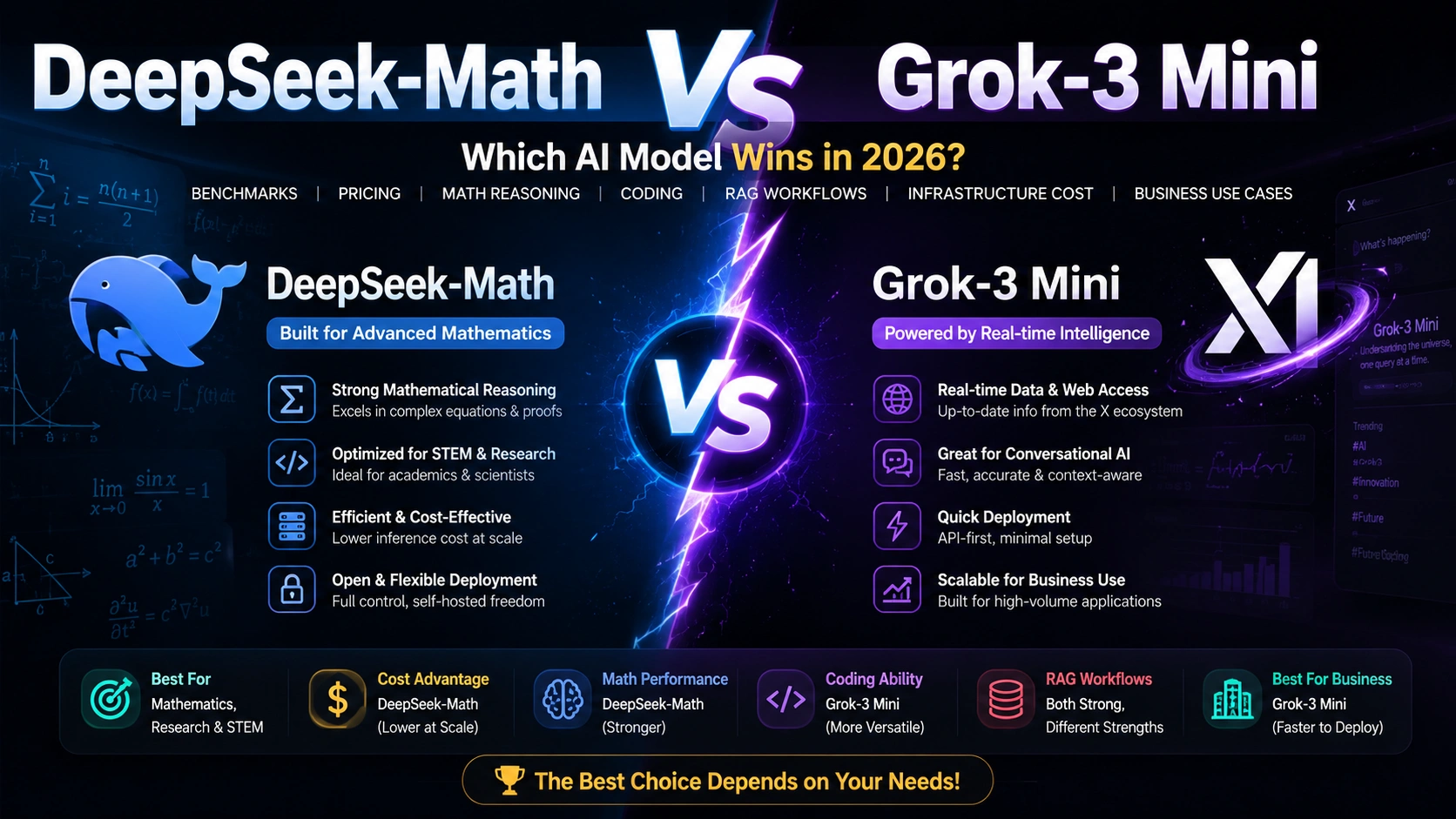
That is exactly why comparing DeepSeek-Math and Grok-3 Mini becomes more interesting than most people expect. On paper, both aim to deliver strong reasoning with efficient performance. But underneath, they represent two different philosophies. DeepSeek-Math prioritizes structured mathematical thinking, longer analytical chains, and cost-efficient reasoning. Grok-3 Mini focuses on responsiveness, fast interaction, broad usability, and developer-friendly workflows.
This guide goes beyond benchmark obsession and compares these models where it actually matters: reasoning quality, deployment flexibility, total cost of ownership, coding, RAG systems, educational value, and business outcomes. By the end, you will know which model fits your goals—not just which one looks better on social media.
Quick Verdict
| Category | Winner |
| Mathematical Reasoning | DeepSeek-Math |
| Response Speed | Grok-3 Mini |
| Cost Efficiency | DeepSeek-Math |
| Coding Workflows | Grok-3 Mini |
| Long Context Analysis | DeepSeek-Math |
| Research Usage | DeepSeek-Math |
| Interactive Productivity | Grok-3 Mini |
| Infrastructure Flexibility | DeepSeek-Math |
What Is DeepSeek-Math?
DeepSeek-Math is a reasoning-focused AI model built to perform strongly on structured mathematical and analytical tasks.
Instead of optimizing primarily for conversational performance, DeepSeek emphasizes:
- Multi-step reasoning
- Mathematical decomposition
- Structured output generation
- Symbolic problem solving
- Analytical workflows
- Extended reasoning chains
That difference becomes noticeable once prompts become more difficult.
Many AI systems appear intelligent on simple tasks.
Far fewer remain reliable when the problem requires 15–20 connected decisions.
DeepSeek attempts to solve exactly that challenge.
Best Use Cases
- Mathematical analysis
- Engineering workflows
- Research environments
- STEM education
- Scientific documentation
- Quantitative finance
What Is Grok-3 Mini?
Grok-3 Mini follows a different philosophy.
Instead of maximizing analytical depth, it focuses on practical performance and responsiveness.
The goal is simple:
Deliver useful outputs quickly.
That makes Grok attractive for teams that care about iteration speed and interaction quality.
Core strengths include:
- Fast generation
- Lower perceived latency
- Coding assistance
- Interactive productivity
- General-purpose workflows
Best Use Cases
- Rapid prototyping
- Startup environments
- Development support
- Internal productivity
- Lightweight AI deployment
DeepSeek-Math vs Grok-3 Mini: Head-to-Head Comparison
| Feature | DeepSeek-Math | Grok-3 Mini |
| Focus | Mathematical reasoning | Interactive performance |
| Speed | Moderate | Excellent |
| Context Handling | Strong | Good |
| Coding | Strong | Strong |
| Research Workflows | Excellent | Good |
| Enterprise Control | Better | Moderate |
| Infrastructure Flexibility | High | Lower |
| Cost Scaling | Better | Moderate |
Benchmarks: Why Numbers Do Not Tell the Full Story
Benchmarks remain useful.
But benchmark performance and production performance are not always the same thing.
Most AI comparisons stop here:
- AIME
- GPQA
- MATH
- Token pricing
- Context size
Those measurements matter.
But users increasingly care about:
- Retry rate
- Reliability
- Infrastructure cost
- Long-form reasoning
- Operational consistency
A model with higher benchmark scores can still create more work in production.
That changes buying decisions.
Mathematical Reasoning: Which Model Thinks Better?
This is where the comparison becomes interesting.
DeepSeek-Math was created specifically to improve structured reasoning.
It performs especially well when problems require:
- Multiple connected steps
- Equation analysis
- Long derivations
- Logical reconstruction
- Analytical decomposition
Example:
Imagine uploading:
A 30-page financial report.
Task:
Find assumptions.
Validate calculations.
Create strategic recommendations.
DeepSeek tends to preserve structure better.
Grok tends to Produce faster iteration.
Winner: DeepSeek-Math
Pricing vs Total Cost of Ownership
One of the biggest SEO gaps in existing comparison articles is cost analysis.
Most compare:
API pricing.
That is incomplete.
Real AI economics looks like this:
Total AI Cost =
Model Cost +
Engineering +
Infrastructure +
Retries +
Maintenance +
Validation
DeepSeek often performs well because flexibility reduces long-term costs.
Grok performs well because simplicity reduces setup time.
Choose DeepSeek If:
- You expect scale
- You need cost control
- AI becomes infrastructure
Choose Grok If:
- Speed matters
- Teams are smaller
- You want lower setup complexity
Coding Performance: Which AI Helps Developers More?
Developers care about outcomes.
Not benchmark screenshots.
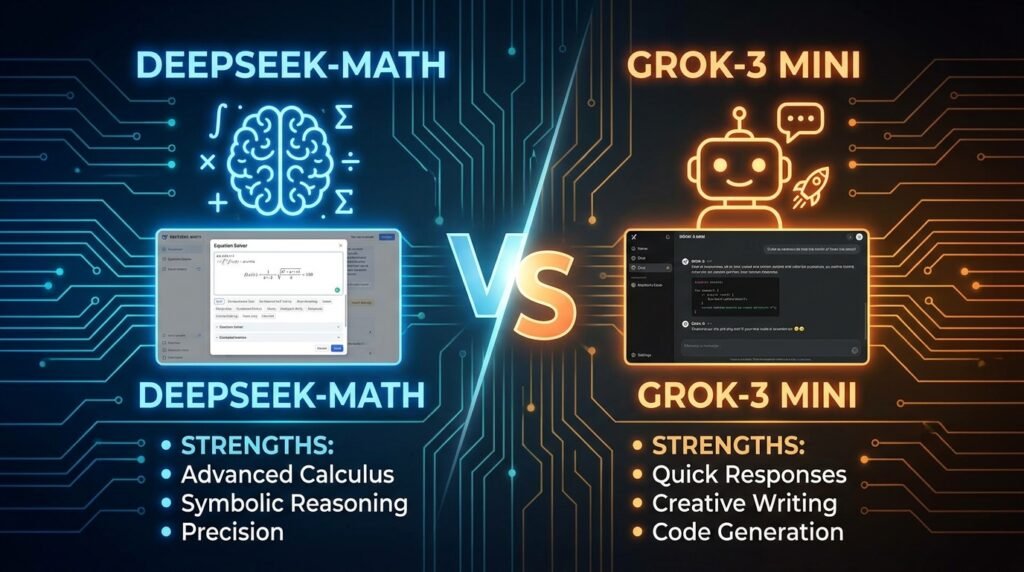
DeepSeek Strengths
- System architecture
- Long coding tasks
- Complex debugging
- Planning
Grok Strengths
- Fast iteration
- Developer interaction
- Rapid fixes
- Productivity
| Development Scenario | Winner |
| Debugging | Grok |
| Architecture | DeepSeek |
| Prototyping | Grok |
| Enterprise Development | DeepSeek |
Final Verdict:
For coding alone, this is nearly a tie.
European Perspective: Which Model Makes More Sense?
European businesses increasingly prioritize:
- Cost predictability
- Infrastructure flexibility
- Governance
- AI independence
Typical examples:
Germany → engineering-heavy use
UK → productivity acceleration
France → AI experimentation
Netherlands → workflow automation
Switzerland → analytical environments
For infrastructure-heavy adoption, DeepSeek often becomes more attractive.
For lightweight productivity, Grok can be easier.
Pros and Cons
DeepSeek-Math
Pros:
- Excellent mathematical reasoning
- Better long-chain consistency
- Flexible deployment
- Strong analytical workflows
Cons:
- Can require more setup
- Less focused on rapid interaction
Grok-3 Mini
Pros:
- Fast interaction
- Excellent responsiveness
- Easy experimentation
Cons:
- Less infrastructure flexibility
- Long reasoning may vary
People Also Ask
A: DeepSeek-Math is generally stronger for mathematical reasoning, research tasks, and long analytical workflows, while Grok-3 Mini performs better for speed, interaction, and fast productivity.
A: For quick coding, debugging, and rapid development cycles, Grok-3 Mini performs well. For architecture planning and complex logic tasks, DeepSeek-Math is often the stronger choice.
A: Yes. DeepSeek-Math works well for students who need structured explanations and step-by-step understanding across mathematics, engineering, and analytical subjects.
A: DeepSeek-Math may provide greater long-term value due to its deployment flexibility, while Grok-3 Mini can reduce setup effort and accelerate adoption.
A: DeepSeek-Math is generally more suitable for long-context retrieval and analytical workflows, while Grok-3 Mini performs well for faster and lighter agent tasks.
Conclusion
DeepSeek-Math vs Grok-3 Mini is not a battle between a “good” model and a “bad” model. It is a decision between two different approaches to AI. DeepSeek-Math pushes toward deeper reasoning, stronger mathematical workflows, better analytical consistency, and long-term deployment flexibility. Grok-3 Mini prioritizes responsiveness, usability, fast interaction, and practical productivity.
If your work includes research, STEM, RAG systems, analytical operations, or complex decision-making, DeepSeek-Math offers a stronger long-term foundation. If your priority is coding assistance, quick experimentation, team productivity, and faster iteration cycles, Grok-3 Mini remains an excellent choice.
The biggest lesson from this comparison is simple:
Benchmarks attract attention.
Workflows create value.
Choose the model that improves outcomes—not the one with the loudest leaderboard. If this guide helped you, bookmark Ultraaiguide.com and explore more AI comparisons before making your next AI decision.