Introduction
The AI industry changed Dramatically when DeepSeek R1, DeepSeek V3, and the growing Meta AI controversy collided in late 2025.
What initially looked like another open-source AI release quickly evolved into a global technology battle involving:
- Chinese AI innovation
- Meta’s open-source ambitions, NVIDIA’s infrastructure dominance
- enterprise AI economics
- The future of reasoning models
Developers, SaaS founders, marketers, and enterprises suddenly started asking bigger questions:
- Is DeepSeek replacing ChatGPT?
- Why did Meta become concerned?
- Is DeepSeek R1 actually smarter than V3?
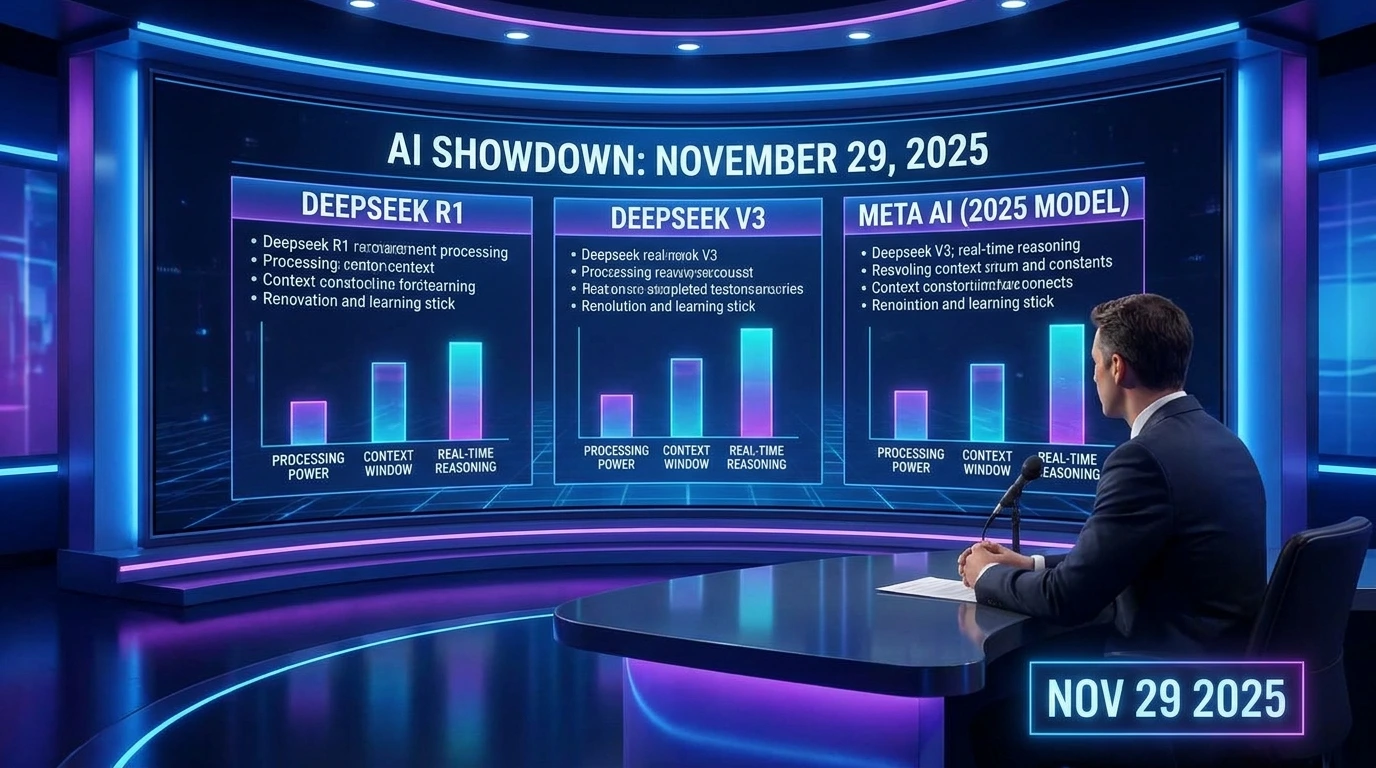
- What happened on November 29, 2025?
- Why did AI pricing wars intensify so quickly?
The answer goes far beyond benchmarks.
This wasn’t just another chatbot launch.
It was the moment the AI market realized that low-cost open-source reasoning models could seriously challenge billion-dollar AI ecosystems.
In this guide, you’ll learn:
- The real difference between DeepSeek R1 and V3
- Why Meta AI faced pressure
- How the AI pricing war escalated
- Which model performs better for coding and reasoning
- What this means for businesses, developers, and the future of AI
What Happened on November 29, 2025?
By late 2025, the AI industry had become intensely competitive.
Several major developments converged at once:
- DeepSeek expanded its reasoning-focused AI ecosystem
- Meta accelerated its open-source AI strategy
- Enterprise AI adoption has increased rapidly
- Inference cost optimization became critical
- NVIDIA-related AI infrastructure discussions intensified
This period became symbolic of a larger industry shift.
Businesses started realizing something important:
Powerful AI models no longer require Silicon Valley-scale budgets.
That realization changed everything.
For years, companies believed advanced reasoning AI required enormous infrastructure spending.
DeepSeek challenged that assumption.
Its models demonstrated that:
- efficient architecture matters
- reasoning optimization matters
- Sparse activation systems matter; open-source accessibility matters
Suddenly, the economics of AI looked very different.
Why DeepSeek Suddenly Became a Threat to Meta AI
DeepSeek disrupted one of Meta’s biggest strategic advantages: open-source AI leadership.
For years, Meta positioned the Llama ecosystem as the future of accessible AI.
Then DeepSeek arrived with:
- lower operating costs
- powerful reasoning capabilities
- fast innovation cycles
- developer-friendly deployment
- aggressive pricing
That combination created enormous pressure.
Meta’s challenge was no longer just competing with proprietary AI labs.
It was competing with highly efficient open-source ecosystems that developers could self-host more cheaply.
This became especially important for:
- SaaS startups
- agencies
- AI automation companies
- coding assistant platforms
- enterprise workflow systems
DeepSeek R1 vs V3 — Core Differences Explained
Although both models belong to the DeepSeek ecosystem, they are designed for very different purposes.
DeepSeek R1 vs V3 Comparison Table
| Feature | DeepSeek R1 | DeepSeek V3 |
| Primary Focus | Advanced reasoning | Fast general-purpose AI |
| Best For | Research & logic | Coding & workflows |
| Architecture Style | Reasoning optimized | Production optimized |
| Speed | Slower | Faster |
| Cost Efficiency | Moderate | High |
| Coding Assistance | Good | Excellent |
| Long Reasoning Chains | Excellent | Moderate |
| Enterprise Automation | Strong | Very strong |
| Latency | Higher | Lower |
| Ideal Users | Analysts & researchers | Developers & SaaS teams |
DeepSeek Architecture Breakdown
One reason DeepSeek gained attention so quickly was its efficient architecture strategy.
Core Technologies Behind DeepSeek
DeepSeek models heavily rely on:
- Mixture of Experts (MoE)
- sparse activation systems
- reinforcement learning optimization
- efficient inference routing
- long-context processing
The key advantage of MoE systems is efficiency.
Instead of activating the entire neural network for every request, only selected “experts” activate dynamically.
This reduces:
- inference cost
- hardware requirements
- energy consumption
- scaling inefficiencies
That became extremely important in 2025 as AI infrastructure costs exploded.
Reasoning vs Non-Reasoning Models
The biggest difference between R1 and V3 is reasoning depth.
Why Reasoning Models Matter
Reasoning-focused models are optimized for:
- multi-step logic
- structured analysis
- mathematical workflows
- research synthesis
- decision systems
R1 specifically emphasizes deliberate reasoning behavior.
Meanwhile, V3 focuses more on:
- speed
- productivity
- conversational efficiency
- coding workflows
- scalable deployment
Simple Explanation
Think of it like this:
- V3 behaves like a fast multitasking assistant
- R1 behaves like a patient analyst
Both are useful.
But they solve different problems.
Why R1 Shocked the AI Industry
DeepSeek R1 became famous because it delivered surprisingly advanced reasoning capabilities at dramatically lower cost than many expected.
This changed industry assumptions.
Why R1 Became a Big Deal
Cost Efficiency
Many AI companies assumed powerful reasoning required massive infrastructure spending.
R1 challenged that narrative.
Open-Source Accessibility
Developers could study, adapt, and deploy models more freely.
That accelerated experimentation.
Competitive Performance
R1 demonstrated strong performance in:
- mathematical reasoning
- structured logic
- research tasks
- analytical workflows
Enterprise Curiosity
Businesses became interested in replacing expensive AI APIs with cheaper alternatives.
That increased pressure on proprietary AI ecosystems.
Meta AI’s Response to Open-Source Competition
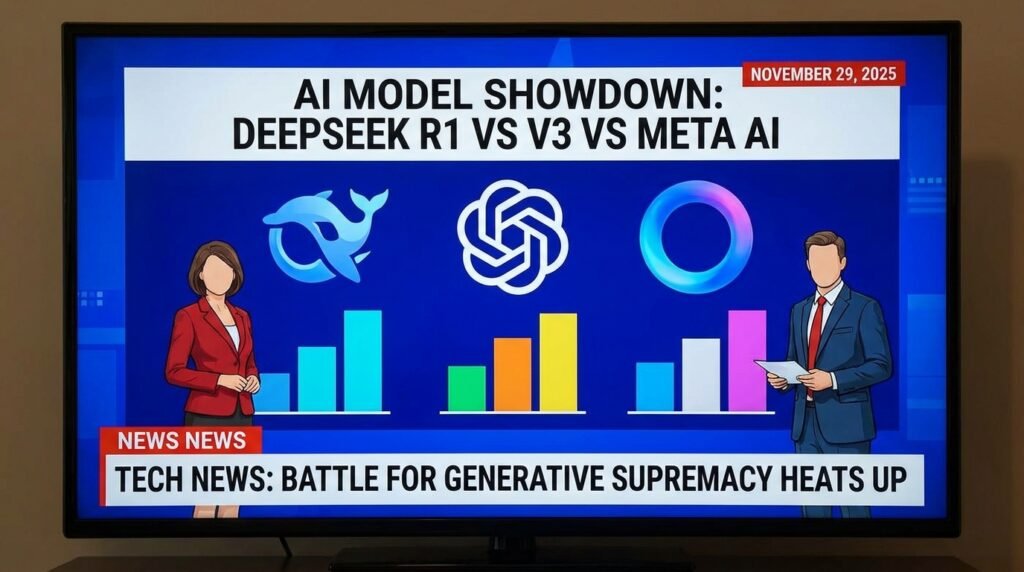
Meta didn’t ignore DeepSeek’s rise.
Instead, the company accelerated its broader AI ecosystem strategy.
Why Meta Still Matters
Despite DeepSeek’s momentum, Meta still holds major advantages:
- global infrastructure
- massive research budgets
- huge developer ecosystems
- enterprise relationships
- consumer platform integration
Meta’s AI ecosystem remains powerful because it combines:
- distribution
- advertising infrastructure
- cloud partnerships
- open-source influence
However, DeepSeek exposed an uncomfortable reality:
Open-source AI innovation was no longer dominated by Western labs alone.
DeepSeek R1 vs V3 Benchmarks
Benchmarks alone never tell the full story.
But they still help explain model behavior.
Workflow-Oriented Benchmark Perspective
| Category | Winner |
| Coding Speed | V3 |
| Deep Reasoning | R1 |
| Mathematical Logic | R1 |
| Conversational Flow | V3 |
| Automation Tasks | V3 |
| Research Workflows | R1 |
| Cost Efficiency | V3 |
| Enterprise Integration | Meta AI |
| Open-Source Flexibility | DeepSeek |
Coding Performance Comparison
For developers, coding workflows matter more than theoretical benchmarks.
Why V3 Performs Better for Coding
DeepSeek V3 usually performs better in:
- autocomplete tasks
- rapid iteration
- API integration support
- conversational coding
- production workflows
Its lower latency makes it more practical for daily development use.
Best Coding Use Cases
- AI coding assistants
- SaaS feature generation
- frontend debugging
- backend scripting
- automation workflows
- rapid prototyping
Real-World Workflow Testing
Most AI comparisons ignore practical workflows.
That’s a mistake.
Businesses care about outcomes — not benchmark screenshots.
Best Model by Workflow
| Workflow | Recommended Model |
| Blog Research | R1 |
| AI SEO Workflows | V3 |
| Customer Support Bots | V3 |
| Enterprise Research | R1 |
| Automation Pipelines | V3 |
| Academic Analysis | R1 |
| Fast Content Drafting | V3 |
| Strategic Reports | R1 |
Which Model Is Better for Developers?
The answer depends entirely on workflow goals.
DeepSeek V3
- fast responses
- scalable APIs
- coding productivity
- automation systems
- conversational speed
- SaaS integrations
DeepSeek R1
- advanced reasoning
- research workflows
- logical analysis
- long-form synthesis
- structured thinking
- analytical reporting
Choose Meta AI Ecosystems If You Need
- enterprise-level deployment
- platform integration
- ecosystem stability
- global-scale distribution
- mature developer tooling
AI Pricing War Explained
One of the biggest reasons DeepSeek disrupted the market was pricing pressure.
AI infrastructure is expensive.
Inference costs matter enormously for:
- SaaS startups
- agencies
- AI automation businesses
- enterprise deployments
DeepSeek demonstrated that lower-cost reasoning systems were possible.
That forced the industry to reconsider:
- token pricing
- GPU utilization
- deployment strategies
- API economics
Why Nvidia Became Part of the Story
NVIDIA sits at the center of the AI infrastructure economy.
As efficient models improved, investors began questioning whether future AI growth would always require exponentially larger hardware spending.
That triggered broader conversations around:
- AI efficiency
- inference optimization
- hardware dependency
- energy consumption
- scalable AI economics
This is why DeepSeek’s rise mattered far beyond chatbot comparisons.
DeepSeek vs Meta AI — Open Source Battle
The real battle isn’t simply “which model is smarter.”
The larger battle is about ecosystem control.
Meta’s Strategy
Meta focuses on:
- ecosystem dominance
- platform integration
- developer adoption
- open-source influence
- global deployment
DeepSeek’s Strategy
DeepSeek focuses on:
- efficiency
- Affordability
- reasoning quality
- rapid iteration
- open accessibility
That creates two very different visions for the future of AI.
How DeepSeek Changed Enterprise AI Thinking
Before DeepSeek, many companies believed advanced AI required premium infrastructure and expensive APIs.
That assumption started changing.
Enterprise Shifts Triggered by DeepSeek
Businesses increasingly explored:
- hybrid AI deployments
- local AI hosting
- open-source integrations
- inference optimization
- multi-model workflows
This especially impacted:
- SaaS startups
- AI agencies
- productivity platforms
- research companies
- automation systems
China vs USA AI Race in 2025
DeepSeek also became symbolic of a much larger geopolitical shift.
Why the AI Race Matters
The global AI competition increasingly involves:
- semiconductor independence
- cloud infrastructure
- AI regulation
- export controls
- national technology strategies
Chinese AI companies accelerated rapidly despite growing restrictions.
That surprised many analysts.
The result:
The AI race became truly global.
Productivity & Automation Benefits
AI adoption is no longer just about chatbots.
Modern businesses use AI for:
- workflow automation
- content systems
- customer support
- coding assistance
- research pipelines
- productivity optimization
Where DeepSeek Fits Best
DeepSeek V3
Best for:
- Automation workflows
- AI productivity systems
- scalable SaaS tools
- customer interaction
DeepSeek R1
Best for:
- strategic reasoning
- research analysis
- structured thinking
- enterprise intelligence workflows
Beginner Setup Guide
Many beginners overcomplicate AI adoption.
Here’s a practical approach.
Step-by-Step Beginner Workflow
Step 1: Define Your Goal
Ask:
- Do you need speed?
- Do you need reasoning?
- Do you need automation?
Step 2: Start With One Workflow
Examples:
- coding assistant
- SEO research
- content workflows
- customer support
Step 3: Test Multiple Models
Never rely on one benchmark alone.
Test:
- response quality
- hallucination behavior
- latency
- workflow consistency
Step 4: Monitor Costs
Inference pricing scales quickly.
Track:
- token usage
- API requests
- workflow efficiency
Security & Privacy Considerations
AI adoption introduces serious trust concerns.
Key Risks Businesses Should Understand
Data Privacy
Never upload highly sensitive information into public AI systems without understanding data policies.
AI Hallucinations
Reasoning models can still confidently produce incorrect information.
Human review remains essential.
Copyright Risks
AI-generated content may raise ownership and attribution concerns.
Compliance Challenges
Businesses in Europe, especially, must consider:
- GDPR compliance
- data residency
- AI governance policies
Ethical AI Considerations
The DeepSeek vs Meta debate also raises ethical questions.
Major Ethical Concerns
- misinformation risks
- synthetic content abuse
- AI-generated propaganda
- training transparency
- energy consumption
- AI labor disruption
Responsible AI adoption requires:
- human oversight
- transparent workflows
- ethical deployment policies
- fact-checking systems
Common Mistakes Users Make
Trusting Benchmarks Too Much
Benchmarks rarely reflect real workflows.
Practical testing matters more.
Ignoring Hallucination Risks
Even advanced reasoning systems make mistakes.
Always verify critical information.
Choosing the Wrong Model Type
Fast models and reasoning models solve different problems.
Ignoring Long-Term Costs
Cheap APIs can become expensive at scale.
Over-Automating Too Early
Human review still improves quality dramatically.
Expert Tips & Best Practices
Best AI Workflow Strategies
Use Multi-Model Workflows
Many professionals combine:
- reasoning models
- coding models
- automation models
Separate Research From Production
Use reasoning models for planning.
Use fast models for execution.
Build Verification Layers
Always validate:
- financial outputs
- legal content
- Medical information
- enterprise reports
Best Alternatives to DeepSeek and Meta AI
Popular AI Alternatives
| Model Ecosystem | Strength |
| OpenAI GPT ecosystem | General intelligence |
| Anthropic Claude ecosystem | Long-context reasoning |
| Google Gemini ecosystem | Search integration |
| Meta Llama ecosystem | Open-source reach |
| DeepSeek ecosystem | Cost-efficient reasoning |
Future AI Trends & Predictions
The AI market will likely move toward:
- hybrid AI systems
- reasoning-specialized models
- lower-cost inference
- efficient architectures
- local deployment ecosystems
- AI agent workflows
What Happens Next?
The next AI battle probably won’t focus only on:
- model size
- benchmark scores
Instead, the market will increasingly prioritize:
- efficiency
- affordability
- reliability
- workflow usability
- enterprise scalability
People Also Ask
It depends on the task. R1 is stronger for reasoning and research workflows, while V3 performs better for speed, coding, and automation tasks.
DeepSeek challenged Meta’s open-source AI leadership by offering highly efficient reasoning models at lower operational costs.
Late 2025 became symbolic of a major AI shift involving open-source disruption, pricing wars, infrastructure concerns, and global AI competition.
Most developers prefer V3 for daily coding workflows because of its lower latency and faster conversational performance.
Not entirely. DeepSeek has become a serious competitor in specific areas such as reasoning efficiency and open-source accessibility, but the AI ecosystem remains highly competitive.
Final Verdict: Which AI Model Actually Wins?
There isn’t a single universal winner.
That’s the biggest misconception in AI comparisons.
DeepSeek R1 Wins For
- advanced reasoning
- analytical workflows
- structured research
- deep logic systems
DeepSeek V3 Wins For
- coding productivity
- automation
- conversational speed
- scalable workflows
Meta AI Wins For
- ecosystem scale
- enterprise infrastructure
- developer distribution
- long-term platform integration
The real winner ultimately depends on:
- your workflow
- your budget
- your infrastructure
- your business goals
But one thing became very clear after late 2025:
The AI industry is no longer controlled by a small group of Silicon Valley companies alone.
And that shift may define the next decade of artificial intelligence.
Conclusion
The DeepSeek R1 vs V3 vs Meta AI debate Represents something much bigger than a simple model comparison.
It reflects:
- The rise of open-source AI
- reasoning-focused innovation
- global AI competition
- infrastructure economics
- The future of enterprise automation
DeepSeek proved that efficient reasoning models could challenge industry giants faster than many expected.