Introduction
Artificial Intelligence in 2026 has evolved into a multi-layered Computational ecosystem where models are no longer just conversational agents but semantic processing engines embedded into digital infrastructure.
From a Natural Language Processing perspective, modern AI systems can be broadly categorized into two dominant paradigms:
- API-first generative intelligence systems
- Conversational interface-driven AI systems
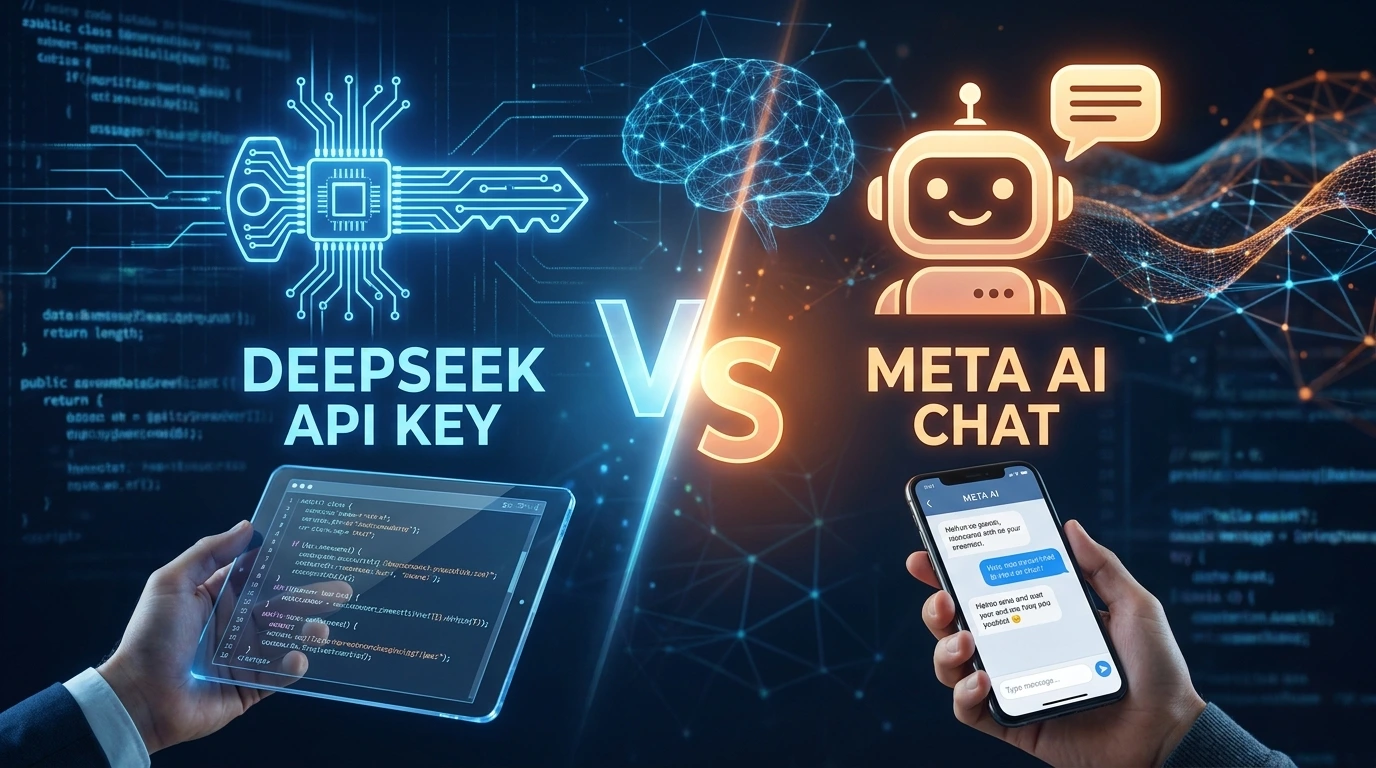
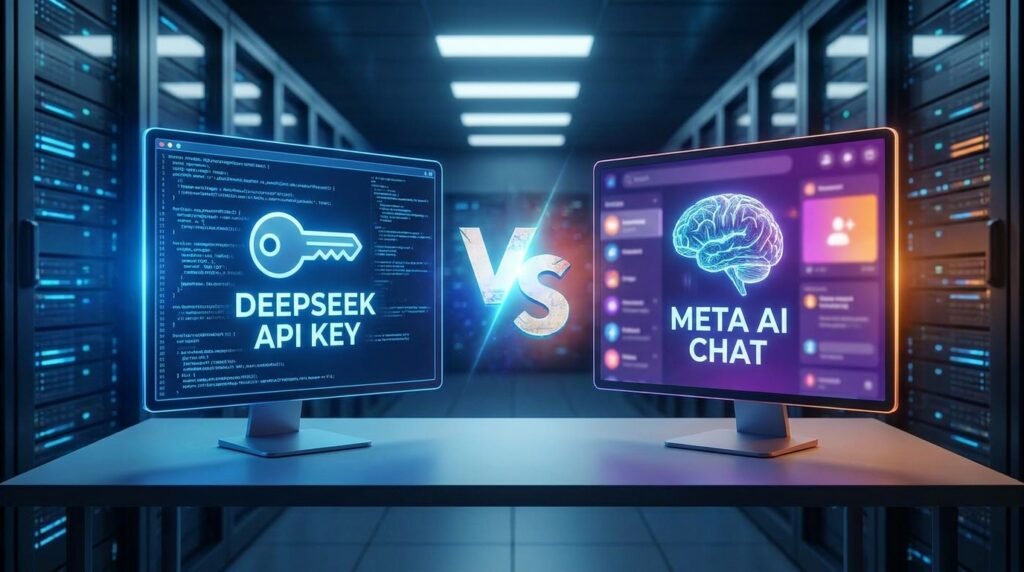
This is exactly where the distinction between DeepSeek API Key and Meta AI Chat becomes critically important.
On one side, DeepSeek API Key functions as a machine-accessible inference engine, designed for developers, engineers, and enterprises building scalable applications, automation pipelines, and multi-agent systems.
On the other side, Meta AI Chat is a human-centric dialogue system, embedded into social platforms like WhatsApp, Instagram, and Messenger, designed for instant interaction without technical barriers.
The key conceptual shift in 2026 is:
Are you consuming AI outputs or embedding AI into computational workflows?
This article provides a deep NLP-driven architectural breakdown, including semantic processing models, token-based economics, workflow automation layers, and real-world enterprise use cases.
What is the DeepSeek API Key?
From a machine learning architecture perspective, the DeepSeek API Key represents an API-driven transformer inference system that exposes model capabilities through structured HTTP requests.
Unlike conversational interfaces, DeepSeek operates as a stateless probabilistic language model endpoint.
Core Concept
DeepSeek functions as:
- A token-based sequence generator
- A context-window optimized transformer
- A structured output inference engine
In simpler terms:
It does not “chat.”
It processes input-output mappings through API calls
Key Functional Characteristics
API-Based Semantic Processing
Developers send encoded text sequences, which are tokenized and processed through transformer layers.
Structured Output Generation
Responses can be formatted into:
- JSON
- Code blocks
- Semantic embeddings
- Task-specific outputs
Integration-Ready Architecture
DeepSeek is designed for:
- Microservices
- Backend systems
- SaaS platforms
- AI agents
Tokenized Billing Model
Pricing follows NLP token consumption:
This means usage scales with computational demand.
Who Uses DeepSeek API Key?
From an NLP ecosystem standpoint, primary users include:
- AI application developers
- SaaS architects
- Data pipeline engineers
- Fintech algorithm designers
- Automation specialists
- European AI startups building LLM-powered tools
Conceptual Summary
DeepSeek = semantic computation layer inside applications
Not a chatbot, but a language model execution interface
What is Meta AI Chat?
Meta AI Chat represents a dialogue-centric natural language interface system embedded within social communication platforms.
Unlike API-based systems, it operates in a closed conversational loop model.
Core Concept
Meta AI Chat is designed as:
- A context-aware conversational agent
- A turn-based dialogue system
- A user-intent interpretation model
It prioritizes:
Simplicity
Accessibility
Real-time conversation
Key Features
Intent Recognition System
Meta AI interprets user queries using:
- Named Entity Recognition (NER)
- Intent classification
- Context tracking
Stateless User Interaction Layer
Each session is partially contextual but not fully programmable.
Embedded Social Graph Integration
Works inside:
- Messenger
No Developer API Exposure
Unlike DeepSeek, Meta AI does not expose backend model control.
Who Uses Meta AI Chat?
- Social media users
- Students
- Content creators
- Mobile-first audiences
- Casual information seekers
Conceptual Summary
Meta AI Chat = front-end conversational interface over an AI model
Core Difference: API vs Chat-Based Architecture
This is the most critical conceptual distinction.
DeepSeek System
From an architecture standpoint:
- Input → Tokenization → Transformer inference → Structured output
- Fully programmable pipeline
- External system integration enabled
Meta AI System
- Input → Intent detection → Response generation → Display output
- Closed-loop conversational system
- No external programmable access
Engineering Analogy
| System | NLP Analogy |
| DeepSeek API | Raw transformer inference engine |
| Meta AI Chat | Conversational UI wrapper |
Deep Technical Workflow Comparison
DeepSeek Pipeline
- The developer encodes the prompt
- The API request is sent
- Tokenization occurs
- The transformer model processes a sequence
- Output tokens decoded
- Structured response returned
Fully deterministic pipeline design
Meta AI Pipeline
- User sends natural language input
- Intent classifier activated
- Context embedding generated
- Response selected/generated
- Output rendered in chat UI
Non-programmable conversational loop
Pricing Model
DeepSeek API Key Pricing Model
DeepSeek follows a computational token economy system:
- Input tokens + output tokens = cost
Advantages
- Scales with usage
- Predictable for enterprises
- Efficient for automation workloads
Disadvantages
- Requires monitoring token consumption
- Costs increase with high-volume usage
Meta AI Chat Pricing Model
Meta AI operates under:
- Zero direct cost model
- Platform-subsidized inference system
However:
Hidden constraint = ecosystem dependency
No monetizable API layer
Economic Insight
- DeepSeek = Pay-per-computation model
- Meta AI = Free but closed ecosystem model
Real-World Use Cases
DeepSeek API Key Use Cases
From a machine learning operations (MLOps) perspective:
- AI SaaS product development
- Customer support automation bots
- Financial prediction systems
- Large-scale content generation pipelines
- Multi-agent orchestration systems
- Workflow automation frameworks
Meta AI Chat Use Cases
From a conversational standpoint:
- Informal Q&A sessions
- Social media assistance
- Quick summarization tasks
- Casual ideation support
- Messaging-based interaction
Head-to-Head Comparison Table
| Feature | DeepSeek API Key | Meta AI Chat |
| Type | API-driven transformer system | Conversational intent model |
| Access | Developer API | Embedded chat UI |
| Customization | High (full control) | Low |
| Automation Support | Full pipeline automation | None |
| Scalability | Enterprise-grade | Platform-limited |
| Integration | External systems | Internal apps only |
| Coding Required | Yes | No |
| Pricing | Token-based | Free |
Performance Analysis
Where DeepSeek Excels
- Complex reasoning chains
- Code generation accuracy
- Structured output formatting
- API chaining workflows
- Multi-step inference systems
Where Meta AI Excels
- Natural conversational flow
- Fast interaction latency
- Zero configuration usability
- Social platform integration
Developer vs Non-Developer Segmentation
Are a Developer
DeepSeek API is optimal if:
- You build AI applications
- You require backend automation
- You design SaaS platforms
- You integrate LLM pipelines
You Are a Casual User
Meta AI Chat is optimal if:
- You use messaging apps daily
- You need instant answers
- You avoid technical complexity
- You prefer conversational UX
Future of AI
AI systems are evolving into two structural layers:
Infrastructure Layer
- Multi-agent AI frameworks
- Autonomous workflows
- Enterprise-grade LLM systems
- DeepSeek belongs here
Interface Layer
- Social AI assistants
- Mobile conversational agents
- Consumer-facing assistants
- Meta AI belongs here
Pros & Cons
DeepSeek API Key
Pros
- High semantic control
- Scalable transformer access
- Ideal for AI systems
- Structured output generation
Cons
- Requires technical expertise
- Integration complexity
- Developer dependency
Meta AI Chat
Pros
- Zero setup required
- Natural language interface
- Free access
- Instant responses
Cons
- No API access
- Limited customization
- Closed ecosystem design
How to Use These AI Systems
Using DeepSeek API Key
- Obtain API credentials
- Encode prompt into structured request
- Send API call
- Parse JSON response
- Integrate into the application pipeline
Using Meta AI Chat
- Open WhatsApp/Instagram
- Start conversation
- Input natural language query
- Receive a response instantly
Tips for AI Prompt Engineering
For optimized performance:
- Use structured prompts
- Include contextual constraints
- Define output format explicitly
- Reduce ambiguity in instructions
- Specify the domain and region context
European AI Adoption Insight (2026)
AI adoption across Europe shows strong segmentation:
- Germany → enterprise automation systems
- UK → AI SaaS startup ecosystem
- France → creative NLP applications
- Netherlands → data-driven AI pipelines
- Spain/Italy → social conversational AI usage
- Developers prefer API-first systems
- Consumers prefer chat-based systems
FAQs
A: It depends on your goal. DeepSeek is better for developers and automation, while Meta AI is better for casual users.
A: No. Meta AI is a closed chat system and cannot replace developer APIs or automation platforms.
A: Not really. It requires basic coding knowledge and API integration experience.
A: DeepSeek API is far better because it supports workflows, integrations, and scalability.
A: Yes, Meta AI Chat is free and integrated into Meta apps like WhatsApp and Instagram.
Conclusion
The comparison between DeepSeek API Key and Meta AI Chat represents a fundamental split in modern NLP architecture:
- One system operates as a transformer-based computational API layer
- The other operates as a natural language conversational interface layer
DeepSeek empowers developers to construct AI-driven systems, automate workflows, and integrate large language models into scalable infrastructures.
Meta AI simplifies access to AI by embedding intelligence directly into communication platforms, making it ideal for non-technical users.