Introduction
Artificial intelligence is no longer limited to text generation. In 2026, the real competition is happening inside the multimodal AI space — systems capable of understanding documents, screenshots, charts, code Repositories, video frames, tables, and complex enterprise workflows.
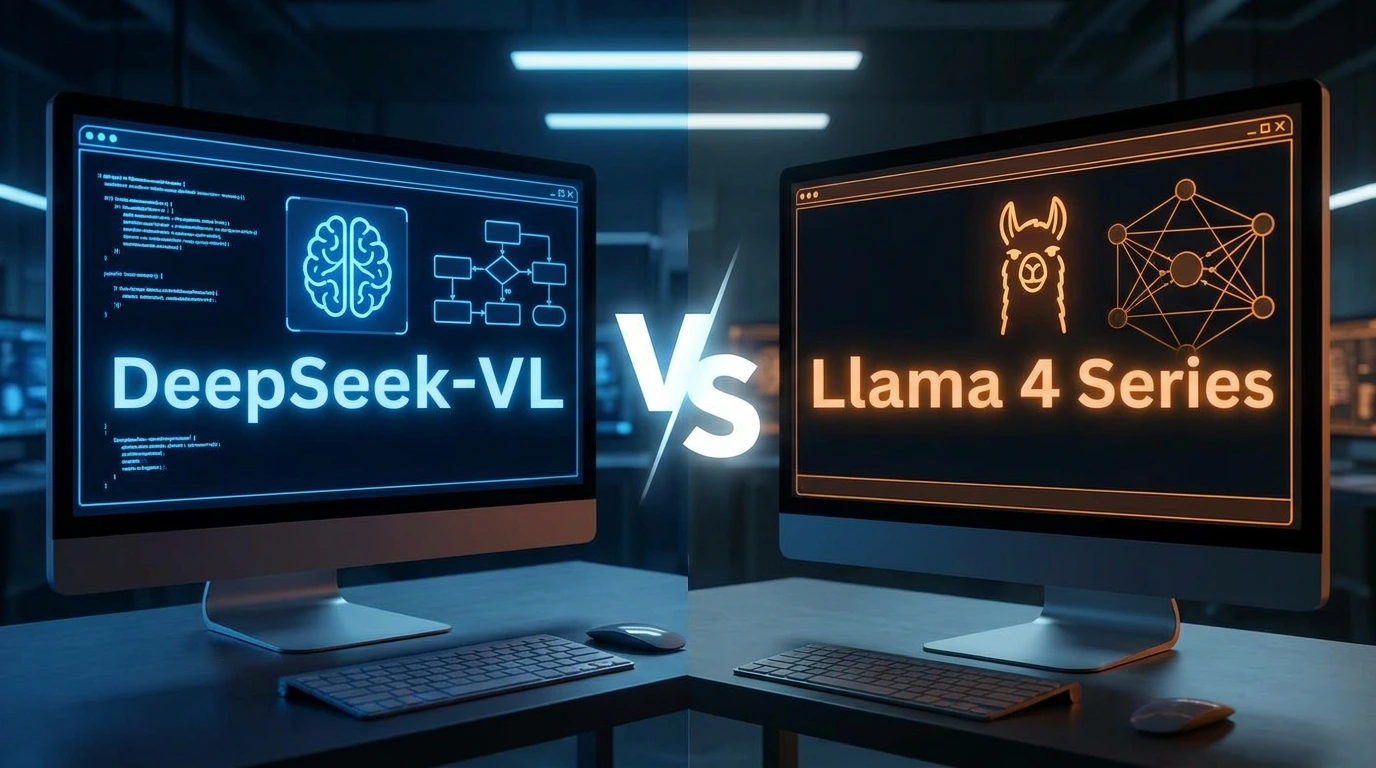
Two open-source giants are leading this transformation:
- DeepSeek-VL
- Llama 4 Series
These models are redefining how developers, startups, and enterprises build AI products across Europe, the USA, and global markets. From OCR automation and document intelligence to coding agents and multimodal assistants, both ecosystems are rapidly becoming alternatives to expensive closed-source AI systems.
However, DeepSeek-VL and Llama 4 Series were built with very different philosophies.
DeepSeek-VL focuses heavily on:
- OCR precision
- document understanding
- multimodal efficiency
- lightweight deployment
- structured visual intelligence
Meanwhile, Llama 4 Series emphasizes:
- giant context windows
- multimodal reasoning
- scalable Mixture-of-Experts (MoE) systems
- enterprise AI orchestration
- agentic workflows
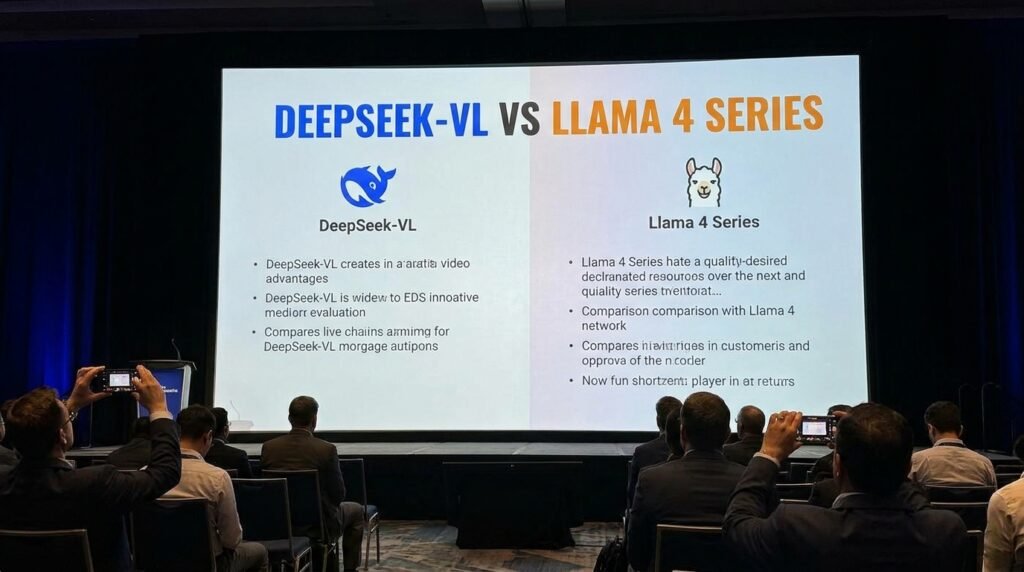
This complete guide explores architecture, benchmarks, real-world performance, enterprise use cases, pricing philosophy, coding workflows, long-context reasoning, and future scalability to help you decide which multimodal AI ecosystem is best in 2026.
Quick Verdict: DeepSeek-VL vs Llama 4 Series
| Category | Winner |
| OCR & Document Understanding | DeepSeek-VL |
| Enterprise AI Agents | Llama 4 |
| Lightweight Local Deployment | DeepSeek-VL |
| Long-Context Memory | Llama 4 |
| Coding Workflows | Llama 4 |
| Research Openness | DeepSeek-VL |
| Ecosystem & Integrations | Llama 4 |
| Visual Reasoning | Tie |
| Structured Table Analysis | DeepSeek-VL |
| Agentic Orchestration | Llama 4 |
| Efficient Multimodal Inference | DeepSeek-VL |
| Enterprise Scalability | Llama 4 |
Why This AI Comparison Matters in 2026
The global AI industry is entering a new phase where multimodal models are replacing traditional text-only systems.
Businesses across Europe now require AI systems capable of:
- analyzing contracts
- reading invoices
- extracting chart data
- understanding PDFs
- managing enterprise memory
- reviewing software repositories
- supporting multilingual workflows
This demand is particularly strong in:
- Germany’s industrial sector
- UK legal-tech startups
- France’s enterprise AI market
- Netherlands-based automation companies
- Swiss finance AI platforms
As organizations search for open-source alternatives to expensive proprietary AI APIs, DeepSeek-VL and Llama 4 have become two of the most discussed multimodal ecosystems worldwide.
Why Most Existing Articles Fail
Most comparison articles ranking online today suffer from major weaknesses.
They Compare the Wrong Models
Many competitors still compare:
- DeepSeek R1 vs Llama 4
- GPT-4o vs Llama
- Claude vs Llama
Very few deeply analyze:
- DeepSeek-VL2
- Llama 4 Scout
- Llama 4 Maverick
- multimodal MoE architectures
- OCR-specific capabilities
This creates a major SEO opportunity.
Weak Technical Depth
Most blogs fail to explain:
- vision encoders
- token allocation systems
- KV-cache optimization
- latent attention
- sparse activation
- multimodal routing
Readers searching for advanced AI comparisons want technical depth, not surface-level marketing summaries.
No Enterprise Perspective
Most articles ignore:
- deployment costs
- GPU requirements
- local inference
- enterprise privacy
- air-gapped AI systems
- multimodal document pipelines
These are critical considerations for businesses in Europe and enterprise markets.
Missing Long-Tail Keywords
Competitor content rarely targets valuable search phrases such as:
- DeepSeek-VL vs Llama 4 multimodal
- best open-source vision language model
- Multimodal MoE AI models
- DeepSeek OCR AI
- Llama 4 Scout benchmarks
- local multimodal AI systems
- enterprise document AI
Ranking for these long-tail keywords can dramatically improve organic traffic.
What Is DeepSeek-VL?
DeepSeek-VL is an advanced open-source vision-language AI model family designed for real-world multimodal tasks.
It specializes in:
- OCR
- PDF analysis
- table extraction
- chart understanding
- screenshot analysis
- document intelligence
- visual grounding
Unlike generalized AI models, DeepSeek-VL focuses heavily on structured visual reasoning.
Key Features of DeepSeek-VL
Hybrid Vision Encoders
DeepSeek-VL uses optimized visual encoders capable of handling:
- small fonts
- dense layouts
- high-resolution documents
- complex tables
OCR Optimization
The system performs exceptionally well on:
- invoices
- contracts
- receipts
- enterprise forms
- scanned PDFs
Efficient Token Allocation
Instead of wasting computation on unnecessary image regions, DeepSeek intelligently prioritizes important visual information.
Lightweight Deployment
Compared to many large multimodal systems, DeepSeek-VL is more efficient for:
- local servers
- startups
- private enterprise infrastructure
- edge AI systems
What Is DeepSeek-VL2?
DeepSeek-VL2 is the next-generation evolution of the original DeepSeek-VL architecture.
It introduced:
- Mixture-of-Experts (MoE)
- dynamic tiling
- Multi-head Latent Attention (MLA)
- optimized KV-cache compression
- faster inference throughput
This significantly improved:
- efficiency
- OCR quality
- reasoning capability
- multimodal scaling
What Is Llama 4 Series?
Llama 4 Series is Meta’s advanced multimodal AI ecosystem designed for large-scale reasoning and enterprise-grade AI infrastructure.
Major variants include:
- Llama 4 Scout
- Llama 4 Maverick
Unlike earlier Llama generations, Llama 4 was built from the ground up for:
- multimodal workflows
- massive context windows
- AI agents
- enterprise orchestration
- memory-heavy reasoning
Key Features of Llama 4 Series
Sparse MoE Architecture
Llama 4 uses sparse activation systems where only selected expert modules activate during inference.
Benefits include:
- better scalability
- improved efficiency
- lower active parameter usage
- higher reasoning performance
Massive Context Windows
One of Llama 4 Scout’s most discussed capabilities is its ultra-long context support.
This enables:
- repository-scale code analysis
- long enterprise memory systems
- multimodal research agents
- persistent AI workflows
Agentic AI Workflows
Llama 4 is heavily optimized for:
- autonomous agents
- long reasoning chains
- multi-step workflows
- orchestration pipelines
This makes it extremely attractive for enterprise automation.
DeepSeek-VL vs Llama 4 Architecture Comparison
| Feature | DeepSeek-VL | Llama 4 Series |
| Primary Focus | OCR & documents | General multimodal reasoning |
| Architecture Type | Vision-language multimodal | Sparse MoE multimodal |
| OCR Optimization | Excellent | Moderate |
| Long Context | Moderate | Excellent |
| MoE Scaling | VL2 generation | Core architecture |
| Dynamic Tiling | Yes | Limited |
| Agentic Workflows | Good | Excellent |
| Local Deployment | Strong | Heavy |
| Enterprise Infrastructure | Growing | Mature |
The Biggest Architectural Difference
The core difference is strategic.
DeepSeek-VL Focuses On:
- multimodal precision
- OCR intelligence
- efficient inference
- document understanding
- structured layout reasoning
Llama 4 Focuses On:
- generalized intelligence
- large-scale orchestration
- massive memory systems
- long-context workflows
- multimodal agents
This single distinction explains most benchmark differences between both ecosystems.
Multimodal Understanding Comparison
| Capability | DeepSeek-VL | Llama 4 |
| OCR | Excellent | Good |
| Chart Analysis | Excellent | Good |
| Table Extraction | Excellent | Very Good |
| Screenshot Understanding | Excellent | Very Good |
| Visual Reasoning | Very Good | Very Good |
| Long-Context Memory | Moderate | Excellent |
| Video Understanding | Moderate | Better |
| AI Agents | Good | Excellent |
Document Intelligence: DeepSeek-VL Dominates
DeepSeek-VL was engineered specifically for document-heavy workflows.
It performs extremely well on:
- scanned contracts
- financial statements
- invoices
- PDFs
- charts
- enterprise dashboards
- handwritten layouts
Why DeepSeek Performs Better for OCR
Most multimodal AI systems struggle with:
- tiny text
- dense tables
- complex formatting
- layout preservation
DeepSeek-VL was trained specifically on OCR-heavy datasets, giving it a major advantage in enterprise document intelligence.
Best Use Cases for DeepSeek-VL
Legal Document Analysis
Law firms across Europe increasingly use OCR AI for:
- contract parsing
- compliance review
- multilingual legal workflows
Financial Automation
DeepSeek excels at:
- invoice extraction
- balance-sheet reading
- chart understanding
- accounting workflows
Healthcare Records
Medical institutions can use it for:
- scanned forms
- prescription analysis
- patient document automation
Long-Context Memory: Llama 4 Takes the Lead
Llama 4 Scout’s massive context capability changes how enterprises build AI systems.
It enables:
- repository-wide code analysis
- persistent memory agents
- enterprise knowledge systems
- long-session research assistants
This is especially valuable for:
- SaaS companies
- AI coding startups
- research organizations
- Enterprise automation teams
Why Long Context Matters
Traditional AI systems forget information quickly.
Ultra-long context windows allow AI systems to:
- remember earlier discussions
- analyze giant documents
- understand entire repositories
- manage persistent workflows
This is where Llama 4 becomes extremely powerful.
Coding & Developer Workflow Comparison
| Coding Capability | DeepSeek-VL | Llama 4 |
| Repository Understanding | Moderate | Excellent |
| Coding Agents | Good | Excellent |
| Debugging | Moderate | Strong |
| OCR + Code Screenshots | Excellent | Good |
| Autonomous Coding | Moderate | Better |
| Memory-Heavy Development | Weak | Strong |
Which Model Is Better for Developers?
Choose DeepSeek-VL If You Need:
- OCR-based coding screenshots
- lightweight deployment
- visual debugging
- structured UI analysis
- document-heavy pipelines
Llama 4 If You Need:
- repository-scale coding agents
- autonomous workflows
- long coding sessions
- multi-step reasoning
- memory-heavy orchestration
Inference Efficiency Comparison
Efficiency is becoming one of the most important AI metrics in 2026.
Running multimodal AI systems is expensive.
DeepSeek-VL Advantages
DeepSeek-VL offers:
- lower VRAM usage
- faster OCR throughput
- efficient image tokenization
- smaller active parameter counts
- optimized local inference
This makes it attractive for:
- startups
- SMBs
- European AI companies
- local GPU deployments
Llama 4 Infrastructure Requirements
Llama 4 can require:
- expensive GPU clusters
- high-end VRAM configurations
- Enterprise infrastructure
- advanced orchestration systems
While powerful, deployment costs can become substantial.
DeepSeek-VL vs Llama 4 Benchmark Comparison
| Benchmark Area | DeepSeek-VL | Llama 4 |
| OCRBench | Stronger | Good |
| DocVQA | Stronger | Very Good |
| Visual Grounding | Strong | Strong |
| Multimodal QA | Strong | Strong |
| Coding | Moderate | Better |
| Agentic Reasoning | Moderate | Better |
| Context Scaling | Moderate | Excellent |
| Throughput Efficiency | Excellent | Good |
Open-Source Ecosystem Comparison
| Feature | DeepSeek-VL | Llama 4 |
| Open Weights | Yes | Yes |
| Community Size | Growing Fast | Massive |
| Fine-Tuning Ecosystem | Moderate | Excellent |
| Enterprise Adoption | Rising | Very Strong |
| Hugging Face Support | Strong | Dominant |
| Tutorials & Resources | Moderate | Extensive |
DeepSeek-VL Pros & Cons
Pros
- Exceptional OCR performance
- Efficient multimodal inference
- Strong PDF understanding
- Lightweight deployment
- Excellent table extraction
- Better for local AI infrastructure
Cons
- Smaller ecosystem
- Limited long-context memory
- Fewer enterprise integrations
- Less mature agentic tooling
Llama 4 Series Pros & Cons
Pros
- Massive context windows
- Excellent agentic workflows
- Strong coding performance
- Huge ecosystem support
- Enterprise scalability
- Powerful multimodal reasoning
Cons
- Expensive infrastructure
- Heavy deployment requirements
- Less OCR specialization
- Complex enterprise setup
How to Use These AI Models Effectively
Best Practices for DeepSeek-VL
Use High-Quality Documents
Better scans improve:
- OCR accuracy
- table extraction
- layout preservation
Optimize for Structured Inputs
DeepSeek performs best on:
- contracts
- invoices
- reports
- forms
Use Local Deployment for Privacy
European enterprises handling GDPR-sensitive data can benefit from local inference.
Best Practices for Llama 4
Use Retrieval-Augmented Pipelines
This improves:
- memory management
- Research workflows
- long-context reasoning
Build Multi-Agent Systems
Llama 4 shines in:
- orchestration
- task delegation
- autonomous workflows
Allocate Sufficient Infrastructure
Long-context AI requires:
- GPU optimization
- memory planning
- scalable deployment architecture
Europe-Focused AI Adoption Trends
Across Europe, demand for open-source multimodal AI is rapidly increasing due to:
- GDPR compliance
- enterprise privacy concerns
- local AI sovereignty
- rising API costs
Countries leading adoption include:
- Germany
- UK
- France
- Netherlands
- Switzerland
- Sweden
DeepSeek-VL is gaining popularity among privacy-focused enterprises, while Llama 4 is becoming dominant in large-scale enterprise AI infrastructure.
Future Outlook
The future of AI is increasingly multimodal and open-source.
DeepSeek’s Future Direction
DeepSeek is aggressively expanding through:
- VL2
- Janus
- OCR specialization
- efficient multimodal scaling
Its strategy focuses on:
- efficiency
- document intelligence
- lightweight deployment
Llama 4’s Future Direction
Meta continues pushing:
- massive MoE scaling
- multimodal infrastructure
- ultra-long context AI
- agentic enterprise systems
Its goal is building generalized AI infrastructure for the entire enterprise ecosystem.
Final Verdict: Which Model Wins?
The answer depends entirely on your use case.
DeepSeek-VL
- OCR systems
- PDFs
- structured documents
- lightweight deployment
- private enterprise AI
- visual extraction workflows
Llama 4
- AI agents
- long-context memory
- repository-scale coding
- enterprise orchestration
- autonomous workflows
In reality, these models are not direct replacements for each other.
DeepSeek-VL is a specialist.
Llama 4 is a scalable multimodal platform.
The smartest enterprises in 2026 may ultimately combine both:
- DeepSeek for document intelligence
- Llama 4 for orchestration and reasoning
That hybrid future is likely where open-source multimodal AI is heading next.
FAQs
Yes. DeepSeek-VL is generally stronger for OCR, document understanding, table extraction, and structured visual intelligence because it was specifically trained for these workflows.
In most large-scale coding workflows, yes. Llama 4 performs better for repository analysis, AI agents, long-context development, and autonomous software orchestration.
Yes. One of DeepSeek-VL’s biggest strengths is lightweight local deployment with lower VRAM requirements compared to larger multimodal systems.
Llama 4 is usually better for enterprise AI agents due to its long-context memory, orchestration capabilities, and scalable MoE infrastructure.
Yes. DeepSeek-VL provides open-weight multimodal systems that are rapidly growing within the open-source AI community.
Conclusion
The battle between DeepSeek-VL and Llama 4 Series represents a major shift in the future of artificial intelligence.
DeepSeek-VL is proving that highly specialized multimodal AI can outperform larger systems in OCR, document intelligence, efficiency, and structured visual workflows. Meanwhile, Llama 4 demonstrates how scalable multimodal infrastructure and long-context reasoning can power the next generation of autonomous AI agents.
For startups, privacy-focused European businesses, and document-heavy industries, DeepSeek-VL may deliver better cost-efficiency and practical deployment advantages.