Introduction
Artificial intelligence competition has entered a Completely new era in 2026. Developers, startups, marketers, SEO agencies, and enterprises are no longer choosing AI models based only on hype — they now care about coding accuracy, automation, long-context reasoning, real-world workflows, and business productivity.
Two names dominate these discussions today: Anthropic’s Claude Opus 4 and xAI’s Grok-1.
Across Reddit communities, developer forums, startup ecosystems, and enterprise AI discussions, users constantly debate which model performs better for coding, content writing, reasoning, automation, and AI agents. While some developers prefer Claude Opus 4 for its reliability and structured outputs, others favor Grok-1 for its speed, real-time capabilities, and integration with the X ecosystem.
The problem is that most comparison articles only focus on benchmark numbers and ignore actual user experience. They rarely test how these models behave in production environments, multi-file coding projects, SEO workflows, frontend generation, debugging, or long-context tasks.
This detailed guide solves that problem.
In this complete comparison, you will learn:
- Claude Opus 4 vs Grok-1 coding performance
- Benchmark and reasoning differences
- SEO writing and content quality
- API ecosystem and automation support
- Pricing and scalability
- AI safety and hallucination risks
- Best use cases for developers, startups, agencies, and enterprises
Whether you are a software engineer in Germany, an AI startup founder in London, an SEO agency in France, or a SaaS builder in the United States, this guide will help you choose the right AI model for your workflow.
What Is Claude Opus 4?
Anthropic developed Claude Opus 4 as part of its enterprise-focused AI ecosystem. Claude models are widely recognized for safe reasoning, structured outputs, advanced coding reliability, and long-context intelligence.
Claude Opus 4 builds heavily on the idea of Constitutional AI, a training approach designed to make AI systems more reliable, transparent, and aligned with human intent.
Key Features of Claude Opus 4
Advanced Coding Intelligence
Claude Opus 4 performs exceptionally well in:
- Multi-file codebases
- Backend architecture
- Refactoring
- API generation
- Documentation writing
- SQL optimization
- Debugging workflows
- AI agent orchestration
Many developers consider Claude one of the most reliable coding assistants currently available.
Long Context Window
Claude models are famous for handling extremely large prompts and documents. This makes them ideal for:
- Legal analysis
- Research workflows
- Large repositories
- Enterprise knowledge bases
- Technical documentation
- Long-form SEO content
Structured Outputs
One of Claude’s strongest advantages is formatting consistency. It performs extremely well when users need:
- JSON outputs
- Markdown formatting
- XML structures
- Step-by-step reasoning
- Clean frontend layouts
- Automation pipelines
Enterprise AI Focus
Claude is heavily adopted in enterprise environments because of:
- Safer outputs
- Better alignment
- Reduced hallucinations
- Professional tone
- Workflow predictability
This makes it popular among banks, SaaS companies, healthcare organizations, and AI automation agencies.
What Is Grok-1?
xAI developed Grok-1 as part of Elon Musk’s broader AI ecosystem.
Unlike Claude’s safety-first approach, Grok focuses more on open internet reasoning, speed, humor, real-time information, and social integration.
Grok gained massive popularity due to its connection with the X platform and its fast-response conversational style.
Key Features of Grok-1
Real-Time Information Access
One of Grok’s biggest strengths is access to current web information and live social trends.
This is highly useful for:
- News analysis
- Social media monitoring
- Trend detection
- Market sentiment analysis
- Real-time research
Fast Output Generation
Developers often praise Grok for:
- Quick responses
- Fast brainstorming
- Rapid idea generation
- Lightweight conversational interaction
Open Internet Style
Grok tends to produce more casual and less filtered responses compared to enterprise-oriented AI systems.
This makes it attractive for:
- Creative workflows
- Social content
- Startup ideation
- Casual interactions
Strong Reasoning Performance
Although Grok sometimes lacks Claude’s structure, it performs well in:
- Problem-solving
- Concept explanation
- Technical discussions
- Mathematical reasoning
- Fast ideation tasks
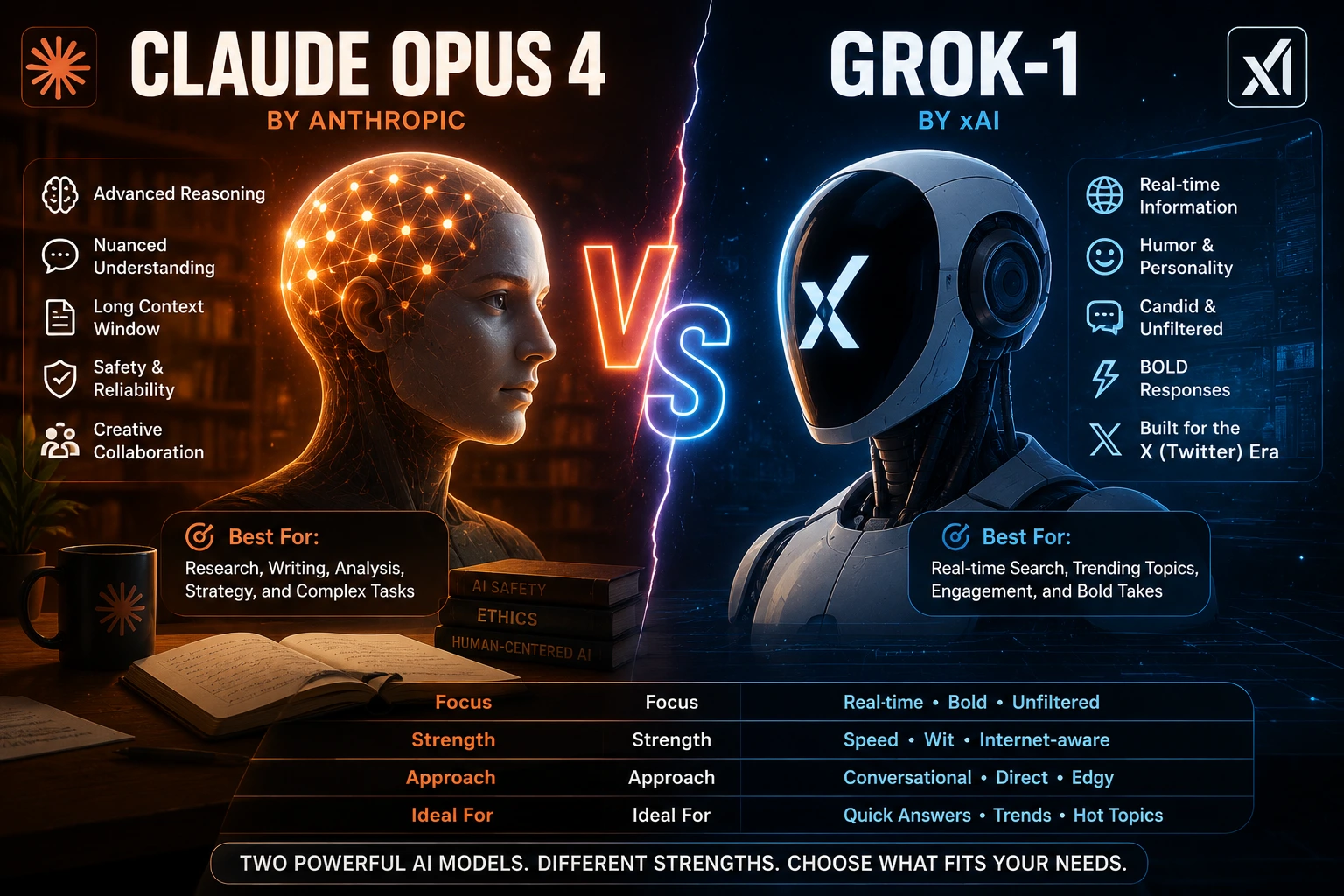
Claude Opus 4 VS Grok-1: Quick Comparison Table
| Feature | Claude Opus 4 | Grok-1 |
| Coding Performance | Excellent | Very Good |
| SEO Writing | Excellent | Good |
| Real-Time Internet Access | Limited | Excellent |
| AI Safety | Strong | Moderate |
| Long Context Handling | Excellent | Good |
| Prompt Consistency | Excellent | Moderate |
| Speed | Moderate | Fast |
| Enterprise Adoption | Strong | Growing |
| Frontend/UI Generation | Excellent | Mixed |
| API Ecosystem | Mature | Expanding |
| Structured Output | Excellent | Good |
| Hallucination Control | Better | Moderate |
| Creative Freedom | Moderate | Strong |
| Cost Efficiency | Moderate | Better |
| Automation Workflows | Excellent | Good |
Claude Opus 4 VS Grok-1 Benchmarks
AI benchmarks matter, but understanding benchmark interpretation matters even more.
Most comparison articles simply throw numbers at readers without explaining what they mean in real-world usage.
Major Benchmarks Compared
MMLU (Massive Multitask Language Understanding)
MMLU measures broad reasoning and academic intelligence.
Claude Opus 4 performs exceptionally well because of:
- Better structured reasoning
- Reduced hallucinations
- More reliable explanations
Grok performs strongly too, especially in faster reasoning tasks.
SWE-Bench
SWE-Bench evaluates software engineering capability.
Claude generally performs better in:
- Repository understanding
- Bug fixing
- Multi-step code reasoning
- Refactoring
This is one reason many developers prefer Claude for professional engineering workflows.
HumanEval
HumanEval focuses on coding generation quality.
Claude often produces:
- Cleaner code
- Better comments
- More maintainable structure
- Safer implementations
Grok tends to prioritize speed and concise generation.
AIME Reasoning Tests
Mathematical reasoning is increasingly important for AI agents.
Claude excels in:
- Step-by-step logic
- Consistent reasoning chains
- Reduced logical collapse
Grok performs well but may occasionally skip logical steps for speed.
Claude Opus 4 VS Grok-1 for Coding
This section is one of the most important for developers and AI engineers.
Backend Development
Claude Opus 4 is significantly stronger for:
- Python
- TypeScript
- Node.js
- SQL
- Rust
- API architecture
- Database optimization
Developers often report that Claude understands architecture decisions more deeply.
Claude Strengths
- Better repository awareness
- Cleaner abstractions
- Superior debugging
- Stronger refactoring
- Safer production code
Grok Strengths
- Faster iterations
- Quick prototypes
- Brainstorming support
- Lightweight coding tasks
Frontend UI Generation
Frontend generation is a major weakness in many AI systems.
Claude typically produces:
- Cleaner Tailwind layouts
- Better React structures
- More responsive design
- Improved component organization
Grok can generate visually interesting layouts quickly, but consistency sometimes varies.
Real-World Developer Feedback
Across developer communities and Reddit discussions, many programmers note that Claude follows frontend instructions more reliably.
Common praise includes:
- Better spacing consistency
- Improved CSS structure
- Fewer hallucinated imports
- Cleaner React state management
Grok users frequently praise speed but mention occasional formatting instability.
Multi-File Projects
Claude Opus 4 clearly performs better in large-scale projects.
Examples include:
- SaaS applications
- Enterprise dashboards
- AI agent systems
- Documentation-heavy repositories
Long-context handling gives Claude a major advantage.
Debugging & Refactoring
Claude is generally considered superior for debugging because it:
- Explains errors clearly
- Detects hidden issues
- Suggests architectural improvements
- Maintains context over long sessions
Grok works well for quick fixes but can occasionally lose context during extended debugging chains.
Claude VS Grok for Content Writing
Content creators, SEO agencies, marketers, and publishers care deeply about writing quality.
SEO Blog Writing
Claude Opus 4 performs exceptionally well for:
- Long-form articles
- Semantic SEO
- Structured headings
- Featured snippet optimization
- Human-like formatting
- Tone consistency
This makes Claude highly valuable for content-heavy websites.
Grok performs better in:
- Fast ideation
- Trend-based writing
- Casual conversational style
- Social media brainstorming
Brand Voice Consistency
Claude is significantly stronger for maintaining:
- Tone consistency
- Professional structure
- Formal brand identity
- Long-document coherence
This matters greatly for European agencies and enterprise brands.
Storytelling & Creative Writing
Grok’s open conversational style helps with:
- Humor
- Casual storytelling
- Viral social concepts
- Creative experimentation
However, Claude usually wins in:
- Narrative structure
- Emotional pacing
- Long-form readability
AI Safety & Alignment
AI safety is becoming a critical factor in enterprise adoption.
Claude’s Constitutional AI
Claude uses a safety-focused alignment strategy designed to reduce:
- Harmful outputs
- Bias escalation
- Hallucinations
- Unsafe automation
This makes it attractive for:
- Financial institutions
- Healthcare organizations
- Enterprise SaaS
- Government workflows
Grok’s Open Style
Grok prioritizes openness and conversational flexibility.
Advantages include:
- Less restrictive interactions
- More creative freedom
- Faster responses
However, enterprises may view this as riskier for regulated industries.

API & Developer Ecosystem
Both AI systems continue expanding their ecosystems rapidly.
Claude API Ecosystem
Claude integrates well with:
- IDE workflows
- AI coding assistants
- MCP ecosystems
- Automation pipelines
- Enterprise SaaS tools
Claude Strengths for Developers
- Better structured outputs
- Stable automation workflows
- Reliable JSON generation
- Enterprise integrations
Grok API Ecosystem
Grok’s ecosystem is growing quickly through:
- X integrations
- Real-time web connectivity
- Social AI workflows
- Startup automation
Grok is especially attractive for builders focused on:
- Live-data systems
- Social intelligence
- Real-time monitoring tools
Pricing Comparison
Pricing matters heavily for startups and scaling companies.
| Pricing Factor | Claude Opus 4 | Grok-1 |
| Enterprise Plans | Strong | Growing |
| API Stability | Excellent | Moderate |
| Cost Efficiency | Moderate | Better |
| Scaling for Startups | Moderate | Good |
| Long Context Value | Excellent | Good |
| Free Ecosystem Exposure | Limited | Stronger |
Who Benefits More?
Choose Claude If:
- You prioritize quality
- You need production reliability
- You run enterprise workflows
- You build AI agents
- You create SEO content
Choose Grok If:
- You need cheaper experimentation
- You prioritize speed
- You build social tools
- You need live internet reasoning
Claude Opus 4 VS Grok-1 for Startups
Startups care about speed, scalability, and automation.
Claude for Startups
Claude is ideal for startups building:
- AI SaaS products
- Enterprise tools
- Developer platforms
- Automation agencies
Its reliability reduces engineering risk.
Grok for Startups
Grok works well for:
- Rapid prototyping
- Social media tools
- Trend intelligence
- Lightweight AI products
Its faster conversational nature helps lean startup teams iterate quickly.
Real Developer & Reddit Insights
Community feedback reveals major differences between these models.
What Developers Say About Claude
Common praise includes:
- Reliable coding
- Better prompt obedience
- Stronger documentation
- Cleaner architecture
- Excellent debugging
Many developers trust Claude for production environments.
What Developers Say About Grok
Common praise includes:
- Fast responses
- Creative reasoning
- Real-time awareness
- Fun interaction style
However, some users report:
- Inconsistent formatting
- Reduced long-session stability
- More hallucinations in technical tasks
Long Context Performance
Long-context reasoning is becoming essential in 2026.
Claude’s Advantage
Claude handles:
- Large PDFs
- Massive repositories
- Long conversations
- Enterprise documentation
extremely well.
This gives it a strong edge for:
- Legal AI
- Research AI
- Coding copilots
- Technical analysis
Grok’s Performance
Grok performs reasonably well but is more optimized for fast conversational interaction rather than extremely deep document workflows.
Automation & AI Agents
Agentic AI is one of the biggest trends in 2026.
Claude for AI Agents
Claude works extremely well for:
- Multi-step planning
- Structured workflows
- Automation chains
- Tool calling
- Enterprise orchestration
Its predictability is highly valuable.
Grok for AI Agents
Grok performs better in:
- Fast idea exploration
- Live-data interactions
- Social monitoring agents
- Conversational assistants
Pros & Cons
Claude Opus 4 Pros
- Exceptional coding reliability
- Superior long-context reasoning
- Excellent SEO writing
- Better structured outputs
- Enterprise-grade safety
- Strong debugging ability
- Reliable automation workflows
Claude Opus 4 Cons
- Higher pricing
- Slower responses
- More restrictive safety filtering
Grok-1 Pros
- Faster responses
- Real-time information strengths
- Lower scaling costs
- Creative conversational style
- Strong social ecosystem integration
Grok-1 Cons
- Less stable formatting
- More hallucination risk
- Weaker long-form consistency
- Less enterprise maturity
How to Use These AI Tools Effectively
Best Practices for Claude Opus 4
For Developers
- Use structured prompts
- Provide repository context
- Request step-by-step reasoning
- Ask for code reviews
For SEO Writers
- Use heading outlines
- Request semantic keyword integration
- Generate schema-ready FAQs
- Optimize for snippets
Best Practices for Grok-1
For Creators
- Use brainstorming prompts
- Explore trend-based ideas
- Test conversational marketing copy
For Startups
- Monitor social sentiment
- Generate rapid prototypes
- Use live-data workflows
Tips to Write Better AI Prompts
Good prompts dramatically improve output quality.
Do This
- Be specific
- Define output format
- Mention audience
- Provide examples
- Request structured responses
Avoid This
- Vague instructions
- Overly broad prompts
- Missing context
- Conflicting requirements
Europe-Focused AI Adoption Trends
Across Europe, AI adoption is accelerating rapidly.
Countries such as:
- Germany
- France
- Netherlands
- Sweden
- Switzerland
- United KingdomThey
are heavily investing in enterprise AI workflows, automation systems, and AI-assisted development.
European businesses often prioritize:
- Data privacy
- Reliable outputs
- Compliance
- Enterprise trust
This gives Claude a strong advantage in regulated industries.
However, startups and social AI companies increasingly experiment with Grok because of its speed and live internet strengths.
Claude Opus 4 VS Grok-1: Which AI Should You Choose?
Choose Claude Opus 4 If:
You need:
- Reliable coding
- Enterprise workflows
- SEO article generation
- Long-context analysis
- Structured outputs
- Safer automation
- Professional documentation
Claude is especially strong for developers, agencies, SaaS companies, and enterprise teams.
Choose Grok-1 If:
You need:
- Fast responses
- Real-time internet awareness
- Social media intelligence
- Trend analysis
- Creative brainstorming
- Lightweight experimentation
Grok is attractive for startups, creators, and social AI projects.
Future of AI Competition
The AI race is evolving beyond simple chatbots.
Major Trends for 2026
Agentic AI
AI systems increasingly operate autonomously across workflows.
Autonomous Coding
AI copilots now handle:
- Refactoring
- Testing
- Deployment support
- Repository management
Multimodal AI
Future systems combine:
- Text
- Video
- Voice
- Images
- Real-time internet reasoning
Enterprise AI Wars
Competition between major AI companies continues to intensify.
Key players include:
- OpenAI
- Anthropic
- xAI
- Meta
The future will likely reward AI systems that balance:
- Reliability
- Speed
- Context intelligence
- Real-time awareness
- Automation capability
People Also Ask
A: Claude Opus 4 is generally better for coding reliability, long-context reasoning, SEO writing, and enterprise workflows. Grok-1 performs better for speed, real-time internet reasoning, and social AI interactions.
A: Many developers currently prefer Claude Opus 4 because of its debugging quality, structured outputs, repository understanding, and prompt consistency.
A: Not completely. Grok excels in speed and live-data workflows, while Claude remains stronger for structured enterprise tasks, automation systems, and professional development workflows.
A: Grok is generally considered more cost-efficient for scaling and experimentation. Claude offers higher reliability but may cost more for enterprise-level usage.
A: Both models are strong reasoners, but Claude often performs better in multi-step logical tasks and structured analysis.
Conclusion
The battle between Claude Opus 4 and Grok-1 represents two different visions of artificial intelligence.
Claude Opus 4 focuses on precision, enterprise reliability, structured workflows, long-context reasoning, and production-grade coding. It is currently one of the strongest AI systems for developers, SEO professionals, automation agencies, and enterprise organizations that value consistency and trust.
Grok-1, on the other hand, prioritizes speed, real-time information, creative flexibility, and social integration. It is highly appealing for startups, creators, social AI tools, and teams that move quickly and experiment Aggressively.
There is no universal winner.
The best AI model depends entirely on your workflow, business goals, budget, and technical requirements.
If your priority is coding quality, structured reasoning, and professional content generation, Claude Opus 4 is likely the better choice.
If you need fast responses, live internet awareness, and rapid experimentation, Grok-1 can be extremely powerful.
As AI competition intensifies in 2026, businesses that understand these differences early will gain a major productivity advantage.
Bookmark this guide, share it with your developer team, and explore more AI comparisons on Ultraaiguide.com to stay ahead in the rapidly evolving AI ecosystem.