Introduction
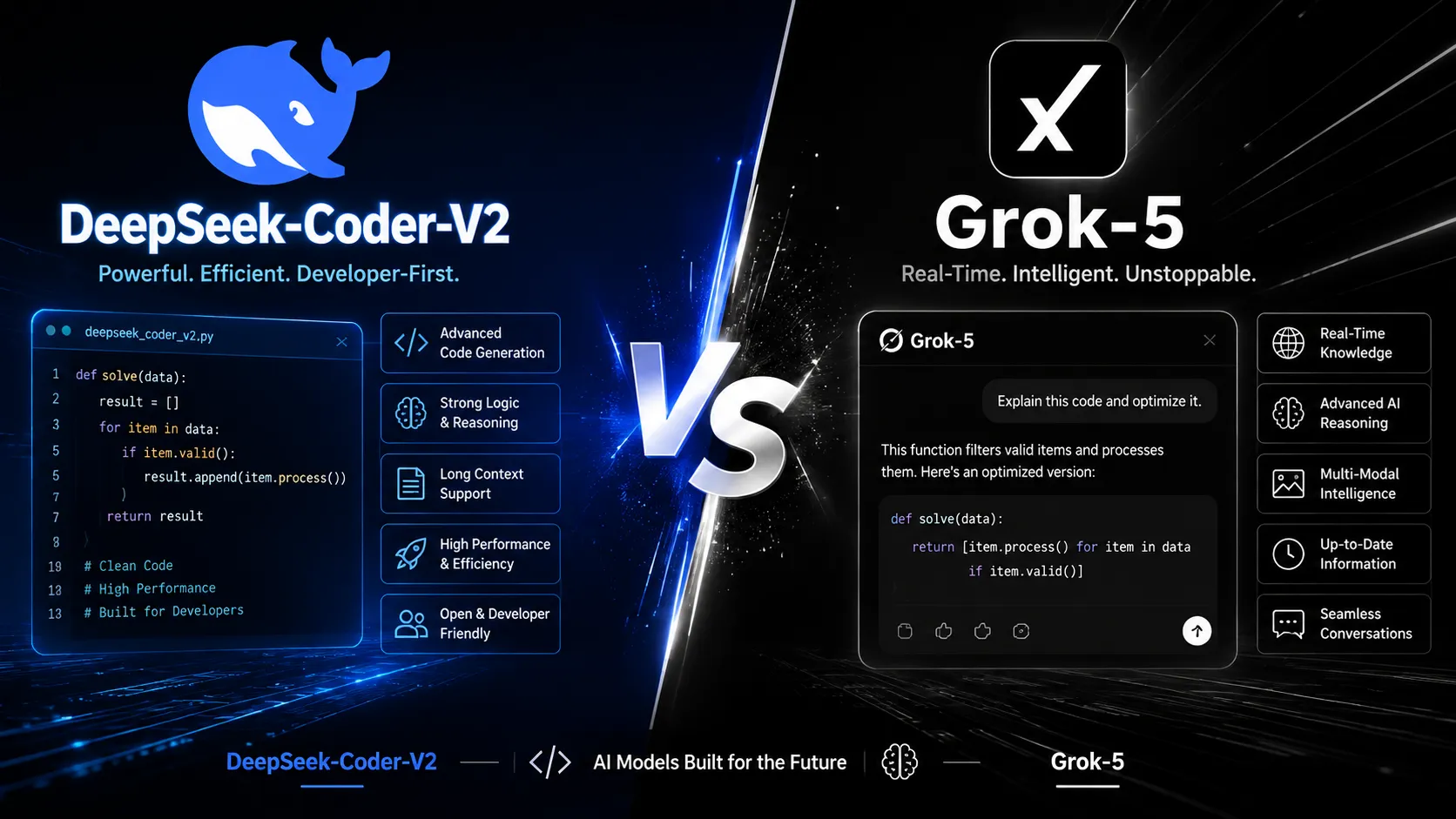
DeepSeek-Coder-V2 vs Grok-5 looks like a straightforward AI showdown—but there is a major problem: the available evidence for the two models is not equally verifiable.
DeepSeek-Coder-V2 has documented model sizes, a 128K context window, support for 338 programming languages, open weights, and published coding evaluations. Grok’s current official documentation, meanwhile, points to newer Grok generations rather than providing a verified Grok-5 specification.
So instead of repeating internet rumors, this comparison focuses on what developers actually need to know: coding, debugging, benchmarks, context, programming languages, deployment, agents, real-world workflows, and which model makes sense for which job.
DeepSeek-Coder-V2 vs Grok-5 at a Glance
If you want the short answer, DeepSeek-Coder-V2 has the stronger verifiable coding evidence, while a definitive Grok-5 verdict should wait for official specifications and reproducible tests.
| Feature | DeepSeek-Coder-V2 | Grok-5 |
| Developer | DeepSeek | xAI |
| Primary strength | Coding + reasoning | Not sufficiently verified for Grok-5 |
| Architecture | Mixture of Experts | Not officially verified |
| Model sizes | 16B Lite / 236B | Not reliably verified |
| Active parameters | 2.4B / 21B | Not reliably verified |
| Context | 128K | Not reliably verified |
| Programming languages | 338 | Not reliably verified |
| Open weights | Yes | Not confirmed |
| Public coding benchmarks | Yes | No comparable verified Grok-5 set |
| Self-hosting | Yes | Not confirmed |
| Best current evidence | Strong coding-specific documentation | Requires official Grok-5 evidence |
DeepSeek’s published repository confirms the 16B and 236B variants, 2.4B and 21B active parameters, and 128K context.
- DeepSeek-Coder-V2 is a dedicated coding model.
- Its specifications are publicly documented.
- It uses a Mixture-of-Experts architecture.
- It has 16B and 236B variants.
- Only a fraction of the total parameters are active.
- It supports a 128K context window.
- DeepSeek reports 338 supported programming languages.
- A benchmark without identical testing conditions is weak evidence.
- Developers need workflow comparisons, not just model statistics.
- The safest current verdict favors the model with verifiable evidence.
What Is DeepSeek-Coder-V2?
DeepSeek-Coder-V2 is an open-weight Mixture-of-Experts code language model designed to improve coding and mathematical reasoning.
The family includes Lite and larger versions, giving developers different deployment possibilities.
- DeepSeek-Coder-V2 is specialized for code intelligence.
- It uses the DeepSeekMoE framework.
- The family includes a 16B Lite model.
- It also includes a 236B model.
- The Lite model activates 2.4B parameters.
- The larger model activates 21B parameters.
- Both are documented with 128K context.
- Base variants are available.
- Instruct variants are available.
- The model supports hundreds of programming languages.
- DeepSeek publicly released model weights.
- It targets coding and mathematical reasoning.
- It can be used outside a proprietary chat interface.
- Developers can build custom deployments around it.
- Its public documentation makes technical evaluation easier.
What Is Grok-5?
This is where comparison articles often go wrong.
A page targeting Grok-5 should not automatically copy specifications from Grok 3, Grok 4, Grok 4.5, or Grok 4.6 and label them as Grok-5 facts.
Current official xAI documentation I found identifies Grok 4.6 as the current Grok assistant, while xAI’s July 2026 announcement discusses Grok 4.5 for coding, agentic tasks, and knowledge work.
Therefore, this article treats Grok-5-specific claims as unverified unless supported by an official xAI announcement or reproducible independent evaluation.
- A model name alone does not establish its specifications.
- Rumored parameter counts are not benchmark evidence.
- Social-media posts are not technical documentation.
- Third-party claims can conflict.
- Grok generations should not be mixed.
- Grok 4.5 should not automatically be called Grok-5.
- Grok 4.6 should not automatically be called Grok-5.
- Context-window claims require verification.
- Coding scores require benchmark conditions.
- Pricing requires an official source.
- API availability can change.
- Product availability can differ from model availability.
- A newer model is not automatically better for every workflow.
- Independent testing matters.
- Official xAI documentation should be the final authority.
DeepSeek-Coder-V2 vs Grok-5: Architecture
Architecture matters because two models with similar-looking parameter counts can behave very differently.
DeepSeek-Coder-V2 uses a Mixture-of-Experts design. Its 236B version has 21B active parameters, while the 16B Lite version has 2.4B active parameters.
For Grok-5, avoid publishing architecture details until they are officially documented.
- DeepSeek-Coder-V2 uses MoE.
- MoE does not mean every parameter is active for every token.
- The 236B figure represents total parameters.
- The 21B figure represents active parameters.
- The Lite model has 16B total parameters.
- The Lite model activates 2.4B parameters.
- MoE can help balance model capacity and computation.
- Architecture affects deployment requirements.
- Parameter count alone does not determine quality.
- Active parameters are useful when discussing inference.
- Context length also affects practical workload capacity.
- Coding specialization matters alongside architecture.
- Training data matters alongside parameter count.
- Tool use can change real-world performance.
- Architecture claims for Grok-5 should remain unverified until officially published.

DeepSeek-Coder-V2 vs Grok-5 Coding Performance
For developers, coding performance is more important than flashy model specifications.
DeepSeek’s published evaluation reports 90.2% on HumanEval, 76.2% on MBPP+, 43.4% on LiveCodeBench, and 73.7% on Aider for DeepSeek-Coder-V2-Instruct.
- Code generation tests raw implementation ability.
- Code completion tests prediction quality.
- Debugging tests error diagnosis.
- Refactoring tests code transformation.
- Repository tasks test broader context handling.
- Aider-style evaluations are closer to practical coding workflows.
- LiveCodeBench can provide more challenging coding evidence.
- HumanEval is useful but should not be treated as the whole story.
- MBPP+ adds another coding perspective.
- Benchmark scores depend on evaluation methodology.
- Prompting can influence results.
- Model versions must be identical during comparison.
- Tool access can change agent performance.
- Human developer judgment still matters.
- No verified Grok-5 head-to-head score should be invented.
DeepSeek-Coder-V2 vs Grok-5 Benchmarks
Benchmark tables are useful only when readers understand what they actually measure.
| Benchmark | DeepSeek-Coder-V2 | Grok-5 | Current interpretation |
| HumanEval | 90.2%* | Verify | DeepSeek evidence available |
| MBPP+ | 76.2%* | Verify | DeepSeek evidence available |
| LiveCodeBench | 43.4%* | Verify | No equivalent verified Grok-5 result here |
| Aider | 73.7%* | Verify | Useful coding-agent evidence |
| MATH | 75.7%* | Verify | Mathematical reasoning evidence |
| GSM8K | 94.9%* | Verify | Reasoning evidence |
- Never compare unrelated benchmark versions.
- Never hide evaluation conditions.
- Provider benchmarks should be labeled.
- Independent tests deserve extra weight.
- Coding benchmarks measure specific abilities.
- General reasoning tests are different.
- Agent benchmarks measure workflow performance.
- Tool-enabled scores are not directly comparable with tool-free scores.
- Prompt format can affect results.
- Sampling settings can affect results.
- Dataset contamination can complicate interpretation.
- Older benchmarks may become saturated.
- One benchmark should never determine the winner.
- Real-world developer testing adds valuable evidence.
- “Winner” should depend on the task.
DeepSeek-Coder-V2 vs Grok-5 Context Window
Context length becomes important when developers work with large repositories, documentation, logs, tests, and multiple files.
DeepSeek-Coder-V2 officially documents a 128K context length.
That makes it particularly relevant to repository-level analysis and long coding sessions.
- Large repositories contain many files.
- Documentation can consume thousands of tokens.
- Debugging logs can become extremely long.
- API documentation may need to stay in context.
- Refactoring often requires multiple files.
- Architecture reviews need broader context.
- Test suites can generate large inputs.
- Agent planning can accumulate information.
- Long conversations can preserve project history.
- Context helps reduce repeated explanations.
- Larger context does not guarantee better reasoning.
- Retrieval quality still matters.
- Relevant context is better than irrelevant context.
- Context limits should be tested in real workloads.
- Grok-5’s exact context figure should be verified before publication.
DeepSeek-Coder-V2 vs Grok-5 Programming Language Support
One of DeepSeek-Coder-V2’s strongest documented advantages is language coverage.
DeepSeek says Coder-V2 expanded programming-language support from 86 to 338 languages.
That makes this model particularly interesting for developers who work outside a single mainstream language.
- Go is supported.
- Rust is supported.
- PHP is supported.
- SQL is supported.
- C# is supported.
- Swift-related development can be evaluated separately.
- The documented language count is 338.
- Broad language coverage helps multilingual development teams.
- Specialized languages can benefit from dedicated training coverage.
- Grok-5 language coverage should be verified rather than guessed.
DeepSeek-Coder-V2 vs Grok-5 for Real-World Developers
The most useful comparison is not “Which model has the biggest number?”
It is:
Which model solves your actual development problem better?
- Python: DeepSeek-Coder-V2 has strong coding-specific evidence.
- JavaScript: DeepSeek provides broad documented language coverage.
- TypeScript: Useful for modern web development.
- C++: Relevant for performance-heavy applications.
- Rust: Useful for systems programming.
- Debugging: Evaluate with your own real bugs.
- Refactoring: Test multi-file transformations.
- Code explanation: Compare clarity, not just correctness.
- Documentation: Test long project documents.
- Large repositories: Context becomes especially important.
- Mathematics: DeepSeek publishes mathematical evaluation results.
- Self-hosting: DeepSeek has a clear open-weight advantage.
- AI agents: Tool use must be evaluated separately.
- General-purpose work: A coding-specialized model may not always be ideal.
- Production: Reliability matters more than benchmark bragging rights.
Open-Weight vs Proprietary AI Approach
This is one of the biggest differences developers should consider.
DeepSeek-Coder-V2’s public model weights provide more flexibility for experimentation, custom deployment, research, and self-hosting.
A hosted proprietary ecosystem can offer a different advantage: users do not have to manage model infrastructure themselves.
- Open weights provide deployment flexibility.
- Self-hosting gives infrastructure control.
- Local deployment can improve data-control options.
- Researchers can experiment with released models.
- Developers can integrate models into custom systems.
- Hardware requirements remain important.
- Large MoE models can be demanding.
- Quantization can affect deployment possibilities.
- Hosted APIs reduce infrastructure management.
- Hosted services can simplify scaling.
- Proprietary models may provide integrated products.
- API ecosystems can simplify application development.
- Vendor dependence is a strategic consideration.
- Evaluate cost based on actual usage volume.
- The best deployment model depends on the developer’s priorities.
DeepSeek-Coder-V2 vs Grok-5 for Coding Agents
Modern software development is moving beyond simple “write me a function” prompts.
Coding agents can navigate repositories, edit multiple files, execute commands, run tests, inspect errors, and repeat the process.
xAI has already demonstrated its focus on coding agents through Grok 4.5, which xAI describes as designed for coding, agentic tasks, and knowledge work.
- Terminal interaction
- Repository navigation
- File editing
- Multi-file changes
- Test execution
- Error interpretation
- Debugging loops
- Planning
- Tool calling
- Code review
- Dependency management
- Git workflows
- Long-running tasks
- Recovery from failed commands
- Human approval checkpoints
Which Is Better for Coding?
That does not mean it is automatically the best model for every developer.
- Choose DeepSeek-Coder-V2 for documented coding specialization.
- Choose it when open weights matter.
- Choose it when self-hosting matters.
- Choose it when 128K context is useful.
- Choose it when broad language support matters.
- Choose it when public benchmark evidence matters.
- Test it on your own repository before committing.
- Consider hosted Grok products for broader workflows.
- Consider agentic workflows separately from coding benchmarks.
- Do not use model age alone to determine quality.
- Do not assume a newer model always wins.
- Do not assume parameter count predicts coding ability.
- Measure latency for your workload.
- Measure total cost for your workload.
- Revisit the comparison when official Grok-5 evidence becomes available.
Pros and Cons
Pros
- Strong coding specialization
- Open weights
- 128K context
- 338 documented programming languages
- MoE architecture
- Public benchmark results
- Multiple model sizes
- Self-hosting potential
Cons
- It is an older model generation.
- Large variants require serious infrastructure.
- Provider-reported benchmarks don’t match independent testing.
- Benchmark performance may not equal modern agent performance.
- General-purpose capabilities may not be its strongest reason to choose it.
Pros
Only claim Grok-5-specific advantages when supported by official xAI documentation.
The broader Grok ecosystem has demonstrated investment in coding and agentic workflows, including Grok 4.5.
Cons
- Grok-5-specific specifications require verification.
- Rumored benchmarks should not be treated as facts.
- Availability can change.
- Pricing can change.
- Comparisons across Grok generations can create misleading conclusions.
- DeepSeek wins on documentation transparency.
- DeepSeek wins on open-weight flexibility.
- DeepSeek has strong coding-specific evidence.
- DeepSeek offers broad language support.
- DeepSeek has a documented 128K context.
- DeepSeek is not a brand-new model.
- Self-hosting requires technical resources.
- Grok has a broader product ecosystem.
- Grok has demonstrated agentic ambitions.
- Grok’s current official ecosystem has moved beyond older generations.
- Grok-5 rumors should not be treated as specifications.
- Independent tests are more valuable than marketing claims.
- Use-case performance matters more than model branding.
- Cost should be calculated from actual usage.
- The “best AI” depends on the job.
Final Verdict — DeepSeek-Coder-V2 vs Grok-5
For a developer choosing based on verifiable evidence, DeepSeek-Coder-V2 is currently the safer choice.
It offers documented 16B and 236B variants, 128K context, 338 programming languages, publicly released weights, and published coding evaluations.
The Grok ecosystem is clearly investing in coding and agentic software engineering, but the important SEO and factual distinction is this: evidence about Grok 4.5 or Grok 4.6 is not automatically evidence about Grok-5. Current official xAI material I found identifies Grok 4.6 as its current assistant model.
So the honest verdict is:
That is a much stronger conclusion than inventing a benchmark winner.
- DeepSeek-Coder-V2 has strong documented coding credentials.
- Its 128K context is useful for large coding tasks.
- Its 338-language support is a major differentiator.
- Its open weights provide deployment flexibility.
- Its MoE design offers a distinctive architecture.
- Published benchmarks provide measurable evidence.
- Those benchmarks are not modern Grok-5 head-to-head tests.
- Grok should be evaluated by generation.
- Grok 4.5 evidence should not be mislabeled as Grok-5 evidence.
- Current official xAI documentation points to Grok 4.6.
- Developers should test models on real repositories.
- Agents need separate evaluation from code-generation benchmarks.
- Cost and latency matter in production.
- “Best” depends on the workflow.
- Evidence beats hype.
People Also Ask
A: There is no reliable apples-to-apples answer using verified Grok-5-specific evidence. DeepSeek-Coder-V2 currently has the stronger documented coding evidence.
A: Based on verifiable evidence, DeepSeek-Coder-V2 is the safer coding choice. Its published evaluations and technical specifications are publicly documented.
A: Yes. DeepSeek’s documentation lists a 128K context length for its Coder-V2 variants.
A: DeepSeek states that Coder-V2 expanded support from 86 to 338 programming languages.
A: DeepSeek publicly released the Coder-V2 model weights and provides Base, Instruct, and Lite variants.
How to Choose Between Them
Use this quick decision guide:
| Your priority | Better direction |
| Open weights | DeepSeek-Coder-V2 |
| Self-hosting | DeepSeek-Coder-V2 |
| Documented coding benchmarks | DeepSeek-Coder-V2 |
| 128K documented context | DeepSeek-Coder-V2 |
| 338-language support | DeepSeek-Coder-V2 |
| Broad hosted AI ecosystem | Grok ecosystem |
| Agentic development | Evaluate the specific current Grok model |
| General-purpose AI | Evaluate the current Grok generation |
| Large repository analysis | DeepSeek-Coder-V2 is a strong candidate |
| Production deployment | Benchmark both on your workload |
Conclusion
DeepSeek-Coder-V2 vs Grok-5 is not a Comparison where the smartest SEO strategy is to manufacture a winner. DeepSeek-Coder-V2 has the advantage of verifiable technical specifications, open weights, 128K context, broad programming-language coverage, and published coding evaluations.
If you’re a developer who values open deployment, coding specialization, documented benchmarks, and technical transparency, DeepSeek-Coder-V2 is the safer evidence-based choice. Your priority is a current hosted AI ecosystem and advanced agentic workflows, evaluate the latest officially documented Grok model rather than relying on unverified Grok-5 claims.