Introduction
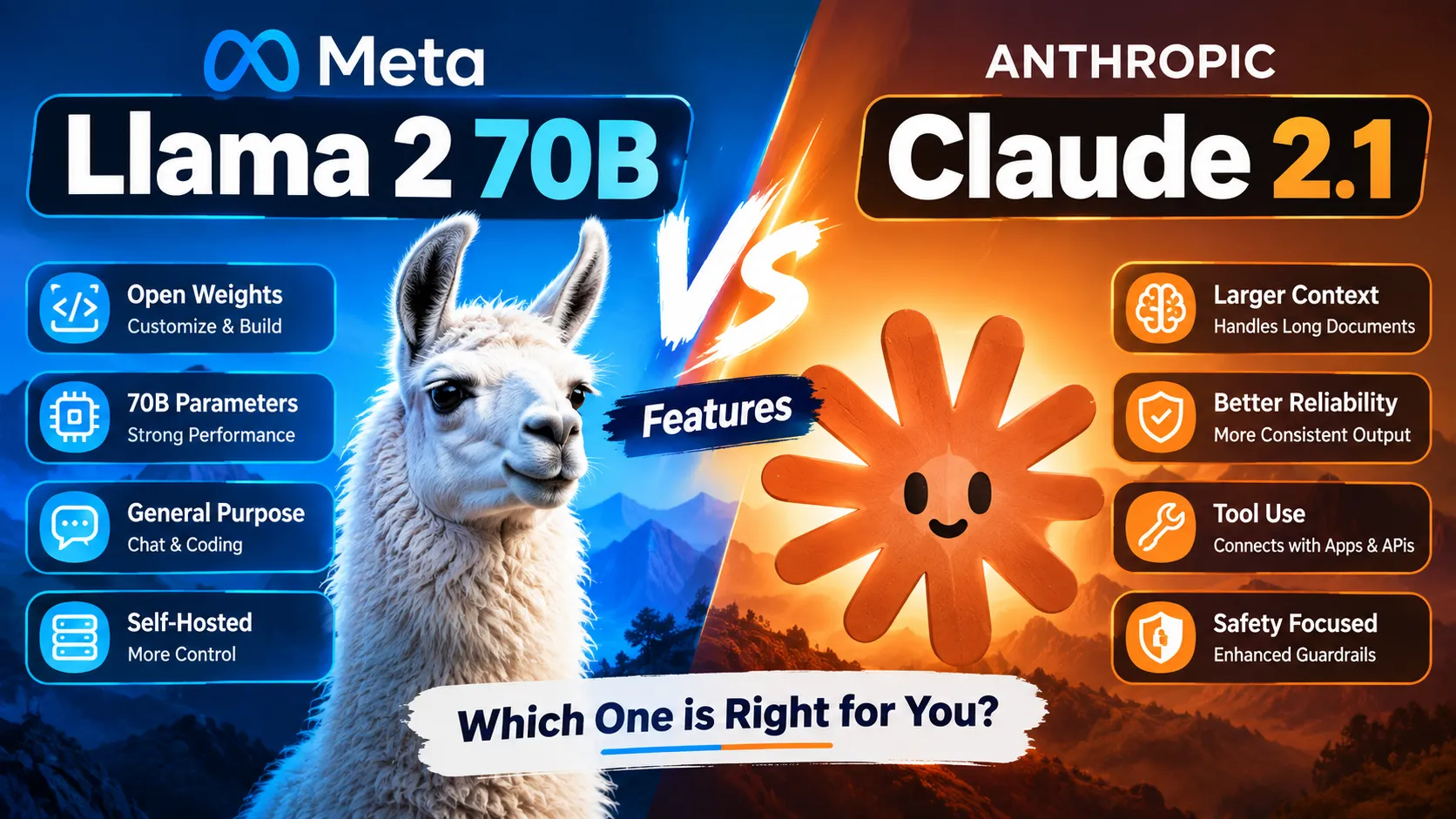
Llama 2 70B vs Claude 2.1 features Highlight two very different approaches to AI development in 2023. Meta’s Llama 2 70B emphasized accessible model weights, customization, research, and self-managed deployment, while Anthropic’s Claude 2.1 focused on massive context, long-document analysis, system prompts, reliability, and API-based tool use.
The difference becomes especially clear when you look beyond headline benchmark numbers.
Llama 2 70B was built around developer control. Claude 2.1 was built around managed AI capabilities and unusually large context.
Meta released Llama 2 on July 18, 2023, including a 70B model. Anthropic introduced Claude 2.1 in November 2023 with a 200,000-token context window, system prompts, and beta tool use.
There is also an important historical qualification: Claude 2.1 is no longer available as a current production model. Anthropic retired Claude 2.1 on July 21, 2025.
So this comparison is most useful for historical research, legacy systems, AI history,y and understanding how open-weight and proprietary LLMs evolved.
Llama 2 70B vs Claude 2.1: Quick Answer
If you only need the answer, use this rule:
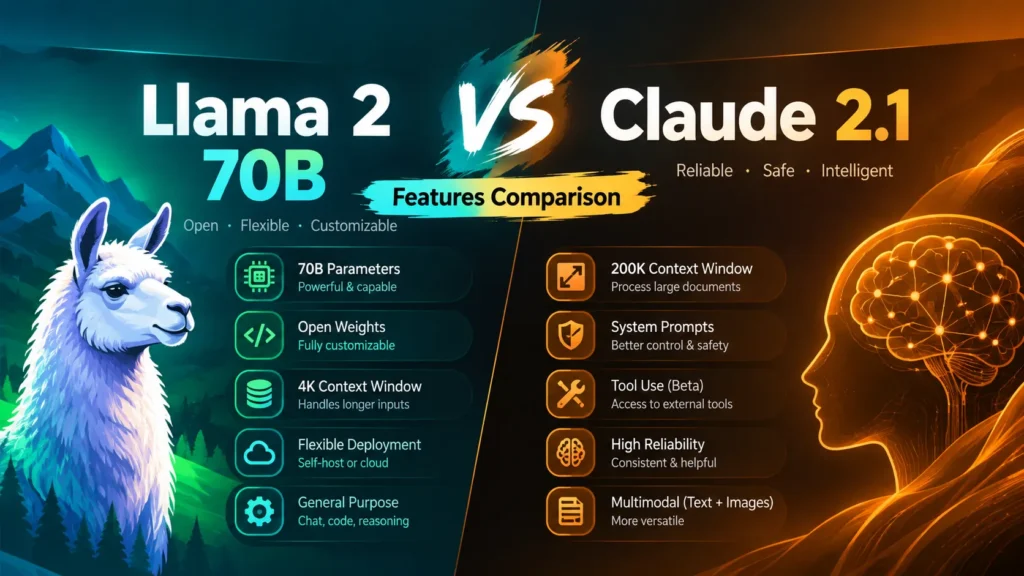
- Choose Llama 2 70B for: model control, self-hosting, customization, research, and open-weight experimentation.
- Choose Claude 2.1 for: huge documents, long-context analysis, system instructions, and managed API workflows.
- Context winner: Claude 2.1.
- Self-hosting winner: Llama 2 70B.
- Customization winner: Llama 2 70B.
- Long-document winner: Claude 2.1.
- Tool-use winner: Claude 2.1.
- Historical open-model ecosystem winner: Llama 2 70B.
- 2026 production winner: neither; newer models should be considered.
Llama 2 70B vs Claude 2.1 Features at a Glance
The fastest way to understand the competition is to compare the fundamentals before examining individual capabilities.
| Feature | Llama 2 70B | Claude 2.1 |
| Developer | Meta | Anthropic |
| Generation | 2023 | 2023 |
| Parameters | 70B | Not publicly disclosed |
| Original context | 4,096 tokens | 200,000 tokens |
| Model access | Weights available under Meta license | Proprietary |
| Self-hosting | Yes, subject to infrastructure/license | No original-weight self-hosting |
| Fine-tuning | Strong ecosystem | Limited compared with open-weight deployment |
| System prompts | Implementation-dependent | Explicitly introduced |
| Tool use | Not comparable to Claude 2.1’s native API feature | Beta tool use |
| Long documents | Limited | Major strength |
| API workflow | Via providers/deployments | Anthropic API |
| Best historical strength | Control | Context |
| Current status | Legacy | Retired |
Anthropic specifically described Claude 2.1’s 200K context as enough for roughly 150,000 words or more than 500 pages.
15 important takeaways
- Llama 2 70B has a known 70-billion-parameter size.
- Claude 2.1’s parameter count was not publicly disclosed.
- Llama 2 70B has a 4,096-token original context.
- Claude 2.1 supports 200,000 tokens.
- Llama is fundamentally more customizable.
- Claude emphasizes managed access.
- Llama supports self-managed deployment.
- Claude was designed for very large inputs.
- Llama became important to the open-weight ecosystem.
- Claude introduced prominent system-prompt support with 2.1.
- Claude 2.1 added beta tool use.
- Llama requires significant compute at 70B scale.
- Claude shifts infrastructure responsibility toward the provider.
- Neither model should be treated as a cutting-edge 2026 system.
- The right winner depends on the workload.
What Is Llama 2 70B?
Llama 2 is Meta’s second-generation Llama family, released in 7B, 13B, and 70B parameter sizes. Meta also released chat-tuned versions for conversational applications.
The 70B model was the largest standard Llama 2 model.
Meta’s published evaluation table reports Llama 2 70B results across code, commonsense reasoning, world knowledge, reading comprehension, mathematics, MMLU, BBH, and AGI evaluation.
15 facts about Llama 2 70B
- It belongs to Meta’s Llama 2 family.
- It launched in 2023.
- The largest standard model was 70B.
- Meta also released smaller 7B and 13B versions.
- Chat-tuned versions were separately developed.
- The model uses a transformer architecture.
- Meta reported training on approximately 2 trillion tokens.
- The original context length was 4,096 tokens.
- The model uses grouped-query attention.
- It became widely used in research.
- It supported local deployment scenarios.
- It encouraged model fine-tuning.
- Quantized community versions expanded accessibility.
- Its license included specific conditions.
- It became an important milestone in open-weight AI development.
One SEO-critical distinction is Llama 2 70B versus Llama 2 70B Chat. A benchmark for the base model should not automatically be presented as a benchmark for the chat-tuned model.
What Is Claude 2.1?
Claude 2.1 was Anthropic’s major late-2023 update to Claude 2.
Rather than simply competing through a Parameter-count announcement, Anthropic emphasized practical capabilities: a 200K context window, lower false-statement rates, system prompts, better long-document performance, and beta tool use.
15 defining Claude 2.1 features
- 200,000-token context window.
- Long-document processing.
- System prompts.
- Beta tool use.
- API access.
- Large-document summarization.
- Document question answering.
- Document comparison.
- Codebase analysis.
- Financial-document analysis.
- Technical-document analysis.
- Improved honesty evaluations.
- Reduced incorrect answers.
- Better long-context retrieval.
- Enterprise-focused workflows.
Anthropic reported a 2× reduction in false statements compared with Claude 2.0 and a 30% reduction in incorrect answers in its evaluations.
Parameters and Architecture
This is one of the areas where comparison articles often become misleading.
Llama 2 70B has a clearly identified parameter count: 70 billion parameters.
Claude 2.1 does not have a publicly disclosed parameter count that can be compared directly with Llama 2 70B.
Therefore, saying “Claude has more parameters, so Claude is better” is unsupported.
15 important architecture considerations
- Llama 2 70B has a documented 70B size.
- Claude 2.1 has no comparable public parameter figure.
- Parameter count is not equivalent to intelligence.
- Architecture matters.
- Training data matters.
- Fine-tuning matters.
- Alignment affects output behavior.
- Context capacity affects workflows.
- Inference infrastructure affects performance.
- Prompting affects results.
- Tool access can expand practical capabilities.
- Retrieval can compensate for knowledge limitations.
- Benchmark methodology affects rankings.
- Model size alone cannot determine the winner.
- Workload-specific testing is more meaningful.
This is an important information-gain opportunity because it prevents readers from making a simplistic parameter-count comparison.
Context Window: 4K vs 200K
This is the most dramatic Specification difference.
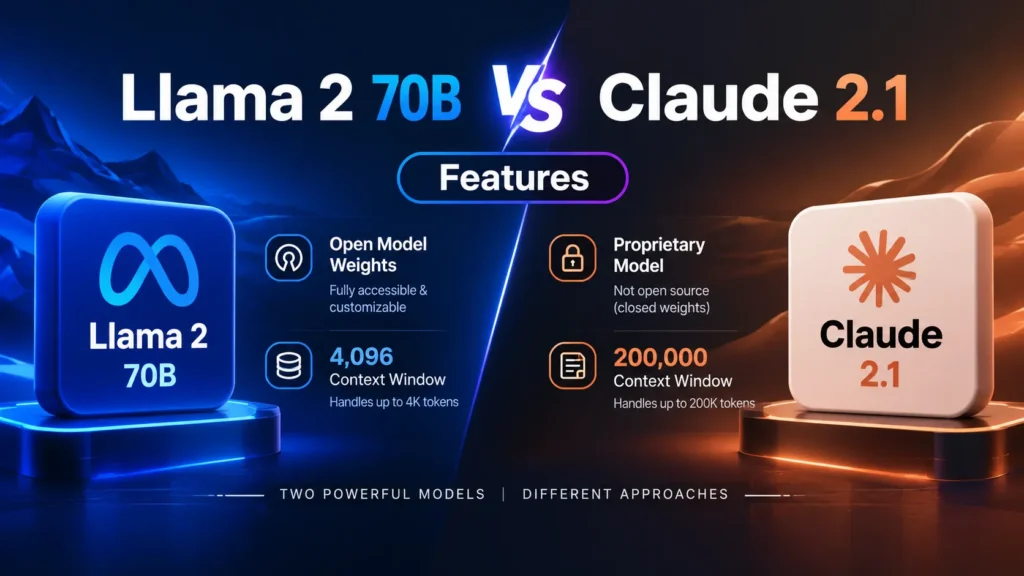
Llama 2 70B originally supported 4,096 tokens, while Claude 2.1 supported 200,000 tokens.
That means Claude 2.1 was designed for a fundamentally different class of long-input workloads.
15 practical implications
- Claude can accept much larger documents.
- Llama needs smaller input chunks.
- Claude can compare multiple large documents.
- Llama often needs retrieval infrastructure.
- Claude can analyze long reports.
- Claude can process large technical documentation.
- Claude can work with large codebases more naturally.
- Claude can analyze long financial documents.
- Llama can still perform well on focused prompts.
- Context length does not equal reasoning quality.
- Longer context can increase processing cost.
- Long context can introduce retrieval challenges.
- Prompt design still matters.
- Relevant information should still be clearly structured.
- Claude 2.1 clearly wins the raw-context comparison.
Anthropic itself documented that prompting affected Claude 2.1’s long-context retrieval behavior, with one internal evaluation improving from 27% to 98% after a prompt adjustment.
Long-Document Analysis
If the task involves Hundreds of pages, Claude 2.1 becomes especially interesting historically.
Anthropic specifically highlighted use cases including codebases, financial statements, and long literary works.
15 long-document use cases
- Contract review.
- Legal-document summarization.
- Financial-report analysis.
- Annual-report comparison.
- Technical documentation.
- Large research papers.
- Book summarization.
- Multi-document comparison.
- Codebase inspection.
- Policy analysis.
- Compliance documents.
- Business reports.
- Product documentation.
- Knowledge-base analysis.
- Long-form question answering.
Llama 2 70B could participate in these workflows, but its 4K context meant users typically needed chunking, retrieval, or other external techniques.
Historical winner: Claude 2.1.
Benchmark Performance
Benchmarks require much more caution than many comparison articles provide.
Meta’s official evaluation table reports the following for Llama 2 70B:
| Evaluation | Llama 2 70B |
| Code grouped score | 37.5 |
| Commonsense reasoning | 71.9 |
| World knowledge | 63.6 |
| Reading comprehension | 69.4 |
| Math | 35.2 |
| MMLU | 68.9 |
| BBH | 51.2 |
| AGI Eval | 54.2 |
A separate HumanEval result often cited for Llama 2 70B is 29.9%, so it should not be confused with Meta’s grouped “Code” score.
15 benchmark lessons
- Meta’s scores are vendor-reported.
- Claude 2.1 does not have an identical public benchmark table.
- Different prompts can change scores.
- Different evaluation settings can change results.
- Base and chat models should be distinguished.
- Zero-shot and few-shot results are not identical.
- Benchmark datasets have different purposes.
- MMLU measures broad knowledge.
- HumanEval measures coding capability.
- BBH tests challenging reasoning tasks.
- TruthfulQA addresses truthfulness.
- Aggregate scores hide individual strengths.
- Context size can affect long-document tasks.
- Vendor claims should be read alongside independent tests.
- Real workloads remain the best final test.
This benchmark methodology is one of the strongest opportunities to differentiate an UltraAIGuide article from shallow comparison pages.
Independent Head-to-Head Evidence
A particularly useful source for this comparison is an academic study that evaluated LLaMA 2 70B and Claude 2.1 in the same experimental framework.
In the FanOutQA evaluation, Claude 2.1 had a 200K context while LLaMA 2 70B had 4,096 tokens. The study reported results across closed-book, open-book, and evidence-provided settings.
15 reasons independent testing matters
- It reduces reliance on vendor claims.
- Both models can be evaluated under one methodology.
- Context differences become visible.
- Open-book tasks test information use.
- Evidence-provided tasks test grounded answering.
- Closed-book tasks test standalone knowledge.
- Human baselines can provide additional context.
- Automatic metrics have limitations.
- Model performance varies by task.
- One benchmark cannot establish universal superiority.
- Context length can influence results.
- Prompt design remains important.
- Model version matters.
- Evaluation date matters.
- Real-world performance should remain the final consideration.
An additional academic study comparing Llama 2 70B, Claude 2.1, and GPT-4 on short-story summarization found substantial faithfulness problems across the models, demonstrating why “best model” claims should be made cautiously.
Coding and Programming
Both models could assist Programmers, but they offered different advantages.
Llama 2 70B provided a customizable foundation that developers could adapt and deploy themselves.
Claude 2.1’s enormous context made it particularly attractive for analyzing large amounts of programming material.
15 coding scenarios
- Code explanation.
- Bug analysis.
- Function generation.
- Documentation generation.
- API explanation.
- Configuration analysis.
- Error-log interpretation.
- Repository analysis.
- Architecture discussion.
- Refactoring suggestions.
- Test-generation assistance.
- Technical documentation analysis.
- Codebase summarization.
- Multi-file reasoning.
- Custom model experimentation.
For a short coding prompt, context size may not matter much.
For a huge repository, however, the difference becomes much more significant.
Long-codebase winner: Claude 2.1.
Custom-deployment winner: Llama 2 70B.
System Prompts and Tool Use
Claude 2.1 introduced system prompts and beta tool use as explicit product capabilities. Anthropic described tool use as a way to connect Claude with developer-defined functions, APIs, web search, and private knowledge bases.
15 practical implications
- System prompts establish persistent behavioral instructions.
- Developers can define roles.
- Applications can provide structured context.
- Tool calls extend model capabilities.
- APIs can connect external systems.
- Databases can become information sources.
- Calculators can handle numerical operations.
- Search APIs can retrieve information.
- Private knowledge bases can provide company information.
- Tools can trigger application actions.
- Tool use moves beyond pure text generation.
- Function calling improves application integration.
- Managed APIs reduce infrastructure burden.
- Llama required more custom infrastructure for comparable workflows.
- Claude 2.1 had the clearer built-in historical advantage here.
The distinction is important: a language model’s raw intelligence and an AI application’s tool ecosystem are not the same thing.
Related To Another Article: https://ultraaiguide.com/deepseek-coder-v2-vs-grok-4-comparison/
Open Weights, Licensing and Customization
This is where Llama 2 70B has its strongest philosophical advantage.
Meta made Llama 2 model weights available under its Llama 2 Community License, subject to its conditions.
That enabled a large ecosystem around:
- fine-tuning,
- quantization,
- local inference,
- research,
- specialized assistants,
- custom deployments.
15 customization advantages
- Local experimentation.
- Custom inference.
- Fine-tuning.
- Quantization.
- Specialized assistants.
- Research projects.
- Private infrastructure.
- Model serving.
- Custom safety layers.
- Custom prompts.
- Retrieval-augmented applications.
- Domain adaptation.
- Hardware experimentation.
- Community tooling.
- Greater control over deployment architecture.
However, avoid simply writing “Llama 2 is completely open source” without qualification.
The more accurate wording is open-weight/available under Meta’s Llama 2 Community License.
That distinction improves both technical accuracy and EEAT.
Pricing and Deployment Economics
Claude 2.1 historically used API pricing, while Llama 2 70B could be deployed using available model weights subject to licensing and infrastructure requirements.
Anthropic’s historical Claude 2.1 price was approximately $8 per million input tokens and $24 per million output tokens.
15 cost considerations
- API pricing is usage-based.
- Self-hosting shifts costs to infrastructure.
- A 70B model requires substantial compute.
- GPU memory becomes important.
- Quantization can reduce hardware requirements.
- Hosting costs vary by provider.
- Electricity matters for private infrastructure.
- Engineering time has a cost.
- API maintenance is different from model hosting.
- Scaling changes the economics.
- Latency requirements affect architecture.
- Privacy requirements can influence deployment.
- Traffic volume affects total cost.
- Token efficiency matters.
- “Open weights” does not mean “zero operating cost.”
This is a better comparison than calling one model “free.”
Best Use Cases for Llama 2 70B
Llama 2 70B makes the most sense when the developer values control over convenience.
15 strong historical use cases
- AI research.
- Model experimentation.
- Fine-tuning.
- Local AI.
- Private inference.
- Custom assistants.
- Academic research.
- Domain-specific adaptation.
- Quantized deployment.
- Developer education.
- Experimental chatbots.
- Retrieval-augmented generation.
- Custom inference servers.
- Open-model ecosystem projects.
- Legacy applications built around Llama 2.
The biggest attraction was not simply its 70B parameter count.
It was the ability to build around the model rather than merely consume it as a hosted service.
Best Use Cases for Claude 2.1
Claude 2.1’s defining advantage was its ability to work with extremely large contexts.
15 historical use cases
- Legal documents.
- Financial statements.
- Long reports.
- Technical documentation.
- Large codebases.
- Research material.
- Book-length text.
- Multi-document analysis.
- Enterprise knowledge workflows.
- Long-form summarization.
- Document comparison.
- Large-scale Q&A.
- API-based assistants.
- Tool-connected applications.
- Complex information retrieval.
Anthropic explicitly marketed Claude 2.1 around long documents, codebases, financial statements, and complex documents.
Important caveat
A 200K context window does not mean every answer will automatically be perfect.
Anthropic’s own long-context research demonstrated that prompting could materially affect retrieval behavior.
That is a useful lesson for anyone designing long-context applications.
Final Verdict: Llama 2 70B vs Claude 2.1
There is no universal winner.
The strongest answer is workload-dependent.
| Requirement | Better historical choice |
| 70B parameter model | Llama 2 70B |
| Known parameter count | Llama 2 70B |
| Huge context | Claude 2.1 |
| Long documents | Claude 2.1 |
| Large codebase analysis | Claude 2.1 |
| System prompts | Claude 2.1 |
| Built-in beta tool use | Claude 2.1 |
| Self-hosting | Llama 2 70B |
| Fine-tuning flexibility | Llama 2 70B |
| Model-weight access | Llama 2 70B |
| Open-weight ecosystem | Llama 2 70B |
| Custom infrastructure | Llama 2 70B |
| Managed enterprise workflow | Claude 2.1 |
| Long-context retrieval | Claude 2.1 |
| Historical research value | Both |
The simplest verdict
Claude 2.1 wins on context and managed long-document workflows.
Llama 2 70B wins on model access, customization, and deployment control.
That distinction is more useful than declaring one model “better” overall.
People Also Ask
A: Not universally. Llama 2 70B offers greater control and customization, while Claude 2.1 had a dramatically larger context window and stronger long-document workflow capabilities.
A: The original Llama 2 models used a 4,096-token context length.
A: Claude 2.1 supports a 200,000-token context window, which Anthropic described as roughly 150,000 words or more than 500 pages.
A: Yes. The “70B” designation refers to approximately 70 billion parameters.
A: Anthropic did not publicly disclose a directly comparable parameter count for Claude 2.1.
What This Comparison Teaches Us About LLM Evolution
The Llama 2 70B vs Claude 2.1 comparison is interesting because the models demonstrate two different directions in AI development.
Llama 2 showed the growing importance of accessible model weights and developer control.
Claude 2.1 showed the growing importance of context, reliability, system instructions, and tool-connected AI applications.
In other words, the competition was never simply about who had the larger model.
It was also about where the intelligence lived and how developers could use it.
Llama put more control in the developer’s hands.
Claude put more emphasis on the managed AI experience.
That distinction helped shape the next generation of LLM products.
Conclusion
Llama 2 70B vs Claude 2.1 features represent two different philosophies of AI development.
Llama 2 70B’s biggest Advantage was control: developers could work with available model weights, experiment with deployment, fine-tune models, and build customized systems.
Claude 2.1’s biggest advantage was context: its 200K-token window made it dramatically better suited to the very large documents and codebases that were difficult to process with Llama 2’s original 4K context. Anthropic also added system prompts and beta tool use, making Claude 2.1 particularly attractive for managed API applications.
The best historical choice therefore depends on the job.
Need customization and self-hosting? Llama 2 70B.
Need enormous context and long-document analysis? Claude 2.1.
And for a new project in 2026, the most important conclusion is different: both are legacy models, so newer generations should be evaluated before making a production decision. Anthropic officially retired Claude 2.1 on July 21, 2025.
For readers researching the evolution of modern AI, however, the comparison remains highly valuable because it shows how the LLM industry moved from simply asking “How large is the model?” toward more useful questions such as “How much context can it handle, how controllable is it, and how easily can it connect to real applications?”
Content disclaimer: This article is provided for informational and historical comparison purposes. Model capabilities, availability, pricing, and deployment options can change over time, so verify current documentation before using an AI model in production.