Introduction
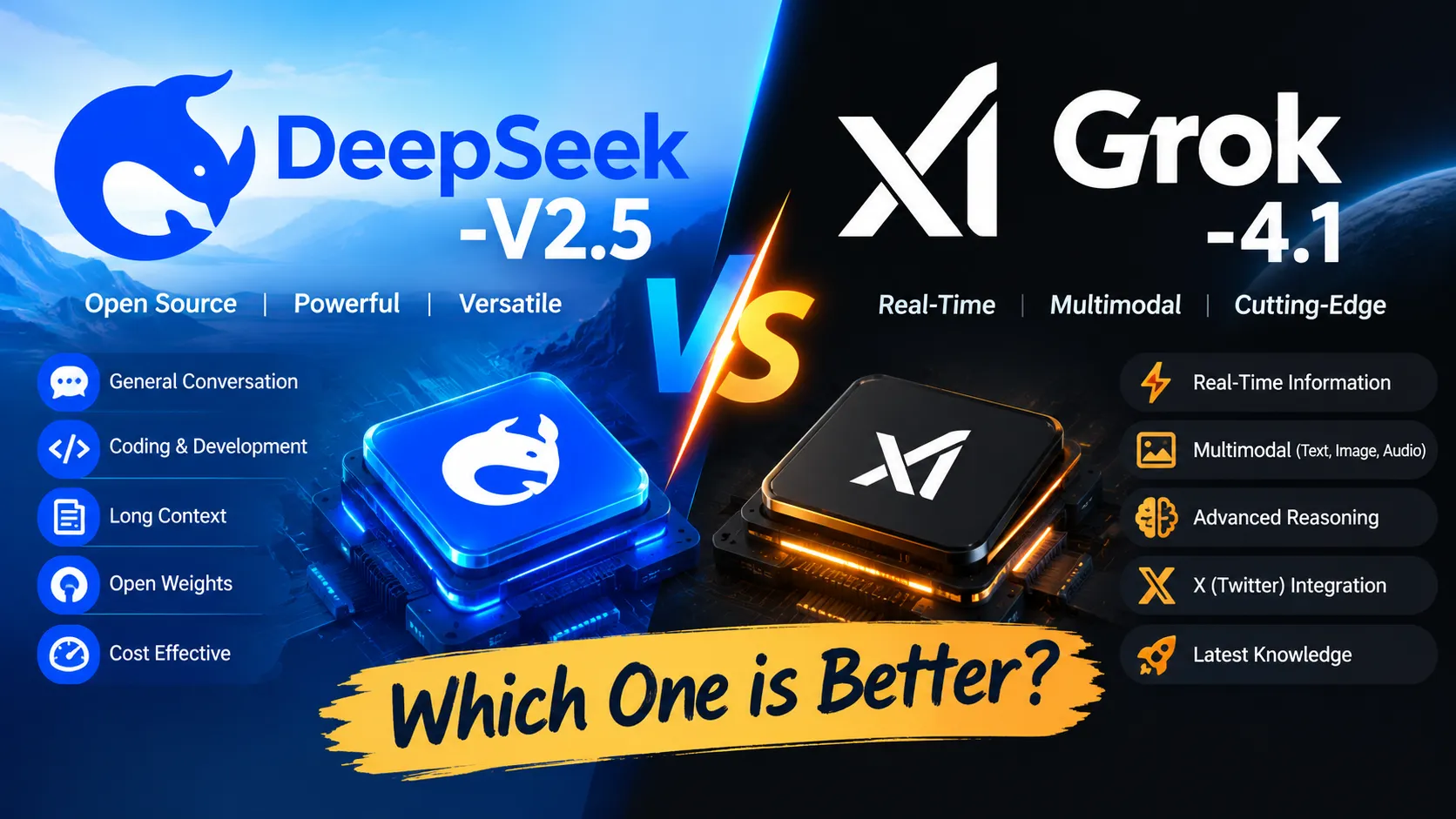
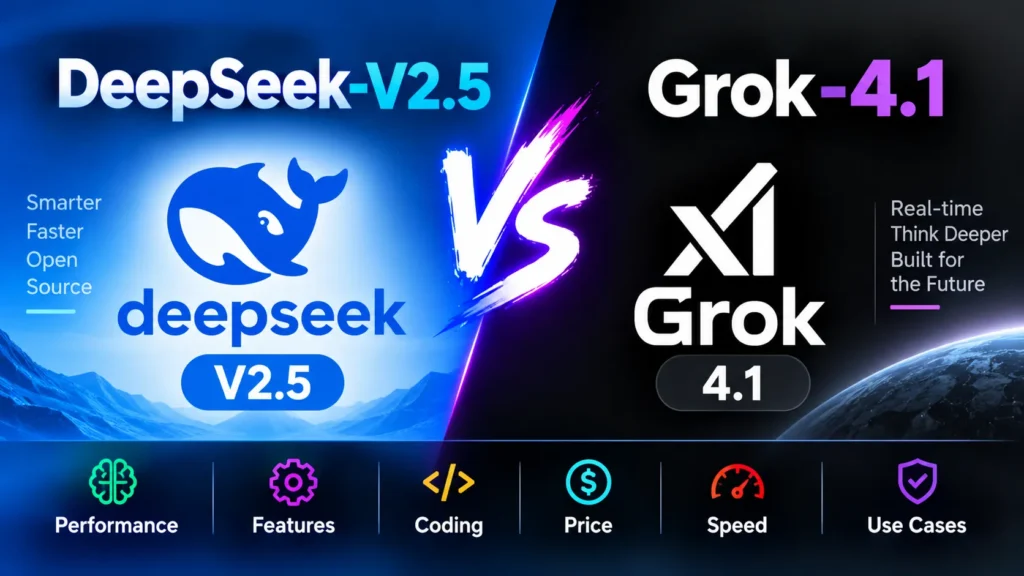
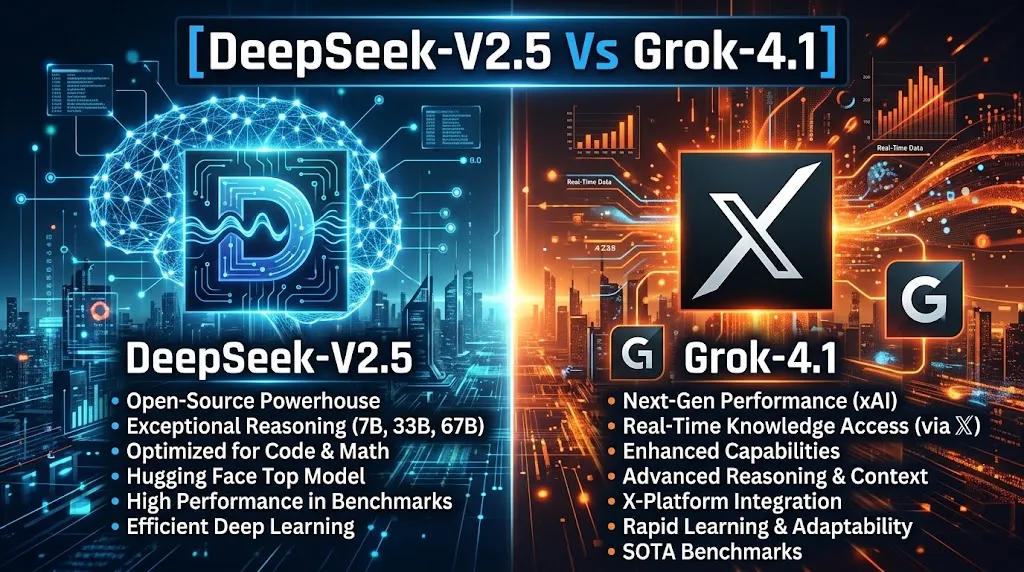
DeepSeek-V2.5 Vs Grok 4.1 compares two AI models from very different generations. DeepSeek-V2.5 launched in September 2024 as an open model combining general conversation and coding capabilities, while Grok 4.1 launched in November 2025 with separate Thinking and Non-Thinking configurations and a stronger emphasis on modern reasoning, conversation, and real-world usability.
The comparison becomes more complicated in 2026 because Grok 4.1, Grok 4.1 Thinking, Grok 4.1 Non-Thinking, and Grok 4.1 Fast should not be treated as identical models. Grok 4.1 Fast was a separate model optimized for tool calling and agentic workloads with a 2-million-token context window. So which one wins?
For open-weight access, customization, and economical deployment, DeepSeek-V2.5 remains the more attractive model. For modern reasoning, conversational performance, and advanced agentic workflows, the Grok 4.1 family is stronger.
And if you’re choosing a model for a brand-new project in 2026, there’s another important consideration: Grok 4.6 is now xAI’s flagship model, so Grok 4.1 should primarily be evaluated when the historical/model-specific comparison itself is what you need.
DeepSeek-V2.5 vs Grok 4.1: Quick Comparison
| Feature | DeepSeek-V2.5 | Grok 4.1 |
| Developer | DeepSeek | xAI |
| Release | September 2024 | November 2025 |
| Architecture | Mixture of Experts | Proprietary |
| Parameters | 236B total / ~21B active | Not publicly disclosed |
| Model access | Open weights | Proprietary |
| Reasoning | General-purpose model | Thinking + Non-Thinking |
| Coding | Strong | Strong modern capability |
| Context | 128K architecture | Variant-dependent |
| Multimodal capability | Primarily text/code | Depends on product/model |
| Local deployment | Yes | No original weights |
| Agentic tooling | Limited compared with newer systems | Stronger |
| Best advantage | Openness and cost | Modern capability |
| Best for | Developers/researchers | Advanced workflows |
DeepSeek’s official model information confirms that V2.5 combines DeepSeek-V2-Chat and DeepSeek-Coder-V2-Instruct. Its published benchmarks include 89% HumanEval, 41.8% LiveCodeBench, and 16.8% SWE-bench Verified.
What Is DeepSeek-V2.5?
DeepSeek-V2.5 is an open model released on September 5, 2024. DeepSeek created it by combining its general conversational model with its coding-focused model. The company specifically highlighted improvements in writing, instruction following, and human-preference alignment.
The model is based on the DeepSeek-V2 architecture and uses a Mixture-of-Experts approach.
Its headline specification is unusual:
- 236 billion total parameters
- Approximately 21 billion active parameters per token
- 128K-token context architecture
- Strong coding capabilities
- Open-weight availability
- Function calling and other developer features
The sparse architecture is important. Saying that DeepSeek-V2.5 is simply a “236B model” misses the point because the model does not activate all parameters for every token.
DeepSeek-V2.5 benchmark highlights
DeepSeek’s published model comparison reports:
- HumanEval Python: 89%
- LiveCodeBench: 41.8%
- SWE-bench Verified: 16.8%
- ArenaHard: 76.2%
- AlpacaEval 2.0: 50.5%
- AlignBench: 8.04
- MT-Bench: 9.02
- DS-FIM-Eval: 78.3%
- DS-Arena-Code: 63.1%
These numbers demonstrate why DeepSeek-V2.5 was significant when it launched, particularly for coding and open-model development.
However, benchmark numbers from 2024 should not be placed beside a 2025/2026 benchmark and treated as though both were conducted under identical conditions.
What Is Grok 4.1?
Grok 4.1 is an xAI model released on November 17, 2025. xAI described it as an improvement focused on real-world usability, creative interaction, emotional intelligence, collaborative behavior, and nuanced instruction following.
Grok 4.1 was offered in two configurations:
4.1 Thinking
This configuration reasons before responding and is intended for more difficult tasks.
Grok 4.1 Non-Thinking
This version responds more directly without the same extended reasoning process.
xAI’s model card explicitly distinguishes the two configurations, stating that the Non-Thinking model responds directly while the Thinking model reasons before responding.
xAI also reported that Grok 4.1 Thinking reached the top position in LMArena’s Text Arena at launch, with the Non-Thinking version ranking second in the reported evaluation.
That makes Grok 4.1 fundamentally different from DeepSeek-V2.5 in terms of its model-generation philosophy.
DeepSeek-V2.5 vs Grok 4.1: Architecture
Architecture is one of the clearest technical differences.
DeepSeek-V2.5 inherits the Mixture-of-Experts Architecture of DeepSeek-V2.
Instead of activating every parameter for every token, the architecture uses a sparse routing strategy.
This gives developers an interesting combination of:
- Very large total parameter count
- Smaller active parameter count
- Efficient computation relative to dense activation
- Large-model capacity
DeepSeek-V2.5 also inherits DeepSeek-V2’s Multi-head Latent Attention approach, designed to reduce key-value cache requirements.
Grok 4.1 is different.
xAI has not publicly provided an equivalent complete parameter-count specification for Grok 4.1, so claiming that one model is better simply because of parameter count would be misleading.
Architecture winner
There isn’t a meaningful winner based solely on architecture.
DeepSeek wins on transparency and openness.
Grok wins only if your definition of “better architecture” means better observed modern system performance—but that cannot be established simply from parameter counts.
DeepSeek-V2.5 vs Grok 4.1: Context Window
Context length is one of the most frequently misunderstood parts of this comparison.
DeepSeek-V2’s architecture supports a 128K-token context length, and DeepSeek-V2.5 is built from that model family.
But Grok 4.1 has multiple variants.
Most importantly, Grok 4.1 Fast is not the same model as standard Grok 4.1.
xAI introduced Grok 4.1 Fast on November 19, 2025, with a 2-million-token context window, specifically targeting tool calling and agentic workflows.
Therefore:
| Model | Context |
| DeepSeek-V2.5 architecture | 128K |
| Grok 4.1 | Variant-dependent |
| Grok 4.1 Fast | 2M |
This distinction is essential.
Do not publish “Grok 4.1 has a 2M context window” without identifying Grok 4.1 Fast.
Context winner
Grok 4.1 Fast wins for extremely long-context workloads.
DeepSeek-V2.5 remains attractive when you specifically want an open model with a 128K architecture.
DeepSeek-V2.5 vs Grok 4.1: Benchmark Performance
This is where many AI comparison articles become unreliable.
The two models were released more than a year apart, and their developers evaluated them using different benchmark sets, versions, and methodologies.
DeepSeek-V2.5 has published results across traditional coding and conversational evaluations. Its official model card reports the scores listed above.
Grok 4.1 was evaluated heavily through newer preference and real-world evaluations. xAI reported 1483 Elo for Grok 4.1 Thinking and 1465 Elo for Grok 4.1 Non-Thinking in its LMArena Text Arena reporting.
But those scores should not be interpreted as:
1483 is automatically better than 89%.
They measure completely different things.
HumanEval is a coding benchmark.
LMArena Elo is a human-preference leaderboard metric.
A responsible comparison therefore separates the benchmark categories rather than creating an artificial overall score.
Benchmark verdict
Grok 4.1 has the stronger evidence for modern general-purpose performance.
DeepSeek-V2.5 has particularly useful published coding results for its generation.
DeepSeek-V2.5 vs Grok 4.1 for Coding
Coding is one of DeepSeek-V2.5’s strongest selling points.
The model was created partly by merging DeepSeek’s general and coding models, and its official results include 89% on HumanEval Python and 41.8% on LiveCodeBench.
It also achieved 16.8% on SWE-bench Verified in the model card’s reported evaluation.
That makes DeepSeek-V2.5 useful for:
- Code generation
- Code completion
- Programming explanations
- Refactoring
- Algorithmic tasks
- Developer experimentation
- Open-model research
Grok 4.1, however, belongs to a newer generation and has a stronger connection to agentic workflows.
The distinction becomes even clearer with Grok 4.1 Fast. xAI specifically designed that model around tool calling and autonomous workflows, including web search, X search, and code execution through its Agent Tools API.
Coding verdict
For open coding experimentation: DeepSeek-V2.5.
For modern agentic software workflows: Grok 4.1 family.
DeepSeek-V2.5 vs Grok 4.1 for Reasoning
This is one of the easiest categories to decide.
DeepSeek-V2.5 was not introduced as a dedicated reasoning model with separate reasoning and non-reasoning configurations.
Grok 4.1 was explicitly released in Thinking and Non-Thinking versions.
That makes Grok better suited to workflows where you want the model to spend additional computation on:
- Multi-step problems
- Planning
- Complex analysis
- Research
- Agentic tasks
- Difficult coding problems
- Long reasoning chains
Reasoning winner
Grok 4.1.
DeepSeek-V2.5 vs Grok 4.1 for Writing
DeepSeek-V2.5 should not be dismissed as a coding-only model.
DeepSeek specifically reported improvements in writing and instruction following when V2.5 launched.
That makes it useful for:
- Blog drafts
- Technical documentation
- Summaries
- Structured content
- Rewriting
- General text generation
Grok 4.1 takes a different approach.
xAI heavily emphasized natural dialogue, creativity, personality, and nuanced intent when announcing the model.
Therefore, the better choice depends on the writing task.
| Writing task | Better choice |
| Technical drafting | DeepSeek-V2.5 |
| Open deployment | DeepSeek-V2.5 |
| Conversational writing | Grok 4.1 |
| Creative interaction | Grok 4.1 |
| Interactive brainstorming | Grok 4.1 |
| Cost-sensitive bulk generation | DeepSeek-V2.5 |
Overall writing edge: Grok 4.1.
DeepSeek-V2.5 vs Grok 4.1 for Research
Research is another category where model access matters as much as intelligence.
DeepSeek-V2.5 can analyze information supplied to it and is useful for document-based reasoning, summarization, and knowledge tasks.
But Grok’s ecosystem adds an important advantage: connected tools.
Grok 4.1 Fast was explicitly introduced with an Agent Tools API supporting capabilities such as web search, X search, remote code execution, and uploaded-document retrieval. This is valuable for research that depends on current information.
For example:
Traditional research workflow
Give the model your sources → ask it to analyze them.
Agentic research workflow
Ask the model to search → collect sources → analyze information → execute tools → produce an answer.
The second workflow is where newer agentic models have a structural advantage.
Research winner
Grok 4.1 family.
DeepSeek-V2.5 vs Grok 4.1: Price
Price comparisons need a timestamp because AI API pricing changes frequently.
DeepSeek-V2.5 has historically been extremely inexpensive. Current third-party pricing records citing DeepSeek’s API pricing list it around $0.14 per million input tokens and $0.28 per million output tokens
That makes the model attractive for:
- High-volume generation
- Experimentation
- Budget-conscious developers
- Large-scale text workloads
Grok pricing varies considerably by model and provider.
More importantly, Grok 4.1 and Grok 4.1 Fast are separate models, so their prices should never be mixed into one “Grok 4.1 price.”
This is one reason a fixed pricing table copied from another comparison website can quickly become outdated.
Price winner
DeepSeek-V2.5 is the obvious choice when low token cost is the priority.
But total application cost is not always equal to token price.
A more capable model may complete a task in fewer calls, use tools more efficiently, or require less human intervention.
DeepSeek-V2.5 vs Grok 4.1: Open vs Proprietary
This is arguably the biggest practical difference.
DeepSeek-V2.5 is available through Hugging Face, where DeepSeek provides the model and instructions for local use.
That creates opportunities for:
- Self-hosting
- Research
- Model experimentation
- Custom infrastructure
- Fine-tuning workflows
- Greater deployment control
The model’s Hugging Face documentation also notes that local BF16 inference requires substantial hardware—listed as eight 80GB GPUs—so “open” does not mean “easy to run on an ordinary laptop.”
Grok 4.1 is proprietary.
You access the model through xAI’s products and API ecosystem rather than downloading the original model weights.
Winner
DeepSeek-V2.5 for openness and deployment control.
Grok 4.1 for managed access and ecosystem convenience.
DeepSeek-V2.5 vs Grok 4.1: Agentic AI and Tool Calling
This category Demonstrates the generational difference especially well.
DeepSeek-V2.5 supports useful developer capabilities, including function calling and JSON output. DeepSeek itself highlighted these capabilities when launching the model. (
But the modern agentic ecosystem around Grok went considerably further.
Grok 4.1 Fast was built specifically around tool calling and long-running agentic tasks. xAI’s Agent Tools API can provide agents with access to web search, X data, code execution, and other capabilities.
This means the distinction isn’t simply:
Which model generates better text?
It becomes:
Which model can participate more effectively in an automated workflow?
For AI agents, that difference is significant.
Agentic winner
Grok 4.1 family.
Relate https://ultraaiguide.com/llama-2-70b-vs-claude-2-1-features/d To Another Article:
DeepSeek-V2.5 vs Grok 4.1: Pros and Cons
DeepSeek-V2.5 Pros
- Open-weight availability
- 236B total parameters
- Approximately 21B active parameters
- Strong coding performance
- 128K architecture
- Custom deployment potential
- Low API pricing
- Good writing and instruction following
- Strong research value for open-model developers
2.5 Cons: DeepSeek-V2
- Released in 2024
- Older generation
- Not designed around modern reasoning modes
- Less naturally suited to advanced agentic workflows
- Significant hardware requirements for local inference
- Outperformed by newer frontier systems on many modern tasks
Grok 4.1 Pros
- Newer generation
- Thinking and Non-Thinking configurations
- Strong conversational ability
- Strong reasoning
- Strong creative interaction
- Better fit for agentic workflows
- xAI ecosystem
- Strong reported LMArena performance
Grok 4.1 Cons
- Proprietary
- No original model weights for self-hosting
- Variant naming can be confusing
- Pricing differs between models
- Grok 4.1 is no longer xAI’s latest flagship in 2026
DeepSeek-V2.5 vs Grok 4.1: Which Is Better for Developers?
There is no universal winner.
Choose DeepSeek-V2.5 if your priorities are:
- Open weights
- Self-hosting
- Model research
- Custom infrastructure
- Low token cost
- Coding experimentation
Choose Grok 4.1 if your priorities are:
- Advanced reasoning
- Modern conversational quality
- Managed API access
- Agentic workflows
- Tool integration
- Research workflows
The simplest way to remember the distinction is:
DeepSeek gives developers more control. Grok gives developers access to a newer proprietary capability stack.
DeepSeek-V2.5 vs Grok 4.1: Which Is Better in 2026?
This question needs a historical-versus-current distinction.
If you’re specifically researching DeepSeek-V2.5 vs Grok 4.1, the comparison remains useful because those are the models in the search query.
But if you’re choosing an AI model for a new project today, you should not automatically assume Grok 4.1 is the latest xAI option.
As of 2026, xAI describes Grok 4.6 as its latest flagship model, designed for coding, knowledge work, and long-running agents. xAI documents a 500K context window and configurable reasoning levels.
The current xAI documentation lists Grok 4.6 at $2 per million input tokens and $6 per million output tokens, with cached input priced at $0.50 per million tokens. So your article should make this distinction explicit:
Historical comparison: DeepSeek-V2.5 vs Grok 4.1.
Current buying decision in 2026: also consider Grok 4.6 and other current models.
That makes the article more trustworthy than pretending a 2025 model is still the newest xAI flagship.
DeepSeek-V2.5 vs Grok 4.1: Final Winner by Category
| Category | Winner |
| Open-weight access | DeepSeek-V2.5 |
| Self-hosting | DeepSeek-V2.5 |
| Custom deployment | DeepSeek-V2.5 |
| Low token cost | DeepSeek-V2.5 |
| Coding experimentation | DeepSeek-V2.5 |
| Modern reasoning | Grok 4.1 |
| Conversational quality | Grok 4.1 |
| Creative interaction | Grok 4.1 |
| Agentic workflows | Grok 4.1 family |
| Tool calling | Grok 4.1 Fast |
| Extremely long context | Grok 4.1 Fast |
| Current xAI ecosystem | Grok |
| Newer generation | Grok 4.1 |
| Overall modern capability | Grok 4.1 |
The important caveat is that these are use-case winners, not universal benchmark winners.
People Also Ask
A: Not overall. Grok 4.1 is newer and better suited to modern reasoning, conversation, and agentic workflows. DeepSeek-V2.5 is more attractive for open deployment, customization, and low-cost development.
A: It is distributed as an open model through Hugging Face under DeepSeek’s applicable model license. Its availability makes it substantially more flexible for developers who want to experiment with model weights.
A: The DeepSeek-V2 architecture supports a 128K-token context length.
A: Be precise here. The 2-million-token context belongs to Grok 4.1 Fast, which xAI introduced as a separate agentic/tool-calling model.
A: DeepSeek-V2.5 is excellent for open coding workflows and reported 89% on HumanEval Python. Grok’s newer family is more attractive for sophisticated reasoning and agentic coding workflows.
Conclusion
DeepSeek-V2.5 Vs Grok 4.1 is ultimately a comparison between two different philosophies of AI development.
DeepSeek-V2.5 represents the open-model approach. Its 236B-parameter MoE architecture, approximately 21B active parameters, strong coding benchmarks, and open availability make it particularly valuable for developers, researchers, and organizations that want greater control over deployment.
Grok 4.1 represents a newer proprietary generation. Its Thinking and Non-Thinking configurations, strong reported human-preference performance, and connection to xAI’s broader ecosystem make it better suited to modern interactive and reasoning-heavy workloads.
The practical verdict is simple:
Choose DeepSeek-V2.5 for openness, customization, self-hosting, and low-cost development.
Choose Grok 4.1 for newer-generation reasoning, conversational performance, and advanced workflows.
And for anyone making a new AI model decision in 2026, don’t stop at this historical comparison. xAI now positions Grok 4.6 as its flagship, with a 500K context window and configurable reasoning.
The smartest model choice isn’t necessarily the one with the biggest benchmark score.
It’s the one that gives you the right combination of capability, cost, context, deployment flexibility, tooling, and reliability for your actual workload.