Introduction
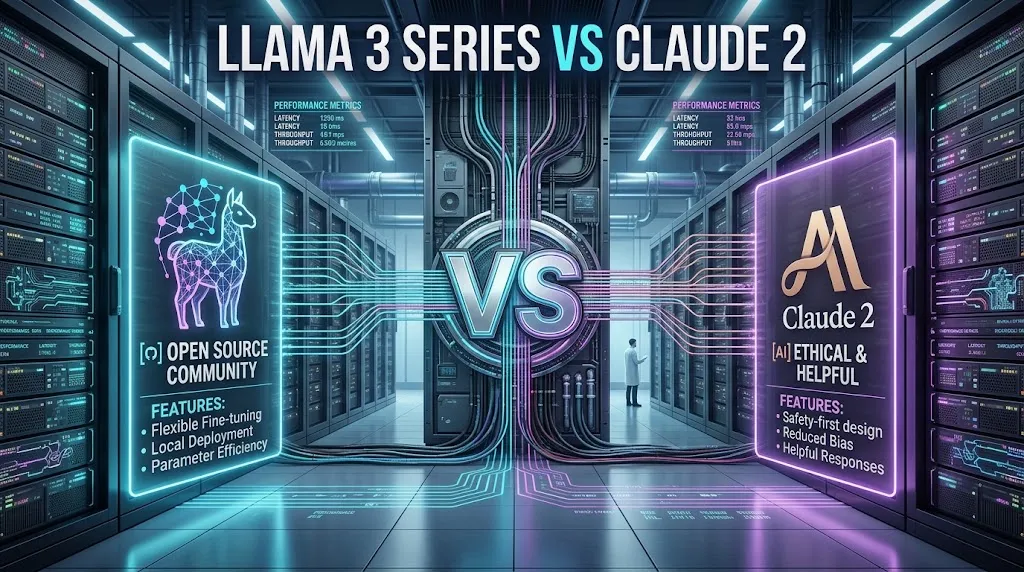
The Llama 3 Series Vs Claude 2 Features comparison brings together two important generations of large language models from Meta and Anthropic.
Meta introduced the original Llama 3 family with 8B and 70B parameter models in April 2024. Anthropic introduced Claude 2 on July 11, 2023, with an emphasis on conversational quality, reasoning, coding, mathematics, safety, and an unusually large 100K-token input context for its time.
Anthropic retired both models on July 21, 2025.
Llama 3 Series vs Claude 2 at a Glance
| Feature | Llama 3 8B | Llama 3 70B | Claude 2 |
| Developer | Meta | Meta | Anthropic |
| Release | April 2024 | April 2024 | July 2023 |
| Model type | Open-weight | Open-weight | Proprietary |
| Parameters | 8B | 70B | Not publicly specified by Anthropic |
| Original context | 8,192 tokens | 8,192 tokens | 100K tokens |
| Architecture | Decoder-only Transformer | Decoder-only Transformer | Details not publicly disclosed in the same way |
| Input | Text | Text | Text |
| Output | Text | Text | Text |
| Training data | 15T+ tokens | 15T+ tokens | Different disclosure approach |
| Self-hosting | Possible under applicable terms | Possible under applicable terms | No downloadable model weights |
| Fine-tuning control | High | High | More limited as a hosted model |
| Current Anthropic API status | Not applicable | Not applicable | Retired |
| Primary significance | Smaller open-weight model | Larger open-weight model | Long-context proprietary model |
Anthropic’s Claude 2 announcement stated that users could provide up to 100K tokens in a prompt, making large-document processing one of its defining capabilities.
What Is Llama 3?
The original release included:
- Llama 3 8B
- Llama 3 70B
Meta used a decoder-only Transformer architecture and introduced a 128K-token vocabulary tokenizer. It also used grouped-query attention, or GQA, to improve inference efficiency.
Meta also reported training Llama 3 on more than 15 trillion tokens from publicly available sources. The company said the training corpus was substantially larger than the one used for Llama 2 and included considerably more code.
One important distinction is that Llama 3 is a family rather than one single model.
Therefore, saying “Llama 3 does X” can be incomplete unless the comparison specifies whether it means 8B or 70B.
What Is Claude 2?
Claude 2 was Anthropic’s second major Claude generation and launched on July 11, 2023.
Anthropic described improvements in coding, mathematics, reasoning, conversational ability, response length, and safety compared with previous Claude models. The model supported a 100,000-token input context at launch. Anthropic said this allowed Claude 2 to process hundreds of pages of technical documentation or even an entire book in a single prompt.
Anthropic also reported a 71.2% HumanEval result and an 88.0% GSM8K result for Claude 2 in its launch materials.
Llama 3 8B vs Llama 3 70B
The difference between Llama 3 8B and Llama 3 70B is essential to this Comparison.
Both belong to the same original Llama 3 generation, but their parameter counts are dramatically different.
Meta’s published instruction-tuned benchmark results illustrate this difference:
| Benchmark | Llama 3 8B | Llama 3 70B |
| MMLU | 68.4% | 82.0% |
| GPQA | 34.2% | 39.5% |
| HumanEval | 62.2% | 81.7% |
| GSM-8K | 79.6% | 93.0% |
| MATH | 30.0% | 50.4% |
This does not mean the 70B model will automatically produce better results for every individual application. Real-world performance depends on prompts, fine-tuning, retrieval systems, quantization, hardware, and the particular workload.
Llama 3 vs Claude 2 Context Window
Context window is one of the clearest technical differences.
Claude 2 launched with a 100,000-token input context. That creates a major difference for document-heavy workflows.
- Short conversations
- Smaller documents
- Code snippets
- Compact instructions
- Focused question answering
Claude 2’s 100K context was much more suitable for:
- Large reports
- Long technical documentation
- Extensive codebases
- Books
- Large collections of text
A larger context window means a model can accept more input. It does not automatically mean the model will understand every part of that input equally well.
Claude 2 vs Claude 2.1 Context Difference
Claude 2 and Claude 2.1 should not be treated as exactly the same model specification.
The original Claude 2 supported a 100K-token context.
Therefore, an article should avoid saying simply “Claude 2 had a 200K context window” without explaining that this refers to Claude 2.1 rather than the original Claude 2 release.
This distinction is particularly important for SEO because many older comparison pages combine specifications from different Claude generations.
Parameters and Model Architecture
Llama 3 was explicitly released in two parameter sizes:
- 8 billion parameters
- 70 billion parameters
Meta described the architecture as a decoder-only Transformer and stated that both models used grouped-query attention. The 128K-token vocabulary tokenizer was another major architectural change compared with earlier Llama generations. Meta said the tokenizer encoded language more efficiently. Claude 2’s parameter count was not publicly specified by Anthropic in the same straightforward way.
That means parameter-count comparisons should not invent a number for Claude 2.
More parameters also do not automatically translate into better performance. Architecture, training data, post-training, inference techniques, prompting, and evaluation methodology all matter.
Training Data and Knowledge Cutoff
Meta reported that Llama 3 was pretrained on more than 15 trillion tokens from publicly available sources. The model documentation lists data freshness through March 2023 for the 8B model and December 2023 for the 70B model.
This distinction is useful because:
Training-data volume is not the same thing as knowledge freshness.
A model can be trained on an enormous corpus but still have a particular cutoff date.
Similarly, a newer cutoff does not guarantee better performance on every task.
For this reason, model comparisons should ideally mention both:
- training-data scale
- data freshness or knowledge cutoff
rather than treating them as one metric.
Llama 3 vs Claude 2 Coding Performance
Coding was an important capability for both model families.
Meta reported the following HumanEval results for its instruction-tuned Llama 3 models:
- Llama 3 8B: 62.2%
- Llama 3 70B: 81.7%
Anthropic reported a 71.2% HumanEval result for Claude 2 in its launch documentation.
These numbers should not be interpreted as a perfectly controlled head-to-head contest.
The evaluation setups were different, and vendor-reported benchmarks are not necessarily performed under identical prompting, sampling, or implementation conditions.
For developers, the practical questions are often more important:
- Can the model understand an existing codebase?
- Can it generate usable functions?
- Can it explain errors?
- Can it follow project conventions?
- Can it work with the available context?
- Can the model run where you need it?
Those questions require workload-specific testing.
Reasoning and Mathematics Benchmarks
Both models were evaluated on reasoning and mathematics.
Meta’s published Llama 3 instruction-tuned results included:
| Benchmark | Llama 3 8B | Llama 3 70B |
| MMLU | 68.4% | 82.0% |
| GPQA | 34.2% | 39.5% |
| GSM-8K | 79.6% | 93.0% |
| MATH | 30.0% | 50.4% |
| HumanEval | 62.2% | 81.7% |
Anthropic’s Claude 2 model evaluation reported:
| Benchmark | Claude 2 |
| MMLU | 78.5% |
| GSM8K | 88.0% |
| Codex HumanEval | 71.2% |
| TriviaQA | 87.5% |
| ARC-Challenge | 91.0% |
These tables are useful for historical context, but they should not be combined into one simplistic leaderboard.
The benchmark protocols, number of shots, prompting methods, datasets, and evaluation implementations can differ.
Benchmark Methodology Matters More Than a Single Number
A common problem with AI comparison articles is presenting benchmark scores as if they were directly interchangeable.
For example, Meta reports Llama 3 MMLU using a particular evaluation configuration, while Anthropic’s Claude 2 model card reports MMLU under its own evaluation setup.
A responsible comparison should therefore ask:
- Which exact model was tested?
- Was it base or instruction-tuned?
- How many shots were used?
- Was chain-of-thought prompting involved?
- What metric was used?
- Who performed the evaluation?
- Was the benchmark version identical?
- Does the benchmark resemble the user’s actual workload?
This is one of the most important differences between a basic comparison article and a genuinely useful technical analysis.
Open-Weight Llama 3 vs Proprietary Claude 2
The deployment philosophy is another major difference.
Llama 3 model weights were released for developers and researchers under Meta’s applicable license terms.
Claude 2 was provided as a proprietary hosted model.
This distinction affects how developers can build around the models.
With Llama 3, developers can potentially:
- Run models on their own infrastructure
- Choose deployment hardware
- Quantize the model
- Build private inference systems
- Adapt the model using supported techniques
- Integrate it into controlled environments
Claude 2 was accessed through Anthropic’s service infrastructure rather than through downloadable model weights.
Therefore, model capability and model control are separate considerations.
A model can be useful through an API without giving developers direct control over its weights.
Self-Hosting and Deployment
Self-hosting is one of the most important practical distinctions.
Llama 3’s released weights made local and private deployment possible under the applicable licensing and hardware requirements.
However, the difference between 8B and 70B is significant.
An 8B model generally requires considerably fewer resources than a 70B model.
That can influence:
- GPU requirements
- RAM or VRAM requirements
- Quantization choices
- Inference speed
- Hosting costs
- Concurrent user capacity
- Deployment complexity
Claude 2 followed a hosted-service model.
Developers interacted with Anthropic’s infrastructure rather than downloading Claude 2 weights and operating the underlying model themselves.
Fine-Tuning and Customization
Llama 3’s model-weight access creates more possibilities for developers who need model-level customization.
Depending on the implementation, developers can explore approaches such as:
- Supervised fine-tuning
- Parameter-efficient fine-tuning
- LoRA-based adaptation
- Quantization
- Retrieval-augmented generation
- Custom inference pipelines
Claude 2 provides a managed model experience.
That can simplify access because developers do not need to operate the underlying model infrastructure, but it provides less direct control over the model itself.
The practical question is therefore:
Do you need control over the model, or do you mainly need access to an AI capability through an API?

Long-Document Analysis
Claude 2’s 100K-token context was particularly relevant for long-document workflows.
Imagine a developer wants to analyze:
- A large technical manual
- Multiple chapters of a book
- A lengthy legal document
- A large codebase
- Extensive product documentation
The ability to place much more source material into one context can simplify certain workflows.
Llama 3’s original 8K context created a much smaller input boundary.
However, long-context capacity is not the same as perfect long-context reasoning.
A system can accept a large document and still fail to correctly retrieve, compare, or reason about information buried inside it.
For production systems, retrieval, chunking, indexing, reranking, and evaluation may still be important.
Llama 3 vs Claude 2 for Developers
For Developers, the comparison should extend beyond benchmark scores.
| Developer Requirement | Llama 3 | Claude 2 |
| Downloadable weights | Yes | No |
| Self-hosting | Possible | No model-weight deployment |
| Hardware control | Developer-controlled when self-hosted | Provider-controlled |
| Model customization | Greater control | More limited |
| Large native context | Original 8K | 100K |
| Smaller model option | 8B | Not publicly specified |
| Larger Llama option | 70B | Not publicly specified |
| Hosted API model | Through providers | Anthropic API historically |
| Current Anthropic API availability | N/A | Retired |
The most important point is that these models were designed around different access models.
Llama 3 vs Claude 2 for Coding Workflows
A coding workflow can involve much more than generating code.
A developer may need an AI system to:
- Understand requirements
- Read existing code
- Identify bugs
- Suggest changes
- Generate functions
- Explain errors
- Write tests
- Refactor code
- Review security issues
- Document implementation decisions
Claude 2’s large context could be particularly useful when a workflow required substantial amounts of source code to be included in one prompt.
Llama 3 provided the alternative of running an open-weight model and building a customized coding pipeline around it.
For a real project, developers should test both the model’s coding quality and the surrounding infrastructure.
Llama 3 vs Claude 2 for AI Applications
Llama 3’s model-weight availability can be useful when building:
- Private chatbots
- Internal assistants
- Custom RAG systems
- Specialized content tools
- Developer tools
- Research systems
- Offline or controlled environments
Claude 2 historically fit a hosted API architecture where the developer consumed the model as a service.
The distinction becomes particularly important for organizations with requirements involving:
- Data residency
- Infrastructure control
- Vendor dependency
- Custom inference
- Model adaptation
- Operational governance
The exact compliance and privacy requirements still depend on the application, hosting environment, contracts, and configuration.
Privacy and Data Security Considerations
Neither model should be evaluated only by its benchmark results.
When deploying an AI system, organizations should examine:
- What data enters the model?
- Where is the data processed?
- Is sensitive information included?
- What retention policies apply?
- What logging occurs?
- Who can access the outputs?
- What third-party services are involved?
- What contractual protections exist?
Self-hosting can provide more direct infrastructure control, but it also transfers security responsibilities to the organization operating the model.
A hosted API can reduce infrastructure responsibilities, but it introduces dependence on the provider’s platform, policies, and security controls.
Neither approach eliminates the need for security engineering.
AI Hallucinations and Human Review
Both Llama 3 and Claude 2 are language models, not databases of guaranteed facts.
They can produce:
- Incorrect facts
- Incorrect code
- Unsupported claims
- Misleading summaries
- Fabricated citations
- Confident but inaccurate explanations
For high-impact applications, outputs should therefore be reviewed and validated.
Useful safeguards include:
- Retrieval from trusted sources
- Automated testing
- Human review
- Structured output validation
- Citation verification
- Monitoring
- Prompt and response logging where appropriate
- Domain-specific evaluation
This is particularly important when AI outputs influence financial, legal, medical, security, or other consequential decisions.
Safety and Responsible AI
Safety was explicitly discussed by both Meta and Anthropic.
Meta’s Llama 3 documentation describes safety evaluations and provides additional resources, including Llama Guard 2 and Code Shield. Meta also emphasizes that application developers need to implement safeguards appropriate to their particular use case.
Anthropic stated that Claude 2 underwent safety evaluation and red-teaming and reported improvements over Claude 1.3 in its internal harmlessness evaluation. Anthropic also noted that no model is immune to jailbreaks.
This leads to an important practical principle:
Model-level safety does not replace application-level safety.
A production AI application needs its own testing, access controls, monitoring, validation, and misuse protections.
Main Feature Differences Between Llama 3 and Claude 2
| Category | Llama 3 Series | Claude 2 |
| Developer | Meta | Anthropic |
| Original release | 2024 | 2023 |
| Model sizes | 8B and 70B | Not publicly specified |
| Original context | 8,192 tokens | 100K tokens |
| Model access | Open-weight | Proprietary |
| Self-hosting | Possible under applicable terms | Not through downloadable weights |
| Customization | Greater model-level control | Hosted-model approach |
| Long documents | More limited in original release | Major capability focus |
| Coding | Strong reported benchmark results | Strong reported benchmark results |
| Math | Strong reported benchmark results | Strong reported benchmark results |
| Infrastructure control | Greater when self-hosted | Provider-managed |
| Current status | Historical original Llama 3 generation | Retired from Anthropic API |
What Are the Biggest Advantages of Llama 3?
The original Llama 3 family introduced several features that were important for developers.
Multiple model sizes
The 8B and 70B options allowed developers to choose between different resource requirements and model capacity.
Open-weight deployment
Developers could work directly with model weights under Meta’s applicable license.
Infrastructure control
Organizations could build their own inference environment rather than relying entirely on a hosted model endpoint.
Customization
Model-weight access created more possibilities for specialized adaptation.
Strong reported benchmarks
Meta reported substantial improvements across MMLU, HumanEval, GSM8K, MATH, and other evaluations.
What Were the Biggest Advantages of Claude 2?
Claude 2’s notable Characteristics included:
Large context
Its 100K-token launch context was a major differentiator in 2023.
Coding improvements
Anthropic reported a 71.2% HumanEval result at launch.
Mathematics
Anthropic reported an 88.0% GSM8K result.
Conversational design
Anthropic positioned Claude as an assistant that could be instructed in natural language for a broad range of tasks.
Hosted access
Users could access the model without managing model-weight infrastructure themselves.
Limitations of Llama 3
The original Llama 3 release had several limitations.
The most obvious was its 8,192-token context length, which was much smaller than Claude 2’s 100K context at launch.
The 70B model also required significantly more computational resources than the 8B model.
The original models were primarily designed around English-language use, and application developers still needed to evaluate performance for their own languages and domains.
Open-weight deployment also does not mean zero operational cost. Organizations still need to manage:
- Hardware
- Inference
- Security
- Monitoring
- Updates
- Scaling
- Model optimization
Limitations of Claude 2
Claude 2’s main limitation from a developer-control perspective was its proprietary hosted architecture.
Developers did not receive downloadable Claude 2 model weights for independent deployment.
The 100K context was also not a guarantee of perfect understanding across an entire document.
Most importantly for today’s users, Claude 2 is no longer an active Anthropic API model.
Anthropic’s current model-deprecation documentation confirms that Claude 2 and Claude 2.1 were retired on July 21, 2025.
Is Llama 3 Newer Than Claude 2?
Yes.
Claude 2 launched on July 11, 2023.
The original Llama 3 models launched on April 18, 2024.
That means Llama 3 came roughly nine months later.
The timing matters because model-development techniques, training datasets, evaluation standards, and infrastructure were changing rapidly during this period.
A benchmark comparison should therefore be understood in its historical context rather than treated as a timeless measurement.
Is Claude 2 Still Available?
No. Claude 2 and Claude 2.1 were retired from Anthropic’s API on July 21, 2025.
This means users researching Claude 2 today are generally interested in:
- Historical AI research
- Legacy applications
- Model evolution
- Benchmark comparisons
- Understanding older LLM architectures
- Comparing past and current model generations
For a new production system in 2026, Claude 2 should not be presented as an active Anthropic API option.
Does Llama 3 Have a Bigger Context Window Than Claude 2?
No.
The original Llama 3 models used an 8,192-token context, while Claude 2 launched with a 100,000-token input context.
Claude 2.1 later increased this to 200K tokens.
This makes context length one of the clearest specification differences between the original models.
Which Model Was More Customizable?
The answer depends on what “customizable” means.
Llama 3 provided direct access to model weights under its applicable license, which created substantially more opportunities for developers to control deployment, quantization, adaptation, and inference.
Claude 2 was primarily a hosted model.
Therefore, developers looking for model-level control had a fundamentally different architecture with Llama 3 than with Claude 2.
This does not mean hosted models are inherently less useful. It means the developer responsibilities and control points are different.
Which Model Was Better for Long Documents?
The original specifications strongly favored Claude 2 for workflows requiring very large prompts because Claude 2 launched with a 100K-token input context compared with Llama 3’s 8,192-token context. However, context length alone does not determine document-analysis quality.
A practical long-document system can also depend on:
- Retrieval quality
- Chunking
- Document structure
- Prompt design
- Reranking
- Model attention
- Output validation
For that reason, context-window size should be treated as an important specification, not as a complete measure of document intelligence.
Which Llama 3 Version Should Be Compared With Claude 2?
For a serious technical comparison, it is useful to compare Claude 2 separately with:
Llama 3 8B
This is the smaller original Llama 3 model and is more relevant when deployment efficiency and resource requirements matter.
Llama 3 70B
This is the larger original model and is more appropriate when comparing higher-capacity Llama 3 performance.
Treating “Llama 3” as one model hides this distinction.
That is one of the most important improvements a comparison article can make.
What the Benchmark Numbers Actually Tell You
The available vendor-reported benchmarks show that both models were capable systems for their respective release periods.
Meta’s Llama 3 70B instruction-tuned model reported:
- 82.0% MMLU
- 93.0% GSM8K
- 50.4% MATH
- 81.7% HumanEval
Anthropic reported for Claude 2:
- 78.5% MMLU
- 88.0% GSM8K
- 71.2% HumanEval
- 87.5% TriviaQA
- 91.0% ARC-Challenge
But these should be read as reported benchmark results, not as a universal ranking.
Different evaluation procedures make direct numerical comparisons less reliable than they initially appear.
Llama 3 Series vs Claude 2: Practical Use Cases
Local AI experimentation
Llama 3 is relevant to developers interested in running an open-weight model in their own environment.
Private AI applications
Llama 3 can be incorporated into controlled infrastructure, subject to the applicable license and operational requirements.
Large-document analysis
Claude 2’s original 100K context made it particularly notable for large inputs.
Lightweight model deployment
Llama 3 8B provides a smaller model option than Llama 3 70B.
Higher-capacity Llama deployment
Llama 3 70B provides significantly more model capacity than the 8B version and showed higher reported results on Meta’s published benchmarks.
Historical AI research
Claude 2 remains useful for studying the development of long-context language models and the evolution of AI assistants.
Hidden Costs Developers Should Consider
Model comparisons often focus on API pricing or benchmark scores while ignoring operational costs.
For an open-weight model, the total cost can include:
- GPU hardware
- Cloud compute
- Storage
- Networking
- Engineering time
- Monitoring
- Security
- Scaling
- Maintenance
For a hosted model, costs can instead include:
- API usage
- Provider dependency
- Data-processing requirements
- Rate limits
- Integration work
- Migration costs when models are retired
Claude 2’s retirement illustrates why model lifecycle should be part of long-term architecture planning.
How to Evaluate an AI Model for Your Own Workflow
Instead of relying entirely on public benchmarks, create a small evaluation set based on your actual workload.
For example, a coding team could test:
- 20 real coding problems
- 10 debugging tasks
- 10 code-review tasks
- 10 documentation tasks
- 10 reasoning questions
Then measure:
- Accuracy
- Compilation success
- Test-pass rate
- Hallucination rate
- Response latency
- Token usage
- Infrastructure cost
- Human editing time
This produces information that is much more relevant to your project than a generic benchmark score.
Llama 3 Series vs Claude 2 Features: Key Takeaways
The most important differences can be summarized as follows:
- Llama 3 was released by Meta in 8B and 70B versions.
- Claude 2 was released by Anthropic in July 2023.
- Llama 3 originally used an 8,192-token context.
- Claude 2 launched with a 100K-token input context.
- Llama 3 model weights were made available under Meta’s applicable licensing terms.
- Claude 2 was a proprietary hosted model.
- Llama 3 offered more direct control over deployment and customization.
- Claude 2 was particularly notable for long-context workflows.
- Meta reported strong Llama 3 results across coding, mathematics, and knowledge benchmarks.
- Anthropic reported strong Claude 2 results across coding, mathematics, knowledge, and reasoning evaluations.
- Benchmark methodologies were not identical, so raw scores should not be treated as a universal leaderboard.
- Claude 2 and Claude 2.1 were retired from Anthropic’s API on July 21, 2025.
People Also Ask
A: There is no single benchmark that establishes one model as universally better for every workload. Llama 3 8B, Llama 3 70B, and Claude 2 had different model sizes, context limits, deployment models, and evaluation conditions.
A: The original Llama 3 8B and 70B models were trained using sequences of 8,192 tokens.
A: Claude 2 launched with a 100,000-token input context.
A: Yes. Claude 2.1 expanded the supported context to 200K tokens. It should therefore be distinguished from the original Claude 2 specification.
A: The original Llama 3 release included 8B and 70B parameter models.
Conclusion
The Llama 3 Series vs Claude 2 features comparison is really a Comparison between two different approaches to large language models.
Meta’s original Llama 3 family introduced 8B and 70B open-weight models, a decoder-only Transformer architecture, grouped-query attention, a 128K vocabulary tokenizer, and training on more than 15 trillion tokens. Anthropic’s Claude 2 focused on a hosted AI experience with improvements in coding, mathematics, reasoning, conversation, safety, and a 100K-token input context at launch.
The most important differences are therefore not limited to benchmark scores.
Llama 3 offered developers more direct control over model deployment and customization, while Claude 2 offered a proprietary service with a dramatically larger context window for its release period.
For developers, the right comparison depends on the actual workload: infrastructure control, context requirements, coding, document analysis, customization, security, operating costs, and maintenance can all matter more than a single benchmark number.
There is also an important modern context. Claude 2 and Claude 2.1 were retired from Anthropic’s API on July 21, 2025, so this comparison should now be treated primarily as a historical and technical reference rather than a guide to selecting an active Claude 2 production API.
For readers researching the evolution of AI models, however, the comparison remains useful because it shows two different paths in LLM development: open-weight model deployment and customization on one side, and large-context proprietary AI services on the other.