Introduction
Meta AI is Revolutionizing the artificial intelligence ecosystem at a remarkable pace, pioneering advancements that influence billions of users across the globe. By integrating next-generation AI models, fostering strategic partnerships, and reconfiguring operational workflows, Meta Platforms — the parent company of Facebook, Instagram, WhatsApp, and Messenger — is positioning itself as a central player in the AI-driven technological landscape.
This comprehensive guide on Meta AI news today combines up-to-the-minute updates, strategic insights, model innovations, and Meta’s 2026 roadmap. Whether you are an AI researcher, developer, investor, technology enthusiast, or corporate executive, this article provides an exhaustive examination of Meta AI’s trajectory, shedding light on both current developments and future directions.
What Is Meta AI?
Meta AI encompasses the entire suite of artificial intelligence technologies developed by Meta Platforms to enhance user experiences, automate processes, and support decision-making across its product ecosystem. It merges advanced machine learning algorithms, large-scale neural networks, and proprietary infrastructure. The core pillars of Meta AI include:
Conversational AI
Meta AI employs sophisticated natural language processing (NLP) and dialogue systems to power virtual assistants across Messenger, Instagram, and WhatsApp. These conversational agents are capable of contextually understanding user queries, generating human-like responses, and facilitating interactions across multiple languages and modalities.
Generative AI
Meta’s generative AI framework consists of large language models (LLMs) capable of content creation, summarization, and semantic understanding. These models leverage massive training datasets to produce coherent, contextually relevant outputs, ranging from text generation to multimodal content integration (images, audio, and video).
AI Infrastructure
To support large-scale AI training and inference, Meta develops proprietary AI chips and partners with cloud providers. Its infrastructure strategy focuses on reducing latency, scaling computational capacity, and minimizing reliance on external GPU providers.
Autonomous Agents
Meta AI’s autonomous agents automate repetitive tasks, execute predefined workflows, and interact with external systems. These agents are crucial for enterprise solutions, enhancing operational efficiency while allowing developers to build intelligent automation pipelines.
Through a combination of internal research, strategic acquisitions, licensing agreements, and advanced NLP techniques, Meta AI delivers real-time, context-aware, and highly adaptive AI capabilities across its platforms.
Latest Meta AI News Today
Avocado AI Model Rollout Delayed
The rollout of Meta’s anticipated Avocado AI model has been postponed to May 2026 or later. This delay is attributed to optimization and performance refinements, particularly in fine-tuning the model’s NLP capabilities and multimodal reasoning efficiency. Meta aims to ensure that Avocado can compete with industry leaders like Google’s Gemini models and OpenAI’s GPT series while maintaining robustness, ethical alignment, and computational efficiency.
The postponement reflects a broader trend in AI development: prioritizing model accuracy, ethical safety, and contextual reliability over rapid release.
Strategic Workforce Restructuring
Meta has reportedly initiated a strategic workforce optimization, involving an approximate 20% reduction in staff. This restructuring is designed to allocate resources toward AI-centric projects, emphasizing innovation and operational efficiency. Analysts note that the move is not a financial emergency but rather a Strategic pivot to foster an AI-first organizational culture.
Key objectives of the restructuring include:
- Enhancing AI deployment pipelines
- Streamlining operational workflows
- Redirecting talent toward high-impact AI initiatives
While the initiative promises long-term benefits, it introduces short-term operational disruption and potential employee dissatisfaction, which Meta is actively mitigating through support programs.
Massive AI Infrastructure Deals
Meta recently formalized a $27 billion collaboration with Nebius, a leading provider of AI-focused cloud computing infrastructure. This strategic investment is intended to:
- Scale the training of large language models
- Enhance real-time inference performance
- Decrease reliance on third-party GPU vendors
By securing dedicated AI infrastructure, Meta ensures it can train increasingly complex models efficiently while retaining competitive advantages in model scalability and responsiveness.
AI Content Licensing Agreements
Meta AI is enhancing its generative and analytical capabilities by partnering with premium content providers, including CNN, Fox News, USA Today, and Le Monde. These licensing arrangements enable Meta to:
- Deliver accurate, real-time news summaries and responses
- Enhance the reliability of AI-driven content
- Support monetization opportunities for media partners
By integrating licensed content into NLP-driven pipelines, Meta ensures factual alignment, reduces misinformation, and strengthens user trust.
AI Tools Expansion Across Products
Meta is embedding AI tools into everyday product interactions, utilizing NLP, computer vision, and recommendation algorithms:
- Facebook Marketplace: AI-powered auto-responses and pricing suggestions for listings
- Photo Analysis: Automated categorization and content tagging using vision-language models
- Messenger, WhatsApp, and Instagram Chatbots: Enhanced conversational AI for customer support and Interactive experiences
These integrations exemplify Meta’s strategy of pervasive AI adoption, seamlessly embedding intelligence into user-facing applications.
Strategic Partnerships & News Integration
Meta AI prioritizes collaborative ventures to amplify AI accuracy and operational robustness:
| Partner | Purpose | Benefit |
| CNN, Fox News, USA Today, Le Monde | Licensed content | Real-time, trustworthy AI-generated news responses |
| Nebius | AI infrastructure | Scalable computing, faster model training, improved inference speeds |
| Moltbook AI startup | Autonomous agents | Enhanced task automation, multi-agent coordination |
These strategic alliances reinforce Meta AI’s capacity to deliver reliable, contextually aware outputs while ensuring ethical use and supporting media industry monetization.
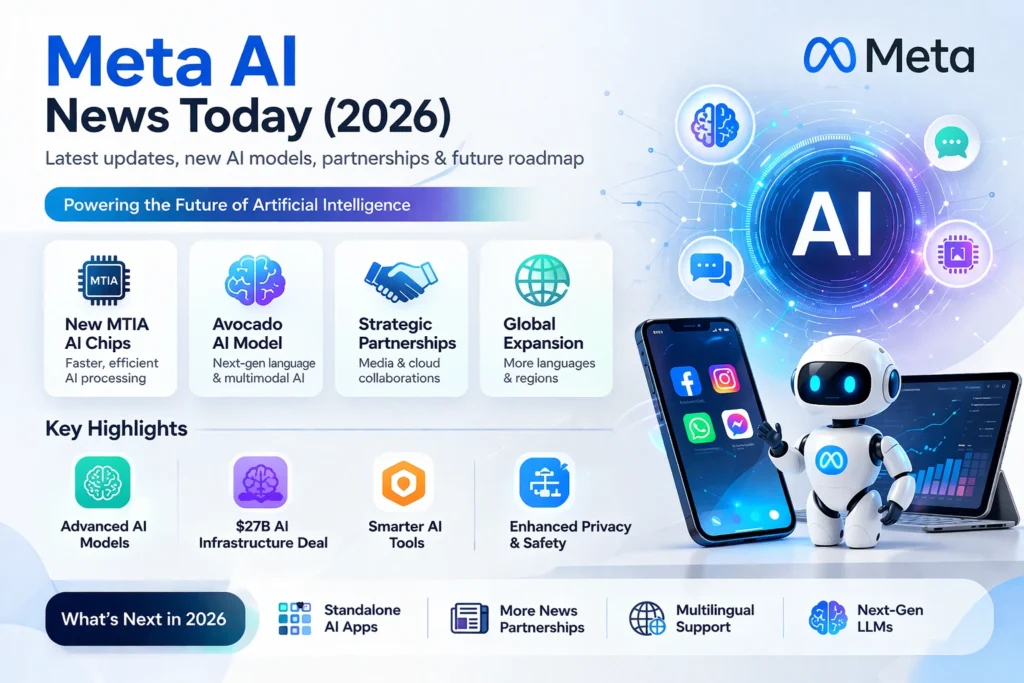
“Meta AI 2026: Key updates on Avocado AI, next-gen MTIA chips, strategic partnerships, AI tools integration, and global expansion across languages and platforms.”
Meta AI Model Developments
MTIA AI Chips
Meta has unveiled four innovative MTIA chips designed for diverse AI workloads:
| Chip | Purpose | Expected Impact |
| MTIA-300 | Standard LLM inference | Reduced latency, faster response generation |
| MTIA-400 | Large model training | Optimized compute efficiency and energy usage |
| MTIA-450 | Multimodal AI tasks | Cross-platform model capability (text, image, video) |
| MTIA-500 | Next-gen AI experimentation | Enables cutting-edge research and prototype testing |
These chips underscore Meta’s commitment to internalizing critical AI infrastructure, enabling highly optimized NLP training and inference processes.
Model Acquisitions
Recent acquisitions, including Manus AI, bolster Meta’s ability to deploy autonomous task execution models and enhance agent-based AI frameworks. This expansion supports Meta’s focus on task automation, intelligent workflow management, and context-sensitive AI reasoning.
Workforce & Operational Shifts
Meta is realigning teams to accelerate AI-first operations:
Advantages:
- Streamlined operational efficiency
- Accelerated AI tool deployment
- Resource focus on high-impact projects
Challenges:
- Temporary operational disruptions
- Employee dissatisfaction risk
- Short-term public perception concerns
The strategic workforce pivot facilitates embedding AI across processes while maintaining organizational agility and innovation capacity.
Privacy Policy & AI Advertising
Meta has updated its AI-driven advertising framework to ensure robust targeting while maintaining privacy compliance:
- AI insights enhance ad personalization without using sensitive topics
- Privacy-first approach emphasizes transparency and user consent
- Ethical AI usage aligns with regulatory frameworks and global standards
This approach demonstrates Meta’s commitment to responsible AI deployment in commercial applications, integrating NLP for content analysis, sentiment evaluation, and contextual ad placement.
Language Support & Global Expansion
Meta AI is expanding multilingual capabilities, utilizing NLP and machine translation models:
- Urdu: Supporting Pakistani users with Accurate contextual understanding
- Arabic and Middle Eastern languages: Facilitating accessibility and inclusivity
- Global AI-powered translation tools ensure seamless cross-cultural user engagement
These expansions underscore Meta’s objective to deploy inclusive AI systems that can operate effectively across diverse linguistic and cultural contexts.
Pros & Cons
Advantages:
- State-of-the-art AI models enabling real-time assistance
- Robust AI infrastructure investments for scalable computation
- Strategic partnerships enhancing reliability and data accuracy
- Global reach with multilingual support
Disadvantages:
- Delays in large language model rollouts
- Workforce disruptions and operational adjustments
- Dependence on continuous optimization for performance and safety
Future Outlook for Meta AI in 2026
Looking forward, Meta AI’s strategic priorities include:
- Launching standalone AI applications with deep integration across products
- Expanding licensed content agreements to improve AI knowledge bases
- Introducing next-generation LLMs surpassing Avocado in reasoning and creativity
- Strengthening proprietary AI hardware and cloud infrastructure to reduce third-party dependency
- Broadening multilingual support and enhancing NLP-powered translation capabilities
These initiatives indicate Meta’s unwavering focus on long-term AI leadership, robust NLP deployment, and global operational excellence.
FAQs
A: The launch is currently postponed to May 2026 or later, pending performance testing and optimization.
A: Meta leverages AI to improve ad targeting without using sensitive personal topics, prioritizing transparency, consent, and ethical AI practices.
A: From Marketplace auto-replies and automated photo analysis to generative content and conversational AI tools, Meta embeds AI features across its ecosystem.
A: Meta AI supports multiple global languages, including Urdu, Arabic, and additional key international languages for broader inclusivity.
Conclusion
Meta AI represents more than technological innovation—it signifies a strategic transformation of Meta Platforms into an AI-first enterprise. Through substantial infrastructure investments, advanced model development, strategic collaborations, and global expansion, Meta is charting a path where AI underpins user experience, operational efficiency, and industry influence.
Staying updated with Meta AI news today is essential for developers, businesses, and AI enthusiasts who wish to anticipate Emerging trends, leverage AI tools effectively, and maintain a competitive edge in a rapidly evolving technological environment.
By understanding Meta’s AI initiatives, readers can grasp the implications of NLP advancements, multimodal AI integration, and autonomous agent deployment on global digital ecosystems. The journey of Meta AI in 2026 is one of innovation, inclusivity, and strategic foresight—a testament to the transformative power of artificial intelligence.