Introduction
The evolution of natural language processing and generative AI continues to accelerate in 2026, Fundamentally transforming workflows across research, enterprise, and consumer-facing domains. Among the forefront of contemporary large language models, DeepSeek V3.1 and DeepSeek R1 have emerged as two preeminent systems, each excelling in different facets of reasoning, analytical rigor, and task execution.
While both models leverage transformer-based architectures with advanced token embeddings, attention mechanisms, and deep contextual reasoning, their design philosophies diverge significantly. V3.1 emphasizes hybrid versatility — combining rapid generation with deep reasoning capabilities, whereas R1 is architected for precision reasoning, structured chain-of-thought outputs, and algorithmic logic.
This analysis explores DeepSeek V3.1 versus R1 through the lens of performance, token utilization, multi-modal reasoning, and practical deployment in European enterprises. You will receive a detailed evaluation of architectures, inference paradigms, agent integration, benchmark performance, cost-efficiency, and optimal use-case recommendations for both models.
Whether you are a developer integrating advanced AI assistants, a data scientist evaluating reasoning workflows, or a business leader optimizing deployment strategies, this guide offers actionable insights for informed decision-making.
DeepSeek V3.1 Focused Overview
DeepSeek V3.1 represents a hybrid next-generation large language model designed for both generalist and specialized reasoning tasks. Unlike single-purpose systems, V3.1’s architecture accommodates multiple inference modalities, supporting both rapid response generation and comprehensive analytical reasoning.
Core Features of DeepSeek V3.1
Hybrid Inference Modes (Think / Non-Think):
- Think Mode: Optimized for in-depth reasoning, chain-of-thought explanations, logic-based inference, and semantic context propagation.
- Non-Think Mode: Prioritizes low-latency, high-throughput output suitable for production systems requiring cost-efficient inference.
Agent and Tool Integration:
V3.1 provides robust support for agent-based workflows, enabling:
- Multi-step task automation
- API orchestration with semantic reasoning
- Context-aware command execution
Extended Context Window (Up to 128K Tokens):
Unlike traditional LLMs constrained to smaller token contexts, V3.1 supports extensive multi-document reasoning, document summarization, codebase analysis, and complex conversation management.
Multilingual Capabilities:
V3.1 supports a broad spectrum of European languages — including German, French, Spanish, Italian, and Dutch — making it ideal for cross-border applications and multilingual customer support automation.
Advanced Code Generation and Analytical Querying:
From algorithm synthesis to debug recommendations, V3.1 can autonomously generate, optimize, and validate code snippets in multiple programming languages.
Example Use Case — European SaaS Platform
Consider a European SaaS provider integrating a multilingual AI assistant capable of:
- Responding to technical and contextual queries in multiple languages
- Performing automated ticket categorization and workflow management
- Scaling efficiently under high-load scenarios
With V3.1, hybrid reasoning ensures context-aware responses, logical consistency, and optimized throughput — all while minimizing operational costs.
DeepSeek R1 -Reasoning Specialist
DeepSeek R1 is a reasoning-first LLM built for structured, stepwise analytical workflows. Unlike hybrid models, R1 emphasizes algorithmic logic, chain-of-thought processing, and reasoning fidelity, making it suitable for research-intensive and compliance-heavy environments.
Core Traits of DeepSeek R1
Reasoning-Centric Architecture:
- Reinforcement learning with logic-oriented fine-tuning
- High precision in sequential reasoning tasks
- Explainable outputs suitable for regulated workflows
Stepwise Analytical Output:
R1 excels in multi-step reasoning, including:
- Complex mathematical proofs
- Algorithmic problem solving
- Statistical modeling and predictive analysis
Ideal for Scientific Workflows:
Academics, data scientists, and quantitative analysts can rely on R1 for robust, reproducible reasoning and structured output formats.
Context Window (64K Tokens):
While smaller than V3.1, R1’s token window ensures deep reasoning without overwhelming computational resources, optimizing logical coherence over context breadth.
Example Use Case — European Fintech Research
A fintech research team analyzing high-dimensional financial models can leverage R1 to:
- Generate structured, stepwise simulations
- Validate regulatory compliance outputs
- Maintain logical consistency across complex datasets
In this setting, R1’s reasoning-centric architecture provides the precision and predictability necessary for high-stakes financial analysis.
Architecture & Training Paradigms
| Feature | DeepSeek V3.1 | DeepSeek R1 |
| Model Type | Hybrid General-Purpose + Reasoning | Reasoning-Oriented LLM |
| Training Focus | Extended Post-Training + Token Optimizations | Reinforcement Learning-Focused Reasoning |
| Context Window | 128K Tokens | 64K Tokens |
| Agent Integration | Strong, Native | Limited |
| Inference Modes | Think / Non-Think | Single Reasoning Mode |
| Primary Strength | Versatile Workflows, Production Efficiency | Deep Analytical Logic |
How V3.1 Builds Upon R1
- Expanded Context Processing: Supports multi-document and multi-session reasoning
- Enhanced Integration: Facilitates real-world agent and API workflows
- Split Inference Modes: Balances speed and analytical depth for diverse applications
Analytical Benchmarks
Benchmarks in 2026 evaluate models on:
- Reasoning and Chain-of-Thought Performance
- Coding Capabilities
- Multilingual Understanding
- Agent and Tool Interaction Efficiency
Reasoning & Analytical Benchmarks
| Model | Reasoning Accuracy | Strengths |
| R1 | ⭐⭐⭐⭐ | Exceptional chain-of-thought consistency, structured logic |
| V3.1 (Think Mode) | ⭐⭐⭐⭐⭐ | Matches or surpasses R1 in complex reasoning and coding tests |
| V3.1 (Non-Think) | ⭐⭐⭐ | Faster, lower reasoning depth |
Insight: V3.1 in Think Mode delivers reasoning comparable to R1 while offering production Scalability, agent integration, and versatility.
Agent & Tool Interaction
| Model | Agent Integration | Tool Execution |
| V3.1 | ⭐⭐⭐⭐ | ⭐⭐⭐⭐ |
| R1 | ⭐⭐ | ⭐⭐ |
Implications: V3.1’s agent capabilities allow multi-step semantic task chaining, external API orchestration, and environment-aware execution.
Summary Benchmarks
- V3.1: Near-R1 reasoning, superior agent, and tool orchestration
- R1: Focused on deep analytical logic and chain-of-thought reasoning
- V3.1: Optimized for high-volume, production-level workflows
Cost-Efficiency & Production Readiness
Real-world adoption requires balancing performance and cost.
Pricing Overview
| Metric | DeepSeek V3.1 | DeepSeek R1 |
| API Cost | Unified, lower | Higher per endpoint |
| Inference Latency | Low | Higher due to reasoning depth |
| Compute Usage | Optimized | Resource-intensive |
Observation: V3.1’s architecture supports higher throughput at reduced operational costs, making it suitable for production deployments.
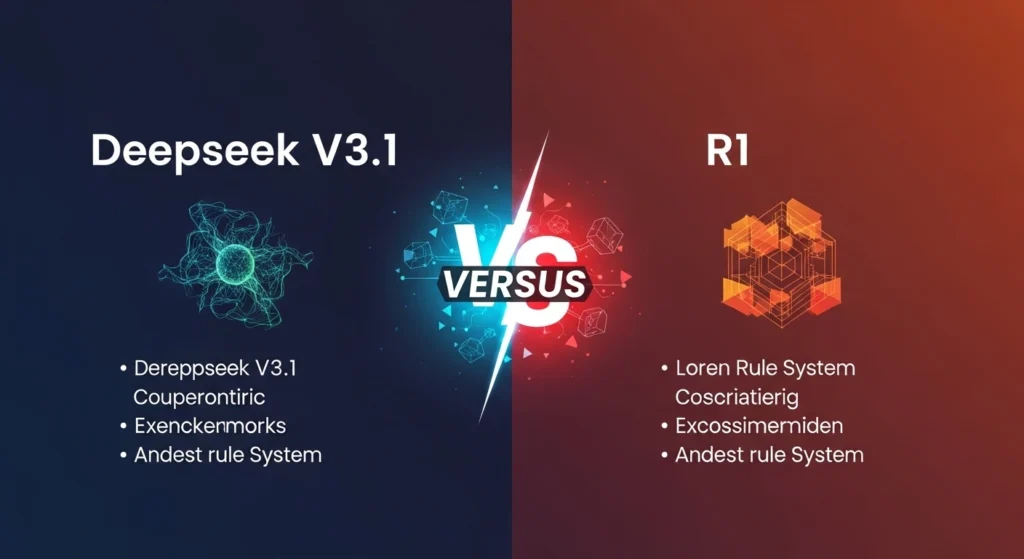
“DeepSeek V3.1 vs R1 (2026) A clear visual comparison of reasoning power, integration capabilities, and production vs research use cases for AI developers and European enterprises.”
Production Suitability
DeepSeek V3.1
- Optimal for high-volume conversational AI and multilingual assistants
- Scales efficiently in automated workflows
- Cost-effective token utilization
DeepSeek R1
- Ideal for research and specialized analytical tasks
- Structured reasoning outputs with high precision
- Less suitable for production-scale conversational systems
Use-Case Recommendations
When to Choose DeepSeek V3.1
Best For: Versatile & production systems
- AI-driven multilingual chatbots
- Developer tools and coding assistants
- Automated agent workflows
- Enterprise API integrations
Example: A SaaS company implementing internal automation pipelines and customer support assistants benefits from V3.1’s hybrid reasoning and operational efficiency.
When to Choose DeepSeek R1
Best For: Analytical and research-intensive tasks
- Algorithm validation and code proofs
- Deep mathematical reasoning
- Scientific publications and compliance documentation
Example: A research lab performing structured proofs or algorithm verification relies on R1 for explainable, stepwise outputs.
Pros & Cons Comparison
| Metric | DeepSeek V3.1 | DeepSeek R1 |
| Inference Speed | ⭐⭐⭐⭐ | ⭐⭐ |
| Reasoning Depth | ⭐⭐⭐ | ⭐⭐⭐⭐ |
| Cost Efficiency | ⭐⭐⭐⭐ | ⭐⭐ |
| Agent Integration | ⭐⭐⭐⭐ | ⭐ |
| Direct Answer Accuracy | ⭐⭐⭐⭐ | ⭐⭐⭐ |
Summary:
- V3.1: Trades extreme reasoning depth for versatility, operational scalability, and cost efficiency
- R1: Excels in high-precision analytical workflows but is less practical for production environments
Implementation Guide
API Integration
- Acquire API keys for V3.1 or R1
- Choose inference mode (Think/Non-Think for V3.1)
- Send queries using REST or SDK endpoints
Performance Optimization
- Activate Think Mode for complex reasoning only
- Use Non-Think for latency-sensitive workloads
- Implement context summarization and caching to reduce token usage
Agent Workflow Deployment
- Use V3.1 for multi-step automation, command chaining, and semantic task orchestration.
Developer Environment Integration
- Both models can integrate with IDEs, code review tools, and CI/CD pipelines
- V3.1’s agentic capabilities provide additional operational efficiency
Best Practices for European Deployment
Multilingual Support
- Prioritize V3.1 for multilingual European deployments
- Optimize token usage for languages with complex morphology (e.g., German, Finnish)
Token Management
- Summarize context before sending long texts
- Dynamically adjust context windows for efficiency
Regional Benchmarking
- Use MMLU and domain-specific European datasets (legal, healthcare, finance)
- Test across local languages and regulatory corpora
Cost Monitoring
- Compare European cloud providers to optimize inference cost
- Factor in token usage and multi-region deployment
FAQs
A: R1 historically excels in reasoning-intensive tasks, but V3.1’s Think Mode now matches or surpasses R1 in most benchmarks while delivering broader functionality.
A: V3.1 generally provides lower API costs, better throughput, and improved production efficiency.
A: For most real-world applications, V3.1 suffices. However, R1 remains valuable for specialized analytical, algorithmic, or compliance-heavy workflows.
A: Both support multiple European languages, with V3.1 optimized for multilingual and production environments.
A: V3.1 outperforms due to hybrid reasoning, agentic workflows, and integration scalability.
Conclusion:
In 2026, DeepSeek V3.1 and DeepSeek R1 serve complementary roles in driving AI adoption. V3.1 balances reasoning with production efficiency, multilingual support, and agentic integration, making it ideal for SaaS platforms, AI assistants, and Automated workflows. Conversely, R1 remains the go-to solution for research, structured reasoning, and analytical rigor in regulated or high-stakes environments.
By understanding the architecture, inference modes, context utilization, and cost implications of each model, developers and businesses can strategically deploy the right solution for their unique requirements.