Introduction
The demand for senior AI engineers has reached Unprecedented levels in 2026, driven by rapid advancements in large language models (LLMs), distributed computing, and AI infrastructure scaling. Among the most competitive and high-impact roles are Senior Grok Engineers at xAI and AI roles evaluated using Claude 3 Sonnet benchmarks from Anthropic.
Although these two ecosystems operate differently, they are increasingly compared in AI engineering interviews because they represent two opposite extremes of modern AI development: Grok emphasizes massive-scale infrastructure and real-time systems, while Claude focuses on reasoning quality, safety alignment, and structured problem-solving.
This guide breaks down everything you need to know about the Senior Grok Engineer interview vs. the Claude 3 Sonnet evaluation mindset. You will learn system design expectations, coding rounds, LLM architecture questions, distributed training challenges, and real interview simulation strategies.
If you are targeting elite AI engineering roles in Europe, the US, or global remote AI teams, this guide will help you understand exactly what top companies expect in 2026.
What is a Senior Grok Engineer Role?
A Senior Grok Engineer works on building, scaling, and optimizing large-scale AI systems powering Grok, developed by xAI.
Core Responsibilities
- Distributed training of LLMs across massive GPU clusters
- Real-time inference systems integrated with social platforms (like X)
- High-performance data pipelines handling billions of tokens
- Model deployment at a global scale with low latency requirements
- Fault-tolerant AI infrastructure engineering
Key Technical Domains
- GPU cluster orchestration (10K–100K+ GPUs)
- Parallel training systems (data + model parallelism)
- Streaming inference architectures
- Kubernetes-based ML infrastructure
- High-throughput networking systems
This role is infrastructure-heavy and extremely performance-driven.
What is Claude 3 Sonnet in an interview context?
Claude 3 Sonnet is not a job role but a benchmark model used in AI evaluations and interviews.
Why It Matters in Interviews
- Used as a reasoning performance baseline
- Measures structured thinking ability
- Evaluates coding clarity and correctness
- Tests step-by-step problem-solving skills
In interviews, Claude-style expectations often mean:
- Clean logic
- Minimal ambiguity
- Strong reasoning traceability
- Safe and structured outputs
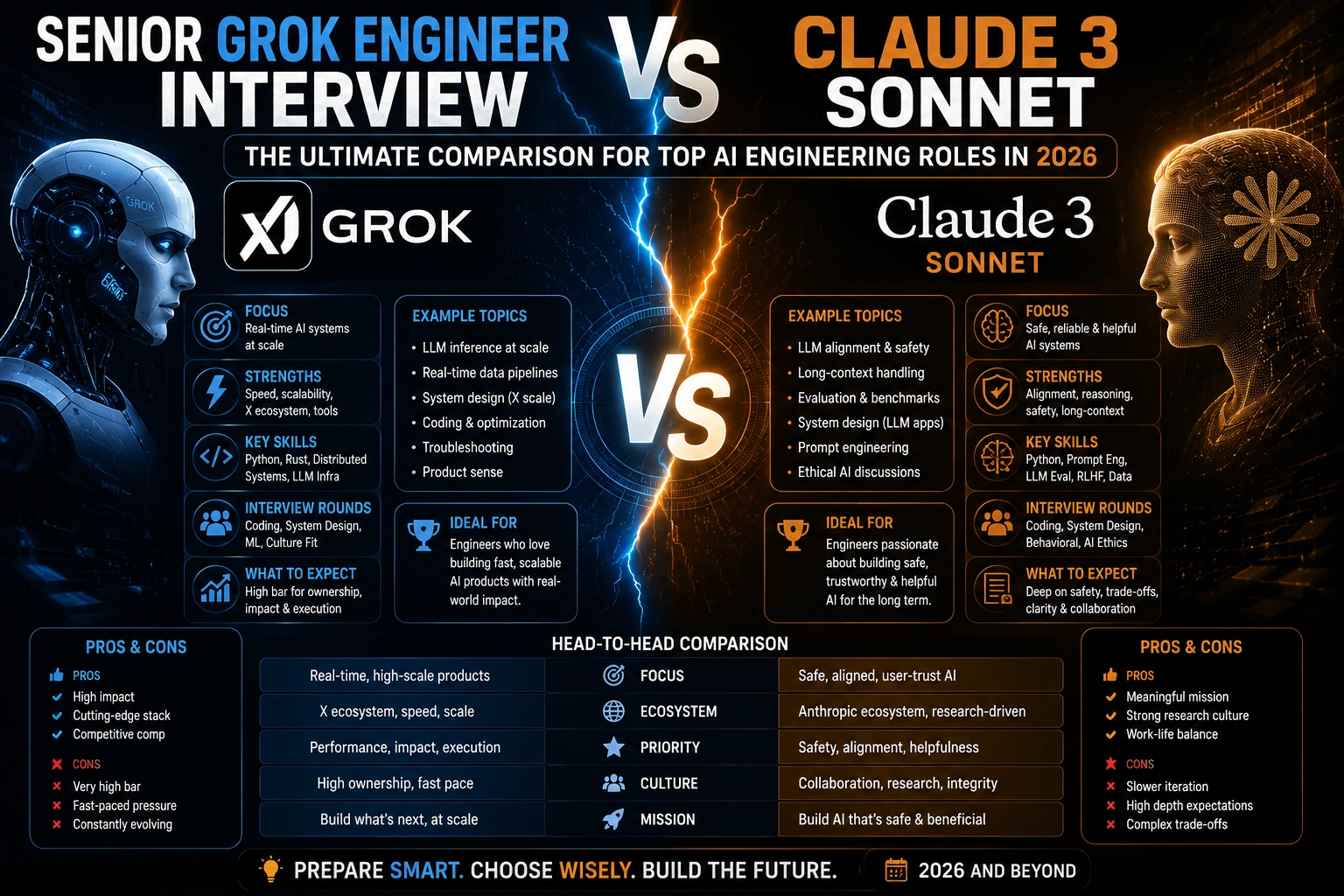
Core Difference: Interview Philosophy
| Factor | Grok (xAI) | Claude (Anthropic Benchmark) |
| Focus | Scale + speed | Reasoning + safety |
| System Design | Distributed GPU systems | Logical architecture clarity |
| Coding Style | Production-grade optimization | Clean algorithmic design |
| Priority | Performance under load | Correctness + structure |
| Evaluation Style | Real-world infra stress | Step-by-step reasoning |
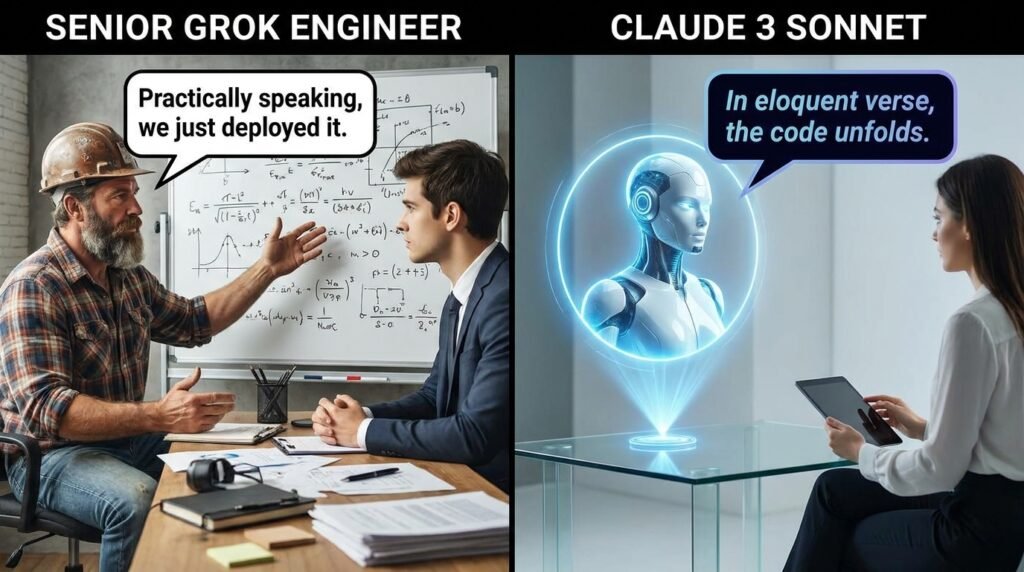
This difference defines everything in interviews.
Senior Grok Engineer Interview Breakdown
Coding Interview
Expect system-level coding problems rather than simple algorithms.
Common Topics
- Attention mechanism implementation
- Multi-threaded data processing
- Streaming token pipelines
- Memory-efficient tensor operations
Example Question
- Implement a simplified transformer attention module optimized for GPU execution.
System Design Interview
This is the most important round.
Expected Questions
- Design a 100K GPU LLM training system
- Design a Grok inference system for millions of concurrent users
- Build a distributed checkpoint recovery system
Key Focus Areas
- Load balancing across clusters
- Fault tolerance strategies
- Network bandwidth optimization
- Latency reduction techniques
LLM Architecture Deep Dive
Core Topics
- Transformer architecture optimization
- RLHF pipeline design
- Tokenization strategies at scale
- Scaling laws for model training
Example Question
- How would you optimize attention computation for long-context inference?
Behavioral Interview
This evaluates the execution mindset.
What Interviewers Look For
- Decision-making under pressure
- Ownership mentality
- Speed vs perfection trade-offs
- Handling ambiguous infrastructure failures
Claude 3 Sonnet Benchmark Influence in Interviews
Why Claude Matters in Grok Interviews
Even though Claude is not part of xAI, it influences evaluation indirectly:
- Used as a reasoning comparison baseline
- Helps evaluate clarity of explanations
- Acts as a coding quality benchmark
Claude-Style Interview Expectations
- Step-by-step reasoning
- Clean and readable code
- Strong logical structure
- Minimal ambiguity in explanations
Coding Interview Comparison
Grok Coding Style
- Focus on scalability
- Production-ready optimization
- Multi-threading and concurrency
- Memory efficiency
Claude Coding Style
- Clear logic structure
- Strong readability
- Algorithm correctness
- Step-by-step explanation
System Design Deep Dive
Typical Senior Grok Engineer Questions
- Design a real-time inference system for global users
- Build a distributed training pipeline across 100K GPUs
- Design a data ingestion system for social media-scale traffic
Key Engineering Skills Tested
- Distributed computing
- GPU orchestration
- Caching strategies
- Latency optimization
- Fault recovery systems
System Design Comparison Table
| Feature | Grok System Design | Claude Benchmark Thinking |
| Scale | Massive distributed clusters | Logical modular systems |
| Priority | Performance & throughput | Correctness & safety |
| Optimization | Hardware-aware design | Algorithm clarity |
| Complexity | Extremely high | Moderate to high |
Most Common Senior Grok Engineer Interview Questions
- How would you scale LLM training to 100,000 GPUs?
- Design a fault-tolerant checkpoint system
- How do you reduce inference latency in real-time systems?
- Explain transformer optimization techniques
- Design an RLHF feedback pipeline for continuous learning
Claude vs Grok Interview Mindset Shift
Claude Mindset
- Focus on correctness
- Structured reasoning
- Safety-first thinking
- Clean abstraction design
Grok Mindset
- Focus on speed and scale
- Real-world production constraints
- Hardware-aware optimization
- Aggressive performance tuning
Pros & Cons Section
Senior Grok Engineer Interview
Pros
- High-paying AI infrastructure roles
- Cutting-edge distributed systems exposure
- Real-world large-scale engineering problems
- Strong career growth in AI infra
Cons
- Extremely difficult technical bar
- Heavy system design focus
- High-pressure interview environment
- Requires deep GPU and infra knowledge
Claude Benchmark-Based Roles
Pros
- Strong focus on reasoning clarity
- Easier to structure preparation
- Better for algorithm-focused engineers
- Emphasis on clean coding practices
Cons
- Less exposure to large-scale systems
- Limited infrastructure complexity
- More theoretical compared to Grok roles
How to Use These AI Tools for Interview Prep
To prepare effectively:
Grok Preparation Strategy
- Practice distributed system design daily
- Study GPU architecture basics
- Build mock inference pipelines
- Solve concurrency-heavy coding problems
Claude-Style Preparation Strategy
- Focus on algorithm clarity
- Practice explaining solutions step-by-step
- Improve code readability
- Strengthen reasoning under constraints
Tips to Master AI Engineering Interviews
- Simulate real interview pressure conditions
- Practice explaining trade-offs clearly
- Focus on system-level thinking, not just coding
- Learn the transformer architecture deeply
- Study distributed computing fundamentals
Europe Relevance Section
AI engineering roles influenced by Grok and Claude-style interviews are increasingly open to European talent, especially in countries like Germany, the Netherlands, and Switzerland, where AI infrastructure and research demand is growing rapidly.
Remote AI roles also allow European engineers to participate in US-based AI companies, making these skills globally valuable.
People Also Ask
A: Yes, Grok interviews are significantly more infrastructure-heavy and require advanced distributed systems knowledge compared to Claude-style reasoning evaluations.
A: Yes, it is often used as a benchmark to evaluate coding clarity, reasoning quality, and structured problem-solving ability.
A: Key skills include distributed systems, GPU cluster design, LLM training pipelines, and high-performance inference systems.
A: Yes, especially transformer architecture, RLHF pipelines, and large-scale training optimization techniques.
A: Beginners can start with system design basics and gradually move toward distributed AI systems and LLM architectures.
Conclusion
The Senior Grok Engineer Interview vs Claude 3 Sonnet comparison highlights two fundamentally different approaches to AI engineering in 2026. One focuses on massive-scale distributed systems and production-grade AI infrastructure, while the other emphasizes structured reasoning, clarity, and algorithmic correctness.
If your goal is to join cutting-edge AI Infrastructure teams like those at xAI, you must master distributed computing, GPU scaling, and LLM training systems. On the other hand, Claude-style evaluation frameworks from Anthropic help you refine logical thinking and coding precision.
The strongest candidates in 2026 are those who can combine both mindsets—thinking like a systems engineer while reasoning like a structured problem solver.
For long-term success in AI careers across Europe and global markets, mastering both perspectives is no longer optional—it is a competitive advantage.