Introduction
Artificial intelligence is evolving at a speed that few industries can match. In 2026, the Conversation is no longer just about “which chatbot is smarter.” The real battle is about ecosystems, infrastructure, openness, privacy, and long-term AI control. That is exactly why the debate around xAI Grok-3 and Meta Llama 2 has become one of the hottest topics among developers, startups, researchers, and enterprises worldwide.
One model focuses on frontier-scale reasoning, real-time internet integration, and massive compute infrastructure. The other empowers developers with open-source flexibility, local deployment, customization, and enterprise-level AI independence.
For European businesses, USA-based AI startups, researchers, and privacy-focused organizations, this comparison matters more than ever. Strict regulations, AI sovereignty concerns, and rising infrastructure costs are changing how companies choose large language models.
In this detailed guide, we will compare Grok-3 vs Llama 2 across architecture, benchmarks, coding performance, AI safety, pricing, privacy, local deployment, hardware requirements, and future AI trends. Whether you are building AI agents, deploying private LLMs, running enterprise copilots, or experimenting with local AI servers, this article will help you decide which AI ecosystem fits your needs in 2026.
What Is Grok-3?
xAI Grok-3 is the latest generation AI model developed by xAI, the artificial intelligence company founded by Elon Musk. The Grok series was created to compete directly with frontier AI systems like GPT, Claude, Gemini, and other advanced reasoning models.
Unlike traditional chatbots, Grok-3 was designed with several ambitious goals:
- Real-time internet awareness
- Advanced reasoning abilities
- Long-context understanding
- AI agent capabilities
- Integration with X (formerly Twitter)
- High-scale multimodal infrastructure
One of Grok-3’s biggest differentiators is its connection to real-time online information. Most AI models rely heavily on static training data, but Grok aims to combine reasoning with continuously updated information streams.
Key Features of Grok-3
Massive Context Window
Grok-3 supports extremely large context handling, making it suitable for:
- Repository-scale code analysis
- Multi-document reasoning
- Long-form research
- AI agent workflows
- Enterprise knowledge systems
Frontier-Scale Compute
xAI reportedly trained Grok using enormous GPU clusters and next-generation AI accelerators. This allows Grok-3 to compete with top-tier proprietary models in:
- Mathematical reasoning
- Scientific analysis
- Coding
- Long-context retrieval
- Agentic workflows
Real-Time Information Access
One major advantage is real-time access to current events and social discussions through X integration. This gives Grok a dynamic knowledge advantage in rapidly changing environments.
Proprietary AI Ecosystem
Grok remains closed-source and cloud-controlled. Developers cannot freely self-host the full Frontier model stack, which creates both advantages and limitations depending on the use case.
What Is Llama 2?
Meta Llama 2 remains one of the most influential open-source AI model families ever released. Even though newer open models now exist, Llama 2 still powers thousands of enterprise deployments, local AI projects, research labs, and developer tools worldwide.
Released in multiple variants, Llama 2 helped accelerate the modern open-weight AI movement.
Llama 2 Model Variants
The series includes:
- 7B parameters
- 13B parameters
- 70B parameters
These different sizes allow developers to optimize performance depending on:
- Hardware availability
- Cost requirements
- Latency needs
- Local deployment goals
Why Llama 2 Still Matters in 2026
Despite newer proprietary AI systems, Llama 2 remains important because it offers:
- Open deployment flexibility
- Fine-tuning freedom
- Offline AI capabilities
- Lower infrastructure costs
- Community-driven improvements
- Local privacy protection
For many European organizations concerned about GDPR compliance and data sovereignty, open-source AI remains highly attractive.
Key Strengths of Llama 2
Local AI Deployment
Llama 2 can run locally using:
- Ollama
- Hugging Face
- GGUF quantized models
- RTX GPUs
- AMD GPUs
- Apple Silicon systems
Fine-Tuning Ecosystem
Developers can customize Llama 2 for:
- Medical AI
- Legal AI
- Enterprise copilots
- Customer support bots
- Coding assistants
- Research tools
Open Research Accessibility
Unlike proprietary frontier models, researchers can inspect, modify, and experiment with Llama 2 much more freely.
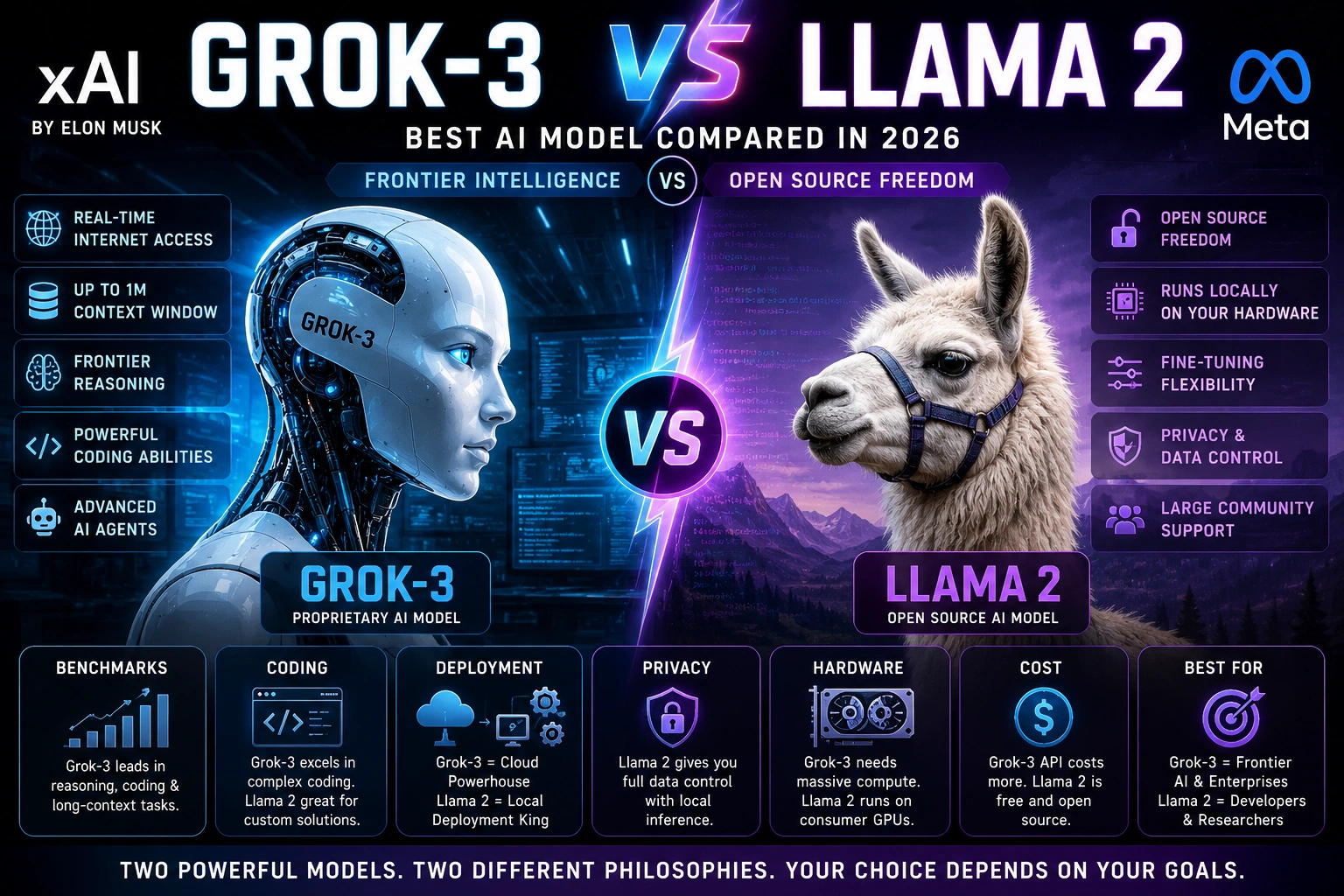
Grok-3 VS Llama 2 — Quick Comparison
| Feature | Grok-3 | Llama 2 |
| Developer | xAI | Meta |
| Release Era | 2025/2026 | 2023 |
| Open Source | No | Yes |
| Context Window | Up to 1M+ | ~4K default |
| Real-Time Internet | Yes | No |
| Local Deployment | Limited | Excellent |
| Fine-Tuning | Restricted | Highly Flexible |
| Best For | Frontier reasoning | Custom AI systems |
| Hardware Needs | Massive cloud clusters | Consumer GPUs possible |
| Privacy | Cloud dependent | Full local control |
| AI Agent Support | Strong | Moderate |
| Enterprise Flexibility | Medium | Very High |
| Infrastructure Cost | Expensive | Lower |
| Community Ecosystem | Smaller | Massive |
Architecture Differences Explained
This section is where most competitor articles fail. Understanding architecture is critical because AI performance depends heavily on infrastructure design.
Transformer Foundations
Both Grok-3 and Llama 2 rely on transformer-based neural network architectures.
f(x)=Transformer(x)f(x)=\mathrm{Transformer}(x)f(x)=Transformer(x)
Transformers predict the next token using self-attention mechanisms that analyze relationships between words, symbols, and concepts across large datasets.
However, the implementation strategy differs dramatically.
Dense vs Sparse Models
Llama 2 Uses Dense Architectures
In dense models, nearly all parameters participate during inference.
Advantages:
- Easier deployment
- Stable inference
- Simpler optimization
- Better compatibility with local hardware
Disadvantages:
- Higher compute cost per token
- Scaling becomes expensive
Grok-3 Likely Uses Mixture-of-Experts (MoE)
Modern frontier AI models increasingly use sparse Mixture-of-Experts architectures.
In MoE systems:
- Only selected expert subnetworks activate
- Compute efficiency improves dramatically
- Scaling becomes more practical
- Massive parameter counts become possible
This architecture helps frontier models scale their reasoning without proportional increases in compute during inference.
Reinforcement Learning and Alignment
Both models incorporate RLHF (Reinforcement Learning from Human Feedback), but Grok-3 appears far more optimized for:
- Agentic reasoning
- Multi-step problem solving
- Dynamic internet interaction
- Long-chain reasoning
Llama 2 prioritizes:
- Stability
- Accessibility
- Open deployment
- Community adaptability
Performance Benchmarks
Benchmark discussions dominate AI communities, but raw scores rarely tell the full story.
Grok-3 Strengths
Grok-3 generally performs strongly in:
- Advanced reasoning
- Long-context tasks
- Coding
- Real-time information
- Scientific analysis
- Multi-step planning
Llama 2 Strengths
Llama 2 still excels in:
- Lightweight deployments
- Fine-tuned applications
- Local inference
- Custom enterprise systems
- Privacy-sensitive workflows
Benchmark Reality Check
Many AI benchmarks are imperfect.
Developers on Reddit and AI forums often point out:
- Benchmarks can be gamed
- Real-world coding differs from synthetic tests
- Latency matters more than raw intelligence in production
- Open models often outperform expectations after fine-tuning
This nuance is missing from many comparison articles.
Coding Performance — Which AI Is Better for Developers?
Coding performance is now one of the biggest AI buying factors.
Grok-3 for Coding
Grok-3 performs exceptionally well in:
- Repository-level understanding
- Multi-file reasoning
- Long-context debugging
- API architecture generation
- Complex algorithm design
Its large context window gives it a major advantage for enterprise-scale software engineering.
Best Use Cases
- AI coding copilots
- Large SaaS platforms
- Research systems
- Multi-agent development
- Infrastructure automation
Llama 2 for Coding
Llama 2 remains highly valuable because developers can customize it extensively.
Popular deployment examples include:
- Self-hosted coding assistants
- Offline developer copilots
- Private code review systems
- Secure enterprise environments
Practical Developer Difference
Grok-3 Wins When:
- You need frontier intelligence
- Long-context reasoning matters
- Cloud infrastructure is acceptable
Llama 2 Wins When:
- Privacy matters
- Offline operation is required
- Cost control matters
- Customization is essential
Open Source vs Proprietary AI
This is one of the most important AI debates of 2026.
Why Open-Source AI Matters
Developers support open models because they provide:
- Transparency
- Independence
- Reduced vendor lock-in
- Greater innovation
- Community improvements
- Local deployment freedom
Why Proprietary AI Dominates Benchmarks
Frontier proprietary systems often outperform open models because companies invest:
- Billions in GPU clusters
- Massive research teams
- Advanced reinforcement learning
- Proprietary training datasets
Europe’s Growing Open AI Movement
European businesses increasingly prioritize:
- AI sovereignty
- GDPR compliance
- Local inference
- Secure infrastructure
- Independent AI ecosystems
This trend strongly benefits open-weight models like Llama 2.
Hardware Requirements
Hardware costs can determine whether an AI system is practical.
Grok-3 Hardware Needs
Frontier-scale models require:
- Enterprise GPU clusters
- High-bandwidth networking
- Cloud-scale inference
- Massive storage infrastructure
This makes Grok-3 extremely powerful but difficult for individuals to self-host.
Llama 2 Hardware Flexibility
Llama 2 can run on surprisingly accessible hardware.
Entry-Level Local AI
- RTX 3060
- RTX 4060 Ti
- Mac Studio
- AMD Radeon systems
Advanced Local Deployments
- Multi-GPU servers
- Quantized GGUF models
- AI workstations
- Enterprise inference nodes
Quantization Advantage
Quantization dramatically reduces memory usage.
Memory Usage∝Parameters×PrecisionMemory\ Usage\propto Parameters\times PrecisionMemory Usage∝Parameters×Precision
This enables local deployment on consumer hardware.
Privacy and AI Safety
Privacy is becoming one of the biggest AI concerns globally.
Grok-3 Privacy Considerations
Since Grok operates primarily through cloud systems:
- Data may pass through external servers
- Enterprise compliance becomes critical
- Some industries may face regulatory limitations
However, cloud AI also provides:
- Better scalability
- Easier updates
- Strong centralized security
Llama 2 Privacy Advantages
Local inference gives organizations:
- Full data control
- Offline operation
- Internal compliance
- Reduced external exposure
This matters heavily for:
- Healthcare
- Legal services
- Government agencies
- Financial institutions
Grok-3 vs Llama 2 for Businesses
Different businesses require different AI ecosystems.
Startups
Grok-3 Advantages
- Faster prototyping
- Strong reasoning
- Powerful APIs
- Frontier capabilities
Llama 2 Advantages
- Lower cost
- Greater flexibility
- Easier customization
- Better long-term control
Enterprises
Large enterprises increasingly prefer hybrid approaches:
- Proprietary AI for advanced reasoning
- Open-source AI for internal workflows
AI SaaS Companies
Many SaaS companies choose Llama 2 because they need:
- Cost predictability
- Custom training
- Local deployment
- Reduced API dependency
Which AI Model Is Better for Local Deployment?
Llama 2 dominates this category.
Popular Local AI Tools
Developers commonly deploy Llama models using:
- Ollama
- Hugging Face Transformers
- LM Studio
- vLLM
- Text Generation WebUI
Why Local AI Is Growing
Local AI provides:
- Privacy
- Lower long-term cost
- Faster iteration
- Offline capability
- Infrastructure independence
Grok-3 Local Deployment Limitations
Because Grok-3 remains proprietary, full local deployment is largely unavailable.
That makes Llama 2 significantly more attractive for hobbyists, researchers, and privacy-focused enterprises.
Grok-3 vs Llama 2 — Pros and Cons
Grok-3 Pros
- Massive reasoning power
- Huge context window
- Real-time internet access
- Strong coding abilities
- Advanced agent workflows
- Frontier AI performance
Cons
- Proprietary ecosystem
- Expensive infrastructure
- Limited customization
- Cloud dependence
- Less transparent
Llama 2 Pros
- Open-source ecosystem
- Excellent local deployment
- Fine-tuning flexibility
- Lower infrastructure costs
- Strong community support
- Privacy-friendly
Llama 2 Cons
- Older architecture
- Smaller context window
- Weaker frontier reasoning
- Less powerful out-of-the-box performance
Community Opinions and Reddit Discussions
AI communities remain deeply divided.
Common Grok-3 Praise
Developers often praise:
- Strong reasoning
- Humor and personality
- Long-context handling
- Real-time awareness
Common Grok-3 Criticism
Critics mention:
- Proprietary limitations
- Infrastructure dependence
- Benchmark hype concerns
Common Llama 2 Praise
The open-source community strongly supports:
- Freedom
- Transparency
- Local AI
- Fine-tuning ecosystems
Common Llama 2 Criticism
Users often mention:
- Older architecture limitations
- Inferior reasoning compared to frontier models
- Smaller default context windows
Future of AI Models in 2026 and Beyond
The future of AI is no longer just about bigger models.
Major Trends
AI Agents
Autonomous systems capable of planning and execution will dominate enterprise AI.
Multimodal Intelligence
Future AI systems increasingly combine:
- Text
- Images
- Audio
- Video
- Real-time interaction
On-Device AI
Privacy regulations and hardware improvements are accelerating local AI adoption.
Open-Weight Ecosystems
Open-source AI communities continue growing rapidly across Europe and globally.
AI Regulation
Governments increasingly focus on:
- Transparency
- Safety
- Data protection
- Copyright compliance
Which AI Model Wins in 2026?
The answer depends entirely on your priorities.
Choose Grok-3 If You Need:
- Frontier reasoning
- Massive context windows
- Advanced coding
- Real-time information
- AI agent capabilities
Choose Llama 2 If You Need:
- Open-source flexibility
- Local deployment
- Enterprise privacy
- Lower costs
- Fine-tuning freedom
People Also Ask
For raw reasoning and long-context tasks, Grok-3 is generally stronger. However, Llama 2 remains superior for local deployment, customization, and open-source flexibility.
Yes. Llama 2 can run locally using tools like Ollama, Hugging Face, LM Studio, and GGUF quantized deployments.
No. Grok-3 is proprietary and cloud-controlled by xAI.
Grok-3 performs better for large-scale reasoning and long-context coding, while Llama 2 is excellent for self-hosted coding assistants.
Modern Grok systems increasingly support multimodal workflows involving text and other media formats.
Conclusion
The battle between Grok-3 and Llama 2 represents something much larger than a simple AI benchmark competition. It reflects the growing divide between frontier proprietary intelligence and open-source AI freedom.
Grok-3 pushes the boundaries of reasoning, context handling, and advanced AI capabilities. It is ideal for organizations seeking cutting-edge performance and cloud-scale intelligence.
Llama 2, meanwhile, remains one of the most important open AI ecosystems in the world. Its flexibility, affordability, local deployment support, and community-driven innovation continue making it a powerful choice for developers, startups, researchers, and privacy-focused enterprises across Europe and beyond.
As AI evolves through 2026 and beyond, businesses will increasingly adopt hybrid strategies that combine both frontier cloud AI and open local models. The future likely belongs not to a single model, but to flexible AI ecosystems capable of balancing intelligence, cost, privacy, and control.