Introduction
Artificial intelligence has moved beyond simple chatbots.
Today, AI assistants help write articles, build applications, analyze documents, summarize reports, brainstorm marketing campaigns, automate workflows, and support daily Productivity.
Two platforms consistently dominate the conversation:
Claude AI and ChatGPT.
If you search for “Claude AI vs ChatGPT,” most comparison articles only provide basic tables and surface-level opinions.
They rarely answer practical questions such as:
- Which AI creates stronger publish-ready content?
- Which performs better for coding?
- Which tool helps marketers move faster?
- Which platform works better for agencies and businesses?
- Which AI provides better value in 2026?
This guide takes a different approach.
Instead of declaring a universal winner, we compare both tools across real workflows, including content creation, SEO, coding, research, long-document analysis, productivity, and business use cases.
By the end, you will know exactly which AI assistant fits your work.
Claude AI vs ChatGPT: Quick Verdict
If you want the short answer:
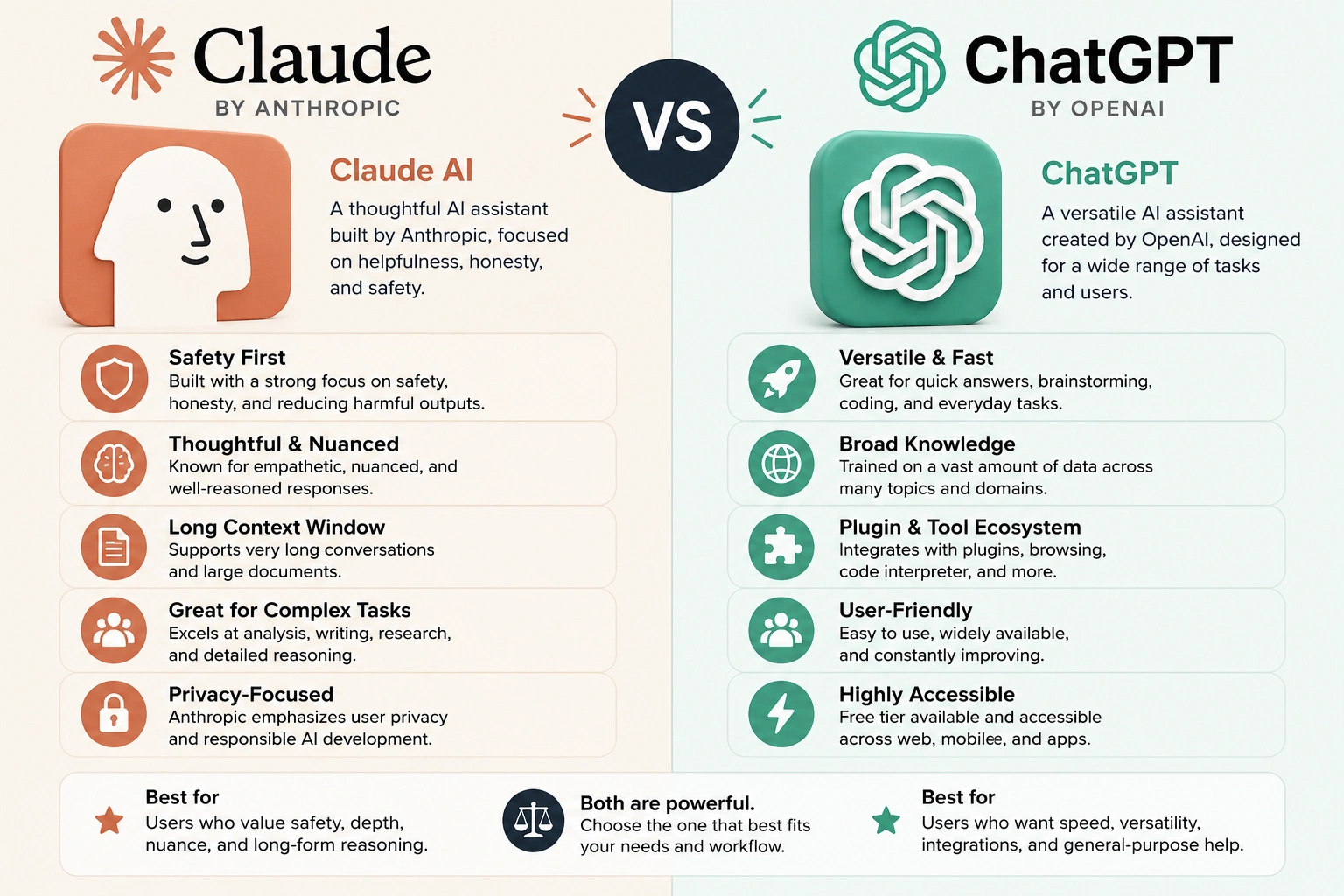
Choose Claude AI if you prioritize:
Long-form writing
Document analysis
Structured outputs
Research-heavy workflows
Technical reasoning
Choose ChatGPT if you prioritize:
Versatility
Creative generation
Daily productivity
Broad integrations
Faster iteration across tasks
For many professionals in 2026, the strongest workflow is not replacing one with the other—it is combining both.
Claude AI vs ChatGPT at a Glance
| Category | Claude AI | ChatGPT |
| Writing Quality | Excellent | Excellent |
| Long Documents | Excellent | Strong |
| Coding | Excellent | Excellent |
| Creativity | Strong | Excellent |
| Research | Excellent | Excellent |
| Productivity | Strong | Excellent |
| Business Workflows | Strong | Excellent |
| Ease of Use | Simple | Flexible |
| SEO Workflows | Strong | Excellent |
| Multimodal Features | Growing | Broad |
| Learning Curve | Low | Low |
| Best For | Analysis & Structure | Productivity & Flexibility |
Bottom line:
Claude specializes in depth.
ChatGPT specializes in breadth.
What Is Claude AI?
Claude AI is an AI assistant developed by Anthropic and designed around natural conversation, structured reasoning, and document workflows.
Its reputation has grown because of its ability to process long inputs while maintaining coherent output.
Many users prefer Claude for tasks requiring concentration and depth rather than rapid ideation.
Key Features of Claude AI
Long Context Understanding
Claude is widely recognized for handling extensive documents and maintaining context across large inputs.
Examples:
- Research papers
- Legal drafts
- Technical specifications
- Multi-section reports
Clean Writing Style
Claude frequently produces:
- Professional tone
- Consistent structure
- Fewer unnecessary flourishes
Strong Instruction Following
Claude performs especially well when prompts include:
- Formatting requirements
- Constraints
- Long instructions
Research-Oriented Workflows
Popular use cases:
- Summaries
- Report synthesis
- Editorial drafting
- Internal documentation

What Is ChatGPT?
ChatGPT is OpenAI’s conversational AI platform built for broad productivity.
It combines conversation, multimodal workflows, research support, writing assistance, coding capabilities, and everyday task management into one environment.
Its biggest advantage is flexibility.
Instead of focusing on a narrow workflow, ChatGPT supports many different use cases inside a single experience.
Key Features of ChatGPT
Strong General-Purpose Performance
Useful for:
- Writing
- Brainstorming
- Coding
- Planning
- Learning
Multimodal Capabilities
ChatGPT supports workflows beyond text, including:
- Image understanding
- Visual generation
- file handling
- structured outputs
Broad Productivity Ecosystem
Popular scenarios:
- Content teams
- Marketing operations
- Developers
- Agencies
- Startups
Flexible Creative Generation
Strong for:
- Ad copy
- Content ideas
- Campaign concepts
- Alternative approaches
Claude AI vs ChatGPT: Detailed Head-to-Head Comparison
This section evaluates performance by actual outcomes instead of specifications.
Writing Quality Comparison
Winner: Claude (Small Advantage)
Writing quality is one of the closest categories.
Both tools produce high-quality text.
The difference appears in style.
Claude’s Writing Strengths
Claude tends to generate:
- Cleaner first drafts
- Better paragraph flow
- Strong consistency
- Lower editing effort
Ideal for:
- Long-form blogs
- Reports
- Editorial content
- Documentation
Example:
A 2,500-word article draft often requires less restructuring.

ChatGPT Writing Strengths
ChatGPT performs well for:
- Marketing copy
- Creative campaigns
- Multiple style variations
- Faster content ideation
Ideal for:
- Content agencies
- SEO teams
- Social campaigns
- Daily publishing
Verdict:
If the quality of the first draft matters most → Claude.
If speed and flexibility matter → ChatGPT.
Coding Comparison
Winner: Draw
Developers increasingly use AI for:
- Debugging
- Documentation
- Architecture
- Refactoring
Both tools perform strongly but differently.
Claude for Coding
Strengths:
- Longer code reasoning
- Better architecture explanations
- Structured outputs
Best for:
- Backend systems
- Large repositories
- Technical reviews
Weaknesses:
- Sometimes conservative
ChatGPT for Coding
Strengths:
- Rapid iteration
- Faster experimentation
- Broader workflow support
Best for:
- MVP building
- Front-end development
- Automation
Weaknesses:
- May require additional prompt tuning
Verdict:
Complex reasoning → Claude
Fast development → ChatGPT
Research & Analysis Comparison
Winner: Claude
This is one of Claude’s strongest categories.
Claude performs especially well when users upload:
- Long reports
- Multi-page documents
- Research material
Claude typically:
- Maintains structure
- Extracts patterns
- Produces organized summaries
ChatGPT remains highly capable but often feels more productivity-oriented than analysis-first.
People Also Ask
A: There is no universal winner. Claude often performs strongly for long-form writing, document analysis, and structured outputs, while ChatGPT stands out for flexibility, productivity, and broader workflow support. The better option depends on the task.
A: ChatGPT is often preferred for faster content production, content briefs, metadata generation, keyword expansion, and campaign ideation. Claude can still be valuable for refining long-form articles and improving editorial quality.
A: Both perform well for coding, but their strengths differ. Claude is frequently chosen for deeper code reasoning and architecture discussions, while ChatGPT is useful for rapid iteration, debugging support, and experimentation.
A: Students often benefit from both platforms depending on their goals. ChatGPT works well for explanations, productivity, and learning support, while Claude can be useful for reading long documents and creating structured summaries.
A: Yes. Many teams combine both tools rather than choosing one. A common workflow is using one AI for research and analysis and the other for drafting, execution, and content production.
Conclusion
After comparing Claude AI vs ChatGPT across writing, coding, research, SEO, productivity, and business workflows, one conclusion becomes clear:
There is no single best AI Assistant for everyone. Claude continues to stand out in areas that require depth, structured reasoning, document analysis, and long-form outputs. It is particularly attractive for users who spend time working with detailed information and editorial refinement.
ChatGPT remains one of the most flexible AI platforms for everyday productivity, content creation, brainstorming, multimodal workflows, and faster execution across multiple tasks. For many professionals, agencies, developers, and creators, the strongest approach is no longer choosing one tool forever—it is selecting the right tool for the right workflow.