Introduction
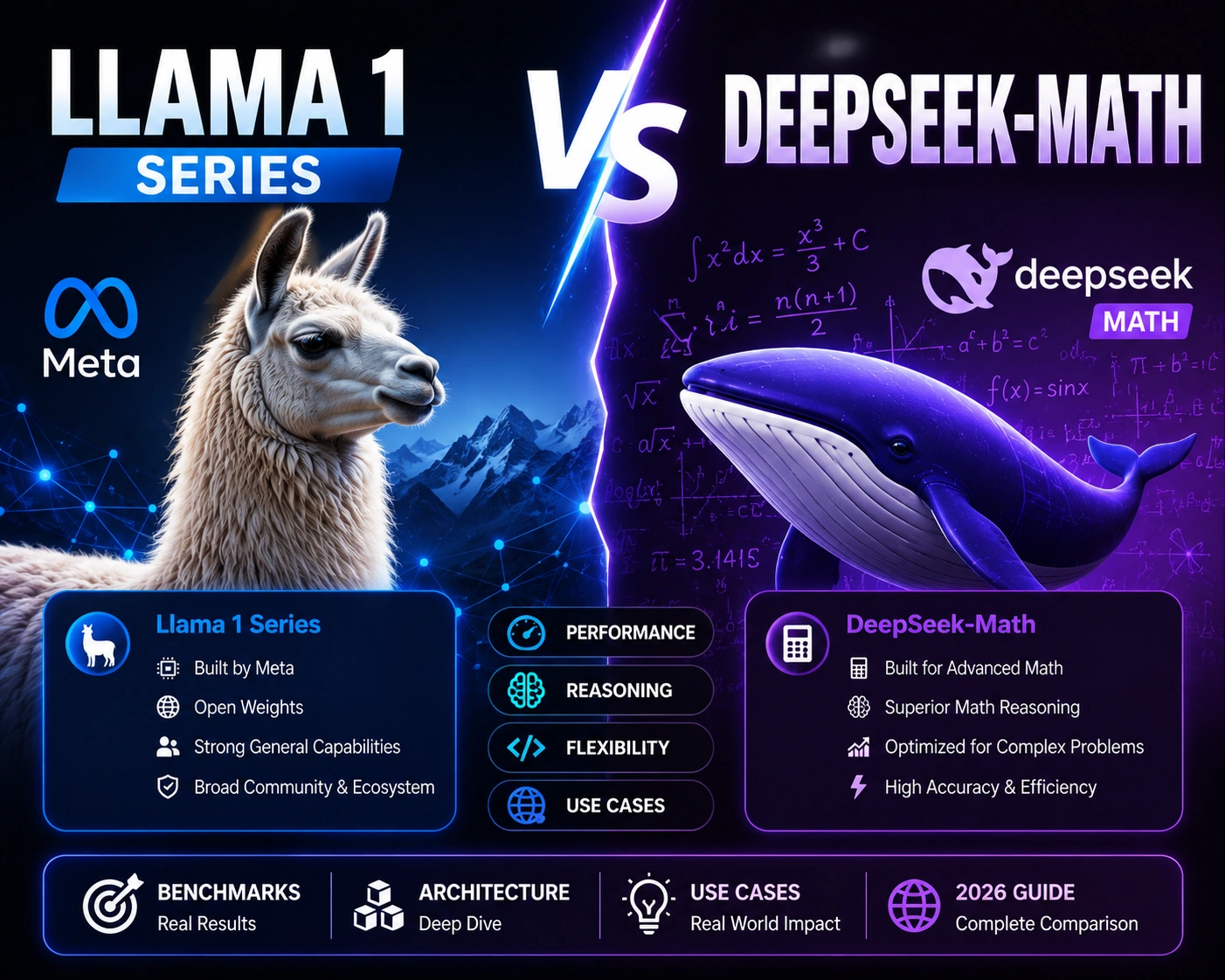
The AI landscape in 2026 is evolving faster than ever, especially in Europe and the US, where AI tools are now widely used in education, research, software development, and business analytics. Among the most discussed comparisons in the AI community is Llama 1 Series vs DeepSeek-Math, two models that represent completely different philosophies in artificial intelligence design.
On one side, Llama 1 is a general-purpose large language model designed for broad natural language tasks such as conversation, summarization, and content generation. On the other side, DeepSeek-Math is a specialized reasoning-focused AI model built specifically to solve complex mathematical problems using structured reasoning techniques.
But which one actually performs better in real-world scenarios? And more importantly, which one should students, developers, and researchers in Europe rely on in 2026?
In this in-depth guide, we break down architecture, benchmarks, use cases, strengths, weaknesses, and practical applications to help you understand the real difference between these two AI systems.
Overview of Llama 1 Series
What is Llama 1?
The Llama 1 Series, developed by Meta AI, is one of the earliest open-weight large language models that contributed significantly to open AI research. It is built on a transformer decoder architecture and trained on large-scale publicly available datasets.
Key Characteristics
- General-purpose language model
- Transformer-based neural network
- Designed for NLP tasks
- Open research accessibility
Strengths of Llama 1
Llama 1 performs well in:
- Text generation and completion
- Summarization tasks
- Basic reasoning and Q&A
- Chat-based applications
- Content creation workflows
Limitations of Llama 1
Despite its popularity, Llama 1 has several weaknesses:
- Weak mathematical reasoning ability
- Limited multi-step logic handling
- Struggles with symbolic computation
- Outperformed by newer models in benchmarks
- Not optimized for structured reasoning tasks
In short, Llama 1 is a generalist model, not a specialist.
Overview of DeepSeek-Math
What is DeepSeek-Math?
DeepSeek-Math is a specialized AI model designed specifically for mathematical reasoning and structured problem-solving. Unlike general LLMs, it focuses heavily on step-by-step reasoning improvements using advanced training techniques.
Key Features
- Reinforcement Learning (RL) for reasoning optimization
- Chain-of-thought training pipeline
- Fine-tuning on Mathematical datasets
- High accuracy in multi-step problems
Strengths of DeepSeek-Math
DeepSeek-Math excels in:
- Complex math problem solving
- Step-by-step reasoning
- GSM8K benchmark performance
- MATH dataset evaluations
- Logical consistency in answers
Limitations
However, it is not perfect:
- Limited creative writing ability
- Narrow specialization (math-heavy focus)
- Less effective in casual conversation
- Not ideal for general content generation
DeepSeek-Math is a specialized reasoning engine, not a general assistant.
Architecture Comparison
Llama 1 Architecture
- Standard transformer decoder model
- Predicts next-word sequences
- General-purpose training pipeline
- Optimized for language fluency
DeepSeek-Math Architecture
- Transformer backbone with reasoning enhancements
- Reinforcement learning from reasoning feedback
- Chain-of-thought guided training
- Optimized for structured logic execution
Key Difference
Llama 1 focuses on language prediction, while DeepSeek-Math focuses on structured reasoning pathways.
Benchmark Performance Comparison
| Benchmark | Llama 1 Series | DeepSeek-Math |
| GSM8K (Math Word Problems) | Moderate | High |
| MATH Dataset | Low–Moderate | High |
| Multi-step reasoning | Weak | Strong |
| Symbolic reasoning | Limited | Advanced |
| Logical consistency | Medium | High |
Insight
DeepSeek-Math significantly outperforms Llama 1 in structured reasoning and mathematical problem-solving tasks, making it more suitable for academic and technical use cases.
Real-World Use Case Comparison
Students (Europe & Global Education)
- Llama 1: Basic explanations, summaries
- DeepSeek-Math: Step-by-step math solutions, problem breakdowns
Developers
- Llama 1: Code assistance, Documentation generation
- DeepSeek-Math: Algorithm validation, logic verification
Researchers
- Llama 1: Literature review support
- DeepSeek-Math: Mathematical modeling and computational reasoning
Businesses
- Llama 1: Chatbots, automation tools
- DeepSeek-Math: Financial modeling, analytical decision systems
Feature Breakdown Table
| Feature | Llama 1 Series | DeepSeek-Math |
| Language ability | Strong | Moderate |
| Math reasoning | Weak | Strong |
| General conversation | Excellent | Limited |
| Structured logic | Weak | Strong |
| Training focus | Broad NLP | Math & reasoning |
| Use flexibility | High | Medium |

Pros and Cons Analysis
Llama 1 Series
Pros
- Open research accessibility
- Strong general language capability
- Lightweight compared to modern models
- Flexible for many applications
Cons
- Weak mathematical reasoning
- Outdated compared to newer LLMs
- Poor performance in structured tasks
- Limited deep reasoning ability
DeepSeek-Math
Pros
- Excellent math-solving accuracy
- Strong chain-of-thought reasoning
- High benchmark performance
- Reliable for structured logic tasks
Cons
- Narrow specialization
- Weak in creative writing
- Not suitable for general conversation
- Less versatile than Llama models
Which Model Should You Choose?
Llama 1 if:
- You need general AI conversation tools
- You want content generation capabilities
- You are building chat applications
- You need flexible NLP tasks
DeepSeek-Math if:
- You need advanced math reasoning
- You work with scientific computations
- You require structured problem-solving
- You are building educational tools
Europe-Focused AI Adoption Insight
Across Europe—especially in countries like Germany, France, the Netherlands, and Sweden—AI adoption is rapidly increasing in education and engineering sectors.
- Universities prefer reasoning models for STEM learning
- Developers rely on general LLMs for productivity tools
- Fintech companies value structured mathematical reasoning systems
In this ecosystem, both Llama 1 and DeepSeek-Math serve different but complementary roles.
How to Use These AI Models Effectively
To maximize results:
For Llama 1:
- Use for summarization tasks
- Combine with external math solvers
- Apply in conversational systems
For DeepSeek-Math:
- Use structured prompts
- Ask step-by-step reasoning questions
- Apply in academic problem-solving workflows
Tips for Writing AI Comparison Content
- Always include benchmark tables
- Use real-world use cases
- Target “versus” keywords
- Add structured pros/cons sections
- Optimize for featured snippets
These techniques improve rankings in Google Discover and European search results.
People Also Ask
A: Llama 1 is a general-purpose language model, while DeepSeek-Math is specialized for mathematical reasoning and structured problem-solving.
A: DeepSeek-Math is better for STEM students because it provides step-by-step solutions, while Llama 1 is better for general explanations.
A: It can solve basic problems, but struggles with multi-step reasoning and advanced mathematical tasks.
A: Yes, but mainly for logical validation and algorithmic reasoning rather than general coding tasks.
A: Llama 1 is more versatile because it handles a wider range of language tasks compared to the specialized DeepSeek-Math model.
Conclusion
The comparison between Llama 1 Series vs DeepSeek-Math highlights a fundamental divide in AI development: generalization versus specialization.
Llama 1 remains a strong general-purpose language model suitable for conversational AI and content generation. DeepSeek-Math, however, is a powerful, specialized system designed for structured reasoning and mathematical problem-solving.
For users in Europe and globally, the choice depends entirely on the task. If your focus is on language and Communication, Llama 1 is sufficient. If your work involves complex reasoning or academic mathematics, DeepSeek-Math is the superior option.
In 2026, the future of AI is not about one model replacing another—but about using the right model for the right problem.