Introduction
A few years ago, Organizations mostly depended on closed AI systems for advanced language capabilities. Today, open-weight large language models are becoming powerful enough to compete in real-world production environments.
Two names now dominate discussions among developers, startups, AI consultants, and enterprise teams:
DeepSeek-LLM and Llama 4 Scout.
At first glance, they appear similar.
Both support advanced language understanding, both attract strong developer communities, and both are increasingly used across coding, automation, research, and business intelligence.
But once you move beyond benchmark charts, major differences emerge.
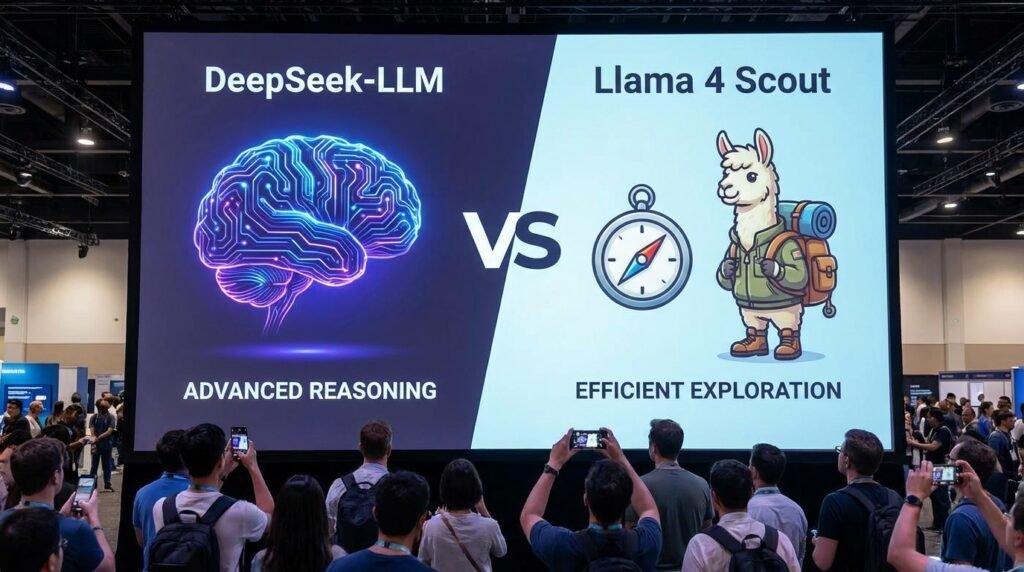
DeepSeek focuses heavily on reasoning quality, efficient performance, coding excellence, and cost-conscious deployment.
Llama 4 Scout takes another route—massive context handling, multimodal capability, enterprise scalability, and long-document intelligence.
So which model actually wins?
The answer depends entirely on your goals.
This guide goes far beyond surface-level benchmark comparisons and explores architecture, real-world usage, AI workflows, enterprise deployment, coding performance, retrieval systems, automation, and practical decision-making for teams across Europe and global markets.
By the end, you’ll know exactly which model deserves a place in your AI stack.
What Are DeepSeek-LLM and Llama 4 Scout?
Before comparing performance, understanding design philosophy matters.
What Is DeepSeek-LLM?
DeepSeek-LLM is an open-weight language model family designed to maximize intelligence per unit of compute.
The project gained rapid adoption because it demonstrated that highly capable reasoning and coding models could be developed more efficiently than many expected.
DeepSeek became especially attractive for:
- Developers
- AI startups
- Research teams
- Automation builders
- Cost-conscious enterprises
Core focus areas include:
- Strong logical reasoning
- Mathematical problem solving
- Efficient inference
- Coding assistance
- Lower operating cost
Many teams now evaluate DeepSeek not as a budget option—but as a serious production model.
What Is Llama 4 Scout?
Llama 4 Scout belongs to Meta’s newer generation of open-weight models.
Scout emphasizes:
- Long-context understanding
- Multimodal capability
- Sparse expert activation
- Enterprise-scale workflows
- Retrieval-heavy applications
Rather than optimizing purely for benchmark intelligence, Scout prioritizes scalability.
That makes it particularly attractive for organizations processing:
- Massive documentation
- Company knowledge systems
- Large code repositories
- Research databases
- AI agents
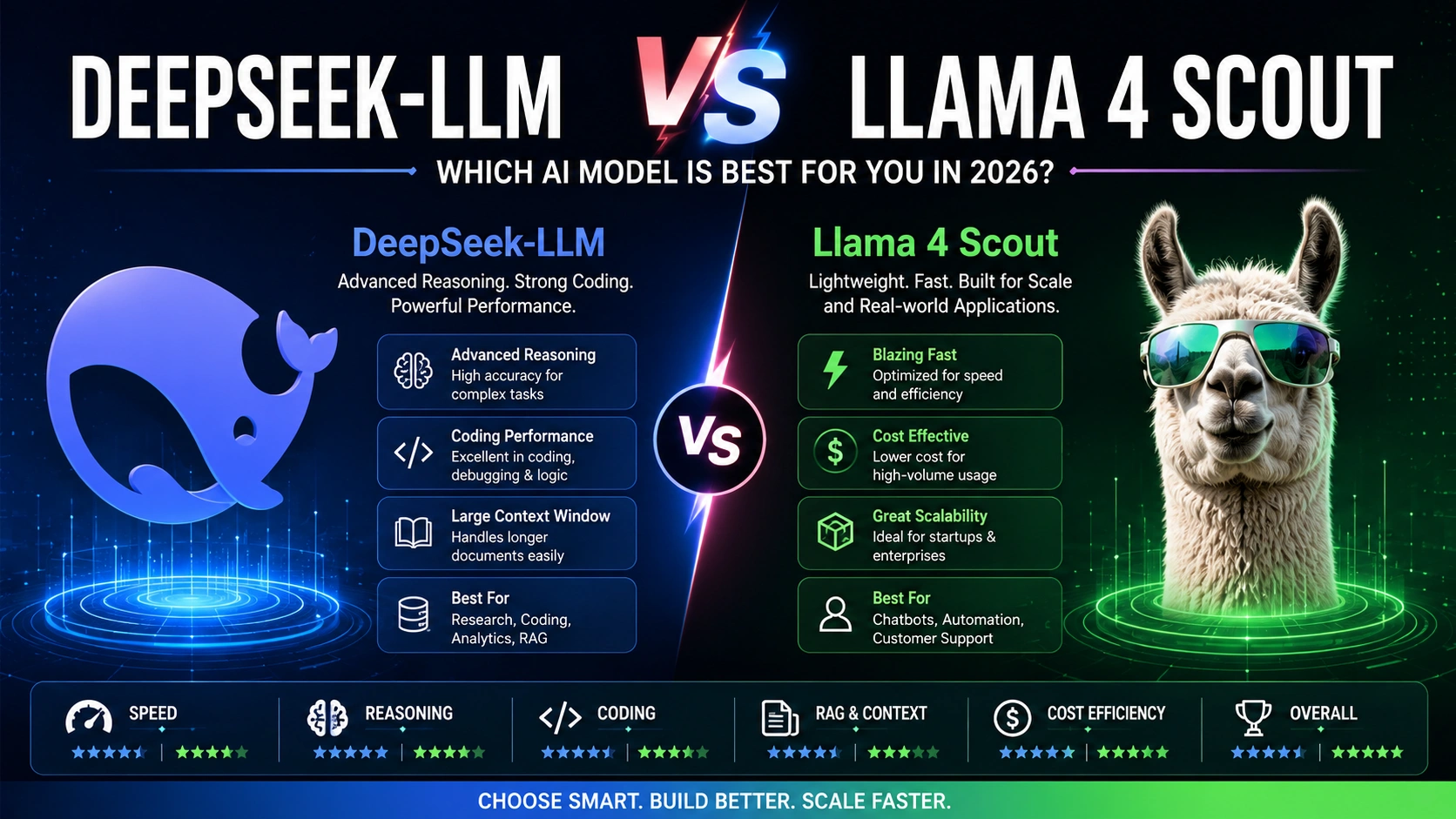
DeepSeek-LLM VS Llama 4 Scout: Quick Comparison Table
| Feature | DeepSeek-LLM | Llama 4 Scout |
| Developer | DeepSeek | Meta |
| Model Style | Open Weight | Open Weight |
| Architecture Focus | Efficiency | Scale |
| Coding | Excellent | Very Strong |
| Reasoning | Excellent | Strong |
| Long Context | Good | Exceptional |
| RAG Systems | Strong | Outstanding |
| AI Agents | Excellent | Excellent |
| Enterprise Adoption | Growing | Massive |
| Multimodal Support | Limited by family | Native |
| Research Usage | Excellent | Excellent |
| Cost Efficiency | High | High |
Quick Verdict
Choose DeepSeek if:
- You prioritize coding
- You need reasoning quality
- You want efficient deployment
Choose Llama 4 Scout if:
- You process huge datasets
- You build an enterprise RAG
- You need long-context workflows
Why Most Comparisons Get This Wrong
Most articles compare:
Parameters
Context windows
Generic benchmarks
But practical buyers care about:
Cost per result
AI workflow reliability
Deployment complexity
Team productivity
Long-term scalability
This article focuses on outcomes—not specifications.
Architecture Comparison
Architecture affects nearly every practical outcome:
- Speed
- Accuracy
- Infrastructure cost
- Memory usage
- User experience
DeepSeek Architecture
DeepSeek emphasizes efficient intelligence.
Its design aims to deliver stronger output without requiring extreme computational overhead.
Key Strengths
- Efficient training
- Strong reasoning pathways
- Better coding consistency
- Lower operational requirements
- Strong mathematical capability
Real-World Example
A software consultancy in Germany building internal coding assistants may prefer DeepSeek because engineers benefit more from precise reasoning than from enormous memory.
Llama 4 Scout Architecture
Scout introduces a different optimization philosophy.
Instead of brute-force activation, Scout uses selective expert activation principles to improve efficiency.
Key Strengths
- Large-scale processing
- Sparse computation
- Enterprise scalability
- Long-context handling
- Multimodal readiness
Real-World Example
A legal analytics company processing thousands of pages daily may gain more value from Scout.
Architecture Winner
| Category | Winner |
| Coding Intelligence | DeepSeek |
| Cost Efficiency | DeepSeek |
| Context Handling | Llama 4 Scout |
| Enterprise Scale | Llama 4 Scout |
| Deployment Flexibility | Tie |
Benchmark Comparison
Benchmarks matter—but only when translated into business outcomes.
Reasoning Performance
Reasoning determines:
- Accuracy
- Multi-step thinking
- Planning ability
- Technical quality
DeepSeek Strengths
- Better structured outputs
- Strong chain-of-thought style performance
- Consistent logical answers
Llama 4 Scout Strengths
- Better document-level understanding
- Larger information retention
Winner
DeepSeek-LLM
Coding Performance
Developers increasingly evaluate models based on production usefulness.
DeepSeek Performs Well For
- Python
- JavaScript
- Refactoring
- Debugging
- Algorithm generation
Scout Performs Well For
- Repository understanding
- Cross-file analysis
- Documentation interpretation
Winner
DeepSeek-LLM
Mathematical Capability
DeepSeek has built strong recognition among technical users.
Excellent for:
- Equations
- Logic
- Structured calculations
- Analytical tasks
Scout remains capable but less specialized.
Winner
DeepSeek-LLM
Multilingual Performance
Europe remains one of the fastest-growing regions for multilingual AI adoption.
Important languages include:
- English
- German
- French
- Italian
- Spanish
- Dutch
- Swedish
Scout often benefits from broader contextual retention.
Winner
Llama 4 Scout
Europe Perspective: Why This Comparison Matters
European businesses increasingly face:
- Data governance requirements
- Local hosting preferences
- Cost optimization pressure
- Internal knowledge automation
Practical trend:
- Startups → DeepSeek
- Enterprise knowledge systems → Scout
- Research teams → Hybrid usage
Organizations that match model strengths to workloads often outperform those choosing purely on hype.
Pros and Cons
DeepSeek-LLM
Pros
Excellent reasoning
Strong coding performance
Efficient deployment
Great cost-performance ratio
Strong technical tasks
Cons
Smaller practical context
Less optimized for massive document workflows
Llama 4 Scout
Pros
Huge context capability
Strong enterprise workflows
Excellent RAG support
Better multimodal readiness
Cons
Reasoning may not always lead to a category
Can require more planning for optimization
People Also Ask
A: It depends on the use case. DeepSeek-LLM generally performs better for reasoning, coding, mathematics, and efficient deployment. Llama 4 Scout becomes stronger for long-context understanding, enterprise knowledge systems, and large-scale document analysis.
A: For most developers, DeepSeek-LLM is often the stronger choice because of cleaner code generation, debugging support, and logical problem solving. Llama 4 Scout performs particularly well when understanding large repositories and cross-file workflows.
A: Yes, in many document-heavy environments. Llama 4 Scout’s large context capability makes it highly suitable for Retrieval-Augmented Generation (RAG), internal search systems, enterprise knowledge bases, and long-document workflows.
A: DeepSeek-LLM is often considered highly efficient for teams prioritizing performance per infrastructure cost. Llama 4 Scout focuses more on scalability and handling larger workloads efficiently.
A: European businesses should match the model to the workload.
Software development
Technical teams
AI automation
Research workflows
Conclusion
DeepSeek-LLM and Llama 4 Scout represent two different directions in open AI development. DeepSeek proves that strong reasoning, coding Intelligence, and efficient deployment can deliver exceptional value without relying entirely on massive scale. Llama 4 Scout demonstrates that context size, multimodal capability, and enterprise-grade knowledge processing are becoming increasingly important for modern AI systems.
If your goal is building developer tools, coding assistants, research workflows, or cost-efficient AI products, DeepSeek-LLM stands out. If your goal is enterprise automation, document intelligence, large repositories, and retrieval-heavy workflows, Llama 4 Scout becomes difficult to ignore. The strongest AI strategy in 2026 may not be choosing one model over another—it may be combining both based on workload. If this comparison helped you, bookmark Ultraaiguide.com and explore more AI model comparisons before making your next AI decision.