Introduction
In 2026, choosing between AI models like Grok-3 and Claude Instant is no longer just a technical decision—it’s a business strategy. Whether you’re running a startup in Europe, building automation pipelines in the UK, or scaling content systems across Germany and France, the AI you choose directly impacts cost, speed, and output quality.
Most comparisons online still focus heavily on benchmarks and abstract performance scores. But real users care about something very different: which model actually works better in daily tasks like coding, writing, customer support, automation, and research.
This in-depth guide breaks down Grok-3 vs Claude Instant from a real-world perspective. You’ll learn not only which model is “smarter,” but which one delivers better ROI, faster workflows, and scalable performance for European businesses.
We’ll also explore a practical decision framework, hybrid usage strategies, cost analysis, pros & cons, and a full comparison table—so you can confidently choose the right AI for your needs.
What is Grok-3?
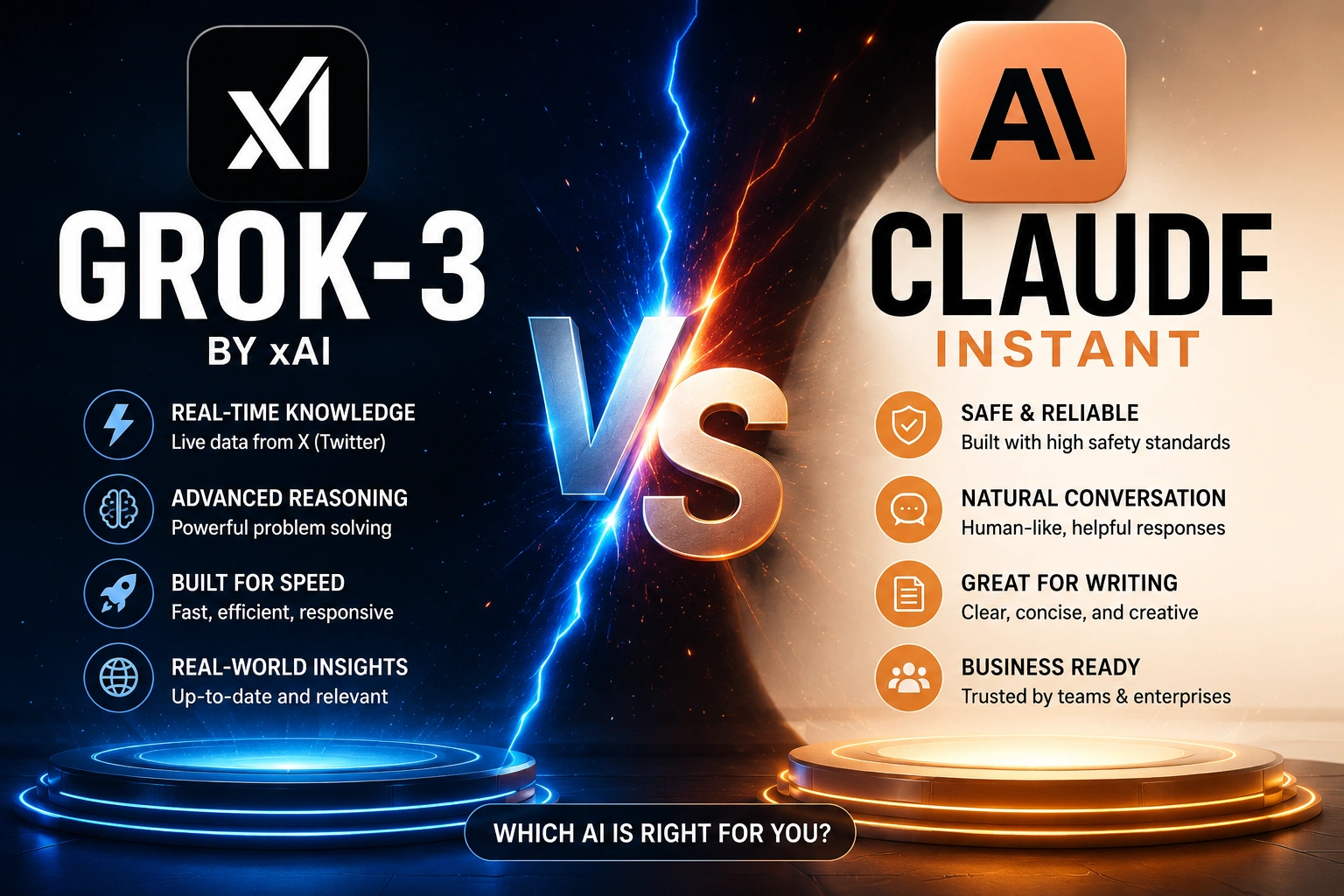
xAI’s Grok-3 is a high-performance large language model designed for advanced reasoning, deep contextual understanding, and complex problem-solving tasks.
Unlike lightweight models, Grok-3 focuses on thinking depth over speed, making it ideal for users who need accuracy in complex workflows.
Key Features of Grok-3
- Advanced multi-step reasoning
- Strong coding and debugging capabilities
- High-context memory handling
- Better performance in analytical tasks
- Suitable for research-heavy environments
Best Use Cases
- Software development & debugging
- Data analysis & research
- Strategic business decisions
- Complex automation logic
- AI agents requiring reasoning depth
What is Claude Instant?
Anthropic’s Claude Instant is a lightweight, fast, and cost-efficient AI model optimized for speed and scalability.
It is designed for high-volume environments where cost per request and response speed matter more than deep reasoning.
Key Features of Claude Instant
- Extremely fast response generation
- Low operational cost per token
- Stable outputs for automation
- Scalable API performance
- Ideal for repetitive workflows
Best Use Cases
- Customer support chatbots
- Bulk content generation
- Marketing automation
- FAQ systems
Grok-3 vs Claude Instant: Core Comparison
Intelligence & Reasoning
Grok-3 is designed for deep logical thinking and multi-step reasoning tasks. It performs better in situations where accuracy depends on understanding complex relationships.
Claude Instant, on the other hand, is optimized for simpler tasks where speed matters more than deep analysis.
Winner: Grok-3
Speed & Performance
Claude Instant is significantly faster due to its lightweight architecture. It is built for real-time systems and high-throughput environments.
Grok-3 trades speed for reasoning depth, making it slower in comparison.
Winner: Claude Instant
Cost Efficiency
Claude Instant is designed for large-scale usage with minimal cost per request. This makes it highly attractive for startups and SaaS companies in Europe trying to reduce infrastructure costs.
Grok-3 is more resource-intensive, making it relatively expensive at scale.
Winner: Claude Instant
Coding & Development
Grok-3 performs better in debugging, logic-heavy coding, and architecture design. It can understand complex code structures more effectively.
Claude Instant works well for simple scripts, boilerplate code, and repetitive coding tasks.
Winner: Grok-3
Business & Automation Use
Claude Instant is excellent for automation pipelines, chatbots, and bulk messaging systems.
Grok-3 is better for decision-making systems and analytical tools.
Result: Tie
Scalability
Claude Instant is built for massive scaling with low latency and Predictable performance.
Grok-3 is not optimized for high-volume, low-cost usage.
Winner: Claude Instant
Grok-3 vs Claude Instant Comparison Table
| Feature | Grok-3 | Claude Instant |
| Reasoning Ability | ⭐⭐⭐⭐⭐ | ⭐⭐⭐ |
| Speed | ⭐⭐⭐ | ⭐⭐⭐⭐⭐ |
| Cost Efficiency | ⭐⭐ | ⭐⭐⭐⭐⭐ |
| Coding Performance | ⭐⭐⭐⭐⭐ | ⭐⭐⭐ |
| Scalability | ⭐⭐⭐ | ⭐⭐⭐⭐⭐ |
| Best For | Deep reasoning | Mass automation |
Real-World Decision Framework
Most comparisons fail because they ignore real-world usage. Here’s how professionals actually choose:
Startups
- Choose Claude Instant for MVPs
- Use Grok-3 for product intelligence layers
Developers
- Grok-3 for debugging & architecture
- Claude Instant for API automation
Marketing Teams
- Claude Instant for content scaling
- Grok-3 for campaign strategy insights
Enterprise Systems
- Hybrid usage is standard
- Separate reasoning and execution layers
Cost vs Output ROI Analysis
The biggest mistake users make is comparing pricing alone. The real metric is:

Output Quality per Dollar
Claude Instant ROI
- High throughput
- Low cost per request
- Best for repetitive tasks
Grok-3 ROI
- High accuracy output
- Fewer retries needed
- Better for high-value decisions
In practice:
- Claude Instant = volume efficiency
- Grok-3 = quality efficiency
Hybrid AI Strategy
The most efficient AI systems do NOT rely on a single model.
Smart Workflow Design:
- Grok-3 → reasoning engine (planning, logic, analysis)
- Claude Instant → execution engine (scale, output, automation)
Example Workflow:
- Grok-3 generates a strategy
- Claude Instant executes content at scale
- System loops feedback for optimization
This reduces cost while Improving quality dramatically.
Europe Market Relevance
In Europe, businesses prioritize:
- GDPR-compliant workflows
- Cost-efficient scaling
- Multi-language support (English, French, German, Spanish)
Why Claude Instant dominates Europe:
- Lower infrastructure costs
- High scalability for SMEs
- Strong API integration support
Why Grok-3 is still important:
- Research-heavy industries (finance, engineering)
- EU-based AI innovation labs
- High-end consulting firms
Pros & Cons
Grok-3
Pros
- Excellent reasoning ability
- Strong coding performance
- Better for complex tasks
Cons
- Slower response time
- Higher cost
- Not ideal for bulk processing
Claude Instant
Pros
- Extremely fast
- Cost-efficient
- Highly scalable
Cons
- Weaker reasoning depth
- Less effective for complex coding
- Not ideal for deep analysis
How to Use These AI Models Effectively
Step-by-Step Workflow
- Identify task type (logic vs volume)
- Assign Grok-3 for reasoning tasks
- Assign Claude Instant for execution
- Automate routing via the API layer
- Optimize based on cost-performance metrics
FAQs
A: Grok-3 is better for reasoning and coding complexity, while Claude Instant is better for speed and scalability. The “better” choice depends entirely on your use case.
A: Claude Instant is significantly faster due to its lightweight architecture designed for real-time applications.
A: Claude Instant is more cost-efficient, especially for high-volume tasks like customer support and automation.
A: Yes, hybrid usage is the most efficient strategy in 2026. Many businesses use Grok-3 for reasoning and Claude Instant for execution.
A: Claude Instant is generally better for startups due to lower costs and scalability, while Grok-3 is useful for advanced product intelligence.
Conclusion
The debate between Grok-3 and Claude Instant is not about which model is universally better—it’s about which model fits your workflow.
If your focus is deep reasoning, coding accuracy, and complex problem-solving, Grok-3 delivers superior performance. But if your priority is speed, scalability, and cost efficiency, Claude Instant is the more practical choice for most businesses in 2026.
The real competitive Advantage comes from not choosing one, but intelligently combining both models. Grok-3 can handle thinking and planning, while Claude Instant can handle execution and scale. This hybrid approach is already becoming the standard in modern AI-driven businesses across Europe and beyond.
As AI continues to evolve, the winners will not be those who pick the “best model,” but those who design the smartest workflows.