Introduction
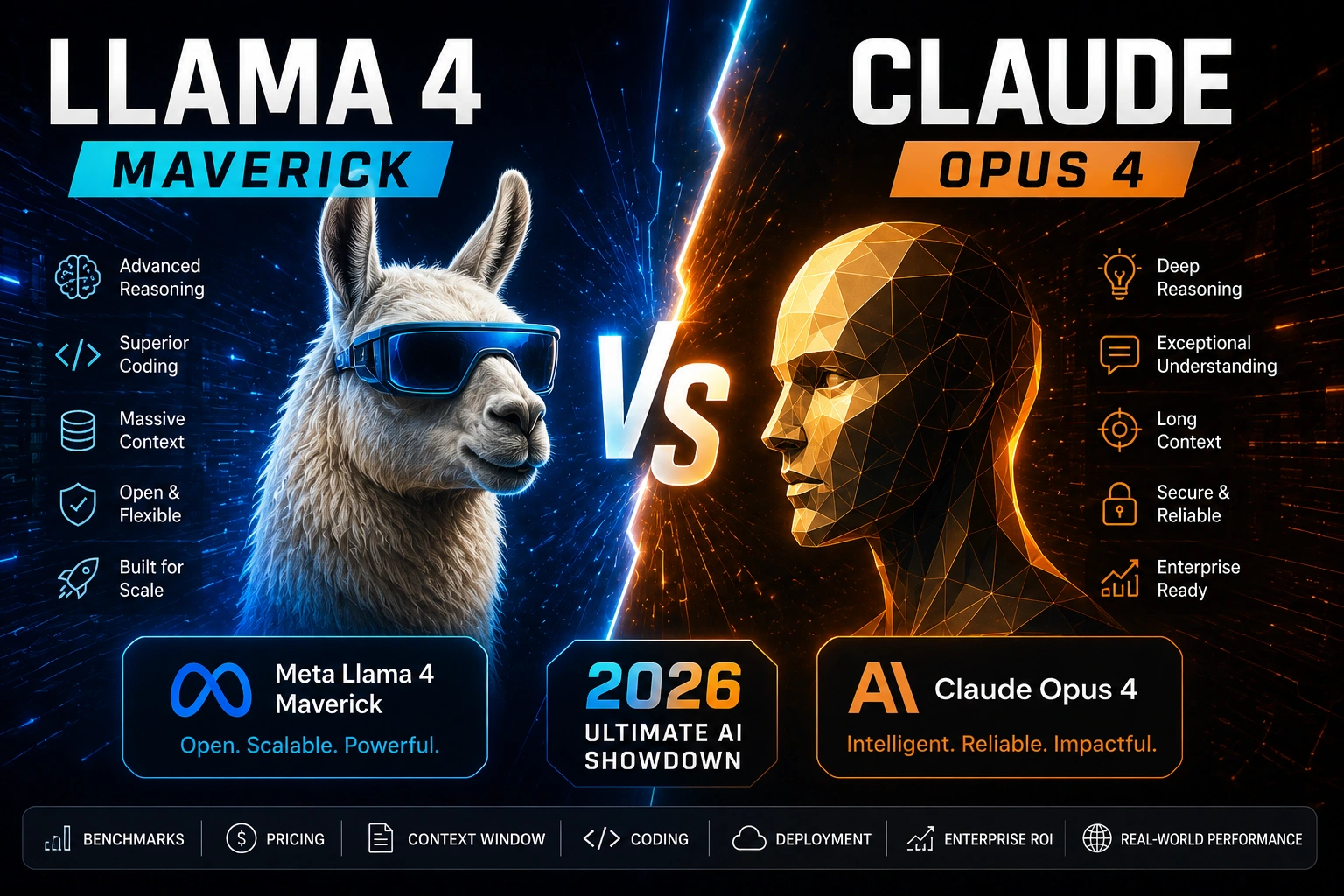
Artificial Intelligence selection in 2026 is no longer about choosing whichever model tops benchmark charts. The market has matured. Today, organizations evaluate AI based on operational cost, deployment flexibility, context capacity, developer productivity, governance, privacy requirements, and long-term return on investment. That is where the comparison between Llama 4 Maverick and Claude Opus 4 becomes important. These models represent two very different strategies.
Llama 4 Maverick emphasizes openness, scalability, deployment ownership, and lower operating costs. Claude Opus 4 focuses on premium reasoning quality, stronger coding workflows, reliability, and enterprise-grade execution. For startups, AI agencies, SaaS founders, software teams, and enterprise decision-makers across Europe and global markets, selecting the wrong model can significantly affect productivity and infrastructure budgets. This guide goes beyond benchmark charts.
You will learn:
- Which model performs better in production
- Which offers a stronger business ROI
- Which handles long-context workflows
- Which reduces infrastructure costs
- Which model fits startups vs enterprises
- Which AI ecosystem is likely to remain competitive long-term
By the end, you will know exactly which model aligns with your goals.
Quick Verdict
| Category | Winner |
| Overall Intelligence | Claude Opus 4 |
| Cost Efficiency | Llama 4 Maverick |
| Context Capability | Llama 4 Maverick |
| Coding Workflows | Claude Opus 4 |
| Enterprise Reliability | Claude Opus 4 |
| Self Hosting | Llama 4 Maverick |
| Customization | Llama 4 Maverick |
| ROI at Scale | Llama 4 Maverick |
Fast Recommendation
If quality matters more than budget → Claude Opus 4
If cost control and ownership matter → Llama 4 Maverick
What Is Llama 4 Maverick?
Llama 4 Maverick is designed around deployment flexibility, efficient inference, and large-scale accessibility.
Rather than locking businesses into a single ecosystem, the model encourages broader implementation across private environments and enterprise infrastructure.
Core Features
- Open-weight ecosystem
- Long-context processing
- Lower inference economics
- Multimodal support
- Fine-tuning potential
- Enterprise customization
Best For
- AI startups
- Internal copilots
- SaaS products
- Knowledge platforms
- Private deployment environments
What Is Claude Opus 4?
Claude Opus 4 is positioned as a premium frontier model focused on reasoning quality, coding performance, and reliable execution.
Its strength appears when tasks become complex.
Core Features
- Advanced reasoning
- Strong multi-step execution
- Coding optimization
- Enterprise reliability
- Agent-style workflows
Best For
- Software engineering
- Research operations
- Enterprise automation
- Legal and document analysis
- Customer-facing AI systems
Architecture Comparison
Llama 4 Maverick Architecture
| Feature | Details |
| Architecture | Mixture of Experts |
| Focus | Efficiency |
| Deployment | Flexible |
| Scaling | Strong |
| Ownership | High |
Advantages
- Lower operating expenses
- Strong scaling economics
- Flexible deployment
Challenges
- Infrastructure responsibility
- Requires optimization expertise
Claude Opus 4 Architecture
| Feature | Details |
| Architecture | Proprietary |
| Focus | Intelligence |
| Deployment | Managed |
| Reliability | Very High |
Advantages
- Excellent reasoning
- Better production consistency
- Strong workflow execution
Challenges
- Higher recurring cost
- Vendor dependency
Benchmarks vs Reality: What Actually Matters?
Benchmarks remain useful.
But real deployment decisions depend on outcomes.
| Area | Llama 4 Maverick | Claude Opus 4 |
| General Knowledge | Strong | Excellent |
| Complex Reasoning | Good | Excellent |
| Coding | Strong | Excellent |
| Long Context | Excellent | Excellent |
| Automation | Good | Excellent |
Production Performance Matters More
Many companies discover that:
Higher benchmark scores do not automatically create higher profits.
Production success depends on:
- Latency
- Reliability
- Cost
- Integration effort
- Maintenance
Context Window Comparison
Context size influences how much information AI can process simultaneously.
| Feature | Llama 4 Maverick | Claude Opus 4 |
| Long Documents | Excellent | Excellent |
| Knowledge Bases | Excellent | Strong |
| Retrieval Systems | Excellent | Very Good |
| Archive Processing | Excellent | Strong |
Real Use Cases
Llama Wins For
- Massive PDFs
- Internal search systems
- Enterprise knowledge
Claude Wins For
- Reasoning over complex inputs
- Multi-step outputs
- Decision support
Pricing Comparison: Total Cost of Ownership
Token pricing alone is misleading.
The real question is total ownership.
| Cost Factor | Llama 4 Maverick | Claude Opus 4 |
| API Cost | Lower | Higher |
| Scaling Cost | Lower | Higher |
| Infrastructure | Variable | Managed |
| Ownership | High | Lower |
Startup Example
Startup:
50 million monthly tokens
Result:
Llama often creates lower long-term operational costs.
Enterprise Example
Enterprise:
Mission-critical customer operations
Result:
Claude often justifies premium pricing through output quality.
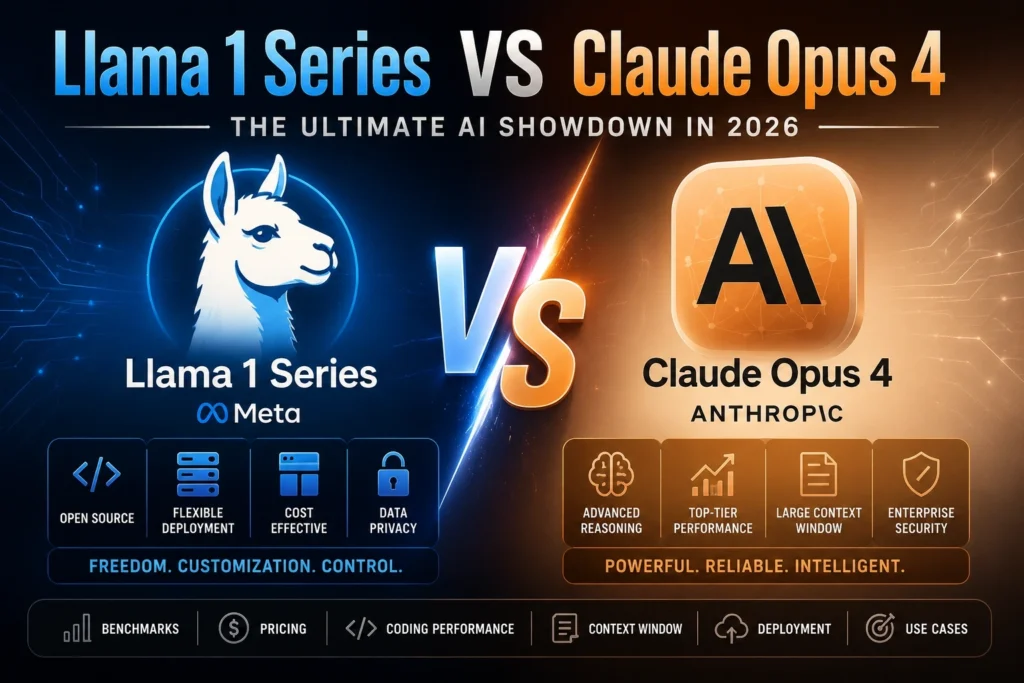
Coding Performance Comparison
Claude Opus 4 Strengths
- Repository understanding
- Debugging
- Refactoring
- Multi-file generation
Llama 4 Maverick Strengths
- Fast prototyping
- Internal tools
- Affordable iteration
Deployment Comparison
Choose Llama 4 Maverick If
- You want infrastructure ownership
- You need custom tuning
- Compliance matters
- Cost optimization matters
Choose Claude Opus 4 If
- You need Reliability
- You deploy externally
- You prioritize quality
Business ROI Analysis
SaaS Startup
Winner:
Llama 4 Maverick
Reason:
Lower operating costs.
Enterprise Automation
Winner:
Claude Opus 4
Reason:
Higher reliability.
Long Document Processing
Winner:
Llama 4 Maverick
Reason:
Context advantages.
Software Development
Winner:
Claude Opus 4
Reason:
Higher coding productivity.
Pros and Cons
Llama 4 Maverick
Pros
- Lower costs
- Flexible deployment
- Strong scalability
- Customizable
Cons
- Requires infrastructure expertise
- More operational overhead
Claude Opus 4
Pros
- Excellent reasoning
- Strong coding
- Reliable outputs
Cons
- Premium pricing
- Platform dependency
How to Use These AI Tools Effectively
Follow this process:
Define Business Goals
Choose:
Speed, quality, ownership, or cost.
Estimate Monthly Usage
Predict:
- Requests
- Token usage
- Peak traffic
Run Controlled Tests
Measure:
- Accuracy
- Cost
- Response quality
Deploy Gradually
Avoid full migration immediately.
Tips to Write Your Own AI Tool Captions
- Focus on outcomes
- Avoid technical jargon
- Mention benefits
- Use action language
- Keep descriptions concise
Example:
Bad:
Advanced AI system.
Better:
An AI assistant that reduces customer support workload.
Europe Perspective: What Buyers Are Prioritizing
Across European markets, businesses increasingly prioritize:
- Governance
- Deployment flexibility
- Cost control
- Data practices
- Vendor diversification
Startups often value ownership. Enterprises often prioritize reliability.
People Also Ask
A: Not universally. Claude generally leads in intelligence, while Llama often provides stronger economics and flexibility.
A: Llama 4 Maverick usually delivers lower operating costs.
A: Claude Opus 4 performs better for complex software workflows.
A: Llama 4 Maverick is commonly favored for large retrieval and document scenarios.
A: ROI depends on scale, infrastructure ownership, and required output quality.
Conclusion
Llama 4 Maverick VS Claude Opus 4 is not a simple benchmark battle. It is a strategic decision. If your priority is premium reasoning, advanced coding, and enterprise execution, Claude Opus 4 remains one of the strongest premium choices.
If your goal is deployment flexibility, ownership, and long-term operating efficiency, Llama 4 Maverick becomes extremely attractive. The strongest organizations in 2026 will not choose one model blindly. They will align AI selection with business outcomes. Bookmark this guide, compare your requirements carefully, and explore additional AI comparisons on Ultraaiguide.com.