Introduction
Artificial Intelligence (AI) chatbots are Experiencing exponential growth in 2026, transforming the way organizations, enterprises, startups, and digital platforms handle communication, customer engagement, and automated support systems. Businesses today demand instantaneous responses, intelligent automation, contextual understanding, and precision-driven knowledge delivery systems.
However, despite advancements in conversational AI technologies, most traditional chatbot systems still face significant limitations:
- They often produce generic and repetitive responses
- They lack deep contextual comprehension
- They rely on keyword matching instead of semantic understanding
- They frequently generate partially inaccurate or hallucinated outputs
These limitations create a gap between user expectations and actual AI performance.
This is where DeepAsk chatbot technology introduces a new paradigm shift in AI-driven knowledge systems.
Instead of functioning as a basic conversational agent, DeepAsk is engineered as a knowledge-centric AI retrieval system powered by advanced Natural Language Processing (NLP), semantic search algorithms, and Retrieval-Augmented Generation (RAG) architecture.
It is designed to:
- Interpret user intent at a deep semantic level
- Extract relevant information from structured and unstructured datasets
- Generate highly accurate, contextually aligned responses
In simple terms:
Instead of searching multiple documents manually or browsing web pages, users can simply ask a question and receive a single, refined, intelligent answer instantly.
This guide provides a comprehensive breakdown of DeepAsk chatbot features, NLP capabilities, real-world applications, limitations, comparisons, and business value in 2026.
What is DeepAsk Chatbot?
The DeepAsk chatbot system is an advanced AI-powered knowledge assistant designed to deliver precision-based answers using machine learning, NLP pipelines, and semantic retrieval frameworks.
Unlike traditional rule-based bots or simple LLM chat systems, DeepAsk operates on a hybrid Natural Language Understanding (NLU)
It decodes human language into structured meaning representations.
Semantic Search Engine Layer
It retrieves conceptually relevant data instead of keyword-matching results.
Contextual AI Reasoning
It maintains conversation continuity and intent tracking.
Knowledge Base Integration System
It connects directly with enterprise datasets, documents, APIs, and repositories.
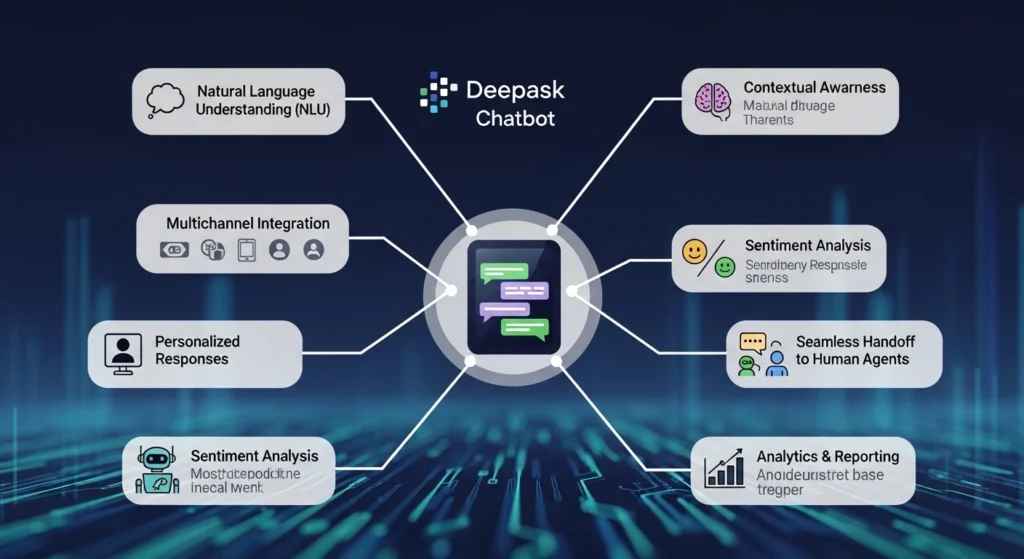
Quick Overview of DeepAsk Chatbot Features
Below is a high-level, structured overview of DeepAsk AI capabilities:
- Advanced Natural Language Understanding (NLU)
- Multi-source semantic intelligence engine
- Instant contextual response generation
- Knowledge base integration framework
- Automated workflow execution
- Omnichannel communication support
- AI-driven personalization engine
- Intelligent summarization system
- 24/7 autonomous availability
- CRM and enterprise tool integration
- Multimodal AI processing (text + images + documents)
- AI-based image generation module
- Context-aware conversation memory
- Real-time inference engine
- Scalable distributed architecture
Top 15 DeepAsk Chatbot Features
Natural Language Understanding Engine
One of the most critical components of DeepAsk is its Natural Language Understanding (NLU) system, which enables machines to interpret human language in a semantically meaningful way.
Functional Capabilities:
- Intent classification
- Entity recognition
- Sentiment interpretation
- Context extraction
- Query disambiguation
Example:
Basic chatbot:
“refund policy”
DeepAsk:
“What is your refund policy after 30 days if the product is damaged or defective?”
It does not just read keywords; it understands intent, context, and conditional logic.
Multi-Source Intelligence System
DeepAsk integrates multiple heterogeneous data sources into a unified reasoning layer.
Supported Sources:
- PDFs and documentation files
- Enterprise databases
- Knowledge graphs
- Internal APIs
This enables cross-document reasoning and data fusion, improving accuracy.
Instant Answer Generation
DeepAsk is optimized for low-latency response generation systems, ensuring fast output delivery.
Benefits:
- Reduced response time (milliseconds to seconds)
- Higher user satisfaction
- Improved UX (User Experience)
- Real-time interaction capability
Knowledge Base Integration System
Organizations can integrate their proprietary data into DeepAsk.
Supported Knowledge Assets:
- FAQ databases
- Internal company manuals
- Product catalogs
This converts static documentation into a dynamic conversational AI system.
Workflow Automation Engine
DeepAsk includes intelligent automation capabilities that reduce human workload.
Automatable Tasks:
- Customer queries
- Ticket classification
- FAQ handling
- Basic troubleshooting
This results in operational efficiency and cost reduction.
Multi-Channel Communication Support
DeepAsk operates across multiple communication channels.
Supported Platforms:
- Web applications
- WhatsApp integration
- Messenger systems
- Slack and team tools
Ensures omnichannel AI accessibility.
Personalization Engine (User-Centric AI)
DeepAsk adapts responses based on user behavior and interaction history.
Factors Used:
- User intent history
- Session context
- Behavioral patterns
- Preference modeling
This creates a hyper-personalized AI experience.
Intelligent Summarization Module
DeepAsk can compress large datasets into simplified insights.
Use Cases:
- Academic research
- Legal document review
- Business reports
Converts complex information into digestible summaries.
Autonomous Availability System
DeepAsk operates continuously without downtime.
Advantages:
- No human dependency
- Always-on AI support
- Global accessibility
CRM Integration Capability
DeepAsk integrates seamlessly with enterprise CRM systems.
Supported CRMs:
- HubSpot
- Salesforce
- Zoho CRM
Enables customer tracking and intelligent lead management.
Multimodal AI Processing System
DeepAsk is not restricted to text-only input.
Input Types:
- Text queries
- Images
- Documents
This increases flexibility and system intelligence.
AI Image Generation Module
DeepAsk includes generative AI capabilities for visual content creation.
Use Cases:
- Marketing visuals
- Product branding assets
- Social media content
Context Awareness & Memory System
DeepAsk maintains conversation continuity using contextual memory models.
Example:
User: “What is your pricing?”
Next: “Is it monthly available?”
The system remembers previous intent without repetition.
Real-Time AI Response System
DeepAsk generates outputs in real-time using optimized inference pipelines.
Benefits:
- Instant communication
- Reduced latency
- Better customer engagement
Scalable Knowledge Delivery Architecture
DeepAsk is built for enterprise-level scalability.
Features:
- Handles thousands of simultaneous users
- Maintains consistent response quality
- Distributed AI processing
DeepAsk Capabilities
DeepAsk operates as a knowledge-centric AI orchestration system with:
- Semantic query processing
- Vector-based retrieval systems
- Neural language generation
- Context-aware response synthesis
Transformation Flow:
Traditional method:
Manual search → Human reading → Answer formulation
DeepAsk method:
Query → AI inference → Instant structured response
Benefits of DeepAsk Chatbot
Time Efficiency
Eliminates manual searching and reduces operational delays.
Reduced Support Load
Minimizes dependency on human agents.
Centralized Knowledge System
All organizational data is unified into one AI layer.
High Accuracy Output
Reduces misinformation and hallucination risk.
Scalable Architecture
Supports enterprise growth without additional staffing.
Real-World Use Cases
Customer Support Automation
Used in e-commerce platforms for instant query resolution.
Internal Enterprise Knowledge Systems
Employees can retrieve answers without manual search.
Research & Content Intelligence
Speeds up data analysis and content creation.
E-commerce Intelligence Systems
Handles:
- Order tracking
- Return queries
- Product recommendations
Educational Platforms
Simplifies complex academic concepts for learners.
Other Chatbots
DeepAsk vs ChatGPT
| Feature | DeepAsk | ChatGPT |
| Knowledge Accuracy | High | Medium |
| Real-time Data | Yes | Limited |
| Document Learning | Yes | Yes |
| Creativity | Low | High |
| Best Use | Q&A Systems | Conversations |
DeepAsk vs Intercom
| Feature | DeepAsk | Intercom |
| Automation | Medium | High |
| Knowledge Retrieval | Strong | Medium |
| Support Efficiency | Strong | Strong |
Drift VS DeepAsk
| Feature | DeepAsk | Drift |
| Sales Funnels | Weak | Strong |
| AI Answer Accuracy | Strong | Medium |
Key Insight:
- DeepAsk = Knowledge Intelligence System
- Others = Conversational or Sales-Oriented Bots
Limitations of DeepAsk
Limited Workflow Complexity
Not ideal for advanced multi-step automation systems.
Data Dependency
Output quality depends on input dataset quality.
Limited Engagement Features
Not designed for emotional or storytelling conversations.
Low Creative Output
Less suitable for entertainment-based AI interactions.
Is DeepAsk Worth It in 2026?
YES, if you need:
- Fast knowledge retrieval systems
- Customer support automation
- Accurate AI-driven answers
- Scalable enterprise intelligence
NO, if you need:
- Sales funnel automation
- Emotional conversational AI
- Creative storytelling systems
Final Verdict
DeepAsk is not just a chatbot system.
It is a next-generation AI knowledge intelligence engine designed for:
- Speed
- Accuracy
- Enterprise scalability
- Semantic understanding
If your goal is to build a data-driven, AI-powered knowledge ecosystem, DeepAsk is highly valuable in 2026.
FAQs
A: DeepAsk is used for answering questions, automating support, and delivering knowledge-based responses instantly.
A: The main Deepask chatbot features include NLP, knowledge integration, real-time answers, personalization, and multi-source intelligence.
A: DeepAsk focuses on accurate knowledge retrieval, while ChatGPT focuses more on conversation and creativity.
A: Especially for customer support, internal knowledge bases, and automation.
A: Common deepask chatbot use cases include support automation, research, e-commerce assistance, and employee knowledge systems.
Conclusion
In conclusion, DeepAsk stands out as a knowledge-first AI chatbot system built for the future of intelligent automation. Unlike traditional chatbots that focus mainly on conversation flow or sales engagement, DeepAsk prioritizes information accuracy, semantic Understanding, and real-time knowledge retrieval.
As organizations continue to generate massive amounts of data, the need for systems that can instantly understand, process, and deliver meaningful insights becomes critical. DeepAsk addresses this challenge by transforming complex datasets into simple, human-like answers powered by NLP and AI reasoning models.
However, while it excels in knowledge management, it is not designed to replace highly creative or emotionally interactive AI systems. Instead, its strength lies in being a reliable enterprise-grade intelligence layer for customer support, research, automation, and internal knowledge systems.