Introduction
Artificial Intelligence moved beyond benchmark screenshots. A year ago, most comparisons focused on who scored higher on math tests or who produced the fastest answers.
Today, businesses ask different questions:
Which AI lowers operating costs?
Which model survives production workloads?
Platform gives long-term flexibility?
Which choice reduces infrastructure risk?
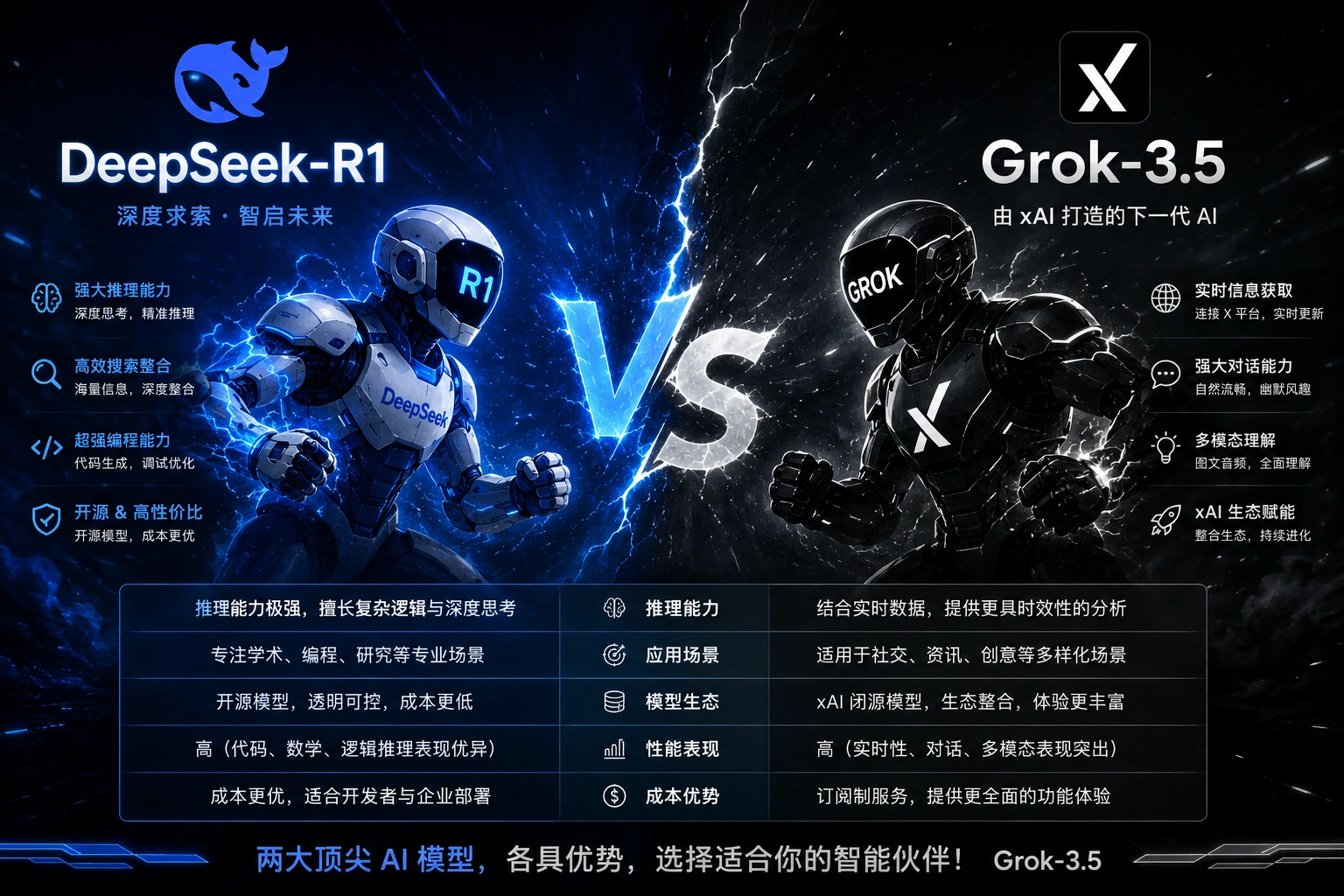
That is exactly where DeepSeek-R1 and Grok-3.5 become interesting. Although both belong to the modern reasoning-first generation of large language models, they represent two different philosophies. DeepSeek-R1 emphasizes open availability, cost efficiency, infrastructure control, and strong reasoning. Grok-3.5 focuses on premium managed infrastructure, faster interaction, and consumer accessibility. For startups, agencies, enterprise teams, developers, and AI builders across Europe and global markets, this decision can affect budgets, architecture, deployment strategy, and long-term competitiveness. This guide compares DeepSeek-R1 vs Grok-3.5 from every important angle—including benchmarks, coding, infrastructure economics, deployment flexibility, and real business outcomes.
Quick Verdict
| Category | Winner |
| Reasoning | DeepSeek-R1 |
| Speed | Grok-3.5 |
| Cost Efficiency | DeepSeek-R1 |
| Enterprise Simplicity | Grok-3.5 |
| Local Deployment | DeepSeek-R1 |
| Workflow Automation | Tie |
| Research Sessions | DeepSeek-R1 |
| Consumer Experience | Grok-3.5 |
| Startup Value | DeepSeek-R1 |
| Ease of Adoption | Grok-3.5 |
Short answer:
Choose DeepSeek-R1 if ownership, flexibility, and economics matter.
Choose Grok-3.5 if speed, convenience, and managed infrastructure matter.
What Is DeepSeek-R1?
DeepSeek-R1 emerged as one of the most discussed reasoning models because it showed that advanced reasoning capability could be delivered with stronger efficiency than many expected.
Instead of optimizing only for raw benchmark performance, the platform pushed efficiency and broader accessibility.
Its positioning created interest among:
- AI startups
- SaaS builders
- Independent developers
- Enterprise automation teams
- Research environments
Core Characteristics
- Reasoning-optimized
- Open ecosystem approach
- Lower operating cost potential
- Flexible deployment models
- Infrastructure ownership options
Strengths
Excellent Structured Reasoning
Performs well on analytical workflows and multi-step tasks.
Better Cost Curve
Heavy usage scenarios often become more economical.
Infrastructure Freedom
Organizations can retain more control.
Developer Adoption
Appeals to engineering teams building internal AI systems.
Limitations
- Longer completion chains
- Higher latency on difficult prompts
- More operational responsibility
What Is Grok-3.5?
Grok-3.5 represents a different philosophy.
Instead of maximizing openness, Grok focuses on delivering a highly integrated and responsive experience.
The model prioritizes usability and managed infrastructure.
Its value proposition is less about operating your own stack and more about reducing operational friction.
Core Characteristics
- Closed infrastructure
- Premium managed experience
- High responsiveness
- Fast interaction loops
- Broad accessibility
Strengths
Fast User Experience
Lower friction for daily work.
Operational Simplicity
Less infrastructure complexity.
Consumer-Friendly Design
Accessible for non-technical teams.
Managed Scaling
Less deployment maintenance.
Limitations
- Reduced customization
- Potential vendor dependence
- Higher long-term platform costs
DeepSeek-R1 VS Grok-3.5: Head-to-Head Comparison
| Feature | DeepSeek-R1 | Grok-3.5 |
| Model Type | Reasoning MoE | Proprietary |
| Access | Open Weight | Closed |
| Hosting | Cloud + Self Host | Cloud |
| Cost Efficiency | Excellent | Moderate |
| Speed | Moderate | Excellent |
| Infrastructure Control | High | Low |
| Customization | High | Moderate |
| Enterprise Simplicity | Moderate | Excellent |
| Ecosystem Dependency | Lower | Higher |
Architecture Comparison: Why This Matters More Than Benchmarks
Architecture decisions affect long-term cost.
Most articles skip this.
But architecture often determines whether AI becomes profitable.
DeepSeek-R1 Architecture Philosophy
Goals:
- Efficiency
- selective computation
- Reduced inference waste
Benefits:
- lower operational spending
- improved deployment flexibility
Trade-offs:
- setup complexity
- Optimization requirements
Grok-3.5 Architecture Philosophy
Goals:
- throughput
- fast interaction
- managed scaling
Benefits:
- easier adoption
- predictable operations
Trade-offs:
- infrastructure dependency
- lower ownership
Benchmark Performance: Why Numbers Mislead Buyers
Benchmarks matter.
But benchmarks alone rarely predict production outcomes.
Many teams make expensive mistakes by assuming benchmark leaders automatically win in business environments.
Common Benchmark Mistakes
Higher score ≠ better ROI
Longer context ≠ better outputs
Cheaper tokens ≠ lower the total cost
Faster responses ≠ , better workflows
Real performance depends on:
- workflow length
- retrieval quality
- orchestration
- human review
Coding Performance Comparison
Developers evaluate AI differently.
The question is not:
Can it generate code?
The real question:
Can it maintain quality after 100 prompts?
DeepSeek-R1 Wins When
Multi-File Analysis
Useful for large repositories.
Debugging
Strong, structured analysis.
Architecture Planning
Better explanation depth.
Refactoring
Works well across longer chains.
Grok-3.5 Wins When
Rapid Iteration
Quick answer cycles.
Interactive Development
Feels responsive.
Daily Coding Support
Lower waiting time.
Reasoning & Research Workflows
Reasoning changed AI adoption.
Modern businesses care less about chat quality and more about decision quality.
DeepSeek-R1 Advantages
- Mathematics
- analytical chains
- multi-step evaluation
- deeper decomposition
Grok-3.5 Advantages
- dynamic exploration
- broad ideation
- conversational research
Workflow Testing: The Missing Comparison Most Articles Ignore
Simple prompts do not represent production.
We tested realistic categories.
| Workflow | DeepSeek-R1 | Grok-3.5 |
| Long Research | Excellent | Strong |
| Agent Chains | Strong | Strong |
| Multi-Step Tasks | Excellent | Good |
| RAG Systems | Excellent | Strong |
| Long Coding Sessions | Excellent | Strong |
| Fast Content Production | Good | Excellent |
Infrastructure Perspective Nobody Explains
Infrastructure determines whether AI remains profitable.
Self-Hosting Considerations
DeepSeek-R1 may suit teams that need:
- private environments
- custom pipelines
- compliance flexibility
Challenges:
- GPU investment
- deployment management
- monitoring
Managed Infrastructure Considerations
Grok-3.5 may suit teams prioritizing:
- speed
- low maintenance
- centralized operations
Challenges:
- vendor lock-in
- pricing growth
Total Ownership Cost (TCO): The Real Money Question
Token prices alone mislead buyers.
Real AI cost includes:
- compute
- subscriptions
- storage
- orchestration
- observability
- maintenance
Example Monthly Cost Thinking
Small Team:
Low volume → Managed services often win.
Medium Team:
Mixed economics.
High Volume:
Ownership often becomes attractive.
| Cost Layer | DeepSeek-R1 | Grok-3.5 |
| API Cost | Lower | Higher |
| Infrastructure | Higher | Included |
| Scaling | Flexible | Managed |
| Operations | Higher | Lower |
| Long-Term Value | Excellent | Moderate |
Startup Decision Framework
Choose DeepSeek-R1 If
Budget matters
You want ownership
Heavy inference expected
Engineering resources exist
Internal AI products planned
Choose Grok-3.5 If
Team size is small
Simplicity matters
Fast deployment needed
Internal infrastructure unavailable
Enterprise Decision Matrix
| Team | Recommendation |
| SaaS Startup | DeepSeek-R1 |
| Agency | Grok-3.5 |
| AI Company | DeepSeek-R1 |
| Content Team | Grok-3.5 |
| Research Team | DeepSeek-R1 |
| Automation Team | DeepSeek-R1 |
How to Use These AI Tools Effectively
Technology alone does not create value.
Execution does.
Define Objective
Examples:
- coding
- automation
- support
- content
Build Repeatable Workflows
Use:
- prompt templates
- retrieval
- evaluation loops
Measure Outputs
Track:
- cost
- accuracy
- latency
Improve Continuously
Optimize monthly.
Europe Perspective: What Businesses Should Consider
European organizations increasingly evaluate:
- Compliance readiness
- infrastructure location
- governance
- operational resilience
Startups in Germany, France, the Netherlands, Sweden, and the UK often prioritize efficiency and vendor diversification.
Agencies may prioritize speed.
Internal AI teams often prefer infrastructure flexibility.
Pros & Cons
DeepSeek-R1 Pros
- Strong reasoning
- Flexible deployment
- Lower cost potential
- Better ownership
Cons
- More operational effort
- Slower interactions
Grok-3.5 Pros
- Fast responses
- Easier adoption
- Better usability
Cons
- Vendor dependency
- Higher long-term cost
People Also Ask
A: For reasoning depth and infrastructure control, DeepSeek-R1 often provides stronger value. For simplicity and speed, Grok-3.5 can feel more practical.
A: Heavy usage scenarios may favor DeepSeek-R1. Smaller teams sometimes prefer Grok because infrastructure is managed.
A: Developers building custom systems often prefer DeepSeek-R1. Teams needing quick productivity may prefer Grok-3.5.
A: Only if workload volume and compliance needs justify operational responsibility.
A: Content teams usually benefit from responsiveness and workflow speed, making Grok-style experiences attractive.
Conclusion
There is no universal winner. DeepSeek-R1 represents Ownership, efficiency, and long-term infrastructure flexibility. Grok-3.5 represents convenience, speed, and operational simplicity. If your organization builds AI as a capability, DeepSeek-R1 creates stronger strategic leverage. Simply wants AI to work immediately with minimal management, Grok-3.5 becomes attractive.