Introduction
Choosing an AI model in 2026 is no longer a simple benchmark battle. For years, businesses compared language models using test scores, token pricing, and context windows. But real-world adoption has changed the Conversation. Today, organizations care more about deployment flexibility, ownership costs, compliance requirements, infrastructure decisions, and long-term scalability than leaderboard positions.
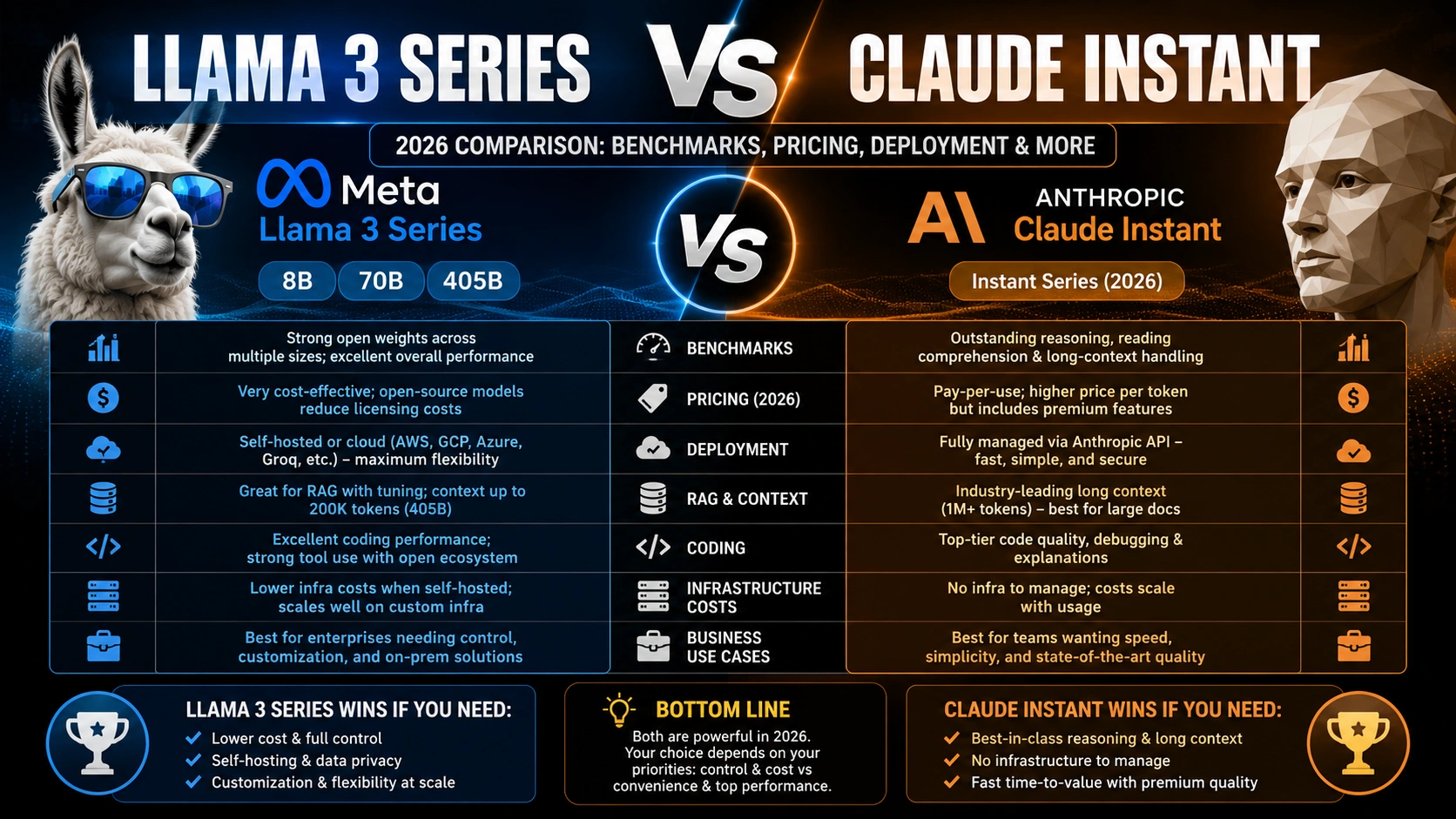
That is exactly why Llama 3 Series VS Claude Instant has become an important comparison for startups, enterprises, developers, agencies, and AI product teams. Llama 3 introduces a different philosophy—greater infrastructure control, deployment freedom, and opportunities to reduce long-term inference costs through open deployment strategies.
Claude Instant approaches the problem differently by prioritizing managed AI delivery, lower operational overhead, faster implementation, and simplified scaling.
So which model actually delivers more value?
Should businesses choose open deployment or managed APIs?
When does self-hosting become financially smarter?
Which model performs better for coding, RAG workflows, internal knowledge systems, and business growth?
In this complete comparison guide, we go beyond benchmarks and explore performance, pricing, infrastructure economics, deployment models, privacy, scalability, and practical business use cases so you can confidently choose the right AI strategy for 2026 and beyond.
What Is Llama 3 Series?
Llama 3 Series represents Meta’s open-weight language model family designed for flexibility across environments.
Unlike closed API-first solutions, Llama gives organizations more control over deployment architecture.
Key Features
- Open-weight access
- Self-hosting capability
- Multiple parameter options
- Fine-tuning support
- Edge deployment possibilities
- Lower marginal inference costs at scale
Typical Use Cases
Enterprise Internal AI
Deploy private assistants internally.
Retrieval-Augmented Generation (RAG)
Connect documents securely.
AI Product Development
Create customized experiences.
Local AI Infrastructure
Reduce dependency on external vendors.
What Is Claude Instant?
Claude Instant is designed for teams prioritizing simplicity and fast implementation.
Instead of managing infrastructure, users access AI capabilities through managed cloud APIs.
Core Strengths
- Rapid deployment
- Minimal infrastructure management
- Strong instruction adherence
- Stable outputs
- Easier maintenance
Typical Use Cases
- Customer support
- Content workflows
- Internal productivity tools
- Lightweight business automation
Llama 3 Series VS Claude Instant — Complete Comparison
| Category | Llama 3 Series | Claude Instant |
| Deployment | Self-hosted + Cloud | API |
| Setup Speed | Moderate | Fast |
| Ownership | High | Limited |
| Fine-Tuning | Excellent | Limited |
| Privacy | Strong | Managed |
| Infrastructure | Required | Minimal |
| Scaling | Excellent | Simple |
| Vendor Lock-In | Lower | Higher |
| Compliance | Flexible | Managed |
| Cost Over Time | Lower at scale | Lower initially |
Architecture & Deployment Differences
Most comparison pages stop at model capability.
The real differentiator is architecture.
Llama 3 Deployment Model
You manage:
- GPU allocation
- Storage
- Scaling
- Monitoring
- Security
- Model updates
Benefits:
- Complete control
- Custom optimization
- Regional compliance
Trade-offs:
- Engineering effort
- Infrastructure spending
Claude Instant Deployment Model
Provider manages:
- Hosting
- Reliability
- Scaling
- Availability
Benefits:
- Faster delivery
- Simpler maintenance
Trade-offs:
- Less flexibility
- Dependence on external APIs
Benchmarks vs Real Business Performance
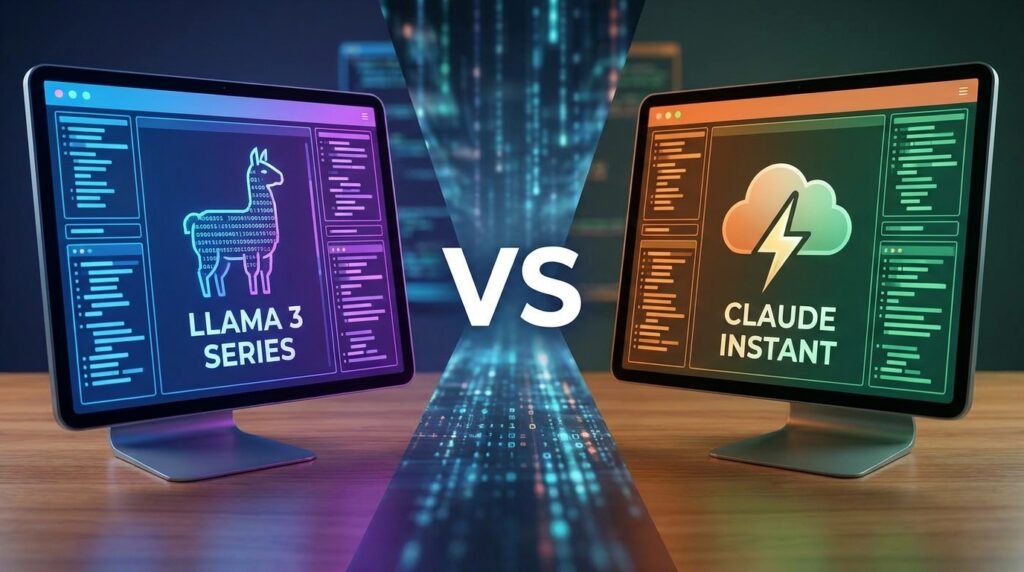
Benchmarks matter.
But production environments matter more.
Benchmark Categories Businesses Care About
Reasoning
Complex decision tasks.
Coding
Development workflows.
Retrieval
Knowledge integration.
Latency
Speed under load.
Cost Efficiency
Total economics.
What Benchmarks Miss
Benchmarks rarely measure:
- Cloud spend
- GPU utilization
- Team efficiency
- Vendor switching cost
Those become larger factors over time.
Coding Performance Comparison
Developers evaluate more than code generation.
Claude Instant Wins At
- Rapid iteration
- Documentation
- Structured outputs
- Lower setup friction
Llama 3 Wins At
- Internal coding copilots
- Fine-tuned workflows
- Controlled environments
- Continuous optimization
Verdict
Small engineering teams benefit from Claude.
Platform teams benefit from Llama.
Context Window & Long Document Handling
Long-context processing affects:
- Legal workflows
- Research
- Internal search
- Enterprise knowledge systems
Claude Instant Strengths
- Easier long-context usage
- Managed scaling
Llama Strengths
- Context optimization options
- Deployment flexibility
Long context only matters if retrieval quality remains high.
Cost Analysis & Infrastructure Economics
This is where most comparison articles fail.
Startup Economics
Best option:
Claude Instant
Why:
- No GPU expense
- Faster deployment
- Predictable billing
Growth Phase
The decision becomes less obvious.
Questions:
- Monthly token volume?
- Engineering maturity?
- Infrastructure budget?
Enterprise Scale
Often shifts toward:
Llama deployment
Reasons:
- Lower inference costs
- Better Ownership economics
- Data governance
Cost Comparison Table
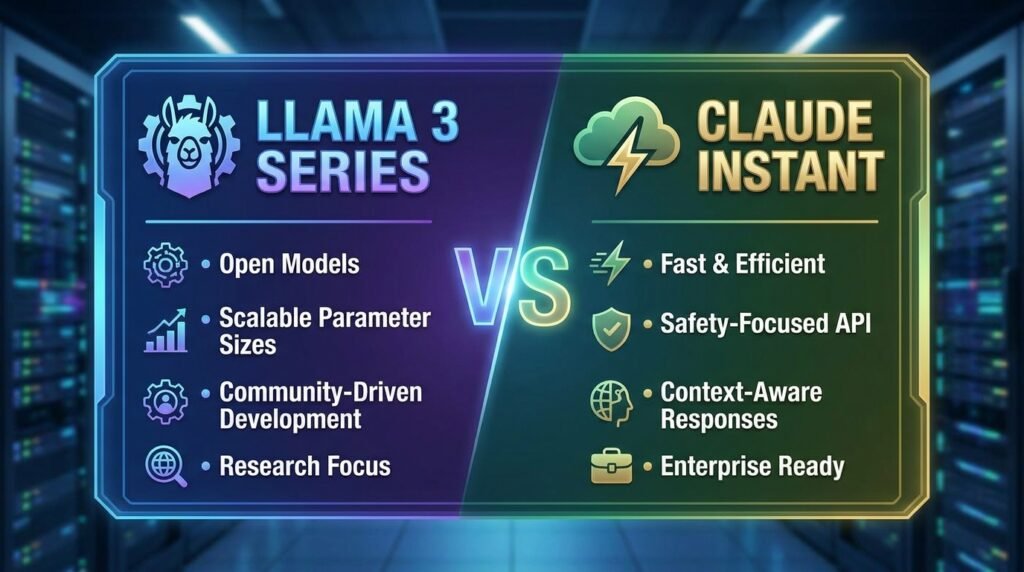
| Cost Area | Llama 3 | Claude Instant |
| Initial Cost | Higher | Lower |
| Monthly Scaling | Lower | Higher |
| Maintenance | Higher | Minimal |
| GPU Need | Yes | No |
| Infrastructure | Required | Included |
Infrastructure Requirements & GPU Economics
Open models introduce operational realities.
Consider:
GPU Selection
Inference performance matters.
Hosting
Cloud vs on-premise.
Storage
Model checkpoints.
Monitoring
Production reliability.
Networking
Latency optimization.
Infrastructure decisions influence total AI spend more than token pricing.
RAG Performance Comparison
Retrieval-Augmented Generation is becoming standard.
Llama 3 Works Better When:
- Documents remain private
- Retrieval pipelines are customized
- Data residency matters
Claude Instant Works Better When:
- Teams want speed
- Simplicity matters
- Infrastructure teams are small
Security, Privacy & Compliance
European organizations increasingly evaluate:
- Data governance
- Regional processing
- Infrastructure ownership
Llama Advantages
- Local hosting
- Data control
- Flexible compliance
Claude Advantages
- Simpler operations
- Reduced internal maintenance
Startup vs Enterprise Decision Framework
Startups
Choose Claude if:
- Speed matters
- The team is small
- Product validation is a priority
Agencies
Choose based on:
- Client requirements
- Compliance expectations
Enterprises
Choose Llama if:
- AI becomes core infrastructure
- Long-term optimization matters
Open Source AI vs Proprietary AI
Open Deployment Advantages
- Control
- Ownership
- Flexibility
Managed AI Advantages
- Simplicity
- Faster launch
- Lower operational complexity
Hybrid strategies increasingly dominate.
Migration Framework: API → Local Models
Most companies eventually evaluate migration.
Move Toward Open Models When
Costs rise
Usage becomes predictable
Privacy requirements grow
Stay API-Based When
Team remains small
Speed matters more than ownership
How to Use These AI Tools Effectively
For Content Teams
Use:
- Summaries
- Draft generation
- SEO assistance
For Developers
Use:
- Code generation
- Internal assistants
- Documentation
For Enterprises
Use:
- Knowledge search
- Workflow automation
- Secure assistants
Tips to Write Better Prompts for AI Models
Be Specific
Avoid vague instructions.
Add Constraints
Define tone and format.
Give Examples
Improve output consistency.
Use Iteration
Prompt refinement matters.
Define Success Metrics
Measure useful outputs.
Europe Market Perspective
Organizations across Europe increasingly prioritize:
- AI governance
- Cost predictability
- Data ownership
- Operational resilience
Businesses planning multi-country deployments should evaluate deployment flexibility early rather than relying only on benchmark rankings.
Pros & Cons
Llama 3 Series
Pros
- Flexible deployment
- Lower long-term cost
- Better customization
- Strong ownership
Cons
- Higher setup complexity
- GPU requirements
- Maintenance overhead
Claude Instant
Pros
- Easy deployment
- Faster onboarding
- Minimal operations
Cons
- Vendor dependence
- Less customization
- Long-term API exposure
People Also Ask
A: It depends on goals. Llama usually offers stronger deployment flexibility, while Claude simplifies operations.
A: Claude is often cheaper initially. Llamas can become more economical at higher usage volumes.
A: Llama often fits private retrieval environments. Claude works well for rapid implementation.
A: For organizations with scale, compliance needs, or predictable usage, self-hosting can reduce long-term costs.
A: Most startups benefit from API simplicity first and evaluate open deployment later
Conclusion
Choosing between Llama 3 Series VS Claude Instant in 2026 is no longer about selecting the model with the highest benchmark score—it’s about selecting the right long-term AI strategy.
If your priority is speed, simplicity, and launching quickly, Claude Instant remains a practical choice for startups, agencies, and teams that want reliable AI without managing infrastructure.
If your priority is ownership, deployment flexibility, privacy, lower long-term inference costs, and custom workflows, Llama 3 Series becomes increasingly attractive as usage grows and AI becomes part of your core operations.
For many organizations, the smartest path is not choosing one model forever—it’s adopting AI in phases. Start with managed APIs to validate value, then move toward open deployment when scale, compliance, or economics justify the transition.
The best AI model is the one that aligns with your business goals, infrastructure maturity, and future growth plans—not the one that wins a benchmark chart.
If this comparison helped you make a clearer decision, bookmark this guide, share it with your team, and explore more in-depth AI comparisons on Ultraaiguide.com.