Introduction
Artificial Intelligence is no longer just about powerful tools like ChatGPT or flashy consumer-facing applications.
Today, the real competition is unfolding behind the curtain—across data Ecosystems, computational infrastructure, and strategic control layers.
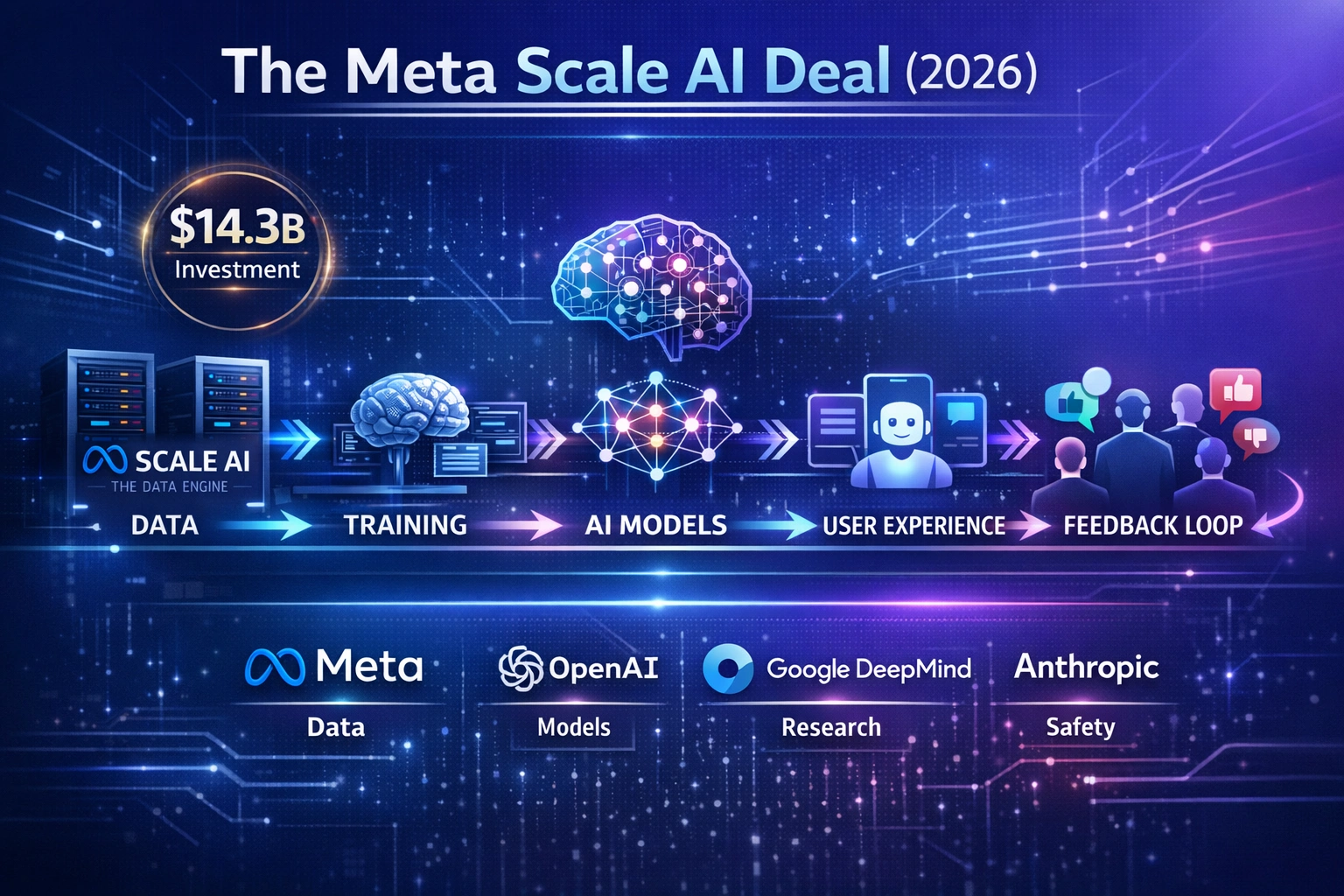
This is exactly why Meta Platforms made a massive $14.3 billion investment in Scale AI.
At first glance, it may appear like just another high-value tech acquisition.
But here’s the deeper reality that most surface-level articles fail to capture:
The future of AI is not determined by who builds the most intelligent model.
It is determined by who owns and optimizes the data pipelines that train those models.
This is where Meta is making a strategic, calculated move—one that could redefine the competitive landscape of artificial intelligence.
What You’ll Learn in This Guide
In this comprehensive pillar guide, you will gain a deeper, structured understanding of:
- What “Meta Scale AI” actually represents
- Why the $14.3B investment is more infrastructural than financial
- How data annotation and RLHF drive modern AI systems
- A strategic comparison between Meta, OpenAI, Google DeepMind, and Anthropic
- The implications for Europe’s AI ecosystem
- Practical ways you can apply these AI concepts in real-world scenarios
Let’s break this down step by step.
What Is Scale AI?
Not a Conventional AI Company
Scale AI is fundamentally different from companies like OpenAI or Google.
It does not build chatbots, assistants, or consumer-facing platforms.
Instead, it operates behind the scenes as a data infrastructure provider.
Think of it like this:
- OpenAI builds the intelligence layer
- Scale AI constructs the training and optimization layer
Core Functions of Scale AI
Scale AI focuses on one of the most critical components of artificial intelligence: high-quality data systems.
Data Annotation
- Tagging images, text, and video content
- Structuring unorganized datasets
- Enabling semantic understanding
RLHF
- Human evaluators score AI outputs
- Models learn preferences and improve accuracy
- Feedback loops enhance contextual relevance
AI Model Evaluation
- Testing model robustness
- Identifying logical inconsistencies
- Measuring performance benchmarks
Synthetic Data Generation
- Producing artificial datasets
- Filling gaps where real-world data is limited
- Enhancing training diversity
Simplified Explanation:
Scale AI trains AI systems how to reason, respond, and evolve efficiently over time.
Who Uses Scale AI?
Scale AI collaborates with:
- AI labs like OpenAI and Google DeepMind
- Government organizations (defense, surveillance, automation)
- Enterprises (analytics, workflow automation, AI integration)
This position scales AI as one of the most influential yet invisible players in the AI ecosystem.
What Is the Meta–Scale AI Deal?
The $14.3 Billion Strategic Move
In 2025, Meta Platforms executed a bold initiative:
- Invested approximately $14.3 billion
- Acquired nearly 49% ownership stake
- Integrated leadership from Scale AI, including Alexandr Wang
More Than a Financial Investment
This is not just capital deployment.
It is about strategic control and long-term dominance.
Meta aims to control:
- Data pipelines
- Training infrastructure
- Feedback optimization systems
This creates a sustainable competitive advantage in AI development.
Why Meta Invested in Scale AI
Data Is the New Oil
AI models rely heavily on:
- Massive datasets
- Clean, structured information
- Continuous feedback loops
Without high-quality data, even advanced models fail.
Meta realized a critical insight:
It was not falling behind due to weak models, but due to inefficient data pipelines.
Fixing Llama’s Limitations
Meta’s Llama models are powerful but have several constraints:
- Weak alignment mechanisms
- Limited fine-tuning processes
- Underdeveloped RLHF pipelines
With Scale AI, Meta gains:
- Improved datasets
- Stronger training cycles
- Enhanced reasoning capabilities
This significantly improves Llama’s competitiveness against GPT-level systems.
Building Advanced AI Labs
Meta is investing in:
- Artificial General Intelligence (AGI)
- Multi-agent AI systems
- Autonomous assistants
The objective is clear:
To compete directly with OpenAI and Google at the highest level.
Meta vs OpenAI vs Google vs Anthropic
| Company | Core Strength | Weakness | Strategy |
| Meta | Data + distribution | Late AI start | Infrastructure-first |
| OpenAI | Advanced models | High cost, closed systems | Model-first |
| Google DeepMind | Research excellence | Slow deployment | Research-first |
| Anthropic | AI safety | Limited ecosystem | Safety-first |
Meta’s Hidden Advantage
Meta owns:
This translates into billions of users and enormous data streams.
Now combined with Scale AI:
Meta controls both data generation AND data refinement systems
This is a powerful strategic position.
The Hidden Power: Data Labeling & RLHF
What Is RLHF?
RLHF (Reinforcement Learning from Human Feedback) is a core optimization technique.
Process:
- AI generates responses
- Humans evaluate outputs
- AI adjusts based on feedback
This is what makes AI responses feel natural and human-like.
Why Data Labeling Matters
AI systems do not inherently understand raw data.
They require:
- Structured inputs
- Contextual tagging
- Semantic labeling
Example:
- Image: Dog
- Label: “Brown dog running in park.”
Now the AI understands context, motion, and environment.
What Scale AI Provides
- Human-in-the-loop systems
- Red-teaming (identifying weaknesses)
- Safety testing pipelines
These are critical for:
- Chatbots
- Autonomous systems
- AI agents
Challenges in the Meta–Scale AI Deal
Data Quality Concerns
- Not all labeled data is accurate
- Human bias can influence outputs
Poor data leads to flawed AI systems
Industry Friction
Some organizations may avoid Scale AI because:
- Meta is now involved
- Competitive risks increase
Regulatory Pressure
Europe enforces strict AI regulations:
- GDPR
- AI Act
These impacts:
- Data collection
- Model training
- Privacy compliance
Europe Relevance: Why This Matters
In Europe:
- AI laws are stricter
- Privacy is prioritized
- Ethical AI is mandatory
Potential Impact
- Slower deployment timelines
- Increased compliance costs
- Greater transparency requirements
Opportunity
Organizations that comply effectively can:
Build trust and achieve long-term growth
Meta’s AI Vision for 2026 and Beyond
Meta is developing a complete AI ecosystem.
Personalized AI Assistants
- Integrated into WhatsApp and Instagram
- Context-aware interactions
- Predictive recommendations
Multi-Agent Systems
- AI systems interacting with each other
- Solving complex tasks collaboratively
AI + Commerce
- Intelligent product recommendations
- Targeted advertising
- In-app purchasing
Future Impact: Why This Deal Changes Everything
Shift From Models to Infrastructure
Old paradigm:
Focus on building better models
New paradigm:
Focus on controlling data ecosystems
Rise of Data Infrastructure Giants
Companies like Scale AI could become:
The “AWS of AI data infrastructure.”
Accelerated AGI Development
Better data pipelines result in:
- Faster learning cycles
- Improved reasoning
- Scalable intelligence
How You Can Use These AI Concepts
Step-by-Step Framework
Select AI Platform
- ChatGPT
- Claude
- Gemini
Use Structured Prompts
- Provide clarity
- Add context
- Define expected output
Implement Feedback Loops
- Refine outputs
- Improve prompts
- Iterate continuously
Leverage Data
- Use datasets
- Train models (if applicable)
Optimize Continuously
- Test performance
- Improve results
Real Business Use Cases
Customer Support
- AI chatbots
- 24/7 service
Content Creation
- Blogs
- SEO content
Data Analytics
- Insights
- Forecasting
Marketing
- Personalized campaigns
- Audience targeting
SEO Tips to Beat Competitors
Common Mistakes
- Superficial explanations
- Lack of insight
- Ignoring data importance
Winning Strategy
- Focus on data vs models
- Simplify complex ideas
- Use comparisons and examples
This is how you dominate search rankings.
Pros & Cons
Advantages
- Strong data advantage
- Faster AI iteration
- Improved competitive position
- Infrastructure control
Disadvantages
- Regulatory challenges
- Data quality risks
- Industry resistance
- High capital investment
FAQs
A: Meta Scale AI refers to Meta’s investment in Scale AI to improve AI training through better data, labeling, and infrastructure.
A: Meta invested in gaining control over high-quality training data, which is essential for building advanced AI systems.
A: Scale AI provides:
Data annotation
RLHF
AI evaluation
These help train and improve machine learning models.
A: But Meta is catching up by focusing on data infrastructure instead of just models.
A: It increases focus on:
AI regulation
Data privacy
Ethical AI
Conclusion
The Meta Scale AI deal is not merely another technology investment.
It represents a structural Transformation in the AI industry.
Meta is no longer just competing—it is building the foundational infrastructure of artificial intelligence:
- Data pipelines
- Training architectures
- Optimization ecosystems
The future of AI will not be decided by who builds the smartest model.