Introduction
Artificial intelligence has evolved quickly—but one comparison continues to generate attention among developers, AI buyers, startups, and enterprise teams:
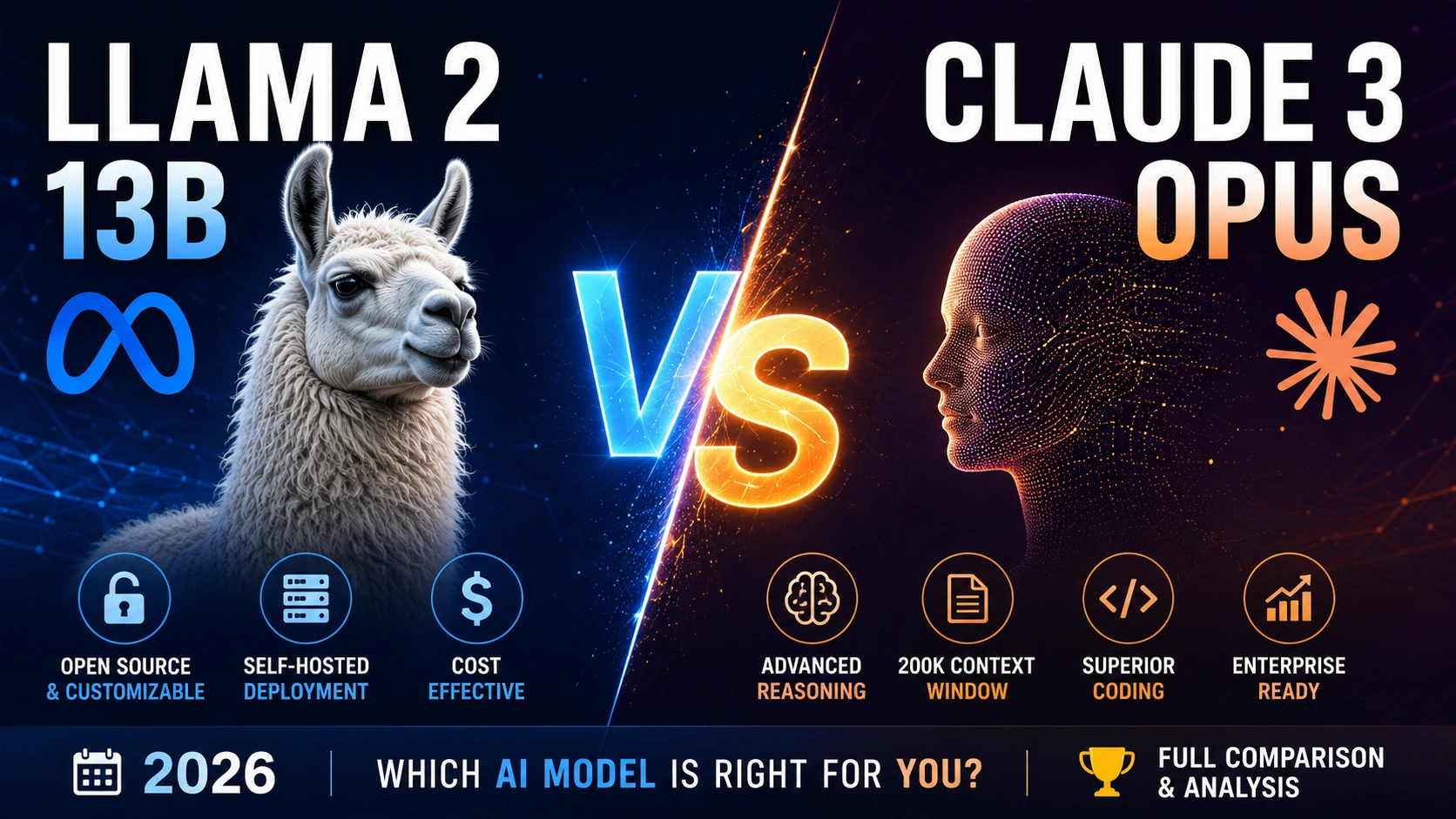
At first glance, this comparison seems unfair. One model was introduced as an open-weight model designed for customization and deployment flexibility. The other was built to deliver premium reasoning, enterprise-grade intelligence, and long-context performance.
Yet businesses continue comparing them because selecting an AI model is rarely about raw intelligence alone. Some organizations care more about ownership cost. Others prioritize privacy. Some need better coding. Others want infrastructure freedom. That makes this comparison surprisingly practical in 2026.
This guide explores everything that matters before choosing:
- Benchmark performance
- Coding capability
- Context window
- RAG performance
- Pricing and ROI
- Infrastructure requirements
- Business deployment
- Security considerations
- Long-term scalability
By the end, you’ll know which model actually wins—and more importantly, which one wins for your use case.
Quick Verdict
Choose Claude 3 Opus if you need:
- Strong reasoning
- Better coding quality
- Large document processing
- Higher answer reliability
- Enterprise productivity
Choose Llama 2 13B if you need:
- Self-hosting
- Local deployment
- Fine-tuning
- Infrastructure ownership
- Better long-term operating control
Llama 2 13B VS Claude 3 Opus: Specifications
| Feature | Llama 2 13B | Claude 3 Opus |
| Release | July 2023 | March 2024 |
| Model Type | Open-weight | Proprietary |
| Deployment | Self-host / API | API |
| Context Window | 4K | 200K |
| Fine-Tuning | Full | Limited |
| Infrastructure Control | Complete | Managed |
| Privacy | High | Service dependent |
| Best Strength | Cost Control | Intelligence |
What Is Llama 2 13B?
Llama 2 13B is a medium-sized open-weight language model designed for organizations that want deployment flexibility.
Instead of paying API fees forever, companies can host it internally.
That makes Llama attractive for:
- Private AI assistants
- Internal copilots
- Edge deployment
- Controlled environments
- Cost-sensitive scaling
Although newer open models exist, Llama 2 remains relevant due to its ecosystem maturity.
What Is Claude 3 Opus?
Claude 3 Opus is a premium large language model focused on advanced reasoning, long-context understanding, and high-quality output generation.
Claude excels in:
- Document analysis
- Coding
- Enterprise workflows
- Complex instructions
- Multi-step reasoning
Organizations using premium AI experiences often evaluate Claude first because of output consistency.
Head-to-Head Comparison
Intelligence and Reasoning
Intelligence still matters.
If your workflows involve judgment, synthesis, and difficult instructions, model quality becomes visible quickly.
Llama 2 13B
Strengths:
- Good for structured prompts
- Consistent for narrow tasks
- Efficient inference
Weaknesses:
- Lower reasoning depth
- Higher hallucination risk
- Less instruction adherence
Claude 3 Opus
Strengths:
- Advanced reasoning
- Strong contextual understanding
- Better abstraction
Weaknesses:
- Higher operating cost
- Closed ecosystem
Winner:
Claude 3 Opus
Benchmark Performance
Benchmarks should never be your only decision factor.
Still, they reveal performance ceilings.
| Benchmark | Llama 2 13B | Claude 3 Opus |
| MMLU | 54.8 | 88.2 |
| HellaSwag | 80.7 | 95.4 |
| GSM8K | 28.7 | 95 |
| HumanEval | 18.3 | 84.9 |
What this means:
- Claude Dominates reasoning
- Claude produces stronger coding
- Claude handles complexity better
- Llama stays competitive only in ownership flexibility
Coding Performance
Developers often ask:
Which AI is better for coding?
Llama 2 for Coding
Pros:
- Deploy internally
- Fine-tune on private repositories
- Lower long-term API dependency
Cons:
- More debugging needed
- Lower first-pass success
Claude 3 Opus for Coding
Pros:
- Better generation
- Better debugging
- Better architecture suggestions
- Better instruction following
Cons:
- Vendor dependency
- Higher premium usage
Winner:
Claude 3 Opus
Context Window: Where the Difference Changes Everything
Context length impacts practical usage.
Llama 2 13B
4K context enables:
- Smaller tasks
- Basic assistants
- Chunked retrieval
Limitations:
- Frequent context loss
- Smaller conversations
Claude 3 Opus
200K context enables:
- Entire reports
- Multi-document analysis
- Legal workflows
- Long research sessions
Winner:
Claude 3 Opus
Open-Source vs Closed AI
This is the real battle.
| Area | Llama 2 | Claude 3 |
| Ownership | Full | Limited |
| Customization | Excellent | Moderate |
| Compliance | Strong | Service dependent |
| Maintenance | User | Provider |
| Speed to Deploy | Moderate | Fast |
Choose open-weight if control matters.
Choose proprietary if capability matters.

RAG Performance Comparison
Retrieval-Augmented Generation remains one of the strongest enterprise AI applications.
Llama 2 for RAG
Best for:
- Internal search
- Cost-sensitive deployments
- Local knowledge bases
Advantages:
- Data control
- Lower scaling costs
Claude 3 Opus for RAG
Best for:
- Research
- Enterprise knowledge
- Long retrieval chains
Advantages:
- Larger memory
- Better synthesis
Winner:
Depends on deployment goals.
Pricing and Total Cost of Ownership
Many buyers underestimate infrastructure.
Claude Cost Model
Approximate pricing:
| Type | Price |
| Input | ~$15 per million |
| Output | ~$75 per million |
Good for:
- Low setup
- Immediate scaling
Llama Cost Model
Costs shift to:
- GPU hosting
- Maintenance
- DevOps
- Monitoring
Good for:
- Predictable scale
- Long-term usage
Infrastructure Requirements
| Requirement | Llama 2 | Claude |
| GPU Hosting | Yes | No |
| API Access | Optional | Required |
| Maintenance | Yes | No |
| Security Control | High | Moderate |
Privacy and Compliance
European businesses increasingly evaluate AI through compliance and governance.
Llama Advantages
- Data stays internal
- Greater control
- Easier custom governance
Claude Advantages
- Faster deployment
- Lower operational burden
For industries handling sensitive information, deployment architecture matters as much as intelligence.
Real Business Use Cases
Choose Llama 2 13B For
- Internal copilots
- On-prem AI
- Manufacturing assistants
- Enterprise knowledge systems
- Edge AI
Choose Claude 3 Opus For
- Legal analysis
- Financial research
- Executive reporting
- Customer intelligence
- Premium AI products
Europe Market Perspective
European teams increasingly balance:
- AI capability
- Data governance
- Cost Predictability
For startups:
Claude often accelerates launch.
For enterprises:
Self-hosted infrastructure may reduce long-term dependence.
How to Use These AI Tools
Define Your Objective
Ask:
- Automation?
- Research?
- Coding?
- Internal search?
Estimate Usage
Evaluate:
- Daily requests
- Context size
- Team size
Test Before Scaling
Measure:
- Accuracy
- Cost
- Speed
- Reliability
Tips to Write Your Own AI Tool Captions
Good AI content captions:
- Focus on outcomes
- Use numbers
- Highlight speed
- Show business value
Examples:
- “Reduce AI costs by 40%.”
- “Process 500-page reports”
- “Deploy AI privately”
Pros and Cons
Llama 2 13B
Pros
- Lower long-term cost
- Local deployment
- Fine-tuning support
- Privacy control
Cons
- Lower reasoning
- Short context
- More maintenance
Claude 3 Opus
Pros
- Strong reasoning
- Premium outputs
- Better coding
- Long context
Cons
- Higher API costs
- Closed ecosystem
Common Buying Mistakes
Mistake 1
Choosing benchmarks over business needs.
Mistake 2
Ignoring ownership cost.
Mistake 3
Buying maximum context unnecessarily.
Mistake 4
Skipping deployment planning.
People Also Ask
A: Yes for reasoning, coding, and long-context tasks.
A: Model access is open-weight, but infrastructure still costs money.
A: Claude for large-context retrieval. Llama for private deployments.
A: Yes, depending on available hardware.
A: Claude for output quality. Llama for customization.
Conclusion
When comparing Meta Llama 2 13B and Anthropic Claude 3 Opus, the better choice depends on what matters most: Performance or control. Claude 3 Opus stands out as the stronger overall AI model in 2026 thanks to its superior reasoning, longer context handling, stronger writing quality, and more reliable performance across complex business and research tasks. It is designed for users who want high-quality output with minimal tuning.
On the other hand, Llama 2 13B remains valuable for developers and organizations that prioritize open deployment, customization, and running models on their own infrastructure. While it cannot match Claude 3 Opus in raw capability, it offers flexibility and lower barriers for experimentation and self-hosted AI workflows.
Final Verdict: If you want the most capable AI experience, choose Claude 3 Opus. If you need open-source flexibility and deployment freedom, Llama 2 13B is still a practical option.