Introdution
Artificial intelligence comparisons have become crowded. Open almost any Comparison article, and you will see the same pattern: benchmark screenshots, vague conclusions, and a winner declared in minutes. But enterprises, developers, startups, and AI teams in 2026 are making decisions differently.
They are not asking:
“Which model scored higher?”
They are asking:
- Which model ships faster?
- Which model lowers operational cost?
- Which model works across long sessions?
- Which model scales economically?
- Which model improves business outcomes?
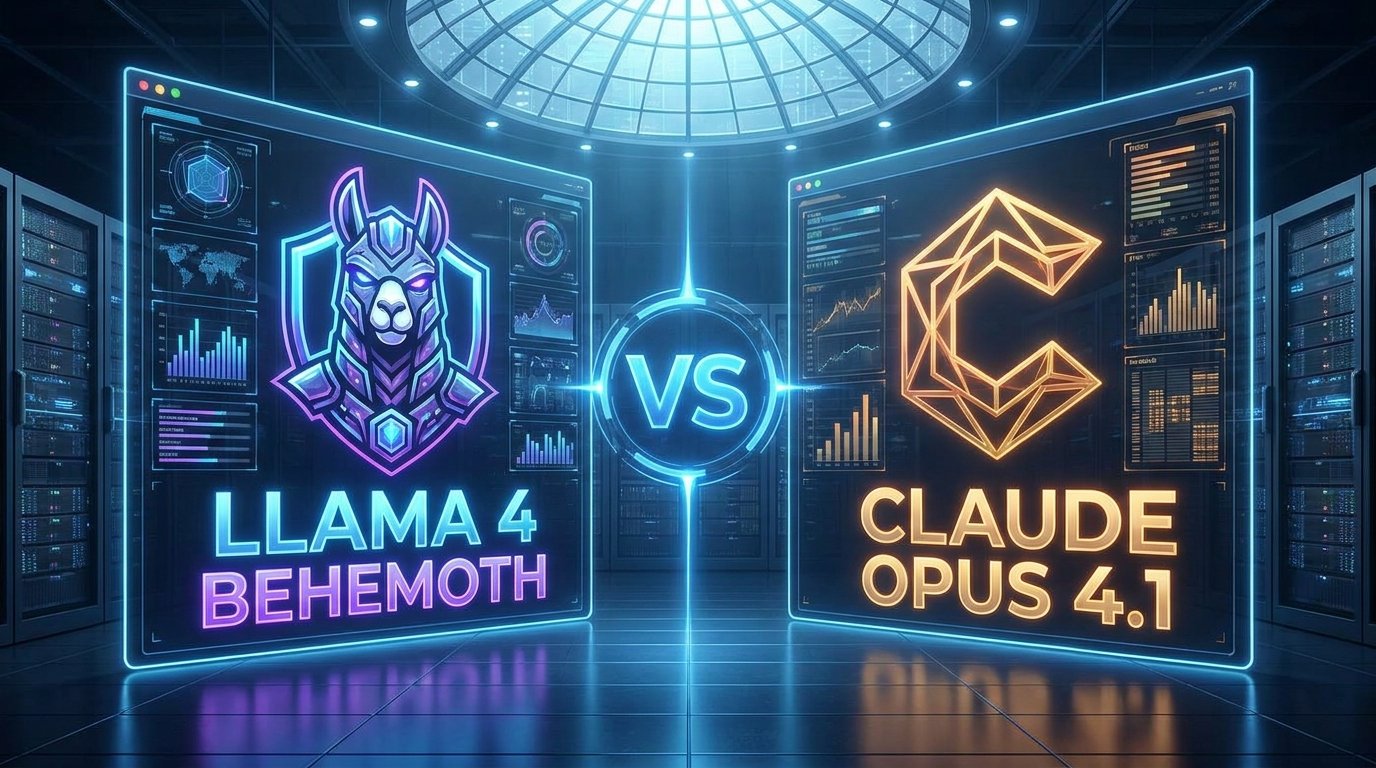
That is where the real comparison begins. This guide goes deeper than benchmarks and compares Llama 4 Behemoth VS Claude Opus 4.1 through production performance, coding capability, context engineering, deployment flexibility, enterprise economics, and practical workflows. If you are choosing an AI platform for Europe, the US, enterprise teams, internal copilots, research environments, or software engineering pipelines, this article is designed to help you make a confident decision.
Quick Verdict
Llama 4 Behemoth if:
Want infrastructure ownership
Plan to self-host AI workloads
Optimize long-term inference economics
Need customization flexibility
Operate enterprise-scale systems
Claude Opus 4.1 if:
Want premium out-of-the-box performance
Prioritize coding quality
Run complex AI agent workflows
Want faster deployment
Value consistent instruction following
Overall Verdict
Capability Winner → Claude Opus 4.1
Control Winner → Llama 4 Behemoth
What Is Llama 4 Behemoth?
Llama 4 Behemoth represents Meta’s largest high-end reasoning architecture within the Llama ecosystem.
It is designed as a large-scale Mixture-of-Experts system focused on advanced reasoning, long-context experiments, and enterprise deployment flexibility.
Core positioning:
- Massive-scale architecture
- Long-context experimentation
- Open ecosystem benefits
- High customization potential
- Infrastructure ownership
The biggest attraction is freedom.
Organizations gain more control over deployment strategy, model routing, orchestration, and cost optimization.
What Is Claude Opus 4.1?
Claude Opus 4.1 focuses on premium enterprise capability.
Its design emphasizes:
- Strong instruction execution
- Stable long-horizon reasoning
- Advanced coding workflows
- Reliable enterprise APIs
- Lower operational friction
Instead of maximizing infrastructure flexibility, Claude prioritizes consistent output quality.
Head-to-Head Comparison Table
| Category | Llama 4 Behemoth | Claude Opus 4.1 |
| Architecture | Mixture of Experts | Proprietary |
| Context Window | Very Large | 200K |
| Deployment | Flexible | Managed |
| Coding | Strong | Excellent |
| Long Sessions | Excellent | Excellent |
| Fine Tuning | Strong | Limited |
| Infrastructure Control | Excellent | Moderate |
| Instruction Reliability | Strong | Excellent |
| Enterprise Operations | Strong | Excellent |
| Cost Predictability | Variable | Premium |
Why Benchmarks Alone No Longer Matter
Benchmarks remain useful.
But benchmark leadership rarely predicts production success.
Real-world AI performance depends on:
- Retrieval quality
- Prompt design
- Context engineering
- Agent orchestration
- Memory management
- Human correction cycles
Two models can score similarly while delivering completely different operational outcomes.
Modern AI evaluation now measures:
Production Metrics That Matter
Cost per completed task
Not token cost.
Actual business outcome.
Time-to-answer
How quickly useful work gets completed.
Success rate
Did the model finish correctly?
Human intervention
How often must people fix outputs?
Coding Performance: Which Model Helps Developers More?
Coding has become one of the most important AI workloads.
Developers increasingly evaluate:
- Repository understanding
- Debugging quality
- Refactoring
- Architecture decisions
- Multi-file execution
Llama 4 Behemoth for Coding
Strengths:
- Large codebase understanding
- Architecture planning
- Infrastructure discussions
- Internal tooling
Weaknesses:
- More tuning required
- Higher setup complexity
- Less turnkey performance
Best for:
Enterprise engineering teams.
Claude Opus 4.1 for Coding
Strengths:
- Strong repo navigation
- Stable debugging
- Better instruction execution
- Cleaner-generated output
Weaknesses:
- Premium operating cost
Best for:
Developer productivity.
Coding Winner
Winner → Claude Opus 4.1
For most coding environments, faster time-to-value matters more than customization.
Long Context Engineering: Advertised vs Usable Context
Context windows became marketing headlines.
But large numbers do not automatically create better AI.
Three questions matter:
- Can the model retrieve correctly?
- Does reasoning degrade?
- Can it maintain objectives?
Effective Context Evaluation Framework
| Metric | Why It Matters |
| Retrieval Accuracy | Finds relevant information |
| Context Compression | Maintains efficiency |
| Session Continuity | Prevents drift |
| Memory Stability | Preserves objectives |
| Response Quality | Maintains output |
Large advertised context without retrieval quality often becomes expensive noise.
Context Winner
Depends entirely on workload.
Research → Llama advantage
Production workflows → Claude advantage
Pricing and Total Cost of Ownership (TCO)
Most comparison articles stop at API pricing.
That is incomplete.
True AI economics include:
- Token spend
- Retry rates
- Human review
- Context overhead
- Engineering salaries
- Infrastructure
Enterprise Cost Model
| Cost Category | Llama 4 | Claude |
| Infrastructure | High | Low |
| Setup | High | Low |
| Maintenance | Medium | Low |
| Tokens | Flexible | Premium |
| Operational Labor | Medium | Low |
Hidden Cost Drivers
Failed generations
Cheap tokens become expensive when repeated.
Human review
Correction time affects ROI.
Long sessions
Large contexts increase costs.
Deployment overhead
Self-hosting adds operational complexity.

Deployment Architecture Comparison
Deployment is where the biggest strategic difference appears.
Choose Llama 4 Behemoth If
- Compliance matters
- Infrastructure ownership matters
- Data residency matters
- Internal AI platforms exist
Example:
A European enterprise handling internal knowledge systems may prefer self-managed environments.
Choose Claude Opus 4.1. If
- Deployment speed matters
- Teams are smaller
- Reliability matters
- Engineering resources are limited
Example:
A startup is launching AI features quickly.
Enterprise ROI Analysis
ROI is increasingly measured through:
- Employee productivity
- Completion rates
- Support reduction
- Developer output
Typical Outcomes
Llama:
Lower long-term platform dependence.
Claude:
Faster short-term value.
AI Agent Workflows
AI agents changed evaluation standards.
Models must:
- Follow goals
- Recover from failures
- maintain memory
- coordinate steps
Llama in Agent Systems
Better for:
- Custom orchestration
- Multi-agent experimentation
Claude in Agent Systems
Better for:
- Stable execution
- Reliable instructions
Winner:
Claude Opus 4.1
Pros and Cons
Llama 4 Behemoth
Pros
- Infrastructure ownership
- Flexible deployment
- Strong long-context potential
- Customizable
Cons
- More operational complexity
- Longer setup time
- Higher engineering overhead
Claude Opus 4.1
Pros
- Excellent coding
- Reliable responses
- Faster onboarding
- Strong enterprise usability
Cons
- Premium pricing
- Less deployment flexibility
Best Use Cases
Llama 4 Behemoth
- Internal copilots
- Enterprise AI platforms
- Custom assistants
- Large experimentation
Claude Opus 4.1
- Coding
- Research
- Knowledge work
- AI agents
Tips to Write Better AI Prompts
Do:
- Add goals
- Specify format
- Give examples
- Define constraints
Avoid:
- Overloading context
- Mixing objectives
- Using vague instructions
Europe-Focused AI Adoption Insight
European organizations increasingly evaluate:
- Data governance
- Compliance
- Multi-language performance
- Infrastructure location
This makes deployment strategy almost as important as capability.
Teams in Germany, France, the Netherlands, Sweden, Switzerland, Spain, Italy, and the UK often compare operational governance alongside benchmark performance.
People Also Ask
A: Not universally.
Llama is stronger for infrastructure flexibility, while Claude is stronger for immediate productivity.
A: Claude Opus 4.1 generally delivers stronger coding workflows and more consistent debugging.
A: Llama may reduce long-term infrastructure costs but requires more operational effort.
A: No.
Usable context matters more than advertised context.
A: Large enterprises often prefer Llama for control.
Fast-moving teams often prefer Claude.
Conclusion
The biggest mistake in AI selection today is assuming one model wins every workload. Llama 4 Behemoth And Claude Opus 4.1 represent two different philosophies. Llama prioritizes ownership, customization, and infrastructure economics. Claude prioritizes capability, reliability, and faster execution. If your goal is the highest output quality with minimal operational complexity, Claude Opus 4.1 is the stronger choice. If your goal is platform control, long-term flexibility, and enterprise architecture ownership, Llama 4 Behemoth becomes extremely attractive. The strongest organizations in 2026 increasingly combine multiple models and route workloads intelligently. Bookmark this guide, share it with your team, and explore more AI comparisons on Ultraaiguide.com.