Introduction
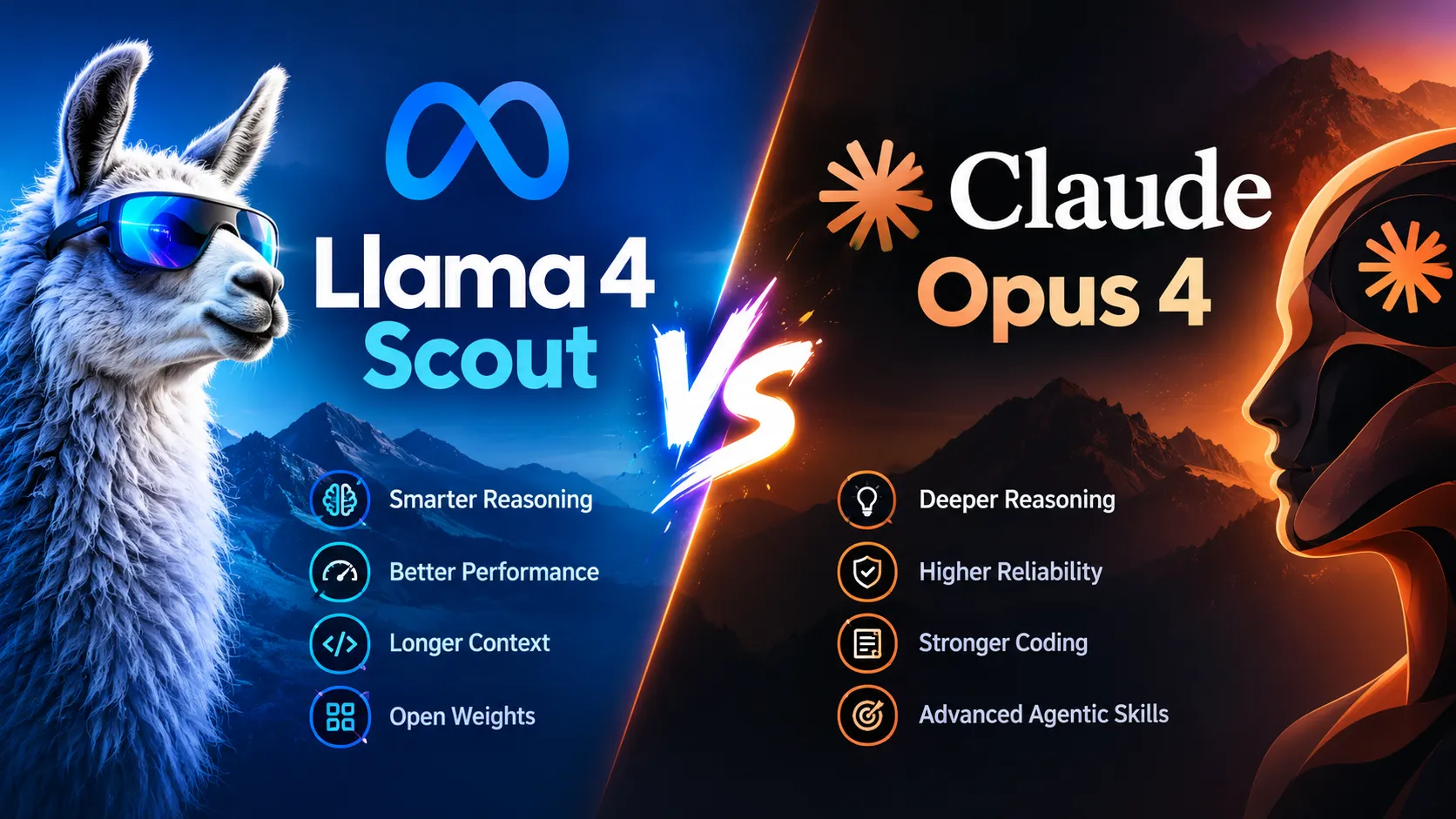
Llama 4 Scout and Claude Opus 4 come from different AI ecosystems and were designed around different priorities. Meta built Scout as a multimodal mixture-of-experts model with a remarkably large context window. At the same time, Anthropic introduced Claude Opus 4 as a high-end model focused on complex reasoning, coding, and agentic workflows.
There is also an important 2026 distinction: the original Claude Opus 4 model is now retired from Anthropic’s Claude API, while Llama 4 Scout remains available as part of Meta’s Llama ecosystem.
| Feature | Llama 4 Scout | Claude Opus 4 |
| Developer | Meta | Anthropic |
| Model family | Llama 4 | Claude 4 |
| Architecture | Mixture of Experts | Proprietary |
| Active parameters | 17B | Not publicly disclosed |
| Total parameters | 109B | Not publicly disclosed |
| Experts | 16 | Not publicly disclosed |
| Context window | 10M tokens | 200K tokens |
| Multimodal input | Text + images | Text + images |
| Model-weight access | Yes, under Llama 4 Community License | No |
| Extended thinking | Not equivalent to Claude’s system | Yes |
| Original API pricing | Provider-dependent | $15/M input, $75/M output |
| Release | April 2025 | May 2025 |
| Anthropic API status in 2026 | N/A | Retired June 15, 2026 |
Meta’s current model information lists Scout at 17B active parameters, 109B total parameters, and 16 experts with a 10M-token context window. Anthropic launched Claude Opus 4 at $15 per million input tokens and $75 per million output tokens.
What Is Llama 4 Scout?
Llama 4 Scout is Meta’s efficient Llama 4 multimodal model. It uses a mixture-of-experts architecture and activates 17 billion parameters while containing 109 billion total parameters across 16 experts.
Its most distinctive specification is the 10-million-token context window. Meta describes Scout as supporting text and image input, while its model card lists multilingual text and code as output capabilities.
Scout was released on April 5, 2025. Meta also provides quantization options, with its model documentation stating that Scout can fit on a single H100 GPU with on-the-fly int4 quantization.
This makes Scout particularly interesting for developers working with large amounts of contextual information, multimodal applications, or deployment scenarios where access to model weights matters.
What Is Claude Opus 4?
Claude Opus 4 was Anthropic’s flagship Claude 4 model introduced on May 22, 2025.
Anthropic positioned it for demanding coding, reasoning, and agent workflows. The launch announcement highlighted sustained performance on complex, long-running tasks and introduced extended thinking with tool use.
At launch, Claude Opus 4 cost $15 per million input tokens and $75 per million output tokens. Anthropic made the model available through its API as well as supported cloud platforms.
However, its status needs to be stated clearly in any article published in 2026: Anthropic retired the original claude-opus-4-20250514 model from the Claude API on June 15, 2026, with Claude Opus 4.8 listed as its replacement in Anthropic’s deprecation documentation.
That means this comparison is most useful for historical evaluation, legacy systems, research, or understanding how the two 2025 models differed.
Llama 4 Scout vs Claude Opus 4: Specifications
The specification table reveals one of the largest differences between the models.
| Specification | Llama 4 Scout | Claude Opus 4 |
| Developer | Meta | Anthropic |
| Release date | April 5, 2025 | May 22, 2025 |
| Architecture | MoE | Proprietary |
| Active parameters | 17B | Not disclosed |
| Total parameters | 109B | Not disclosed |
| Experts | 16 | Not disclosed |
| Context window | 10M | 200K |
| Input modality | Text + images | Text + images |
| Output | Text + code | Text |
| Model weights | Available under Llama license | Proprietary |
| Original input price | Provider-dependent | $15/M |
| Original output price | Provider-dependent | $75/M |
| Current Anthropic API status | N/A | Retired |
Meta’s documentation confirms Scout’s 17B active/109B total configuration and 10M context. Anthropic’s launch announcement confirms the original Opus 4 pricing and capabilities.
One important SEO and technical writing point: parameter count should not be treated as a direct intelligence score. The two companies expose different architectural details, so comparing “17B” with an undisclosed proprietary parameter count would not produce a meaningful quality conclusion.
Context Window: 10M vs 200K Tokens
Context is probably the most obvious numerical difference in this comparison.
Llama 4 Scout has a documented 10-million-token context window, while Claude Opus 4 had a 200,000-token context window. Meta’s official model information and model card document Scout’s 10M context, while Anthropic’s Claude 4 documentation establishes the 200K context window.
That difference can matter when working with:
- Large source-code repositories
- Massive document collections
- Long technical manuals
- Research archives
- Large logs
- Extended conversations
- Multiple project files
- Large retrieval-augmented-generation contexts
But there is an important distinction:
A larger context window does not automatically mean better reasoning.
A model can accept more information without necessarily using every piece of that information equally well. Retrieval quality, prompt structure, information placement, task complexity, and evaluation methodology still matter.
For smaller prompts, the 10M-versus-200K difference may have little practical effect.
Architecture and Model Design
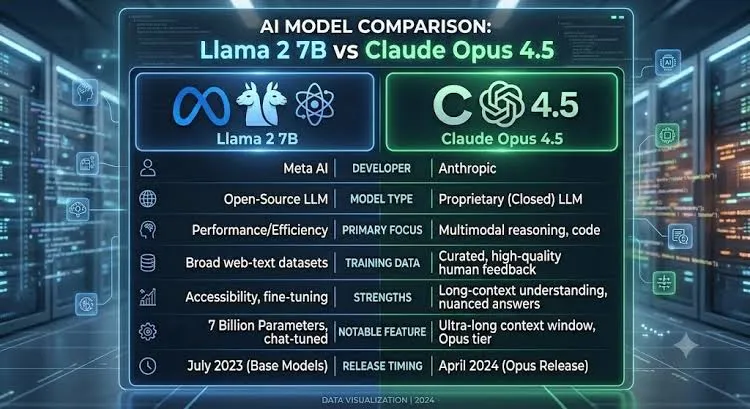
Llama 4 Scout uses a Mixture-of-Experts architecture with 16 experts. Meta reports 17 billion active parameters and 109 billion total parameters. The Llama 4 models also use early fusion for native multimodality.
In an MoE system, the model does not necessarily activate every parameter for every token. Routing mechanisms select portions of the network for different inputs.
Claude Opus 4 uses a proprietary architecture, and Anthropic does not publish an equivalent detailed expert configuration.
For developers, the practical architectural questions are more important than the terminology:
- How much hardware is required?
- Can the model be self-hosted?
- What license applies?
- What context size is supported?
- What modalities are available?
- What inference providers support it?
- What does the complete workload cost?
Those questions translate architecture into actual engineering decisions.
Reasoning and Problem-Solving
Claude Opus 4 was explicitly introduced for advanced reasoning and complex, long-running tasks. Anthropic also introduced extended thinking with tool use alongside the model.
Potential workloads include:
- Multi-step technical analysis
- Complex programming
- Research synthesis
- Planning
- Difficult debugging
- Tool-assisted workflows
- Agentic tasks
Llama 4 Scout can also be used for reasoning-oriented applications, but its official positioning emphasizes multimodal intelligence, efficiency, and very large context.
The key lesson is that “reasoning” should not be measured by one generic label. A useful evaluation should test the exact task the application performs.
For example, a developer building a code-review agent should evaluate actual repository tasks rather than assuming that a model’s general benchmark score predicts production performance.
Coding and Software Engineering
Coding is one of the most important dimensions of the Claude Opus 4 comparison because Anthropic specifically positioned Opus 4 around difficult coding and agent workflows.
Claude Opus 4 was designed for workflows such as:
- Code generation
- Debugging
- Refactoring
- Repository analysis
- Test generation
- Architecture discussions
- Multi-step development tasks
- Agent-assisted programming
Scout can also be used for software development, especially when a project benefits from very large contextual inputs.
Imagine a repository containing source code, documentation, configuration files, API references, and technical notes. Scout’s 10M context window creates a very different technical possibility from a 200K-context model.
However, context capacity and coding quality are separate measurements.
A strong production evaluation should measure:
- Tests passed
- Bugs introduced
- Code-review acceptance
- Repository understanding
- Tool-call reliability
- Latency
- Token consumption
- Total cost
This approach is more meaningful than choosing a model solely because it has a larger context window or a higher score on one coding benchmark.
Multimodal and Vision Capabilities
Both models support visual input, but the surrounding model design differs.
Meta describes Llama 4 Scout as a natively multimodal model supporting text and image input. Its model card specifically identifies multilingual text and image inputs.
Claude Opus 4 also supports image understanding as part of Anthropic’s Claude 4 generation.
Potential multimodal tasks include:
- Screenshot analysis
- Document understanding
- Charts
- Diagrams
- Image question answering
- Visual debugging
- Scanned-document analysis
For real applications, “supports vision” is only the starting point.
Developers should also test:
- OCR accuracy
- Small-text recognition
- Chart interpretation
- Complex diagrams
- Multiple images
- Document layouts
- Latency
- Cost
This produces a much more useful multimodal comparison than a simple “Vision: Yes” row.
Benchmarks and Performance: How to Read the Numbers
Benchmark tables are attractive because they make AI comparisons easy to scan. They can also create misleading conclusions when results come from different evaluation setups.
Third-party comparison pages currently publish different collections of scores for these models. For example, one comparison source reports Claude Opus 4 at 79.6% on GPQA, 72.5% on SWE-bench Verified, and 75.5% on AIME 2025, while reporting Scout at 79.6% on MMLU and 69.4% on MMMU.
Those numbers should not simply be combined into a single universal ranking because benchmark versions, prompts, Test Configurations, and reporting methodologies can differ.
| Benchmark | What it broadly measures |
| MMLU | Broad academic knowledge |
| GPQA | Graduate-level reasoning |
| SWE-bench | Software-engineering tasks |
| AIME | Mathematical problem solving |
| MMMU | Multimodal reasoning |
| MMLU-Pro | More challenging academic reasoning |
The better question is not “Which model has the largest number?”
It is:
Which evaluation resembles the workload you actually need to solve?
For an AI coding product, software-engineering tests may be more relevant than general knowledge. For a document-processing system, long-context retrieval and document-understanding evaluations may matter more.
Pricing and Total Cost
Claude Opus 4 launched at $15 per million input tokens and $75 per million output tokens.
Scout does not have one universal API price because the model weights can be used through different hosting and inference arrangements. Third-party providers have published different rates, so a current article should avoid presenting one provider’s Scout price as a universal Meta price.
For Scout, potential costs can include:
- GPU rental
- Hardware
- Electricity
- Storage
- Networking
- Inference software
- Monitoring
- Engineering
- Maintenance
Therefore, comparing only token prices can hide the real economics.
A better calculation is:
Total Cost = Inference + Infrastructure + Engineering + Operations
For a hosted API, infrastructure may be largely hidden inside the provider’s price. For self-hosting, those costs become the developer’s responsibility.
Licensing, Model Weights, and Self-Hosting
This is a major distinction between the two models.
Meta makes Scout weights available under the Llama 4 Community License Agreement. Meta’s model documentation explicitly identifies Scout as licensed under this agreement.
That creates deployment possibilities such as:
- Private Infrastructure
- Cloud GPU deployment
- Research environments
- Custom applications
- Managed inference
- Fine-tuning and customization workflows where permitted
Claude Opus 4 followed a proprietary model-access approach. Users interacted with the model through Anthropic’s services and supported cloud platforms rather than downloading the underlying model weights.
One terminology detail matters here: calling Scout simply “open source” can be misleading. Open-weight or weights available under the Llama 4 Community License is more precise.
Organizations should always read the applicable license before commercial deployment.
Real-World Use Cases
The models can overlap, but their documented characteristics lead to different practical evaluation scenarios.
Llama 4 Scout
Scout can be considered for:
- Very large-context applications
- Document analysis
- Multimodal applications
- Private infrastructure
- Custom AI products
- Research
- Long-context retrieval
- Cost-sensitive inference
Meta specifically highlights its 10M context, multimodal capabilities, and 17B-active/109B-total MoE configuration.
Claude Opus 4
The original Opus 4 was particularly relevant to:
- Complex coding
- Advanced reasoning
- Agentic workflows
- Research synthesis
- Long-running technical tasks
- Tool-use workflows
Anthropic’s launch announcement specifically emphasized coding, advanced reasoning, AI agents, and extended thinking.
Because the original Opus 4 was retired from Anthropic’s API in June 2026, developers starting a new project should also examine the currently supported Claude Opus models rather than treating the 2025 model as Anthropic’s current endpoint.
Which Model Fits Your Workflow?
There is no single specification that determines the right model for every application.
Scout’s documented characteristics become particularly relevant when a project requires:
- Extremely large context
- Model-weight access
- Self-hosting possibilities
- Multimodal input
- Infrastructure control
- Customized deployment
The original Claude Opus 4 becomes relevant when studying:
- Historical Claude 4 performance
- Existing Opus 4 integrations
- Legacy workloads
- Its original coding and reasoning behavior
- Historical benchmark comparisons
For a new 2026 project, the comparison should be expanded beyond these two models because Anthropic has retired the original Opus 4 API model. Anthropic currently lists newer Opus generations, including Opus 4.6, 4.7, and 4.8, as active models.
The most reliable approach is to build a private evaluation set based on your own application.
Test:
- Accuracy
- Coding success
- Reasoning quality
- Context retrieval
- Multimodal performance
- Latency
- Token consumption
- Cost
- Failure rate
- Operational complexity
People Also Ask
A: No. Both are multimodal language models, but Scout is a Meta Llama 4 MoE model with publicly available weights under the Llama 4 Community License, while Claude Opus 4 is a proprietary Anthropic model.
A: Llama 4 Scout has the larger documented context window at 10 million tokens, compared with 200,000 tokens for the original Claude Opus 4.
A: Scout has 17 billion active parameters and 109 billion total parameters across 16 experts.
A: Anthropic does not publicly disclose an equivalent parameter figure for Claude Opus 4.
A: Anthropic positioned Claude Opus 4 specifically for advanced coding, complex reasoning, and long-running agent workflows.
How to Test Llama 4 Scout vs Claude Opus 4 Yourself
A practical model evaluation can be more useful than a generic leaderboard.
Create a test set containing real examples from your application.
Coding assistant, include:
- Bug fixes
- Refactoring
- Unit tests
- Repository questions
- API integration
- Documentation generation
Document system, include:
- Long PDFs
- Tables
- Repeated information
- Conflicting sources
- Cross-document questions
- Citation requirements
For multimodal AI, include:
- Screenshots
- Charts
- Scanned pages
- Diagrams
- Small text
- Multiple images
Then record the same metrics for every model:
| Metric | What to measure |
| Accuracy | Correct answers |
| Task completion | Completed tasks |
| Hallucination rate | Unsupported claims |
| Latency | Time to useful output |
| Cost | Cost per completed task |
| Context handling | Retrieval from large inputs |
| Coding | Tests passed |
| Vision | Correct visual interpretation |
| Reliability | Repeated-task consistency |
This produces application-specific evidence rather than relying entirely on third-party leaderboards.
Conclusion
Llama 4 Scout and Claude Opus 4 represent two different approaches to advanced AI. Scout’s most distinctive documented characteristics are its 17B active parameters, 109B total parameters, 16-expert MoE architecture, native multimodal design, and 10M-token context window. Claude Opus 4 was introduced as a high-end model for coding, advanced reasoning, and agent workflows, with extended thinking and tool use among its major capabilities. The most important update for readers in 2026 is model status: the original Claude Opus 4 API model was retired on June 15, 2026.
So this comparison is most useful when you want to understand the technical differences between the two 2025 models, investigate a legacy Claude Opus 4 workflow, or evaluate Scout’s long-context and deployment Characteristics. For a new production system, however, the evaluation should include currently supported models and should be based on the application’s actual requirements.