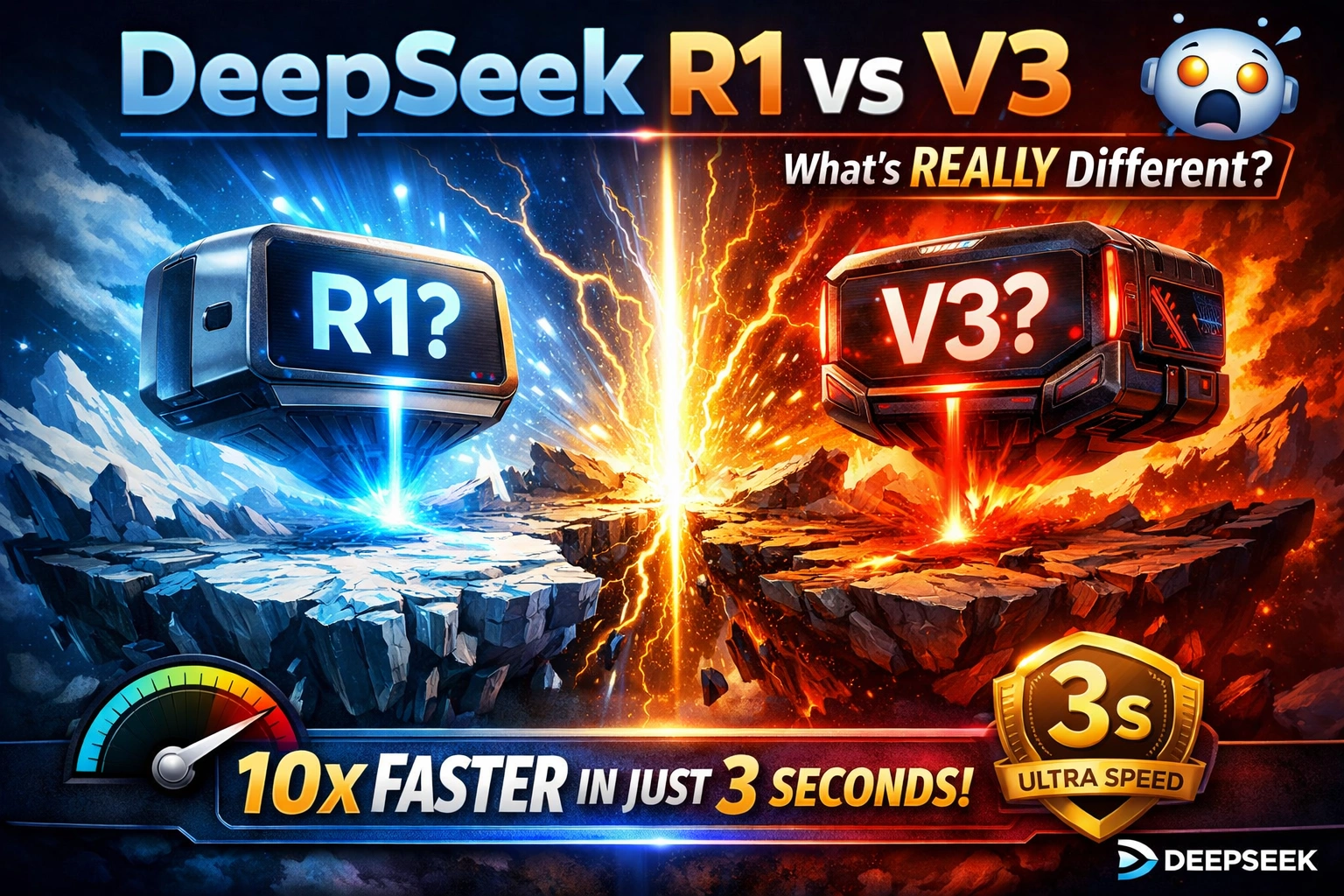
DeepSeek R1 vs V3 — Which Model Truly Wins in 2026?
So DeepSeek R1 is the better pick for reasoning, while V3 wins for versatility. DeepSeek R1 vs V3 breaks down benchmarks, coding, and real-world use so you can choose faster and smarter. See which model fits research, coding, and everyday tasks—and why the verdict may surprise you in 2026. DeepSeek R1 excels in advanced reasoning and mathematical problem-solving, whereas DeepSeek V3 dominates everyday applications such as coding, writing, and conversational tasks.
If you’re searching for DeepSeek R1 vs V3, you’re likely looking for one direct answer:
Which AI model should you actually use in 2026?
This decision is more important than ever before. Artificial intelligence is no longer just an optional utility—it has evolved into a core infrastructure layer powering startups, enterprises, freelancers, and creators alike. From engineers building scalable systems to marketers crafting persuasive content, the right AI model can dramatically enhance efficiency and output quality.
However, there’s a critical challenge:
Choosing the wrong model can lead to inefficient workflows, inaccurate results, and missed opportunities.
What Is the Real Difference Between DeepSeek R1 and V3?
In this detailed comparison, you will discover:
- The core distinctions between DeepSeek R1 and V3
- Which model performs better across coding, reasoning, and speed
- Practical use cases that reflect real-world applications
- A simplified decision-making framework you can apply immediately
No fluff. No ambiguity. Just clear, actionable insights.
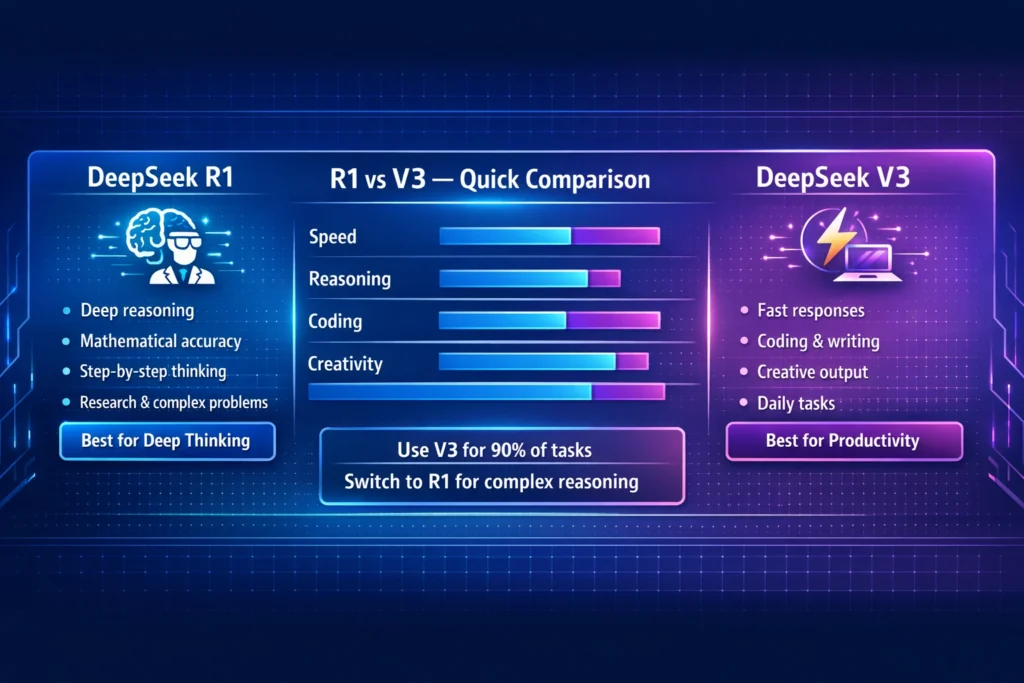
DeepSeek R1 vs V3 — Quick Comparison
| Feature | DeepSeek R1 | DeepSeek V3 |
| Purpose | Reasoning-centric | General-purpose |
| Speed | Slower | Faster |
| Coding | Strong (logic-heavy) | Exceptional |
| Creativity | Limited | Highly expressive |
| Accuracy | Very high (structured tasks) | Balanced |
| Best Use | Complex problem-solving | Daily productivity |
Simple reality:
- R1 = Deep analytical intelligence
- V3 = Everyday efficiency engine
What is DeepSeek R1?
Understanding DeepSeek R1
DeepSeek R1 is a reasoning-first artificial intelligence model specifically engineered to tackle intricate logical challenges, mathematical computations, and structured analytical tasks.
Unlike conventional AI systems that prioritize quick responses, R1 emphasizes deliberate thinking and sequential reasoning.
It doesn’t merely generate answers—it constructs solutions step by step, ensuring higher reliability.
Key Features of DeepSeek R1
- Advanced logical inference capabilities
- Superior mathematical computation accuracy
- Structured, stepwise problem-solving approach
- High precision in technical and analytical domains
- Reinforcement learning-driven optimization
How DeepSeek R1 Works
DeepSeek R1 utilizes a methodology commonly referred to as chain-of-thought reasoning.
This means:
Instead of producing an instant answer, it decomposes the problem into smaller logical segments and processes them sequentially.
This layered reasoning significantly improves correctness in complex domains such as mathematics, engineering, and research.
Best Use Cases for DeepSeek R1
You should rely on DeepSeek R1 when dealing with:
- Academic research and scholarly analysis
- Engineering calculations and simulations
- Data science modeling and statistical evaluation
- Complex decision-making scenarios
- Financial forecasting and risk assessment
Example:
A data scientist conducting predictive modeling or evaluating probabilistic systems will obtain more accurate outputs using R1.
Simple Explanation
Think of R1 as a highly analytical AI scientist who prioritizes depth over speed.
What is DeepSeek V3?
Understanding DeepSeek V3
DeepSeek V3 is a general-purpose AI model designed for versatility, rapid response, and scalability.
It is optimized for handling a wide variety of everyday tasks efficiently, making it highly practical for both individuals and organizations.
Key Features of DeepSeek V3
- High-speed response generation
- Exceptional coding assistance
- Strong natural language generation capabilities
- Multilingual adaptability
- Enterprise-grade scalability
How DeepSeek V3 Works
DeepSeek V3 is built on a Mixture-of-Experts (MoE) architecture.
This means:
- Only specific parts of the model activate when needed
- Computational resources are used more efficiently
- Output is generated faster without sacrificing quality
Best Use Cases for DeepSeek V3
You should use DeepSeek V3 for:
- Software development and debugging
- Content writing and blogging
- Marketing copy creation
- Chat-based interactions
- Workflow automation
Example:
A startup founder building a product, writing landing pages, and automating processes will benefit significantly from V3.
Simple Explanation
Think of V3 as your intelligent daily assistant that handles most tasks effortlessly.
DeepSeek R1 vs V3 — Key Differences Explained
1. Reasoning Ability
- R1: Deep analytical reasoning with structured logic
- V3: Balanced reasoning with less depth
Winner: DeepSeek R1
Best suited for:
- Mathematical problem-solving
- Scientific computations
- Complex logical frameworks
2. Speed & Usability
- R1: Slower due to detailed reasoning processes
- V3: Fast, responsive, and user-friendly
Winner: DeepSeek V3
Best suited for:
- Instant answers
- Real-time interactions
- Productivity workflows
3. Coding Performance
- R1: Strong in algorithmic logic and theoretical coding
- V3: Superior for real-world software development
Winner: DeepSeek V3
Best suited for:
- Debugging code
- Writing scripts
- Full-stack development
4. Creativity & Content Writing
- R1: Structured but rigid output
- V3: Natural, fluent, and engaging responses
Winner: DeepSeek V3
Best suited for:
- Blogging
- Copywriting
- Social media content
5. Scalability & Business Applications
- R1: Limited deployment flexibility
- V3: Enterprise-ready and scalable
Winner: DeepSeek V3
Best suited for:
- SaaS platforms
- Automation systems
- Business operations
DeepSeek R1 vs V3 — Pros & Cons
DeepSeek R1
Advantages
- Exceptional reasoning precision
- Ideal for technical disciplines
- Highly accurate in structured domains
Limitations
- Slower response time
- Not beginner-friendly
- Limited creative capabilities
DeepSeek V3
Advantages
- Fast and efficient
- Excellent for coding tasks
- Strong content generation abilities
- Versatile across multiple domains
Limitations
- Less depth in reasoning
- May struggle with highly complex logic
- Slightly less precise in mathematical tasks
When to Use DeepSeek R1
Use DeepSeek R1 when your tasks require:
- Mathematical computations
- Scientific analysis
- Logical reasoning
- Complex decision-making
Real Example:
A researcher evaluating statistical datasets will benefit from R1’s precision.
When to Use DeepSeek V3
Use DeepSeek V3 when your tasks involve:
- Coding and programming
- Content creation
- Daily productivity tasks
- Fast responses
Real Example:
A developer building applications daily should rely on V3.
Final Verdict — Which is Better?
Choose DeepSeek V3 (for approximately 90% of users)
Choose DeepSeek R1 (for specialized analytical tasks)
Simple Decision Rule
- If task = normal → V3
- If task = complex reasoning → R1
Pro Tip (Featured Snippet Ready)
Use V3 as your default model. Switch to R1 only when deeper analysis is required.
How to Use These AI Tools
Step 1: Identify Your Task
- Coding → V3
- Math/logic → R1
Step 2: Start with V3
Why?
- Faster execution
- Greater flexibility
- Handles most tasks efficiently
Step 3: Switch to R1 if Necessary
Use R1 when:
- You need deeper reasoning
- Results appear superficial
Step 4: Combine Both Models
Optimal strategy:
- Use V3 for drafting
- Use R1 for validation
Prompt Engineering Tips
Best Practices
- Be specific and detailed
- Use structured prompts
- Provide context and examples
Common Mistakes
- Asking vague questions
- Using incomplete prompts
- Ignoring context
Example Prompt
Instead of:
“Write code”
Use:
“Write a Python function that implements quicksort with comments and edge case handling.”
Europe-Focused Insight
AI adoption continues to accelerate across Europe:
- Germany & Netherlands: Engineering and automation
- UK & France: Startup ecosystems and SaaS
- Sweden & Switzerland: Research and AI innovation
Trend Insight:
- Developers prefer V3 for productivity
- Researchers rely on R1 for precision
Detailed Comparison Table
| Category | DeepSeek R1 | DeepSeek V3 |
| Architecture | Reinforcement learning-based reasoning | Mixture-of-Experts |
| Performance | High accuracy | Balanced efficiency |
| Speed | Slow | Fast |
| Coding | Logic-focused | Real-world coding |
| Writing | Limited | Excellent |
| Best Users | Researchers | Developers, marketers |
| Use Case | Complex analysis | Everyday productivity |
Common Mistakes to Avoid
Mistake 1: Using R1 for everything
It reduces efficiency due to slower speed
2: Ignoring R1 entirely
You miss deeper analytical insights
Mistake 3: Poor prompt design
Even advanced AI fails with unclear instructions
FAQs — DeepSeek R1 vs V3
No. R1 is superior for reasoning tasks, while V3 is better for overall daily use.
DeepSeek V3 is better for most programming tasks.
Yes. It is slower because it focuses on step-by-step reasoning.
Yes. Combining both models is the most effective approach.
DeepSeek V3 is more user-friendly and accessible.
Best Strategy
For optimal performance:
- Use V3 for speed and efficiency
- Use R1 for depth and accuracy
- Combine both for maximum productivity
This hybrid approach is widely adopted by top developers and AI professionals in 2026.
Conclusion
Choosing between DeepSeek R1 and V3 becomes straightforward once their strengths are clearly understood.
V3 serves as your primary, everyday AI engine
R1 acts as a specialized analytical tool
For most users—including developers, marketers, and entrepreneurs—DeepSeek V3 will handle the majority of tasks effectively.
However, when precision, logic, and complexity become critical:
DeepSeek R1 becomes indispensable.