Introduction
Artificial intelligence has transformed software development faster than almost any other technology trend in recent years. Developers now use AI to generate code, debug applications, explain complex functions, create documentation, build APIs, automate repetitive tasks, and even assist with software architecture decisions.
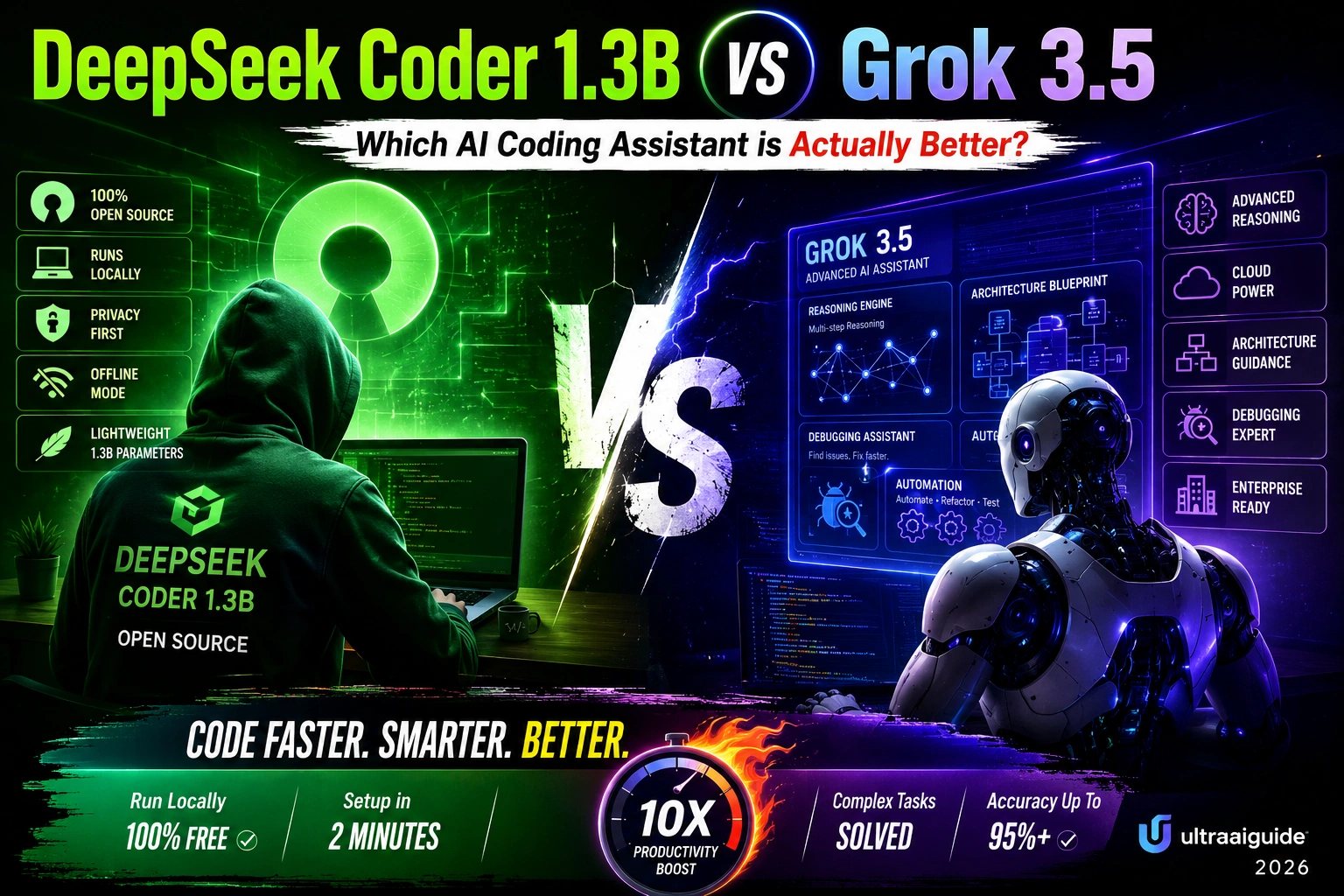
Among the growing number of AI models available today, two names often attract attention from developers searching for coding assistance: DeepSeek Coder 1.3B and Grok 3.5.
At first glance, comparing these models might seem unusual. DeepSeek Coder 1.3B is a compact, open-source coding-focused model designed for local deployment and low-resource environments. Grok 3.5, developed by xAI, represents a much larger cloud-based AI assistant focused on advanced reasoning, conversation, research, and coding support.
This difference is exactly why the comparison matters.
Many developers, startups, students, and businesses want to know whether a lightweight open-source coding model can realistically compete with a frontier AI assistant for real-world programming tasks.
This guide provides a practical, evidence-based comparison covering architecture, coding capabilities, deployment options, privacy considerations, workflow automation, pricing, productivity, and future relevance so you can choose the right tool for your specific needs.
Quick Answer: DeepSeek Coder 1.3B vs Grok 3.5
If you want the short answer:
Choose DeepSeek Coder 1.3B if:
- You need a local deployment
- Privacy is critical
- You prefer open-source software
- You want complete control
- You have a limited budget
Choose Grok 3.5 if:
- You need advanced coding help
- You work on large software projects
- You want stronger reasoning capabilities
- You need architecture guidance
- You value convenience over customization
For most professional software teams, Grok 3.5 offers broader capabilities. For privacy-focused users and local AI enthusiasts, DeepSeek Coder 1.3B remains extremely attractive.
What Is DeepSeek Coder 1.3B?
DeepSeek Coder 1.3B is a specialized coding language model created by DeepSeek AI.
Unlike general-purpose chatbots, DeepSeek Coder was trained specifically for programming-related tasks.
The model focuses on:
- Code generation
- Code completion
- Syntax understanding
- Documentation creation
- Programming education
- Basic debugging
The “1.3B” designation refers to approximately 1.3 Billion parameters, making it significantly smaller than most frontier AI models.
Why Developers Use DeepSeek Coder
The biggest attraction is accessibility.
Developers can:
- Run it locally
- Deploy it on private infrastructure
- Customize workflows
- Avoid recurring subscription costs
- Maintain full data control
This makes DeepSeek especially appealing for organizations with strict security requirements.
What Is Grok 3.5?
Grok 3.5 is an advanced AI model developed by xAI.
Unlike DeepSeek Coder, Grok is not solely a coding model.
Instead, it functions as a broader AI assistant capable of:
- Coding support
- Research assistance
- Technical analysis
- Complex reasoning
- Long-form content generation
- Problem solving
For software developers, Grok acts more like an AI teammate than a simple code generator.
It can help with:
- Debugging
- Refactoring
- Architecture planning
- Framework selection
- Technical documentation
- Engineering discussions
This broader capability is one of its strongest advantages.
Why This Comparison Matters in 2026
The AI landscape has changed dramatically.
Just a few years ago, developers mainly used AI for autocomplete suggestions.
Today, AI assists with:
- Full-stack development
- Software architecture
- Infrastructure planning
- Security reviews
- Testing strategies
- Technical decision-making
As AI becomes more integrated into development workflows, choosing the right model directly affects:
- Productivity
- Security
- Cost
- Development speed
- Team efficiency
The decision is no longer simply about generating code.
It is about selecting the right AI partner for your workflow.
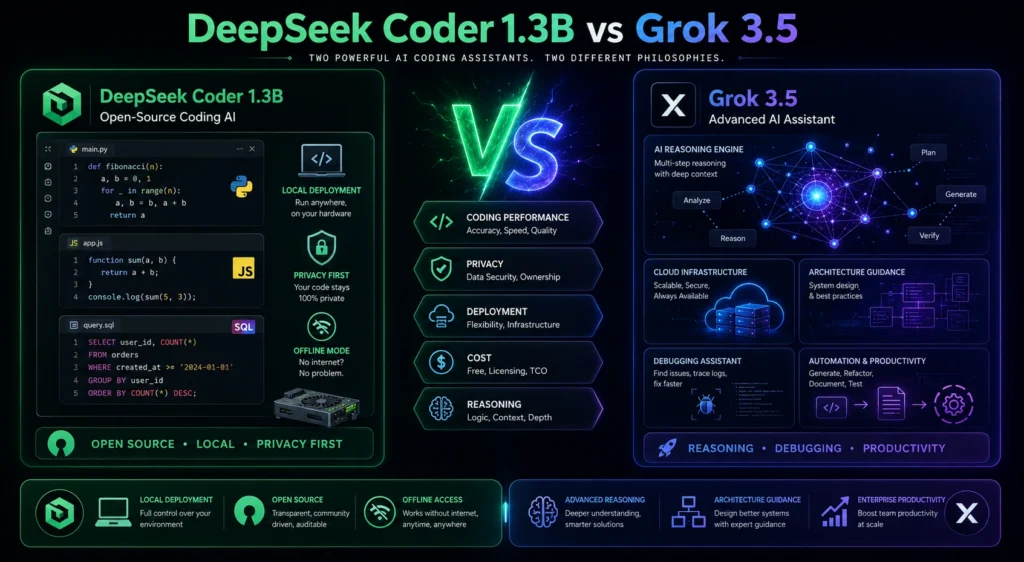
DeepSeek Coder 1.3B vs Grok 3.5: Feature Comparison
| Feature | DeepSeek Coder 1.3B | Grok 3.5 |
| Primary Focus | Coding | General AI + Coding |
| Open Source | Yes | No |
| Local Deployment | Yes | No |
| Offline Access | Yes | No |
| Fine-Tuning | Supported | Not Available |
| Coding Assistance | Strong | Very Strong |
| Advanced Reasoning | Limited | Excellent |
| Multi-Step Problem Solving | Moderate | Excellent |
| Privacy Control | Excellent | Moderate |
| Subscription Required | No | Yes |
| Enterprise Customization | High | Limited |
| Ease of Use | Moderate | High |
Key Takeaway
DeepSeek wins on ownership and flexibility.
Grok wins on intelligence and convenience.
Core AI Technology Behind Each Model
DeepSeek Coder 1.3B Architecture
DeepSeek Coder is built using a transformer-based language model architecture optimized for programming tasks.
Its training emphasizes:
- Source code repositories
- Programming languages
- Technical documentation
- Developer workflows
Because it is relatively small, it can run efficiently on consumer hardware.
Benefits
- Faster deployment
- Lower infrastructure costs
- Lightweight operation
- Easier experimentation
Trade-Offs
- Less contextual understanding
- Reduced reasoning depth
- Lower performance on complex tasks
Grok 3.5 Architecture
Grok 3.5 leverages large-scale AI infrastructure and advanced reasoning techniques.
While exact architectural details may not be publicly disclosed, Grok is designed to perform:
- Deep reasoning
- Multi-step analysis
- Complex coding tasks
- Large-context understanding
This allows it to tackle problems beyond simple code generation.
Benefits
- Better debugging
- Stronger architectural guidance
- More sophisticated explanations
- Improved software engineering assistance
Trade-Offs
- Cloud dependency
- Subscription costs
- Less customization
Coding Performance Comparison
Code Generation
For simple coding tasks such as:
- Utility functions
- Small scripts
- Basic APIs
- Programming exercises
Both models perform reasonably well.
However, when projects become more complex, differences emerge.
DeepSeek Strengths
- Boilerplate code
- Common programming patterns
- Educational examples
Grok Strengths
- Large applications
- Framework-based projects
- Multi-file systems
- Complex engineering tasks
Winner
Grok 3.5
Debugging
Debugging often reveals the true capability of an AI coding assistant.
DeepSeek Coder
Works well for:
- Syntax issues
- Common errors
- Basic troubleshooting
Grok 3.5
Excels at:
- Root cause analysis
- Logic errors
- System-level debugging
- Architectural issues
Winner
Grok 3.5
Code Refactoring
Refactoring requires understanding not only code syntax but also design patterns and maintainability.
DeepSeek
Provides useful cleanup suggestions.
Grok
Provides:
- Architectural improvements
- Performance recommendations
- Scalability insights
- Design pattern guidance
Winner
Grok 3.5
Programming Language Support
Both models support popular programming languages including:
- Python
- JavaScript
- TypeScript
- Java
- C++
- Go
- PHP
- Rust
- SQL
For common development work, language support is not a deciding factor.
The difference lies in reasoning quality rather than language coverage.
Real-World Workflow Examples
Scenario 1: Student Learning Python
Recommended Choice
DeepSeek Coder 1.3B
Why
Students often need:
- Low-cost tools
- Local access
- Educational coding help
DeepSeek provides excellent value in this environment.
Scenario 2: SaaS Startup
Recommended Choice
Grok 3.5
Why
Startups benefit from:
- Faster development
- Better architecture recommendations
- Strong debugging assistance
Time savings often outweigh subscription costs.
Scenario 3: Government or Healthcare Organization
Recommended Choice
DeepSeek Coder 1.3B
Why
Privacy and compliance requirements may prohibit sending sensitive code to external AI services.
Local deployment becomes a major advantage.
Scenario 4: Software Consultant
Recommended Choice
Grok 3.5
Why
Consultants frequently switch between domains and need broader reasoning support.
Grok’s versatility provides a significant advantage.
Productivity and Automation Benefits
Modern developers increasingly use AI for workflow automation.
DeepSeek Can Help Automate
- Code templates
- Documentation drafts
- Repetitive coding tasks
- Internal development tools
Grok Can Help Automate
- Development planning
- Architecture reviews
- Technical research
- Code explanations
- Documentation generation
- Engineering decisions
Productivity Verdict
For broader workflow automation, Grok currently provides more value.
Beginner Setup Guide
Setting Up DeepSeek Coder
Step 1
Install a local AI runtime such as Ollama or LM Studio.
Step 2
Download DeepSeek Coder 1.3B.
Step 3
Load the model locally.
Step 4
Create development prompts.
Step 5
Connect with your preferred IDE if supported.
Getting Started with Grok
Step 1
Create an account.
Step 2
Access Grok through the supported platform.
Step 3
Enter coding requests.
Step 4
Review generated outputs.
Step 5
Integrate suggestions into your workflow.
Pricing and Value Analysis
| Category | DeepSeek Coder 1.3B | Grok 3.5 |
| Model Access | Free | Paid |
| Subscription | None | Required |
| Infrastructure Cost | User Managed | Provider Managed |
| Ownership | Full | Limited |
| Long-Term Cost | Low | Higher |
Value for Different Users
Students
Winner: DeepSeek
Freelancers
Winner: Depends on workload
Agencies
Winner: Grok
Enterprises
Depends on security requirements
Security and Privacy Considerations
Privacy has become one of the most important AI adoption concerns.
DeepSeek Advantages
- Local deployment
- Full control
- Offline operation
- Reduced data exposure
Grok Considerations
Organizations should review:
- Data handling policies
- Compliance requirements
- Internal security policies
Security Best Practices
Never upload:
- API keys
- Passwords
- Customer information
- Proprietary source code
without proper authorization.
Ethical AI Considerations
Regardless of which model you choose, responsible AI usage matters.
Developers should understand that AI can:
- Hallucinate
- Generate insecure code
- Suggest outdated libraries
- Misinterpret requirements
Human review remains essential.
AI should assist developers—not replace critical judgment.
Common Mistakes Users Make
Blindly Trusting Generated Code
Always review outputs before deployment.
Ignoring Security Audits
Run:
- Static analysis
- Security scans
- Dependency checks
Using Generic Prompts
Specific prompts almost always produce better results.
Overlooking Privacy Risks
Organizations should evaluate compliance requirements before using cloud AI platforms.
Expert Tips for Better Results
Use Detailed Prompts
Instead of:
“Build an API.”
Try:
“Build a production-ready REST API using Node.js, Express, PostgreSQL, JWT authentication, validation middleware, and error handling.”
Ask for Trade-Offs
Prompt:
“Explain the scalability advantages and disadvantages of this approach.”
Request Security Reviews
Prompt:
“Identify potential security vulnerabilities in this code.”
These techniques significantly improve output quality.
Pros and Cons
DeepSeek Coder 1.3B
Pros
- Open source
- Free
- Privacy-friendly
- Local deployment
- Customizable
- Lightweight
Cons
- Smaller model
- Less reasoning power
- Weaker complex debugging
Grok 3.5
Pros
- Strong reasoning
- Better debugging
- Broader capabilities
- Better architecture support
Cons
- Paid access
- Cloud dependent
- No local deployment
Best Alternatives to Consider
If neither model perfectly fits your needs, consider:
| Alternative | Best For |
| ChatGPT | General development |
| Claude | Long-context coding |
| GitHub Copilot | IDE integration |
| Gemini | Google ecosystem |
| Codeium | Budget-conscious developers |
| Qwen Coder | Open-source workflows |
Future AI Trends Developers Should Watch
The next generation of AI development tools will likely include:
- Autonomous coding agents
- Automated testing systems
- AI security auditing
- Multi-agent development workflows
- Local-cloud hybrid AI environments
Developers who learn how to collaborate effectively with AI today will be better positioned for future software engineering workflows.
People Also Ask
Not overall. DeepSeek is better for local deployment and privacy, while Grok generally offers stronger reasoning and software engineering assistance.
Yes. Local deployment is one of its biggest advantages.
Yes. Its broader reasoning capabilities make it useful for complex software projects and technical problem-solving.
Many startups benefit from Grok because faster development often outweighs subscription costs.
DeepSeek Coder 1.3B provides greater privacy because it can operate entirely on local infrastructure.
No. AI increases productivity but still requires human oversight, testing, validation, and decision-making.
Final Verdict: DeepSeek Coder 1.3B vs Grok 3.5
The comparison between DeepSeek Coder 1.3B vs Grok 3.5 is less about determining a universal winner and more about identifying the right tool for the right situation.
If your priorities are privacy, ownership, local deployment, and cost efficiency, DeepSeek Coder 1.3B remains one of the most practical open-source coding models available.
If your priorities are advanced reasoning, software architecture guidance, debugging support, and overall development productivity, Grok 3.5 offers a more capable experience.
For most professional software teams, Grok 3.5 will likely deliver greater overall value. For students, researchers, open-source enthusiasts, and privacy-focused organizations, DeepSeek Coder 1.3B remains an excellent choice.
The smartest developers often combine multiple AI tools, using each where it performs best.
As AI-assisted software development continues evolving, staying informed is essential. Explore more expert AI tool comparisons, coding guides, and SaaS insights on UltraAIGuide.com to make smarter technology decisions and future-proof your workflow.