Introduction
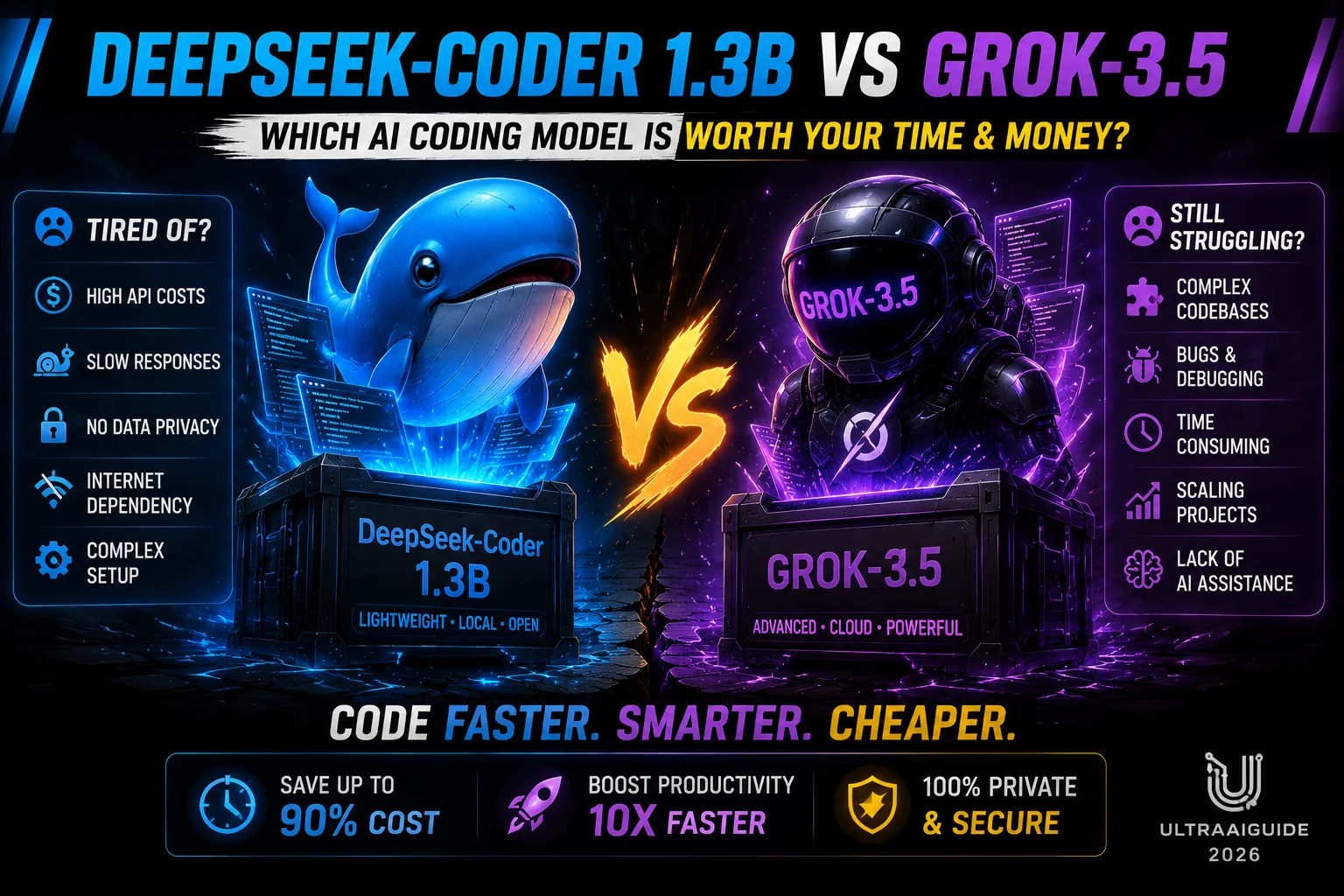
The AI coding landscape has evolved rapidly, giving developers more choices than ever before. Two models attracting attention in 2026 are DeepSeek-Coder 1.3B and Grok-3.5. At first glance, comparing them might seem straightforward, but they actually target very different users and deployment scenarios.
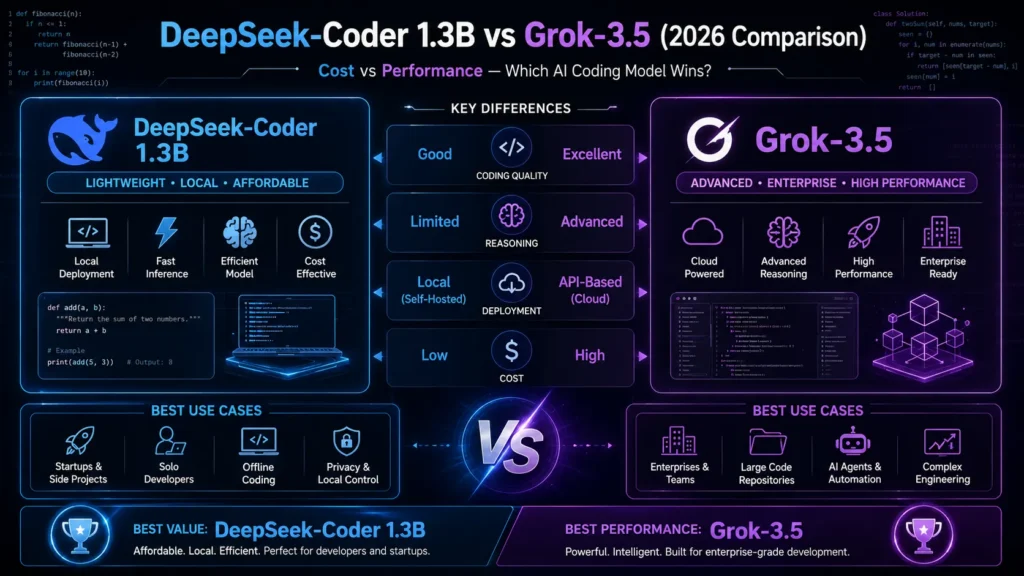
DeepSeek-Coder 1.3B is a lightweight open-source coding model designed for affordability, local deployment, and efficient code generation. Grok-3.5, on the other hand, represents a frontier-scale AI system focused on advanced reasoning, large-context understanding, and enterprise-grade coding assistance.
Many comparison articles focus only on benchmark scores and token pricing. However, real-world developers care about deployment flexibility, infrastructure costs, repository-level understanding, RAG performance, and long-term scalability. These factors often matter far more than a few percentage points on coding benchmarks.
In this detailed comparison, we’ll analyze DeepSeek-Coder 1.3B vs Grok-3.5 across benchmarks, coding capabilities, infrastructure requirements, pricing, retrieval-augmented generation (RAG), business applications, and overall value. By the end, you’ll know exactly which model fits your workflow.
What Is DeepSeek-Coder 1.3B?
DeepSeek-Coder 1.3B is a lightweight code-focused language model trained on large-scale programming datasets. Unlike massive frontier models, it prioritizes efficiency and affordability while still delivering strong coding performance relative to its size.
Key Features
- Open-weight deployment
- Lightweight infrastructure requirements
- Fast code completion
- Local execution support
- IDE integration compatibility
- Cost-efficient experimentation
Advantages
- Extremely affordable
- Can run on consumer hardware
- No vendor lock-in
- Privacy-friendly deployment
Limitations
- Limited reasoning abilities
- Smaller context handling
- Less effective on complex multi-step tasks
- Reduced repository-wide understanding
What Is Grok-3.5?
Grok-3.5 is a next-generation frontier AI model built for advanced reasoning, software development, long-context understanding, and agent-based workflows.
Unlike lightweight coding models, Grok-3.5 aims to function as a full software engineering assistant capable of planning, debugging, researching, and executing complex tasks across large codebases.
Key Features
- Advanced reasoning capabilities
- Large context windows
- Multi-step problem solving
- Agent workflow support
- Enterprise integrations
- Strong repository-level understanding
Advantages
- Excellent coding quality
- Superior debugging
- Better architectural reasoning
- Stronger RAG performance
Limitations
- Higher operating costs
- Closed ecosystem
- API dependency
- Less deployment flexibility
DeepSeek-Coder 1.3B VS Grok-3.5: Quick Comparison Table
| Category | DeepSeek-Coder 1.3B | Grok-3.5 |
| Model Type | Open Coding Model | Frontier AI Model |
| Deployment | Self-Hosted | API-Based |
| Coding Quality | Good | Excellent |
| Reasoning | Limited | Advanced |
| Context Window | 16K | Much Larger |
| Local Deployment | Yes | No |
| Infrastructure Cost | Very Low | Medium to High |
| RAG Performance | Moderate | Strong |
| Agent Workflows | Limited | Excellent |
| Enterprise Readiness | Moderate | High |
| Vendor Lock-In | No | Yes |
| Best For | Local Coding | Production Engineering |
DeepSeek-Coder 1.3B VS Grok-3.5 Benchmarks
One of the biggest mistakes many comparison articles make is treating benchmark scores as the ultimate measure of usefulness.
Benchmarks provide useful signals, but real-world performance depends heavily on workflow requirements.
Coding Benchmarks
DeepSeek-Coder 1.3B performs surprisingly well considering its small parameter count. It can generate functions, autocomplete code, and handle common programming tasks effectively.
However, Grok-3.5 consistently demonstrates stronger performance on:
- Complex debugging
- Software architecture
- Multi-step coding tasks
- Repository reasoning
- Agent workflows
Winner: Grok-3.5
For overall coding intelligence and engineering workflows, Grok-3.5 holds a clear advantage.
Coding Performance Comparison
Single-File Development
Many developers work on individual files, scripts, and isolated coding tasks.
DeepSeek-Coder 1.3B performs exceptionally well in this environment because:
- Low latency
- Fast completions
- Lightweight inference
- Minimal infrastructure costs
Best Use Cases
- Python scripts
- Web snippets
- Function generation
- Autocomplete tasks
- Educational projects
Winner: DeepSeek-Coder 1.3B
Multi-File Repository Development
Modern software projects often span hundreds or thousands of files.
In these situations, understanding relationships between files becomes critical.
Grok-3.5 excels because it can:
- Analyze larger contexts
- Understand dependencies
- Debug across repositories
- Maintain project-wide awareness
Winner: Grok-3.5
Context Window Comparison
Context windows determine how much information a model can process simultaneously.
DeepSeek-Coder 1.3B
Benefits:
- Efficient context management
- Lower inference cost
- Fast processing
Challenges:
- Limited repository awareness
- Reduced large-project visibility
Grok-3.5
Benefits:
- Better long-context reasoning
- Larger repository understanding
- Strong document processing
Challenges:
- Higher operational costs
Winner: Grok-3.5
Pricing and Total Cost of Ownership
Most comparison articles ignore Total Cost of Ownership, which often matters more than benchmark scores.
DeepSeek-Coder 1.3B Cost Analysis
Potential cost advantages include:
- Local hosting
- No recurring API fees
- Low GPU requirements
- Predictable scaling
For startups and solo developers, these savings can become substantial over time.
Grok-3.5 Cost Analysis
While more expensive, Grok-3.5 offers:
- Better productivity
- Faster problem-solving
- Reduced engineering effort
- Higher-quality outputs
Large teams often justify higher costs through increased efficiency.
TCO Comparison Table
| Factor | DeepSeek-Coder 1.3B | Grok-3.5 |
| API Cost | Low | High |
| Hosting Cost | Low | Managed |
| Maintenance | Moderate | Low |
| Scaling Cost | Predictable | Variable |
| Team Productivity | Good | Excellent |
| Enterprise ROI | Moderate | High |
Best Value Winner: DeepSeek-Coder 1.3B
Productivity Winner: Grok-3.5
RAG Comparison
RAG systems have become essential for modern AI coding assistants.
DeepSeek-Coder 1.3B
Works well when:
- Repositories are small
- Retrieval quality is high
- Context remains controlled
Challenges arise with:
- Large codebases
- Complex dependency graphs
- Multi-project retrieval
Grok-3.5
Performs better in:
- Enterprise knowledge bases
- Large repositories
- Multi-document retrieval
- Cross-file reasoning
Winner: Grok-3.5
Infrastructure Requirements
DeepSeek-Coder 1.3B
Ideal for:
- Solo developers
- Startups
- Edge deployments
- Offline environments
Typical deployment options:
- Ollama
- Local GPUs
- Consumer hardware
- Private servers
Grok-3.5
Ideal for:
- Enterprises
- SaaS platforms
- Cloud-native applications
- Large engineering teams
Requirements:
- API integration
- Monitoring systems
- Cost management
- Production observability
Winner: Depends on Use Case
Real-World Use Cases
Use DeepSeek-Coder 1.3B If You:
Want local deployment
Need offline coding assistance
Have budget constraints
Require privacy-focused workflows
Build embedded applications
Use Grok-3.5 If You:
Manage large repositories
Need advanced reasoning
Build AI agents
Require enterprise scalability
Need repository-level understanding
Pros and Cons
DeepSeek-Coder 1.3B Pros
- Open-source deployment
- Extremely affordable
- Fast inference
- Local execution
- No vendor lock-in
DeepSeek-Coder 1.3B Cons
- Limited reasoning
- Smaller context window
- Weak multi-agent workflows
- Less capable on large projects
Grok-3.5 Pros
- Advanced reasoning
- Better debugging
- Strong RAG performance
- Enterprise-ready
- Excellent coding assistance
Grok-3.5 Cons
- Higher cost
- Closed ecosystem
- API dependency
- Limited deployment flexibility
How to Use These AI Coding Models Effectively
To maximize value from either model:
- Define clear coding objectives.
- Use structured prompts.
- Implement RAG for repository awareness.
- Validate generated code before deployment.
- Monitor costs and usage patterns.
- Combine AI with traditional testing practices.
For European businesses handling sensitive data, local deployment with DeepSeek-Coder may help satisfy privacy requirements. Larger organizations requiring advanced reasoning may benefit more from Grok-3.5 despite higher operating costs.
Tips for Choosing the Right AI Coding Model
Choose DeepSeek-Coder 1.3B When
- Cost is your priority.
- Local deployment is required.
- Privacy matters.
- Infrastructure budgets are limited.
Choose Grok-3.5 When
- Productivity matters most.
- Teams handle large repositories.
- Advanced reasoning is required.
- Enterprise scaling is important.
People Also Ask
A: Not overall. DeepSeek-Coder 1.3B is better for low-cost local deployment, while Grok-3.5 offers stronger reasoning and coding performance.
A: Yes. One of its biggest advantages is the ability to run on local hardware without relying on external APIs.
A: Grok-3.5 is generally better suited for enterprise environments due to stronger reasoning, larger context handling, and advanced workflow support.
A: DeepSeek-Coder 1.3B is significantly cheaper because it can be self-hosted and does not require expensive API usage.
A: For large repositories and enterprise RAG systems, Grok-3.5 generally performs better due to stronger context management and reasoning capabilities.
Conclusion
DeepSeek-Coder 1.3B vs Grok-3.5 proves that choosing an AI model in 2026 is no longer about selecting the biggest model or chasing benchmark numbers.
If your priority is affordability, local deployment, fast inference, and lightweight coding workflows, DeepSeek-Coder 1.3B offers impressive value. It is especially attractive for solo developers, startups, internal tools, offline environments, and teams that want greater deployment control without high operating costs.
On the other hand, if your goal is production-grade software development, advanced reasoning, larger context handling, repository-level understanding, and AI agent workflows, Grok-3.5 delivers a more capable experience for complex engineering environments.