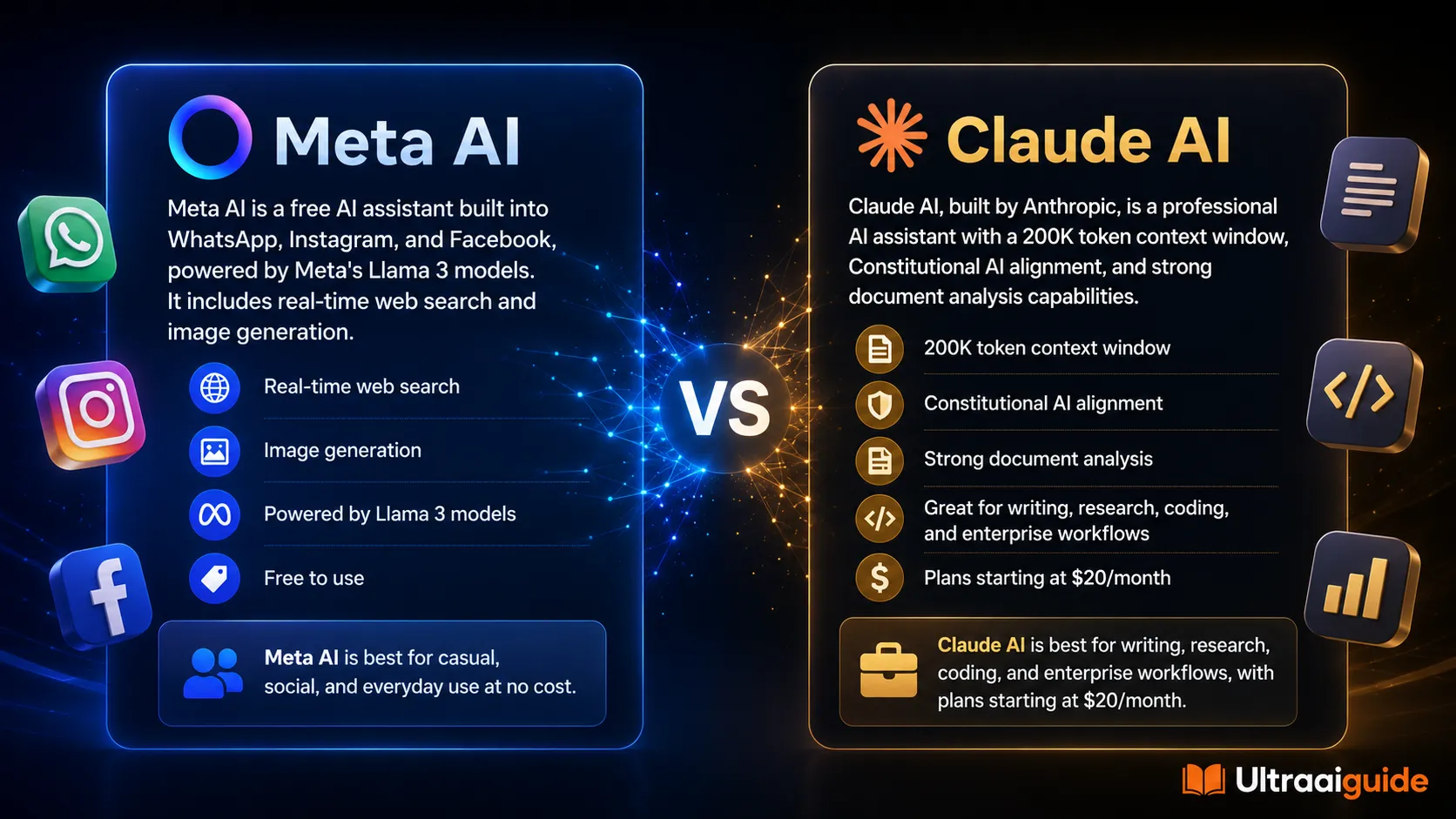
Which AI Assistant Actually Wins?
Every week, millions of people switch AI tools — not because the one they were using stopped working, but because they’re not sure it’s the right one. If you’ve been going back and forth between Meta AI and Claude AI, you’re not alone.
Meta AI is everywhere. It’s built into WhatsApp, Instagram, Facebook, and even Ray-Ban smart glasses. It’s free, fast, and effortless. Claude AI, on the other hand, is built by Anthropic — one of the most safety-focused AI research companies in the world — and it’s beloved by writers, researchers, developers, and businesses for its depth, nuance, and impressive document analysis.
But here’s the problem: most comparisons just list features side by side without helping you figure out which AI actually fits your life or business. This guide goes further. We’ll cover how each AI is built, what it genuinely excels at, where it falls short, real-world use cases, pricing, privacy, and — most importantly — a clear recommendation based on your specific needs.
Quick Answer: Meta AI wins for casual, social, and free everyday use. Claude AI wins for professional writing, research, coding, and complex business workflows. Keep reading to find the perfect fit for you.
1. What Is Meta AI?
Meta AI is Meta’s flagship artificial intelligence assistant, launched broadly in 2023 and significantly expanded through 2025 and 2026. It’s powered by Meta’s own Llama 3 family of large language models — open-weight models that Meta also releases publicly for researchers and developers.
Unlike most AI assistants, Meta AI isn’t just a standalone app. It’s deeply embedded across Meta’s entire product ecosystem:
WhatsApp (chat assistant and group help)
Instagram (captions, DMs, creative suggestions)
Facebook (post ideas, comments, search)
Messenger (conversational assistant)
Ray-Ban Meta smart glasses (voice-activated AI)
Meta.ai web portal (standalone chat interface)
This ecosystem integration is Meta AI’s biggest competitive advantage. You don’t need to download anything new — it’s already where you are.
Key Point: Meta AI’s strength is accessibility. If your audience lives on Meta platforms, Meta AI meets them there with zero friction.
2. What Is Claude AI?
So Claude AI is an AI assistant developed by Anthropic, an AI safety company co-founded in 2021 by former members of OpenAI — including Dario Amodei and Daniela Amodei. Claude is named intentionally; the team wanted an approachable, human name that reflected their vision of AI as a thoughtful collaborator, not just a tool.
It Claude is built on Anthropic’s Constitutional AI (CAI) framework — a unique approach to alignment that trains the model to follow a set of principles rather than relying solely on human feedback. This makes Claude notably more consistent, less prone to manipulation, and more trustworthy for sensitive business applications.
Available through Claude.ai (web and mobile), Claude Pro ($20/month), Team, and Enterprise plans, as well as the Anthropic API, Claude is primarily positioned as a professional AI assistant for knowledge work.
Claude 3.5 Sonnet and Claude 3 Opus — state-of-the-art reasoning models
Claude 4 family — Anthropic’s latest generation (as of 2026)
200,000 token context window — process entire books, legal documents, codebases
Claude Code — a dedicated agentic coding tool
Available as a Chrome extension, Excel add-in, and PowerPoint integration
Key Point: Claude AI is built for depth. If your work involves long documents, complex reasoning, or sensitive data, Claude is the professional-grade choice.
3. Core AI Technology: How Each Model Is Built
Meta AI — Powered by Llama 3
Meta’s Llama 3 (and its variants) are trained using Reinforcement Learning from Human Feedback (RLHF) combined with Supervised Fine-Tuning (SFT). The models are open-weight, meaning Meta has released model weights publicly — a deliberate strategy to foster community development, third-party integration, and competitive pressure on closed competitors.
Llama 3 models range from 8B to 70B+ parameters, with larger variants powering the Meta AI consumer experience. The models support multimodal inputs (text and image) and have been fine-tuned extensively for conversational assistant tasks.
Claude AI — Powered by Constitutional AI
Anthropic’s Claude models are trained using a proprietary method called Constitutional AI (CAI). Instead of relying purely on human raters to shape behavior, CAI uses a written set of principles — a ‘constitution’ — to guide the model’s self-critique and revision during training.
This produces a model that is:
More consistent in following instructions across varied contexts
Resistant to jailbreaking and adversarial prompts
More transparent about its limitations and uncertainties
Better calibrated for sensitive professional and business contexts
Claude 3.5 Sonnet, widely regarded as one of the top models in the industry, set benchmarks in coding (HumanEval), reasoning (MMLU), and long-document comprehension. Claude 4 models, available in 2026, extend these capabilities further.
Tech Insight: CAI vs RLHF isn’t just a technical difference — it translates to real-world behavioral differences. Claude is less likely to tell you what you want to hear and more likely to give you what you actually need.
4. Full Feature Comparison: Meta AI vs Claude AI
Here’s a comprehensive side-by-side comparison of both AI assistants across the dimensions that matter most to real users and businesses:
| Feature / Aspect | Meta AI | Claude AI |
| Developer | Meta (Facebook) | Anthropic |
| Underlying Model | Llama 3 family | Claude 3.5 / Claude 4 family |
| Primary Access | WhatsApp, Instagram, Facebook, Messenger, Ray-Ban glasses | Claude.ai, API, Claude Pro/Team/Enterprise |
| Free Tier | Yes (fully free) | Yes (limited messages/day) |
| Paid Plan | No standalone paid plan | Claude Pro ($20/mo), Team, Enterprise |
| Context Window | ~128K tokens | 200K tokens (Claude 3.5+) |
| Internet Search | Yes (real-time web search built-in) | Yes (claude.ai with search tool) |
| Image Generation | Yes (Meta AI image tools integrated) | No native image gen |
| File & Doc Analysis | Limited | Strong (PDFs, CSVs, code files, 200K context) |
| Coding Assistance | Good | Excellent (Claude Code, agentic coding) |
| API Access | Via together.ai / Meta Llama API | Anthropic API (paid, tiered) |
| Privacy / Data Policy | Integrated with Meta social data | Privacy-focused; no training on free-tier chats by default |
| Safety & Alignment | Standard RLHF guardrails | Constitutional AI (CAI), strong alignment focus |
| Multilingual Support | Strong (40+ languages) | Strong (major global languages) |
| Best For | Social/casual AI, image gen, accessibility | Professional writing, research, code, long docs |
5. Pricing Plans & Value Analysis
One of the most important factors in any AI tool comparison is cost. Here’s how Meta AI and Claude AI stack up on pricing:
| Plan | Meta AI | Claude AI | Best For |
| Free | Fully free, unlimited via Meta apps | Free tier, daily message limits apply | Casual & beginner users |
| Pro / Paid | No paid tier (as of 2026) | $20/month (Claude Pro) | Power users, researchers, writers |
| Team | N/A | $25/user/month | Small businesses, agencies |
| Enterprise | Meta Business Suite only | Custom pricing, SSO, admin controls | Large orgs, compliance-heavy industries |
| API | Llama API / Together.ai (tiered) | Anthropic API (pay-per-token) | Developers, SaaS builders |
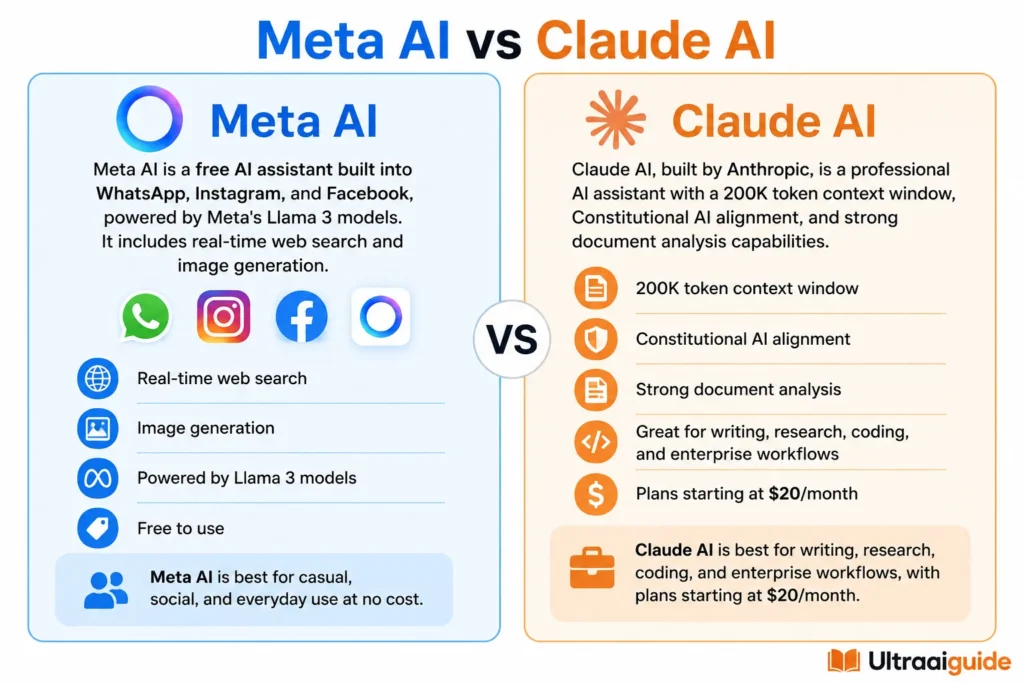
private, powerful, and built for serious work. This infographic breaks
down the 7 biggest differences — so you stop guessing and start choosing
smarter. Full comparison at UltraAIGuide.com
Meta AI Pricing Breakdown
Meta AI is entirely free across all its platforms as of 2026. There’s no paid tier, no usage cap advertised for standard users, and no API in the traditional sense (though Llama models can be accessed via Meta’s Llama API or partners like Together.ai and Hugging Face). This makes Meta AI the most accessible AI assistant available for consumer use.
The trade-off? Meta’s business model is advertising. Your interactions with Meta AI may inform product development and ad targeting, though Meta states it does not use personal WhatsApp messages for ad targeting.
Claude AI Pricing Breakdown
Claude’s free tier on Claude.ai gives you access to Claude with daily message limits. Claude Pro at $20/month unlocks priority access, higher usage limits, and early access to new features. Team plans at $25/user/month add collaboration features, centralized billing, and usage analytics. Enterprise plans are custom-priced and include SSO, advanced admin controls, and compliance features suitable for regulated industries.
For API users, Anthropic charges per token — pricing varies by model, with Claude Haiku being the most affordable and Claude Opus being the most capable (and expensive). This makes Claude highly scalable for businesses that need to control costs.
Value Tip: If you’re a professional who needs daily AI assistance for writing, research, or coding, Claude Pro at $20/month is one of the best value AI subscriptions available. If you just need occasional casual help, Meta AI’s free tier is unbeatable.
6. Best Use Cases: When to Use Meta AI vs Claude AI
| Use Case | Best Tool | Why |
| Long-form content & research | Claude AI | 200K context, nuanced writing, deep reasoning |
| Quick social media replies | Meta AI | Embedded in WhatsApp/Instagram — zero friction |
| Coding & debugging | Claude AI | Claude Code, agentic tasks, strong code comprehension |
| Image generation | Meta AI | Native image gen integrated in Meta ecosystem |
| Customer support bots | Claude AI | API depth, long context, safety guardrails |
| Casual Q&A & everyday help | Meta AI | Free, instant, no setup required |
| Legal / medical document review | Claude AI | Longer context, lower hallucination rate, privacy controls |
| Marketing copy (quick drafts) | Either | Both capable; Claude for nuance, Meta for speed |
| Academic research & analysis | Claude AI | Deep reasoning, citation awareness, long doc processing |
| Multilingual chat for families | Meta AI | WhatsApp-native, 40+ languages, accessible globally |
Real-World Workflow Examples
Workflow 1: Content Marketing Agency
A digital marketing agency uses Claude AI for:
1. Uploading full client briefs (PDFs) and asking Claude to identify content gaps
2. Drafting 2,000-word SEO articles with structured H2/H3 frameworks
3. Reviewing competitor content pasted directly into Claude’s context
4. Generating meta descriptions, title tags, and schema markup suggestions
They use Meta AI for:
5. Quick Instagram caption brainstorming directly from the app
6. WhatsApp group queries for fast on-the-go answers
Workflow 2: Freelance Developer
A freelance developer relies on Claude Code for:
7. Reviewing entire GitHub repositories and suggesting refactors
8. Writing unit tests with full function context
9. Debugging complex async issues that require reading 50+ files at once
10. Generating boilerplate for new API integrations
They use Meta AI for personal use: quick how-to questions, recipe ideas, and social content — never for code.
Workflow 3: Student & Researcher
A PhD student uploads 200-page research papers to Claude and asks it to:
11. Identify methodology gaps and suggest counterarguments
12. Summarize dense statistical findings in plain language
13. Compare findings across three papers simultaneously
14. Draft literature review sections with accurate citations flagged for review
7. How to Get Started: Beginner Setup Guide
Getting Started with Meta AI
15. Open WhatsApp, Instagram, Facebook, or Messenger on your phone
16. Look for the Meta AI icon (blue circle) in the search bar or chat menu
17. Tap it to open the AI chat interface
18. Type your question naturally — Meta AI responds immediately
19. For image generation, type ‘imagine [your description]’ and Meta AI will create an image
20. Visit meta.ai for the web-based standalone interface
No account creation needed beyond your existing Meta account. No downloads, no setup.
Getting Started with Claude AI
21. Visit claude.ai and click ‘Sign up’ — use your email or Google account
22. The free tier gives you access to Claude Sonnet with daily message limits
23. Start a new conversation and type your first prompt
24. To upload a file (PDF, Word doc, code file), click the paperclip icon and select your file
25. For Pro features, go to Settings > Upgrade to Claude Pro
26. For API access, visit console.anthropic.com to create an API key
Claude’s interface is clean and minimal. The learning curve is almost zero for basic use, but its full power emerges as you learn to write better prompts.
Pro Tip: Claude responds remarkably well to explicit structure in your prompts. Instead of ‘Write me a blog post’, try: ‘Write a 1,500-word SEO article on [topic] with H2 headings, a clear intro, and a CTA at the end.’ The difference in output quality is dramatic.
8. Pros & Cons: Honest Assessment
Meta AI — Pros
100% free with no usage caps for standard users
Embedded in the world’s most-used social apps — zero friction
Real-time web search is built in by default
Native image generation (Imagine feature)
Voice-activated via Ray-Ban Meta glasses
Multi-platform presence: web, mobile, desktop, wearables
Open-weight Llama models available for developers
Meta AI — Cons
Privacy concerns: tied to Meta’s ad-based data ecosystem
No dedicated paid tier for power users or professionals
Limited document analysis compared to Claude
Shorter context window than Claude (128K vs 200K)
Less suited for complex, multi-step professional reasoning tasks
No fine-tuning or enterprise controls for business deployments
Output quality inconsistent on nuanced writing tasks
Claude AI — Pros
Industry-leading 200K context window — process entire books
Constitutional AI alignment — safer, more consistent, less manipulable
Exceptional for long-form writing, research, and analysis
Claude Code enables advanced agentic coding workflows
Strong API with broad model selection (Haiku, Sonnet, Opus)
Privacy-focused: no training on conversations by default
Enterprise-ready with SSO, admin controls, and compliance features
Integrates with Chrome, Excel, and PowerPoint
Claude AI — Cons
Free tier has daily message limits — can feel restrictive
No native image generation
API costs add up at scale without careful management
Less accessible for non-technical users who want a plug-and-play experience
No built-in social media platform integration
9. Expert Prompt Engineering Tips
Prompting Meta AI Effectively
Be direct and conversational: Meta AI excels with natural, conversational prompts. ‘Help me write a fun birthday caption for Instagram’ works better than overly structured requests.
Use ‘Imagine’ for images: The trigger word ‘imagine’ followed by a description generates images. Be specific: ‘Imagine a cozy coffee shop in Paris on a rainy morning, warm lighting, photorealistic.’
Specify your platform: ‘Write a tweet’ vs ‘write an Instagram caption’ will get you appropriately formatted outputs.
Prompting Claude AI Effectively
Use role assignment: Start with ‘Act as a [role]’ — e.g., ‘Act as a senior UX designer and critique my landing page copy.’
Leverage the context window: Paste entire documents, code files, or research papers. Claude can reason across massive inputs that other models truncate.
Request structured outputs: Ask Claude to respond in JSON, markdown tables, numbered lists, or XML for easy integration into your workflow.
Iterate in conversation: Claude maintains exceptional context across long conversations. Build on previous responses rather than starting fresh each time.
Use negative constraints: ‘Write this without buzzwords, avoid passive voice, and keep sentences under 20 words’ dramatically improves output quality.
10. Security, Privacy & Ethical AI Considerations
Meta AI: Privacy Landscape
Meta’s business model is built on advertising revenue, and while Meta states it doesn’t use private WhatsApp messages for ads, your interactions with Meta AI across Instagram and Facebook may contribute to profile data. Meta AI operates within Meta’s broader data infrastructure, which has a complex history with regulators, including significant GDPR fines in the EU.
For European users (Germany, France, Netherlands, Sweden, etc.), it’s worth checking the current regulatory status of Meta AI data practices in your country, as this continues to evolve.
For businesses handling sensitive client data, customer information, or proprietary IP: exercise caution before inputting confidential information into Meta AI.
Claude AI: Privacy-First Architecture
Anthropic takes a notably different approach. Claude.ai does not use your conversations to train its models by default (free-tier users can opt in; paid-tier users are opted out by default). Enterprise plans include additional data handling agreements suitable for regulated industries.
Anthropic’s Constitutional AI framework also means Claude has been explicitly trained to refuse requests that could cause harm, maintain user privacy, and be transparent about its limitations — including admitting uncertainty rather than fabricating information.
AI Hallucinations: What to Watch For
Both Meta AI and Claude AI can hallucinate, generating plausible-sounding but factually incorrect information. However, the nature of their errors differs:
Meta AI with real-time web search is less likely to hallucinate on recent facts,b ut may still misattribute sources
Claude is more likely to say ‘I’m not certain’ rather than confidently fabricating — a meaningful behavioral difference for professional use.
Neither AI should be your sole source for medical, legal, or financial decisions.s
Safety Rule: Always treat AI outputs as first drafts that require human review, especially for facts, statistics, legal claims, and medical information. Build a ‘human in the loop’ into any AI-powered workflow.
Ethical AI & Copyright Awareness
Content generated by AI tools exists in a legally evolving grey zone regarding copyright. As of 2026, AI-generated content is generally not automatically copyrightable in most jurisdictions, and using AI to reproduce substantial portions of copyrighted material is a legal risk.
Use AI for drafting and ideation, not wholesale reproduction of existing works
Disclose AI assistance in content that requires transparency (academic, journalistic)
Review Anthropic’s and Meta’s terms of service regarding the commercial use of generated content
11. Common Mistakes Users Make
With Meta AI
Treating it as a search engine for critical research — its real-time search can miss context and nuance.
Over-relying on AI-generated image prompts without checking for brand consistency
Sharing sensitive business or personal data in Meta app chats
Not verifying factual claims before sharing on social media
With Claude AI
Writing vague, undirected prompts and blaming the AI for generic outputs
Ignoring Claude’s uncertainty signals — when Claude says it’s not sure, take that seriously
Not using the file upload feature — this is where Claude really shines
Hitting free-tier message limits and not upgrading when AI is genuinely transforming their work
Using Claude for tasks that need real-time data without enabling the search tool
12. Future AI Trends & Predictions (2026 and Beyond)
Meta AI’s Trajectory
Meta is investing aggressively in AI hardware (custom silicon), multimodal AI (understanding images, audio, and video simultaneously), and AR/VR AI integration via Ray-Ban glasses and future Meta Quest headsets. Expect Meta AI to become increasingly ambient — present in your environment, not just your phone.
The open-weight Llama strategy is also a long-term play: by giving developers free access to powerful models, Meta builds a massive ecosystem that generates data, developer goodwill, and competitive moats against closed competitors.
Claude AI’s Trajectory
Anthropic is racing toward AGI while maintaining its safety-first culture — a genuinely difficult balance. Claude’s trajectory in 2026 and beyond includes:
Deeper agentic capabilities — AI that can autonomously plan, execute, and iterate on complex multi-step tasks
Expanded tool use — web browsing, code execution, API calls, and computer use
Multimodal expansion — native image and potentially video understanding
Enterprise AI automation — full workflow automation for knowledge workers
Anthropic’s partnership with Google (a major investor) and its API-first business model position Claude as the backbone AI for a wide range of business applications.
Prediction: By 2027, the distinction between ‘AI assistant’ and ‘AI employee’ will blur. Claude is better positioned for that enterprise-grade evolution; Meta AI is better positioned to dominate consumer-facing, ambient AI.
13. People Also Ask: Your Real Questions Answered
Neither is universally better — they’re built for different purposes. Meta AI is better for casual, social, and everyday use (it’s free and embedded in apps you already use). Claude AI is better for professional tasks: long-form writing, research, coding, and document analysis. Your ‘best’ choice depends entirely on your use case.
Yes, Claude has a free tier on Claude.ai with daily message limits. For unlimited access and priority features, Claude Pro costs $20/month. Enterprise and Team plans are also available for organizations.
Yes. Meta AI includes an image generation feature called ‘Imagine.’ Type ‘imagine [your description]’ in WhatsApp, Instagram, or on meta.ai, nd Meta AI will generate an image. Claude AI does not have native image generation.
Claude AI has stronger privacy protections for business use. Anthropic does not train on your conversations by default, and enterprise plans include data processing agreements. Meta AI is tied to Meta’s advertising ecosystem, which raises valid privacy concerns for sensitive business data.
Yes, Claude is available as a mobile app for iOS and Android in addition to the web interface at claude.ai. Meta AI is accessible within existing Meta apps (WhatsApp, Instagram, Facebook, Messenger) — there’s no standalone Meta AI app required.
Yes, Claude AI is excellent for coding, testing, debugging, and handling complex programming tasks.
14. Best Alternatives to Consider
If you’re not fully sold on either Meta AI or Claude AI, here are the top alternatives worth exploring in 2026:
• ChatGPT (OpenAI): The market leader. GPT-4o and o1 models excel at a wide range of tasks. Strong plugin ecosystem and image generation (DALL-E). Best overall all-rounder.
• Google Gemini: Deep Google ecosystem integration (Gmail, Docs, Drive). Excellent for Google Workspace users. Strong multimodal capabilities.
• Microsoft Copilot: Best for Microsoft 365 users. Deeply embedded in Word, Excel, Outlook, and Teams. Powered by OpenAI models.
• Perplexity AI: The best AI search tool. Not a chatbot in the traditional sense — it’s purpose-built for research with real-time citations.
• Mistral AI: A European-developed open-weight alternative with strong privacy credentials — particularly relevant for EU businesses.
Conclusion: Which AI Should You Choose?
After this deep dive, here’s the clear verdict:
• Choose Meta AI if: You want a completely free AI assistant that works inside the apps you already use daily (WhatsApp, Instagram, Facebook). You need image generation, quick answers, and casual conversation without any setup or subscription.
• Choose Claude AI if: You’re a professional who relies on AI for writing, research, coding, document analysis, or business automation. You need a trustworthy, privacy-respecting AI with the context capacity to handle serious workloads.
• Use both if: Use Meta AI for quick, social, and casual tasks throughout the day. Use Claude AI for deep work sessions where quality, depth, and accuracy matter.
The AI landscape in 2026 isn’t winner-take-all. The smartest users are building AI stacks — combining tools for different jobs the same way they combine apps. Meta AI and Claude AI can absolutely coexist in your toolkit.
Bookmark this guide and share it with your team. For more expert AI comparisons, tool breakdowns, and workflow guides, explore UltraAIGuide.com — your trusted source for premium AI knowledge.