Introduction
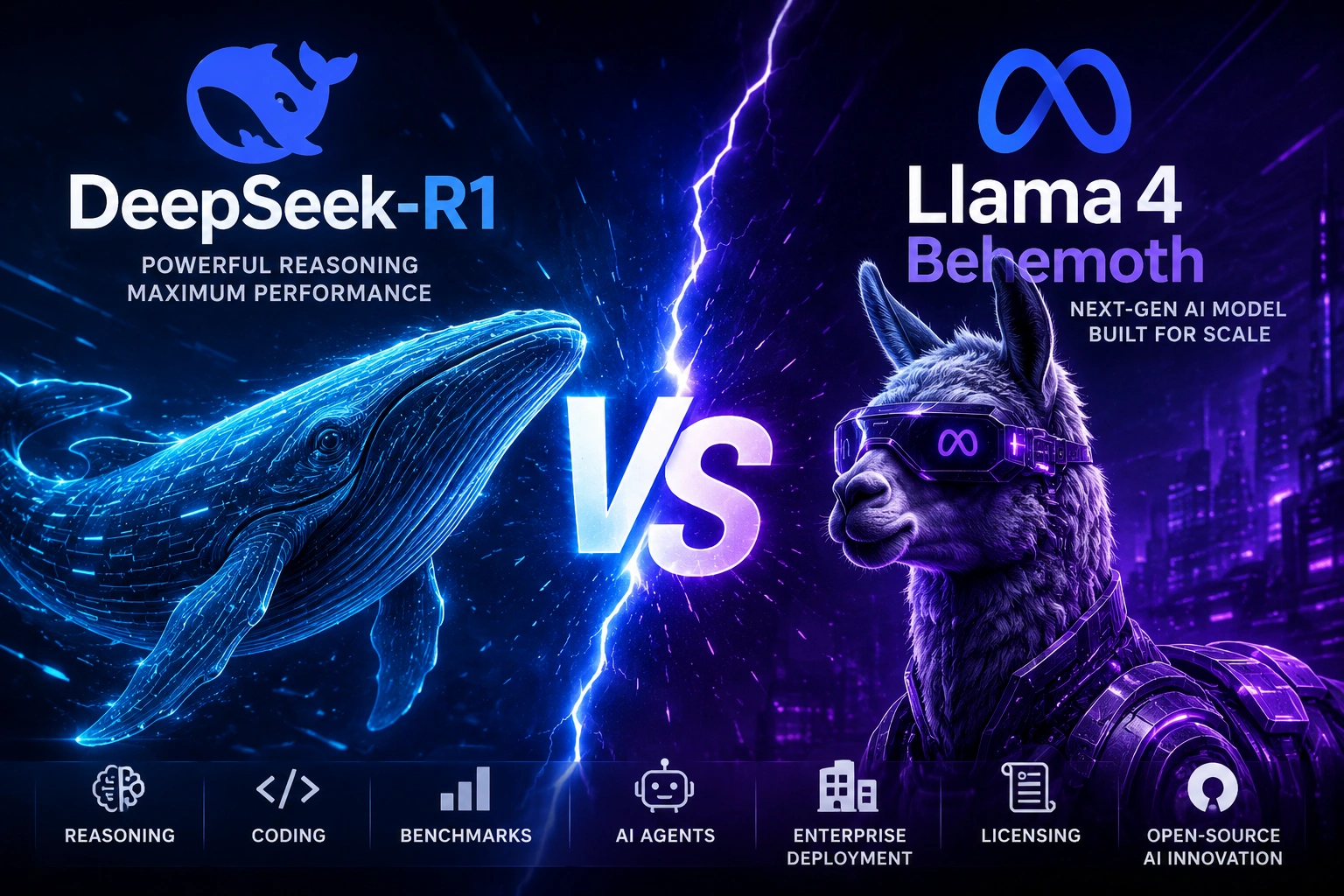
Artificial intelligence is evolving faster than ever. What was once dominated by closed proprietary systems is now becoming a fierce competition between advanced open-source and open-weight AI models. In 2026, two names consistently appear in discussions among developers, researchers, startups, and enterprise technology leaders: DeepSeek-R1 and Llama 4 Behemoth.
Both models represent different philosophies in AI development. DeepSeek-R1 focuses heavily on advanced reasoning, structured thinking, mathematics, and problem-solving. Llama 4 Behemoth, meanwhile, aims to demonstrate what large-scale Mixture-of-Experts (MoE) systems can achieve through massive model capacity, multimodal intelligence, and enterprise-grade scalability.
The question many organizations ask is simple: Which model is better?
The answer depends on your priorities. Some teams need exceptional reasoning and research capabilities. Others need enterprise deployment, multimodal workflows, and ecosystem maturity. This comprehensive comparison explores architecture, benchmarks, coding performance, AI agents, deployment economics, licensing, security, and future potential.
By the end of this guide, you’ll understand exactly which model best fits your business, research, or development goals.
What Is DeepSeek-R1?
DeepSeek-R1 is a reasoning-focused AI model developed by DeepSeek AI.
Unlike many language models optimized primarily for conversational responses, DeepSeek-R1 was designed to improve multi-step reasoning. Through reinforcement-learning-based optimization and advanced reasoning techniques, it became known for solving complex mathematical, scientific, and analytical problems.
Key Features of DeepSeek-R1
- Advanced reasoning capabilities
- Strong mathematical problem-solving
- High coding performance
- Open-weight availability
- Research-friendly ecosystem
- Cost-efficient deployment options
- Competitive benchmark performance
Many developers compare DeepSeek-R1 to specialized reasoning systems because of its ability to break difficult tasks into logical steps before generating answers.
What Is Llama 4 Behemoth?
Llama 4 Behemoth represents Meta’s large-scale AI research vision.
The model is designed around a Mixture-of-Experts architecture that selectively activates portions of the network rather than using every parameter for every request.
This approach allows extremely large model capacity while improving computational efficiency.
Key Features of Llama 4 Behemoth
- Massive parameter scale
- Sparse MoE architecture
- Enterprise-oriented design
- Strong multimodal capabilities
- Extensive developer ecosystem
- Advanced long-context processing
- Large-scale deployment support
For organizations seeking infrastructure-ready AI solutions, Behemoth offers a compelling framework for enterprise implementation.
DeepSeek-R1 VS Llama 4 Behemoth: Quick Comparison Table
| Feature | DeepSeek-R1 | Llama 4 Behemoth |
| Developer | DeepSeek AI | Meta |
| Primary Focus | Reasoning | General Intelligence |
| Architecture | Reasoning-Optimized | Sparse MoE |
| Coding Ability | Excellent | Very Strong |
| Mathematics | Excellent | Strong |
| AI Agents | Strong | Excellent |
| Multimodal Support | Limited | Advanced |
| Open Ecosystem | Growing | Mature |
| Enterprise Adoption | Growing | Extensive |
| Fine-Tuning | Flexible | Extensive Tooling |
| Research Use Cases | Excellent | Strong |
| Licensing Freedom | High | Moderate |
Architecture Comparison
Architecture often determines how AI models behave in real-world scenarios.
DeepSeek-R1 Reasoning Architecture
DeepSeek-R1 prioritizes structured reasoning.
Instead of relying solely on large parameter counts, the model focuses on:
- Deliberate reasoning
- Logical decomposition
- Self-verification
- Multi-step analysis
- Reinforcement learning optimization
This allows the model to excel in tasks where accuracy and logical consistency matter more than raw conversational fluency.
Why It Matters
For developers solving complex engineering problems, financial modeling, scientific research, or advanced mathematics, reasoning quality often matters more than general conversation skills.
Llama 4 Behemoth Mixture-of-Experts Design
Llama 4 Behemoth uses a sparse MoE system.
In a traditional model, every parameter contributes to every prediction. In an MoE architecture, only selected expert networks activate for specific tasks.
Benefits include:
- Improved scalability
- Lower inference costs
- Better specialization
- Efficient deployment
- Enterprise optimization
This approach enables large capacity without proportional increases in computational expenses.
Parameter Efficiency Explained
Many people assume bigger models automatically perform better.
In reality, parameter efficiency is often more important.
DeepSeek-R1 attempts to maximize intelligence through reasoning optimization.
Llama 4 Behemoth attempts to maximize capability through scalable expert networks.
Both approaches are valid, but target different audiences.
Reasoning Performance Comparison
Reasoning is becoming one of the most important AI capabilities.
Modern organizations increasingly depend on AI for:
- Research
- Financial analysis
- Strategic planning
- Legal document review
- Scientific workflows
DeepSeek-R1 shines in scenarios requiring:
- Step-by-step logic
- Analytical thinking
- Mathematical precision
- Research assistance
Llama 4 Behemoth performs well but generally prioritizes broader intelligence over specialized reasoning.
Overall Winner: DeepSeek-R1
Coding & Software Engineering Performance
Developers are among the largest AI user groups worldwide.
DeepSeek-R1 for Coding
Strengths include:
- Competitive programming
- Debugging
- Algorithm design
- Technical problem solving
- Mathematical coding
Best For
- Software engineers
- Researchers
- Data scientists
- AI developers
Llama 4 Behemoth for Coding
Strengths include:
- Enterprise software projects
- Long-context repositories
- Large codebase analysis
- Team collaboration workflows
Best For
- Large development teams
- SaaS companies
- Enterprise engineering departments
AI Agent Workflows & Automation
One area competitors rarely discuss is AI agents.
AI agents are rapidly transforming industries.
Examples include:
- Autonomous research systems
- Customer service agents
- Sales automation
- Coding assistants
- Workflow automation
DeepSeek-R1 for AI Agents
Excels when agents require:
- Deep reasoning
- Decision making
- Complex analysis
- Problem-solving
Llama 4 Behemoth for AI Agents
Excels when workflows require:
- Tool usage
- Multimodal processing
- Long memory
- Enterprise integrations
Winner
Llama 4 Behemoth often performs better in large-scale agent ecosystems.
Long Context Window Performance
Long-context processing is becoming increasingly important.
Organizations now analyze:
- Thousands of documents
- Legal contracts
- Research papers
- Enterprise knowledge bases
DeepSeek-R1
Strong context handling with emphasis on reasoning quality.
Llama 4 Behemoth
Designed for larger-scale contextual workflows.
Winner
Llama 4 Behemoth
Enterprise Deployment Comparison
Enterprises evaluate AI differently from individual users.
Key concerns include:
- Reliability
- Infrastructure costs
- Governance
- Scalability
- Security
DeepSeek-R1
Advantages:
- Cost efficiency
- Reasoning quality
- Research applications
Challenges:
- Smaller ecosystem
- Less enterprise tooling
Llama 4 Behemoth
Advantages:
- Enterprise integrations
- Large ecosystem
- Infrastructure support
- Production readiness
Winner
Llama 4 Behemoth
GPU Requirements & Infrastructure Costs
Deployment economics matter.
DeepSeek-R1
Benefits:
- Lower operational costs
- More accessible deployment
- Research-friendly scaling
Suitable for:
- Startups
- Universities
- Small teams
Llama 4 Behemoth
Benefits:
- Massive scalability
- Enterprise optimization
Challenges:
- Higher infrastructure complexity
- Larger deployment planning requirements
Fine-Tuning & Customization
Organizations increasingly want customized AI models.
DeepSeek-R1
Strong flexibility for:
- Custom datasets
- Research applications
- Specialized deployments
Llama 4 Behemoth
Strong ecosystem support through:
- Framework integrations
- Community resources
- Enterprise tooling
Open-Source Ecosystem Comparison
Many organizations underestimate ecosystem strength.
An ecosystem determines:
- Community support
- Documentation
- Fine-tuned models
- Integrations
DeepSeek Ecosystem
Growing rapidly among:
- Researchers
- AI engineers
- Academic communities
Llama Ecosystem
One of the largest AI ecosystems globally.
Advantages include:
- Extensive tutorials
- Third-party tools
- Framework compatibility
- Community adoption
Winner
Llama 4 Behemoth

Licensing & Commercial Usage
Licensing matters for businesses.
DeepSeek-R1
Advantages:
- More permissive licensing
- Greater flexibility
- Easier commercial usage
Llama 4 Behemoth
Advantages:
- Large ecosystem support
Challenges:
- More restrictions than permissive open-source licenses
Winner
DeepSeek-R1
Safety, Alignment & Security Risks
No AI model is perfectly secure.
Organizations should evaluate:
- Hallucinations
- Prompt injection risks
- Data leakage concerns
- Bias issues
- Regulatory compliance
DeepSeek-R1
Strengths:
- Transparent research approach
Challenges:
- Requires additional safeguards
Llama 4 Behemoth
Strengths:
- Enterprise governance focus
Challenges:
- Complex deployments increase security considerations
Best Practice
Always implement:
- Human oversight
- Access controls
- Monitoring systems
- Security audits
Use Cases: Which Model Wins?
Startups
Winner: DeepSeek-R1
Reasons:
- Lower cost
- Strong reasoning
- Flexible deployment
Developers
Winner: DeepSeek-R1
Reasons:
- Excellent coding support
- Strong debugging
- Research-friendly
Researchers
Winner: DeepSeek-R1
Reasons:
- Mathematics
- Scientific reasoning
- Academic workflows
AI Agents
Winner: Llama 4 Behemoth
Reasons:
- Tool integration
- Workflow orchestration
- Multimodal capabilities
Enterprises
Winner: Llama 4 Behemoth
Reasons:
- Ecosystem maturity
- Scalability
- Enterprise support
Pros & Cons
DeepSeek-R1 Pros
- Outstanding reasoning
- Excellent mathematics
- Strong coding performance
- Flexible licensing
- Cost-effective deployment
- Research-friendly
DeepSeek-R1 Cons
- Smaller ecosystem
- Fewer enterprise integrations
- Limited multimodal support
Llama 4 Behemoth Pros
- Massive scale
- Enterprise readiness
- Strong multimodal capabilities
- Large ecosystem
- Excellent AI agent support
Llama 4 Behemoth Cons
- More restrictive licensing
- Higher infrastructure complexity
- Can lag in specialized reasoning tasks
How to Use These AI Tools Effectively
Whether you choose DeepSeek-R1 or Llama 4 Behemoth, follow these best practices:
- Use detailed prompts.
- Break complex tasks into smaller steps.
- Verify critical outputs.
- Use AI as a productivity partner.
- Combine AI with human expertise.
European organizations increasingly use AI for:
- Business automation
- Software development
- Customer support
- Research
- Compliance workflows
Adopting these practices can significantly improve AI outcomes.
Tips to Write Better AI Prompts
To maximize performance:
Do
- Provide context
- Specify goals
- Define output formats
- Include examples
Don’t
- Use vague instructions
- Assume the AI knows your intent
- Skip verification
Well-structured prompts often dramatically improve output quality.
Future of Open-Source AI
The competition between DeepSeek-R1 and Llama 4 Behemoth highlights a larger trend.
Open-source AI is closing the gap with proprietary systems.
Future developments will likely include:
- More capable AI agents
- Better reasoning models
- Lower deployment costs
- Enhanced multimodal systems
- Stronger enterprise governance
The winners will be organizations that learn how to integrate AI effectively into their workflows.
People Also Ask
A: It depends on the use case. DeepSeek-R1 generally excels in reasoning, mathematics, and analytical tasks, while Llama 4 Behemoth offers broader enterprise capabilities and ecosystem support.
A: DeepSeek-R1 often performs better for algorithmic coding and debugging, while Llama 4 Behemoth is strong for large-scale software engineering projects.
A: DeepSeek-R1 is often attractive for startups because of its cost efficiency, flexibility, and reasoning performance.
A: Yes. Both models support AI-agent workflows, although Llama 4 Behemoth typically provides stronger integration capabilities for large-scale automation.
A: Llama 4 Behemoth generally offers stronger enterprise infrastructure, ecosystem maturity, and deployment support.
Conclusion
DeepSeek-R1 and Llama 4 Behemoth represent two of the most influential AI models shaping the future of open-source intelligence in 2026.
DeepSeek-R1 distinguishes itself through exceptional reasoning, mathematics, coding performance, and licensing flexibility. It is Particularly attractive for developers, researchers, startups, and organizations that prioritize analytical intelligence and cost-effective deployment.
Llama 4 Behemoth, meanwhile, delivers strengths in enterprise scalability, multimodal capabilities, AI agent orchestration, and ecosystem maturity. Large organizations seeking production-ready infrastructure and long-term deployment support may find it the stronger option.