Introduction
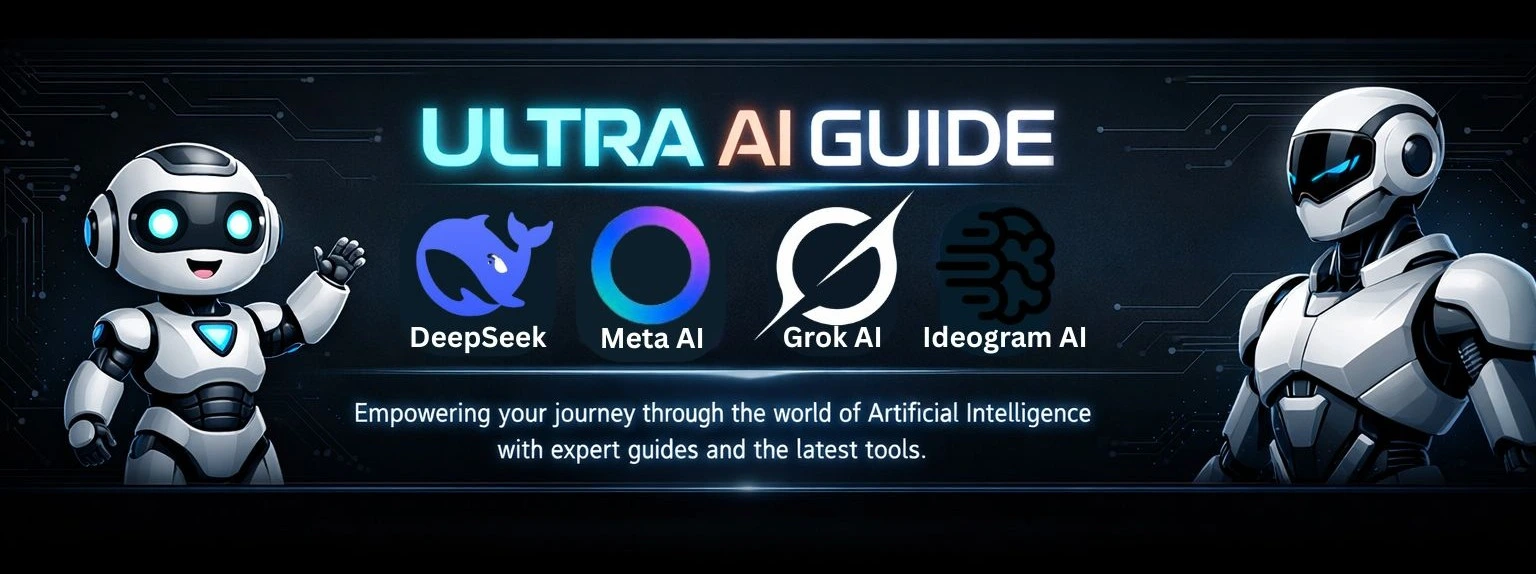
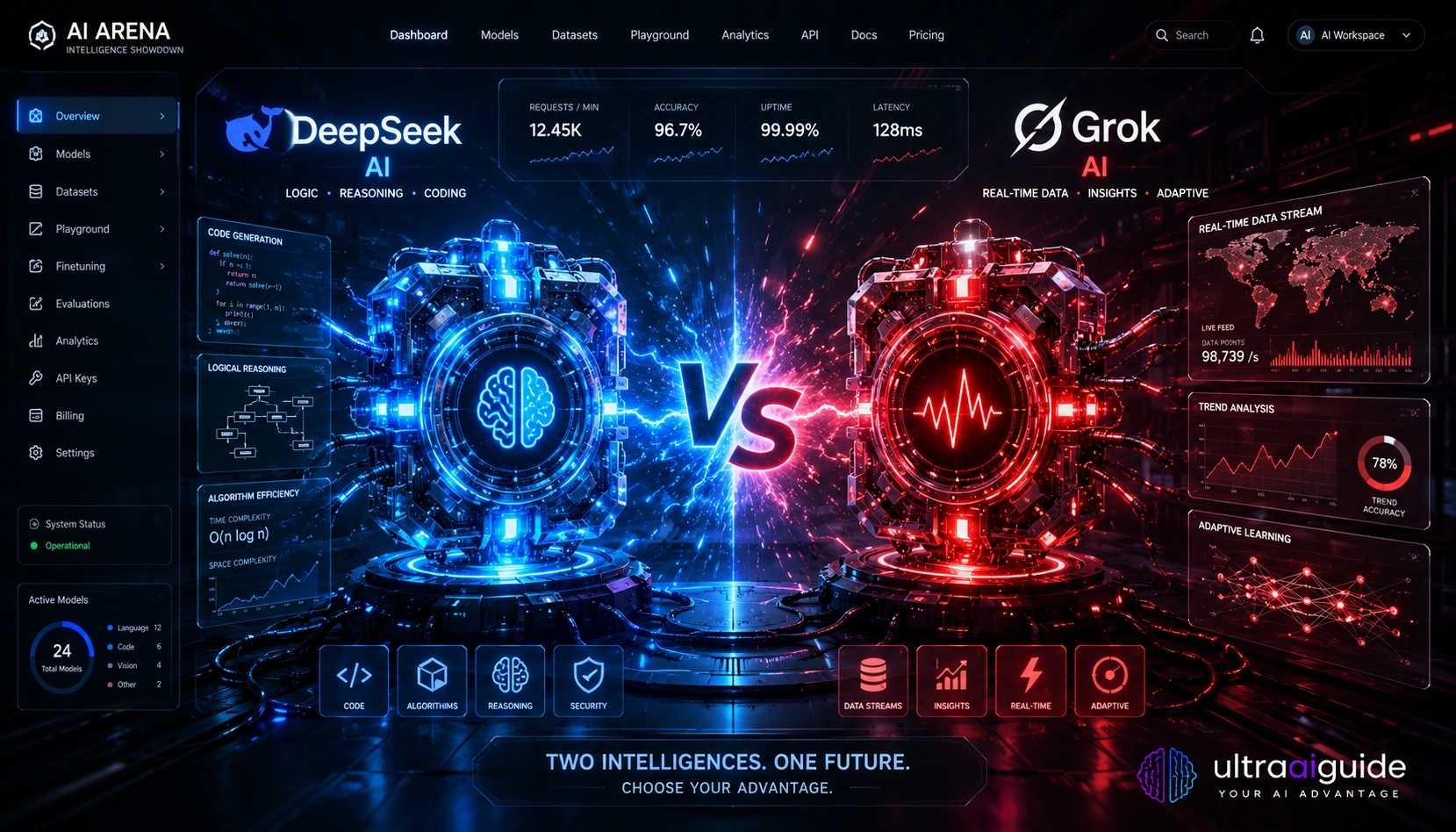
The AI landscape is moving fast, and two models are shaping conversations in 2026: DeepSeek AI and Grok AI. Both are powerful large language models, but they are built with completely different philosophies.
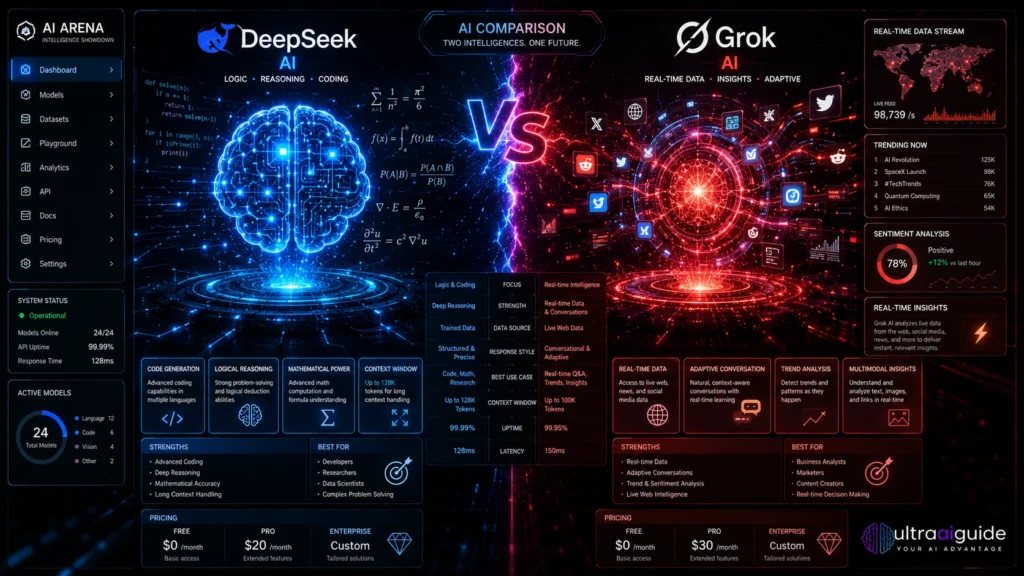
DeepSeek focuses on deep reasoning, coding strength, and cost efficiency, making it a favorite among developers and technical users. Grok AI, on the other hand, is designed for real-time intelligence, conversational depth, and live data awareness, tightly integrated with dynamic online ecosystems.
If you’re trying to decide between them, the choice isn’t simple. It depends on whether you value accuracy in structured tasks or real-time awareness and conversational intelligence.
In this DeepSeek vs Grok AI breakdown, we’ll go far beyond surface-level comparisons. You’ll see real use cases, workflow differences, pricing insights, limitations, and expert recommendations that actually help you choose the right AI for your needs.
1. What is DeepSeek AI?
DeepSeek AI is a high-performance large language model optimized for reasoning, coding, and efficiency. It has gained popularity due to its ability to deliver strong performance at relatively low computational cost.
Core Idea Behind DeepSeek
DeepSeek is designed to:
- Solve complex reasoning tasks
- Perform high-level coding
- Deliver structured, logical responses
- Reduce training and usage cost
Key Strengths
- Strong mathematical reasoning
- Excellent coding and debugging ability
- Efficient model architecture
- Developer-friendly ecosystem
Where It Fits Best
- Software development
- Data science tasks
- Academic problem-solving
- API-based automation workflows
2. What is Grok AI?
Grok AI, developed by xAI, is designed for real-time, conversational intelligence. It integrates live data streams and focuses heavily on contextual awareness.
Core Idea Behind Grok
Grok is built to:
- Understand real-time events
- Respond conversationally and naturally
- Stay updated with live information
- Engage in personality-driven interactions
Key Strengths
- Real-time data awareness
- Strong conversational tone
- Trend and news understanding
- Context-rich responses
Where It Fits Best
- Social media analysis
- News interpretation
- Content creation
- Real-time research tasks
3. DeepSeek vs Grok AI: Core Feature Comparison
| Feature | DeepSeek AI | Grok AI |
| Reasoning Ability | ⭐⭐⭐⭐⭐ | ⭐⭐⭐⭐ |
| Real-Time Knowledge | ⭐⭐ | ⭐⭐⭐⭐⭐ |
| Coding Performance | ⭐⭐⭐⭐⭐ | ⭐⭐⭐ |
| Conversational Style | ⭐⭐⭐ | ⭐⭐⭐⭐⭐ |
| Speed | ⭐⭐⭐⭐⭐ | ⭐⭐⭐⭐ |
| Cost Efficiency | ⭐⭐⭐⭐⭐ | ⭐⭐⭐ |
| Creativity | ⭐⭐⭐⭐ | ⭐⭐⭐⭐⭐ |
Quick Insight:
DeepSeek is a “logic engine,” while Grok is a “real-time intelligence assistant.”
4. Core AI Technology Behind Both Models
DeepSeek Architecture Approach
- Optimized transformer-based LLM
- Focus on efficiency and compression
- Strong reinforcement learning for reasoning tasks
Grok Architecture Approach
- Real-time data integration layer
- Large-scale conversational training
- Social data alignment (X ecosystem influence)
Key Difference:
- DeepSeek = static intelligence + deep reasoning
- Grok = dynamic intelligence + live awareness
5. Why These AI Models Matter in 2026
AI is no longer just about answering questions. It now powers:
- Business automation
- SaaS workflows
- Coding pipelines
- Content generation systems
- Real-time decision-making
These two models represent two extremes:
- DeepSeek = precision & logic
- Grok = adaptability & real-time intelligence
6. Real-World Use Cases
DeepSeek Use Cases
- Algorithm design
- Backend development
- Financial modeling
- Research calculations
- AI automation pipelines
Grok Use Cases
- Social media trend analysis
- Breaking news interpretation
- Marketing insights
- Content ideation
- Audience engagement strategy
7. Step-by-Step Workflow Comparison
Using DeepSeek (Developer Workflow)
- Define a technical problem
- Input structured query
- Receive a logical breakdown
- Optimize code or solution
- Deploy into the system
Using Grok (Content/Research Workflow)
- Ask a real-time question
- Get updated context
- Analyze trends
- Generate content insights
- Apply to marketing or writing
8. Pricing & Accessibility
| Category | DeepSeek | Grok AI |
| Free Access | Limited/open versions | Limited via platform tiers |
| Paid Plans | Low-cost API usage | Subscription-based access |
| Developer Access | High flexibility | Platform-dependent |
| Enterprise Use | Strong | Moderate |
Key Insight: DeepSeek is generally more cost-efficient for scaling applications.
9. Pros and Cons
DeepSeek AI
Pros
- Excellent coding ability
- Highly efficient
- Strong logical reasoning
- Cost-effective
Cons
- Limited real-time awareness
- Less conversational personality
Grok AI
Pros
- Real-time data access
- Highly engaging responses
- Strong contextual awareness
- Great for trending topics
Cons
- Less optimized for deep coding
- Platform dependency limitations
10. Security & Privacy Considerations
Both models raise important AI safety concerns:
- Potential hallucinations in complex queries
- Data privacy risks in cloud-based usage
- Unverified real-time information (Grok)
- Model bias in training data
Best Practice
- Always verify critical outputs
- Avoid sensitive data input
- Use human review for business decisions
11. Ethical AI Considerations
- AI-generated content may contain inaccuracies
- Real-time models can amplify misinformation
- Code outputs require validation
- Attribution and copyright must be respected
12. Common Mistakes Users Make
- Relying fully on AI without verification
- Using Grok for heavy coding tasks
- Using DeepSeek for real-time news decisions
- Ignoring model limitations
13. Expert AI Workflow Tips
- Use DeepSeek for backend logic
- Use Grok for frontend insights & trends
- Combine both for hybrid AI workflows
- Validate outputs with human review
14. Best Alternatives
- ChatGPT (balanced general AI)
- Claude (writing & reasoning)
- Gemini (Google ecosystem integration)
- Perplexity AI (research-focused AI)
15. Future AI Trends (2026+)
- Hybrid AI systems combining real-time + reasoning
- More autonomous AI agents
- SaaS workflow automation expansion
- Multi-model AI orchestration
Final Verdict: Which AI Should You Use?
There is no single winner in DeepSeek vs Grok AI.
- Choose DeepSeek AI if you need:
- Coding
- Logical reasoning
- Cost efficiency
- Choose Grok AI if you need:
- Real-time insights
- Content trends
- Conversational intelligence
Best strategy: Use both together in different workflows.
People Also Ask
Yes, DeepSeek performs better in structured coding tasks due to its strong reasoning and optimization focus.
Yes, Grok is designed to access and interpret real-time data, making it ideal for trending topics and news.
DeepSeek is generally more cost-efficient, especially for developers using APIs at scale.
Not fully. Grok is better for real-time insights, but ChatGPT remains stronger in balanced tasks.
Grok is easier for casual users, while DeepSeek is better for technical learning.
Conclusion
DeepSeek vs Grok AI is not a battle with one winner—it is a comparison of two different AI philosophies. DeepSeek is built for precision, logic, and developer-focused workflows, while Grok is designed for real-time awareness and conversational intelligence.
For most users, the best approach is not choosing one, but combining both based on tasks. This hybrid usage model is becoming the future of AI-powered productivity.
If you want to stay ahead in the AI space, UltraAIGuide.com will continue breaking down tools like this into practical, real-world guidance that helps you make smarter decisions.