The AI Decision That Could Save You Thousands in 2026
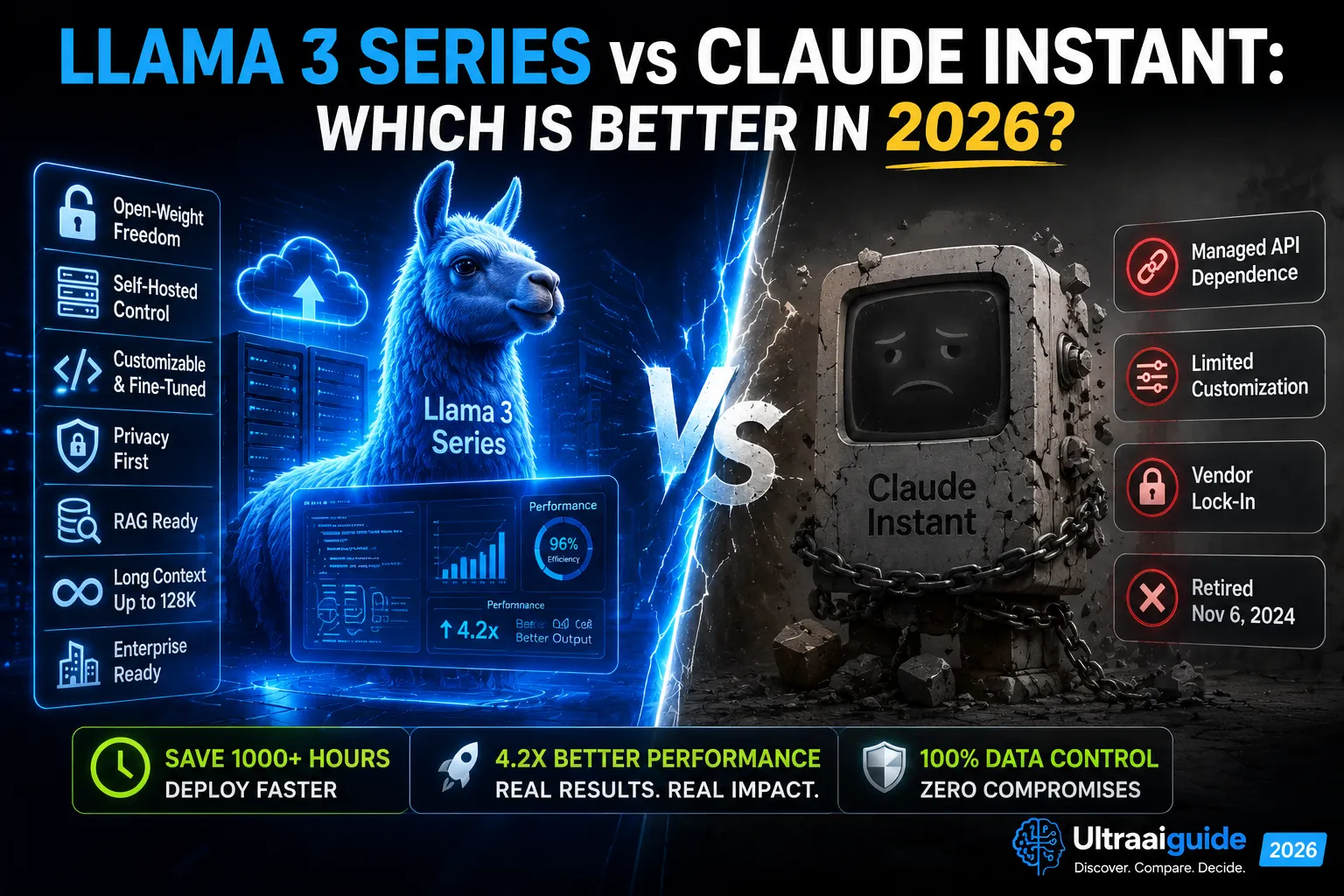
If you’re comparing Llama 3 Series vs Claude Instant in 2026, the most important fact is that Claude Instant has been retired. That means this comparison is no longer about choosing between two actively competing AI models. Instead, it’s about understanding whether an organization should migrate from legacy Claude Instant workflows to modern alternatives such as the Llama 3 family.
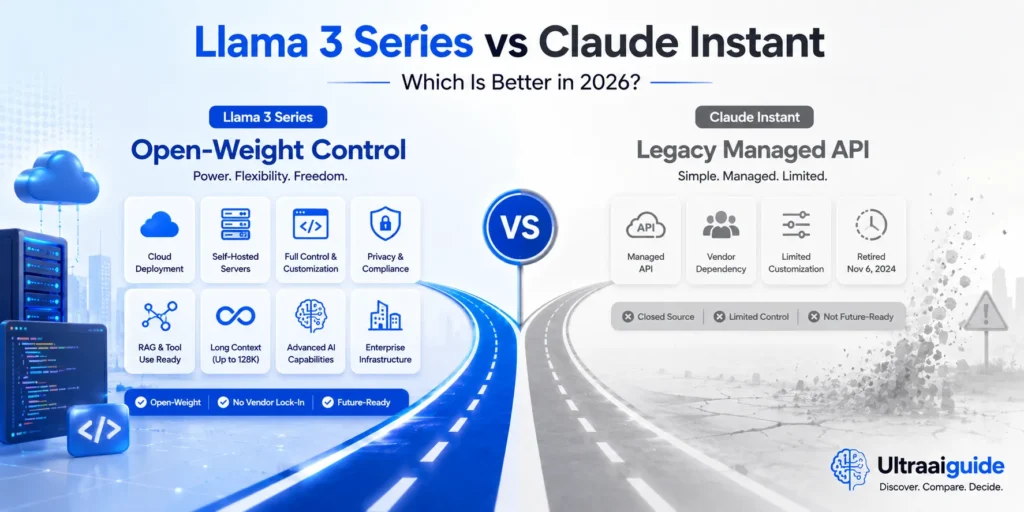
For most businesses, developers, and AI teams, Llama 3 Series is the more practical option in 2026 because it offers open-weight deployment, flexible infrastructure choices, long-context capabilities, and extensive ecosystem support. Claude Instant remains relevant primarily as a historical reference for teams maintaining legacy systems or evaluating migration strategies.
Is Claude Instant Still Available?
No.
Anthropic officially retired the Claude 1 and Claude Instant model families in November 2024. Organizations still using documentation, prompts, workflows, or integrations designed around Claude Instant should treat them as legacy assets.
This changes the buying journey significantly.
Many comparison articles still frame Claude Instant as an active product. However, users searching for “Claude Instant vs Llama 3” today are typically trying to:
- Understand migration options
- Evaluate replacement models
- Compare deployment strategies
- Assess infrastructure costs
- Improve existing AI workflows
As a result, the real comparison has evolved from model selection into platform strategy.
What Is the Llama 3 Series?
Llama 3 is Meta’s family of large language models designed for flexibility, customization, and broad deployment options.
The Llama 3.1 generation expanded the ecosystem with:
- 8B parameter model
- 70B parameter model
- 405B parameter flagship model
- 128K context window support
- Function calling capabilities
- Multilingual improvements
- RAG optimization
- Tool-use support
- Enterprise deployment flexibility
Unlike closed commercial AI systems, Llama emphasizes openness and deployment control.
Organizations can deploy Llama across:
- Cloud environments
- Private infrastructure
- On-premise systems
- Hybrid architectures
- Edge deployments
This flexibility is one of its biggest advantages.
What Was Claude Instant?
Claude Instant was Anthropic’s lightweight, faster, lower-cost model designed for:
- Conversational AI
- Customer support
- Text summarization
- Knowledge retrieval
- Document analysis
- Basic automation
Compared to larger foundation models available at the time, Claude Instant prioritized:
- Speed
- Simplicity
- Lower operating costs
- Managed infrastructure
Many businesses adopted Claude Instant because they wanted AI capabilities without managing servers, GPUs, model hosting, or infrastructure.
That convenience made Claude Instant popular before its retirement.
Llama 3 Series vs Claude Instant: At a Glance
| Feature | Llama 3 Series | Claude Instant |
| Availability | Active | Retired |
| Deployment | Self-hosted or cloud | Managed API |
| Context Window | Up to 128K | Legacy architecture |
| Customization | High | Limited |
| Infrastructure Control | Full | Minimal |
| Fine-Tuning Potential | Extensive | Limited |
| Enterprise Governance | Strong | Moderate |
| Vendor Dependency | Lower | Higher |
| Long-Term Viability | Excellent | Legacy Only |
Benchmarks and Real-World Performance
Raw benchmark scores can be useful, but they should never be the only evaluation criteria.
When assessing AI systems, consider:
Accuracy
How often does the model provide useful responses?
Consistency
Can it reliably produce acceptable outputs at scale?
Tool Usage
Can it integrate with external systems?
Long-Context Handling
Can it understand lengthy documents?
Production Stability
Can it operate reliably under real business workloads?
Llama 3’s ecosystem is particularly attractive because developers can optimize deployments around their own needs rather than relying entirely on a third-party vendor’s roadmap.
Context Window, Speed, and Long-Document Processing
One of the most important developments in modern AI is long-context reasoning.
Businesses increasingly need models capable of handling:
- Contracts
- Research papers
- Compliance documents
- Knowledge bases
- Customer conversations
- Technical documentation
Llama 3.1 introduced 128K context support, making it significantly more suitable for:
- Enterprise search
- RAG systems
- Internal knowledge assistants
- Document intelligence platforms
Claude Instant was never designed around these modern long-context requirements.
As a result, Llama gains a significant advantage for document-heavy workflows.
Pricing and Total Cost of Ownership
One of the biggest mistakes AI buyers make is focusing only on token pricing.
True AI costs include:
Infrastructure
- GPUs
- Storage
- Networking
Engineering
- Deployment
- Monitoring
- Maintenance
Security
- Compliance reviews
- Governance frameworks
Operations
- Scaling
- Reliability management
- Performance optimization
Claude Instant offered simplicity because Anthropic handled infrastructure.
Llama changes the equation.
Organizations gain more control but also accept more operational responsibility.
The best choice depends on internal technical resources.
Deployment, Privacy, and Compliance
For many enterprises, privacy is no longer optional.
Industries such as:
- Healthcare
- Finance
- Legal services
- Government
- Insurance
Often require strict data controls.
This is where Llama becomes especially attractive.
Benefits include:
Data Residency Control
Organizations decide where data is stored.
Infrastructure Ownership
No dependency on a single AI provider.
Compliance Flexibility
Supports custom governance frameworks.
Security Auditing
Greater visibility into deployment architecture.
For regulated environments, these advantages can outweigh benchmark differences.
RAG, Coding, and Enterprise Use Cases
Retrieval-Augmented Generation (RAG)
Llama performs exceptionally well in:
- Internal knowledge systems
- Private search tools
- Enterprise assistants
- Customer support automation
Coding Assistants
Organizations frequently use Llama for:
- Code generation
- Documentation creation
- Software analysis
- Internal developer tools
AI Agents
Modern agent workflows increasingly require:
- Tool calling
- API orchestration
- Multi-step reasoning
Llama’s ecosystem supports these requirements effectively.
Hidden Limitations Most Reviews Ignore
Many comparison articles only discuss strengths.
That’s a mistake.
Challenges of Llama
- Infrastructure management
- Deployment complexity
- Operational expertise requirements
- Performance optimization effort
Challenges of Claude Instant
- Retired product
- No future roadmap
- Legacy integration risks
- Migration requirements
Understanding these limitations leads to better decisions.
Best Users and Worst Users
Llama 3 Is Best For
- SaaS companies
- AI startups
- Enterprise teams
- Developers
- Security-focused organizations
- RAG builders
Llama 3 May Not Be Ideal For
- Teams without technical resources
- Organizations wanting zero infrastructure management
- Users seeking instant deployment
Claude Instant Was Best For
- Lightweight automation
- Fast API adoption
- Customer support workflows
Claude Instant Is Not Ideal For
- New projects
- Modern AI deployments
- Long-term platform planning
How to Migrate Away from Claude Instant
If your organization still uses Claude Instant-era prompts or workflows, follow this process:
Step 1: Audit Existing Prompts
Identify:
- Prompt templates
- System instructions
- Workflow dependencies
Step 2: Review Context Requirements
Measure:
- Input length
- Retrieval needs
- Memory requirements
Step 3: Evaluate Infrastructure Strategy
Choose between:
- Self-hosting
- Managed hosting
- Hybrid deployment
Step 4: Re-Test Outputs
Validate:
- Accuracy
- Formatting
- Workflow compatibility
Step 5: Optimize
Refine prompts for:
- Long-context tasks
- RAG systems
- Tool integration
This approach reduces migration risk significantly.
AI Safety, Security, and Governance Considerations
Regardless of model choice, organizations should implement:
- Human review processes
- Security audits
- Data governance policies
- Prompt testing procedures
- Hallucination monitoring
No AI system should operate without oversight.
Responsible AI deployment requires ongoing evaluation.
People Also Ask
No. Claude Instant was retired in November 2024 and should be considered a legacy model.
Llama is often described as open-weight rather than fully open source. Organizations can download and deploy models under Meta’s licensing terms.
Llama 3 generally offers more flexibility for private RAG implementations because organizations can control the deployment and retrieval infrastructure.
For most enterprise environments in 2026, Llama 3 is the stronger strategic choice due to flexibility, governance, and deployment options.
Only for migration planning or understanding legacy systems.
Final Verdict
Comparing Llama 3 Series vs Claude Instant in 2026 is less about performance and more about strategy.
Claude Instant belongs to an earlier generation of AI deployment focused on convenience and managed infrastructure. While it played an important role in enterprise AI adoption, it is now retired.
Llama 3 represents a different philosophy: openness, deployment flexibility, infrastructure control, and long-term adaptability.
Choose Llama 3 Series If:
- You want deployment flexibility
- You need strong RAG support
- You value privacy and governance
- You want long-term AI infrastructure control
- You are building enterprise AI systems
Consider Claude Instant Only If:
- You are maintaining legacy workflows
- You need migration guidance
- You are auditing historical AI deployments
For nearly all new AI initiatives in 2026, Llama 3 Series is the more future-ready choice.